Philipp Lenard – Nobel Lecture
Nobel Lecture, May 28, 1906
On Cathode Rays
Read the Nobel Lecture
Pdf 187 kB
Philipp Lenard – Nominations
Philipp Lenard – Biographical
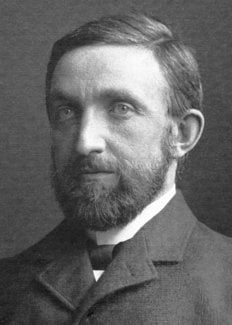
Philipp von Lenard was born at Pozsony1 (Pressburg) in Austria-Hungary on June 7, 1862. His family had originally come from the Tyrol. He studied physics successively at Budapest, Vienna, Berlin and Heidelberg under Bunsen, Helmholtz, Königsberger and Quincke and in 1886 took his Ph.D. at Heidelberg.
From 1892 he worked as a Privatdozent and assistant to Professor Hertz at the University of Bonn and in 1894 was appointed Professor Extraordinary at the University of Breslau. In 1895 he became Professor of Physics at Aix-la-Chapelle and in 1896 Professor of Theoretical Physics at the University of Heidelberg. In 1898 he was appointed Professor Ordinarius at the University of Kiel.
Lenard’s first work was done in the field of mechanics, when he published a paper on the oscillation of precipitated water drops and allied problems and in 1894 he published the Principles of Mechanics left behind by Hertz.
Soon he became interested in the phenomena of phosphorescence and luminescence. This was a development of the mysterious attraction which weak light appearing in darkness had had for him since his boyhood, when he had, with his school fellows, warmed fluorine crystals to make them luminescent; and now he took up, with the astronomer W. Wolf, the study of the luminosity of pyrogallic acid when it is mixed with alkali and bisulphite for developing photographs. He found that its luminosity depended on the oxidation of the pyrogallic acid. At this time he also carried out studies of magnetism with bismuth and, in collaboration with V. Klatt, who had been his first teacher of physics in his native town, he studied, at the Modern College at Pressburg, the so-called self-luminous substances such as calcium sulphide on which Klatt had been working for some years. Together they found that calcium sulphide, after previous illumination, exerts light in the dark, but only if it contains at least some traces of heavy metals, such as copper and bismuth, which form crystals on which the colour and the intensity and durations of the luminosity depend; if it is quite pure, it is not luminous. This work with Klatt was the beginning of work in a field which occupied Lenard for the next 18 years.
In 1888, when he was working at Heidelberg under Quincke, Lenard had done his first work with cathode rays. He investigated the view then held by Hertz that these rays were analogous to ultraviolet light and he did an experiment to find out whether cathode rays would, like ultraviolet light, pass through a quartz window in the wall of a discharge tube. He found that they would not do this; but later, in 1892, when he was working as an assistant to Hertz at the University of Bonn, Hertz called him to see the discovery he had made that a piece of uranium glass covered with aluminium foil and put inside the discharge tube became luminous beneath the aluminium foil when the cathode rays struck it. Hertz then suggested that it would be possible to separate, by means of a thin plate of aluminium, two spaces, one in which the cathode rays were produced in the ordinary way and the other in which one could observe them in a pure state, which had never been done. Hertz was too busy to do this and gave Lenard permission to do it and it was then that he made the great discovery of the “Lenard window”.
After many experiments with aluminium foil of various thicknesses he was able to publish, in 1894, his great discovery that the plate of quartz that had, until then, been used to close the discharge tube, could be replaced by a thin plate of aluminium foil just thick enough to maintain the vacuum inside the tube, but yet thin enough to allow the cathode rays to pass out. It thus became possible to study the cathode rays, and also the fluorescence they caused, outside the discharge tube and Lenard concluded from the experiments that he then did that the cathode rays were propagated through the air for distances of the order of a decimetre and that they travel in a vacuum for several metres without being weakened. Although Lenard at first followed Hertz in believing that the cathode rays were propagated in the ether, he later abandoned this view as a result of the work of Jean Perrin in 1895, Sir J.J. Thomson in 1897 and W. Wien in 1897, which proved the corpuscular nature of the cathode rays.
Later Lenard extended the work of Hertz on the photoelectric effect. Working in a high vacuum, he analysed the nature of this effect, showing that when ultraviolet light falls on a metal it takes from the metal electrons which are then propagated in the vacuum, in which they can be accelerated or retarded by an electric field, or their paths can be curved by a magnetic field. By exact measurements he showed that the number of electrons projected is proportional to the energy carried by the incident light, whilst their speed, that is to say, their kinetic energy, is quite independent of this number and varies only with the wavelength and increases when this diminishes.
These facts conflicted with current theory and were not explained until 1905, when Einstein produced his quantitative law and developed the theory of quanta of light or photons, which was verified much later by Millikan. But Lenard never forgave Einstein for discovering and attaching his own name to this law.
In the course of his work Lenard had, for the purpose of accelerating the speed of the electrons and measuring their energy, invented a photoelectric cell which was the first model of the “3-electrode lamp” which is so important today in radioelectric technique. The only difference between these two cells was that in Lenard’s cell the electrons were taken from the cathode by light, whereas on the “3-electrode lamp” the cathode is a white-hot filament capable of sending into the vacuum currents of much higher intensity.
In 1902 Lenard showed that an electron must have a certain minimum energy before it could produce ionisation when it passed through a gas.
In 1903 he published his conception of the atom as an assemblage of what he called “dynamides”, which were very small and were separated by wide spaces; they had mass and were imagined as electric dipoles connected by two equal charges of contrary sign and their number was equal to the atomic mass. The solid matter in the atom was, he thought, about one thousand millionth of the whole atom. This work contributed much to Lorentz‘ theory of electrons.
In his later years Lenard studied the nature and origin of the lines of the spectrum. Developing the work of Rydberg, Kayser and Runge, who had shown that the lines of the spectrum of a metal can be arranged in two or more different series and that there is a marked mathematical relationship between the wavelengths of these series, Lenard showed that in each series a definite modification of the atom has occurred and that these modifications determine the series and are differentiated by the number of electrons lost.
Lenard was an experimentalist of genius, but more doubtful as a theorist. Some of his discoveries were great ones and others were very important, but he claimed for them more than their true value. Although he was given many honours (for instance, he received Honorary Doctorates of the Universities of Christiania, now Oslo, in 1911, Dresden in 1922 and Pressburg in 1942, the Franklin Medal in 1905, the Eagle Shield of the German Reich in 1933, and was elected Freeman of Heidelberg in the same year), he believed that he was disregarded and this probably explains why he attacked other physicists in many countries. He became a convinced member of Hitler’s National Socialist Party and maintained unreserved adherence to it. The party responded by making him the Chief of Aryan or German Physics. Among his publications are several books: Ueber Aether und Materie (second edition 1911), Quantitatives über Kathodenstrahlen (1918), Ueber das Relativitätsprinzip (1918) and Grosse Naturforscher (second edition 1930).
Von Lenard, who was married to Katharina Schlehner, died on May 20, 1947 at Messelhausen.
1. Today Bratislava, located in Slovakia.
This autobiography/biography was written at the time of the award and first published in the book series Les Prix Nobel. It was later edited and republished in Nobel Lectures. To cite this document, always state the source as shown above.
The Nobel Foundation's copyright has expired.Philipp Lenard – Facts
Award ceremony speech
Presentation Speech by Professor A. Lindstedt, President of the Royal Swedish Academy of Sciences, on December 10, 1905
Your Majesty, Your Royal Highnesses, Ladies and Gentlemen.
The Royal Swedish Academy of Sciences has decided to give this year’s Nobel Prize for Physics to Dr. Philipp Lenard, Professor at the University of Kiel, for his important work on cathode rays.
The discovery of the cathode rays forms the first link in the chain of brilliant discoveries with which the names of Röntgen, Becquerel and Curie are connected. The discovery itself was made by Hittorf as long ago as 1869 and therefore falls in a period before that which the Nobel Foundation is able to take into account. However, the recognition which Lenard has earned himself by the further development of Hittorf’s discovery (which is becoming of increasing importance) shows that he too deserves the same reward as has already come to several of his successors for work of a similar nature.
Cathode rays are a phenomenon which occurs when electricity is discharged in a rarified gas. If an electric current is led through a glass tube containing rarified gas, certain radiation phenomena appear both in the gas and around the metal wires or poles through which the current is carried. These phenomena change in form and nature if the gas contained in the tube is rarified even further. At a given low pressure of gas, rays are emitted from the negative pole, called the “cathode”, which are invisible to the naked eye but which can be observed through certain peculiar effects. This is due to the fact that when these rays hit the walls of the glass tube, or other obstacles in their path, they cause them to glow or fluoresce and are able to bring objects against which they are directed to a glowing heat. Like rays of ordinary light they propagate in straight lines, but they differ in that they can be deflected from their straight path by means of a magnet.
The general characteristics of these cathode rays had been known a long time, although not sufficiently to clarify their true nature. Twenty years ago two basically different concepts were prevalent. According to one concept, which was supported especially by German physicists, cathode rays consisted as do normal rays of light, of undulatory motion in the ether. According to the other concept, which was mainly popular among English scientists, cathode rays were supposed to consist of particles which were ejected from the cathode and were charged with negative electricity. The decision for one or other of these theories rested on the results of experimental research. These experiments, however, were greatly impeded by the fact that one seemed to be restricted to phenomena within the glass tube itself, since the cathode rays ended at the wall of the tube. The question of whether they could at all exist outside the tube remained unanswered.
These were the circumstances prevailing when Lenard began his work on cathode rays in 1893. He started from a fact which had been observed by his great and prematurely deceased teacher Heinrich Hertz: that these rays were able to pass through thin metal plates which had been introduced into the discharge tube. At Hertz’s suggestion he utilized this fact in an attempt to lead the rays out of the tube. He used for this a tube which was not wholly made of glass but terminated at one place in a very thin aluminium plate. As the cathode rays reached Lenard’s “aluminium window”, it was found that they passed through it and continued their course in the air outside the tube. This constituted a discovery which was to have the most far-reaching consequences, above all for the study of the radiation phenomena themselves. It became possible to study cathode rays under much simpler and more convenient experimental conditions than before, and also to separate observations on conditions needed for the production of the rays in the tube from questions concerning their propagation and other characteristics.
Lenard found first of all that the rays coming through the aluminium window possessed the same characteristics as those previously noted in rays inside the tube, i.e. that they cause fluorescence, can be deflected by a magnet and so on. He further proved that cathode rays have certain chemical effects such as causing impressions on photographic plates, ozonizing air, making gases conducting through so-called ionisation, etc. It was also discovered that these rays pass unimpeded through empty space but that in gases they are subject to diffusion which increases with the density of the gas; and, moreover, that bodies in general differ in permeability, as their absorptive power bears a direct relationship to their density. Cathode rays proved to be carriers of negative electricity even in empty space and they could be deflected from their path by both magnetic and electrical fields. Finally, Lenard showed that there are various types of cathode rays, differentiated amongst other things by the fact that they are deflected by magnets, to a greater or lesser extent. He also found that the formation of one or other type of ray is determined by the degree of gas rarification in the discharge tube.
When Lenard began his work on cathode rays he approached the concept of their nature from the German viewpoint noted above, whereby the rays are explained as being vibrations in the ether. Through the results of his work which we have just briefly described and in particular through the discovery that cathode rays are influenced by electrical fields, this view became untenable. He now came closer to the English view, put forward mainly by Crookes, that the rays are composed of particles which are ejected by the cathode and are bearers of negative electricity. Since then, however, this theory has had to be modified in several significant details in order to reconcile it with phenomena which have been brought to light through the work of Lenard and others. It was shown, for example, that these particles which, according to Crookes, are ejected from the cathode – the so-called “electrons” – must have a considerably smaller mass than chemical atoms, that the velocity of these electrons can come to about one-third of the speed of light, but that there are also cathode rays which are considerably slower: the various types of cathode rays are in fact explained by the different speeds with which they are ejected from the cathode. In his more recent work Lenard has been able to produce cathode rays with relatively slow speed, rays which are formed through the influence of ultraviolet light on bodies charged with negative electricity. This has also served to explain an important phenomenon noted by other research workers.
The research by Lenard, only a very brief report of which is given here, has been followed by a series of valuable studies by other scientists as well. Development of the theoretical basis for the theory of electrons has gone hand in hand with the experimental work. The study of electrons, their characteristics and their behaviour in relation to matter has been given a sounder basis through these researches on cathode rays and has been gradually developed into one of the foremost theories of modern physics by Lenard himself and by other workers. This theory is in fact not only important for the explanation of cathode rays and other closely related phenomena – the electron theory with its concepts on the constitution of matter has become of the most fundamental importance for the sciences of electricity and of light and for both the physicist and the chemist.
It is clear that Lenard’s work on cathode rays has not only enriched our knowledge of these phenomena, but has also served in many respects as a basis for the development of the electron theory. Lenard’s discovery that cathode rays can exist outside the discharge tube, in particular, has opened up new fields of research in physics. It gave an impetus to the search for other thus far unknown sources of similar rays, and the revolutionary discoveries by past Nobel Prize winners – Röntgen, Becquerel and the two Curies – and by other scientists which have followed can well be considered the fruits of this impetus and links in the history of development of one and the same science.
Because of the overall importance of Lenard’s work, and because of its scientific value and pioneering nature, the Royal Swedish Academy of Sciences has decided to award him the Nobel Prize in Physics for the year 1905.