Niels Bohr – Photo gallery

Portrait of Niels Bohr.
Source: Library of Congress, Prints and Photographs division, via Wikimedia Commons Photographer unknown No known copyright restrictions
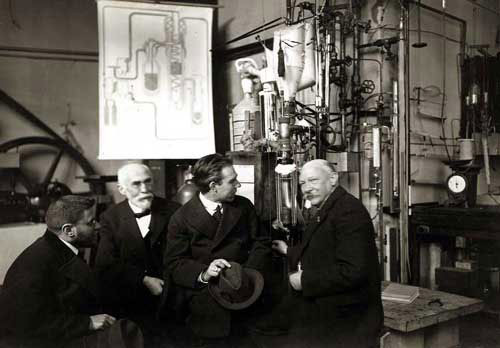
The Cryogenics Laboratory in Leiden, 1919. From left: Paul Ehrenfest, Hendrik Lorentz, 1922 Nobel Laureate in Physics Niels Bohr and 1913 Nobel Laureate in Physics Heike Kamerlingh Onnes.
Photographer unknown Public domain via Wikimedia Commons

Niels Bohr (left) and Albert Einstein (right). The picture was taken at physicist Paul Ehrenfest's home in Leiden, December 11, 1925.
Source: Wikimedia Commons
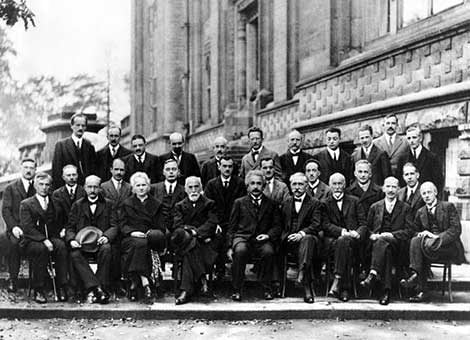
The fifth Solvay International Conference on Electrons and Photons, was held in October 1927. Prominent physicists from all the world met to discuss the newly formulated quantum theory. 17 of the 29 participants were or became Nobel Laureates. Back row, left to right: Auguste Piccard, Émile Henriot, Paul Ehrenfest, Édouard Herzen, Théophile de Donder, Erwin Schrödinger, Jules-Émile Verschaffelt, Wolfgang Pauli, Werner Heisenberg, Ralph Howard Fowler, Léon Brillouin. Middle row, left to right: Peter Debye, Martin Knudsen, William Lawrence Bragg, Hendrik Anthony Kramers, Paul Dirac, Arthur Compton, Louis de Broglie, Max Born, Niels Bohr. Front row, left to right: Irving Langmuir, Max Planck, Marie Skłodowska Curie, Hendrik Lorentz, Albert Einstein, Paul Langevin, Charles-Eugène Guye, Charles Thomson Rees Wilson, Owen Willans Richardson.
Photo: Benjamin Couprie, Institut International de Physique Solvay, Brussels, Belgium. Public domain via Wikimedia Commons

Nobel Laureates in Physics Albert Einstein (left) and Niels Bohr (right) walking. Photo taken at the 1930 Solvay Conference in Brussels.
Source: Danish Film Institute Photo: Paul Ehrenfest

Niels Bohr (third from left) with physics laureate Sir Chandrasekhara Venkata Raman to his right at the University of Copenhagen Institute for Theoretical Physics, 1930. The others are (from left): George Gamow, Thomas Lauritsen, Ebbe Rasmussen, and Oskar Klein.
Unknown author, Public domain, via Wikimedia Commons
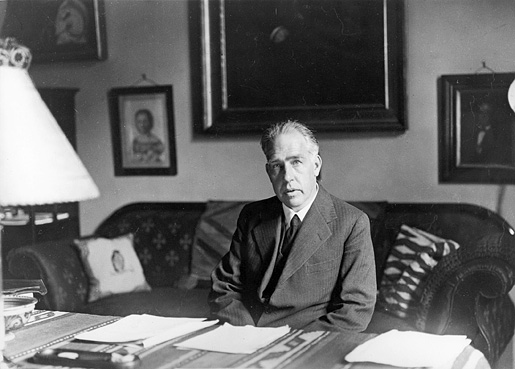
Portrait of Niels Bohr, 1935.
Source: Wikimedia Commons
Niels Bohr – Nominations
Niels Bohr – Nobel Lecture
Nobel Lecture, December 11, 1922
The Structure of the Atom
Read the Nobel Lecture
Pdf 326 kB
Niels Bohr – Banquet speech
English
Danish
Niels Bohr’s speech at the Nobel Banquet in Stockholm, December 10, 1922
(Translation)
Your Royal Highnesses, Ladies and Gentlemen.
In attempting to give expression to my deep and heartfelt gratitude for the great honour that the Royal Swedish Academy of Sciences has bestowed upon me by awarding me the Nobel Prize for Physics for this year, I am naturally forcibly reminded of Alfred Nobel’s insistence upon the international character of science, which indeed forms the very basis of his most munificent bequest. That point of view – the international character of science – suggests itself all the more readily to myself, as the contributions that I may have had the good fortune to make to the development of physical science consist in a combination of the results arrived at by a number of fellow-investigators, belonging to a variety of nations, on the basis of study carried on under widely differing scientific traditions.
The grand discoveries which scientific experiment yielded at and about the turn of the century, in which investigators in many countries took an eminent part and which were destined all unexpectedly to give us a fresh insight into the structure of atoms, were due in the first instance, as all are aware, to the work of the great investigators of the English school, Sir Joseph Thomson and Sir Ernest Rutherford, who have inscribed their names on the tablets of the history of scientific research as distinguished witnesses to the truth that imagination and acumen are capable of penetrating the crowded mass of registered experience and of revealing Nature’s simplicity to our gaze. On the other hand, abstract thinking, which throughout the ages has been one of the most powerful of man’s aids in lifting the veil that shrouds the laws of Nature from the eyes of the uninitiated observer, has proved of the utmost importance for enabling the insight into the structure of atoms so obtained to be applied practically in elucidating the properties of those elements that are immediately accessible to our perceptions. To this branch of the work too, men of many nations have made important contributions; but it was the great German investigators, Planck and Einstein, who, as a result of their systematic abstract investigations, were to show us for the first time that the laws of the movements of atomic particles, which determine the properties of the elements, are of an essentially different character from those laws by the aid of which science has hitherto sought to bring order into the mass of our observations of natural phenomena. If it has been my good fortune to be in some sense a connecting link at one point in the development, that is but one among many evidences of the fruitfulness of the closest relations prevailing in the scientific world between those carrying on investigations under varying human conditions. A Danish scientist, however, on finding himself in Stockholm on such an occasion as this, cannot confine his thoughts to the international character of science but must also dwell in an equal degree on the intellectual solidarity that exists in these Scandinavian countries, of which we are all – and, especially in the domain of science – fully and perfectly aware. It might be tempting to endeavour to indicate the great debt owed by science, and consequently by Danish investigators, to Swedish scientists of earlier and recent times. That, however, would carry me too far, even if I were to confine myself only to the most important of the contributions that we owe to the distinguished representatives of Swedish investigations in natural science who are present here this evening, and whose work in a variety of ways has been of fundamental importance, for instance, for atomic research. Hence I must rest content only to recall the name of one single Swedish physicist, the late Professor Rydberg of Lund, whose brilliant work on the spectral laws has been of such great importance for extending our knowledge of atoms and especially for the particular contribution that it was to fall to my lot to make.
In once more gladly availing myself of this opportunity to express my deep gratitude for the honour that the Academy of Sciences has bestowed upon myself and upon Danish scientific investigation by awarding me the Nobel Prize, I also beg leave at this banquet to propose the toast of International Cooperation for the Advancement of Science, which is, I may say, in these so manifoldly depressing times, one of the bright spots visible in human existence, and also to give you, in particular, Prosperity to the sense of unity and solidarity in scientific work among the peoples of Scandinavia who, notwithstanding the characteristic peculiarities of each, do feel themselves intimately bound together by the ties of racial affinity.
Niels Bohr – Documentary
Niels Bohr – Banquet speech
English
Danish
Niels Bohr’s speech at the Nobel Banquet in Stockholm, December 10, 1922 (in Danish)
Deres Kgl. Højheder, mine Damer og Herrer.
Ved Forsøget paa at give Udtryk for min dybtfølte Taknemmelighed for den store Hæder, som Kungl. Svenska Vetenskapsakademien har vist mig ved at tildele mig Nobelprisen for Fysik for dette Aar, falder det naturligt for mig at minde om den Fremhæven af Videnskabens internationale Karakter, der ligger til Grund for Alfred Nobels storstilede Stiftelse. Dette ligger mig saa meget nærmere, som de Bidrag, jeg maatte have haft Held til at bringe til den fysiske Videnskabs Udvikling, bestaar i en Forbinden af Resultater, som vi skylder Forskere af forskellige Nationer, der har bygget paa vidt forskellige videnskabelige Traditioner.
Naar de store eksperimentelle Opdagelser omkring Aarhundredeskiftet, hvori Forskere fra mange Lande har taget saa fremragende Del, skulde give os saa uanet et Indblik i Atomernes Bygning, skyldes dette jo først og fremmest de store Forskere af den engelske Skole Sir Joseph Thomson og Sir Ernest Rutherford, der i Videnskabens Historie har indskrevet deres Navne som lysende Eksempler paa, hvorledes Fantasi og Skarpsyn formaar at se igennem Erfaringernes Mylder og lægge Naturens Enkelhed blot for vore Øjne. Paa den anden Side har den abstrakte Tænkning, der gennem alle Tider har været et af Menneskehedens mægtigste Hjælpemidler til at løfte det Slør, som tilhyller Naturlovene for den umiddelbare Betragter, været af afgørende Betydning for Benyttelsen af det erhvervede Indblik i Atombygningen til Forklaringen af de Egenskaber hos Stofferne, der er umiddelbart tilgængelige for vore Sanser. Ogsaa i Arbejdet herpaa har Mænd fra mange Nationer leveret betydningsfulde Bidrag; men det var de store tyske Forskere, Planck og Einstein, der ved deres systematiske og abstrakte Undersøgelser først skulde belære os om, at de Love for Atomdelenes Bevægelser, der behersker Stoffernes Egenskaber, er af en væsentlig anden Art end de Love, hvorved Videnskaben hidtil havde forsøgt at bringe Orden i vore Iagttagelser over Naturfænomenerne.
Naar det har været min Lykke paa et Punkt i denne Udvikling at det skulle blive et forbindende Mellemled, er dette et Vidnesbyrd blandt saa mange andre om Frugtbarheden af den nøjeste Forbindelse i Videnskabens Verden mellem Forskningsarbejdet, som det udvikler sig under forskellige menneskelige Vilkaar.
Naar en dansk Videnskabsmand befinder sig her i Stockholm ved en Lejlighed som denne, maa han dog ikke alene tænke paa Videnskabens internationale Karakter, men fuldt saa meget paa den aandelige Samhørighed mellem de nordiske Lande, som vi alle føler, ikke mindst paa Videnskabens Omraade. Det kunde være fristende at forsøge at beskrive den store Gæld, hvori Videnskaben og derfor ogsaa dansk Forskningsarbejde staar til svenske Forskere i ældre og nyere Tid. Dette vilde imidlertid føre altfor langt, selv om jeg vilde inskrænke mig til at nævne blot de betydningsfuldeste af de Bidrag, som skyldes de fremragende Repræsentanter for svensk Naturvidenskab, der er her til Stede i Aften, og hvis Arbejder paa forskellig Maade har været af Grundlæggende Betydning ogsaa for Atomforskningen. Jeg skal derfor kun minde om en enkelt svensk Fysiker, den for faa Aar siden afdøde Professor Rydberg i Lund, hvis geniale Arbejde paa Udredningen af Spektrallovene har været af saa stor Betydning for Uddybningen af vort Kendskab til Atomerne, og ikke mindst for det Bidrag, det skulde falde i min Lod at give.
Idet jeg endnu engang gerne vil udtrykke min dybe Taknemmelighed over den Hæder, som Vetenskapsakademien har vist mig og dansk Videnskab ved at tildele mig Nobelprisen, vilde jeg gerne have Lov til ved denne Banket at udbringe en Skaal for Trivselen af det internationale Arbejde paa Videnskabens Fremgang, der er et af den menneskelige Tilværelses Lyspunkter i disse i saa mange Henseender sørgelige Tider, samt især for den videnskabelige Samhørighed mellem de nordiske Nationer, der til Trods for de karakteristiske Forskelle føler sig saa nøje sammenknyttet ved Slægtskabets Baand.
Niels Bohr – Other resources
Links to other sites
‘A Science Odyssey: People and Discoveries: Niels Bohr’ from PBS Online
On Niels Bohr from Niels Bohr Institute
Award ceremony speech
Presentation Speech by Professor S.A. Arrhenius, Chairman of the Nobel Committee for Physics of the Royal Swedish Academy of Sciences, on December 10, 1922
Your Majesty, Your Royal Highnesses, Ladies and Gentlemen.
Ever since Kirchhoff and Bunsen (1860) introduced spectral analysis, that extremely important aid to investigation has produced the finest results. To begin with, material was collected and spectra were investigated not only from terrestrial objects but also from the heavenly bodies. There was a splendid harvest. Then came the second stage of research. Attempts were made to find regularities in the structure of the spectra. To begin with, it was natural to try to compare the different spectral lines which are emitted by a glowing gas with the different notes that could be produced by a vibrating solid. The vibrating bodies in a glowing gas would in that case be its atoms and molecules. But little progress could be made on this track. It was necessary to fall back on another method, namely to try by calculation to establish the connection between the various vibrations which could be emitted by a gas. Hydrogen ought to be the simplest of all gases. The Swiss Balmer in 1885 found a simple formula for the connection mentioned between the lines of hydrogen as then known. There followed a large number of investigators, such as Kayser and Runge, Ritz, Deslandres, and especially our compatriot Rydberg, who sought for similar regularities in the spectra of the other chemical elements. Rydberg succeeded in representing their light vibrations by means of formulae which exhibited a certain resemblance to Balmer’s formula. These formulae contain a constant which has afterwards acquired extremely great importance and has been recorded amongst the universal and fundamental values of physics under the name of the Rydberg constant.
Now, if it were possible to obtain an idea of the structure of the atom, of course, that would form a good starting-point to create a conception of the possible light vibrations that can be emitted by an atom of hydrogen. Rutherford, who has to such an extraordinary degree wrung their secrets from the atoms, had constructed such “atom models”. According to his conception, the atom of hydrogen should consist of a positive nucleus, with a unit charge, of extremely small dimensions, and about this a negatively charged electron should describe an orbit. As probably only electric forces are at work between the nucleus and the electron, and as these electric forces follow the same law as the attraction of gravity between two masses, the path of the electron ought to be elliptical or circular, and the nucleus to be situated either in one of the foci of the ellipse or in the centre of the circle. The nucleus would be comparable to the sun and the electron to a planet. In accordance with the classical theory of Maxwell, therefore, these orbit movements should emit rays and consequently cause a loss of energy, and the electron would describe smaller and smaller tracks with a declining period of revolution and finally rush in towards the positive nucleus. Thus the track would be a spiral, and the rays of light emitted, which will require a steadily declining period of vibration, would correspond to a continuous spectrum, which, of course, is characteristic of a glowing solid or liquid body, but not at all of a glowing gas. Consequently, either the atom model must be false, or else the classical theory of Maxwell must be incorrect in this case. Ten years or so previously there would have been no hesitation in the choice between these alternatives, but the atom model would have been declared to be inapplicable. But in 1913, when Bohr began to work at this problem, the great physicist Planck of Berlin had traced his law of radiation, which could be explained only on the assumption, which was in conflict with all preceding notions, that the energy of heat is given offin the form of “quanta”, that is to say small portions of heat, just as matter consists of small portions, i.e. the atoms. With the help of this assumption Planck succeeded, in complete accordance with experience, in calculating the distribution of energy in radiation from a hypothetically completely black body. Afterwards (in 1905 and 1907) Einstein had perfected the quantum theory and deduced therefrom several laws, such as the diminution of the specific heat of solid bodies with declining temperature and the photoelectric effect, for which discovery he has this day been awarded the Nobel Prize.
Accordingly, Bohr had no need to hesitate in his choice: he assumed that Maxwell’s theory does not hold good in the present case, but that the atom model of Rutherford is correct. Thus the electrons do not emit light when they move in their tracks round the positive nucleus, tracks which we begin by assuming to be circular. The emission of light would take place when the electron jumps from one track to another. The quantity of energy which is thus radiated is a quantum. As, according to Planck, the quantum of energy is the product of the number of light vibrations with the Planckian constant, which is denoted by the letter h, it is possible to calculate the number of vibrations which corresponds to a given passing from one orbit to another. The regularity which Balmer found for the spectrum of hydrogen requires that the radii of the different orbits should be proportional to the squares of the whole numbers, that is to say as 1 to 4 to 9, and so on. And indeed Bohr succeeded, in his first treatise on this question, in calculating the Rydberg constant from other known magnitudes, namely the weight of an atom of hydrogen, the Planckian constant, and the value of the electric unit of charge. The difference between the value found by observation and the calculated value of the Rydberg constant amounted to only 1 percent; and this has been diminished by more recent measurements.
This circumstance at once attracted the admiring attention of the scientific world to Bohr’s work and made it possible to foresee that he would to a great extent solve the problem before him. Sommerfeld showed that what is known as the fine structure of the hydrogen lines, by which is meant that the lines observed with a strongly dispergent spectroscope are divided up into several closely adjacent lines, can be explained in accordance with Bohr’s theory in the following way. The various stationary tracks for the movement of the electrons – if we leave out of account the innermost one, which is the ordinary one, and is called the “orbit of rest” – may be not only circular but also elliptical, with a major axis equal to the diameter of the corresponding circular orbit. When an electron passes from an elliptical orbit to another track, the change in the energy, and consequently the number of vibrations for the corresponding spectral lines, is somewhat different from what it is when it passes from the corresponding circular orbit to the other track. Consequently we get two different spectral lines, which nevertheless lie very close to one another. Yet we observe only a smaller number of lines than we should expect according to this view of things.
The difficulties thus revealed, however, Bohr succeeded in removing by the introduction of what is known as the principle of correspondence, which opened up entirely new prospects of great importance. This principle to some extent brings the new theory nearer to the old classical theory. According to this principle, a certain number of transitions are impossible. The principle in question is of great importance in the determination of the tracks of electrons which are possible within atoms that are heavier than the atom of hydrogen. The nuclear charge of the atom of helium is twice as great as that of the atom of hydrogen: in a neutral condition it is encircled by two electrons. It is the lightest atom next that of hydrogen. It occurs in two different modifications: one is called parhelium, and is the more stable, and the other is called orthohelium – these were supposed at first to be two different substances. The principle of correspondence states that the two electrons in parhelium in their tracks of rest run along two circles, which form an angle of 60° to one another. In orthohelium, on the other hand, the tracks of the two electrons lie in the same plane, the one being circular, while the other is elliptical. The following element with an atomic weight which is next in magnitude to helium is lithium, with three electrons in a neutral state. According to the principle of correspondence, the tracks of the two innermost electrons lie in the same way as the tracks of the two electrons in parhelium, while the track of the third is elliptical and is of far greater dimensions than the inner tracks.
In a similar manner Bohr is able, with the help of the principle of correspondence, to establish, in the most important points, the situation of the various tracks of electrons in other atoms. It is on the positions of the outermost electron tracks that the chemical properties of the atoms depend, and it is on this ground that their chemical valency has partly been determined. We may entertain the best hopes of the future development of this great work.
Professor Bohr. You have carried to a successful solution the problems that have presented themselves to investigators of spectra. In doing so you have been compelled to make use of theoretical ideas which substantially diverge from those which are based on the classical doctrines of Maxwell. Your great success has shown that you have found the right roads to fundamental truths, and in so doing you have laid down principles which have led to the most splendid advances, and promise abundant fruit for the work of the future. May it be vouchsafed to you to cultivate for yet a long time to come, to the advantage of research, the wide field of work that you have opened up to Science.
The Nobel Prize in Physics 1922
Niels Bohr – Biographical
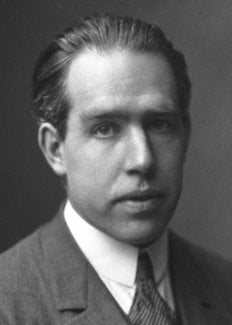
Niels Henrik David Bohr was born in Copenhagen on October 7, 1885, as the son of Christian Bohr, Professor of Physiology at Copenhagen University, and his wife Ellen, née Adler. Niels, together with his younger brother Harald (the future Professor in Mathematics), grew up in an atmosphere most favourable to the development of his genius – his father was an eminent physiologist and was largely responsible for awakening his interest in physics while still at school, his mother came from a family distinguished in the field of education.
After matriculation at the Gammelholm Grammar School in 1903, he entered Copenhagen University where he came under the guidance of Professor C. Christiansen, a profoundly original and highly endowed physicist, and took his Master’s degree in Physics in 1909 and his Doctor’s degree in 1911.
While still a student, the announcement by the Academy of Sciences in Copenhagen of a prize to be awarded for the solution of a certain scientific problem, caused him to take up an experimental and theoretical investigation of the surface tension by means of oscillating fluid jets. This work, which he carried out in his father’s laboratory and for which he received the prize offered (a gold medal), was published in the Transactions of the Royal Society, 1908.
Bohr’s subsequent studies, however, became more and more theoretical in character, his doctor’s disputation being a purely theoretical piece of work on the explanation of the properties of the metals with the aid of the electron theory, which remains to this day a classic on the subject. It was in this work that Bohr was first confronted with the implications of Planck‘s quantum theory of radiation.
In the autumn of 1911 he made a stay at Cambridge, where he profited by following the experimental work going on in the Cavendish Laboratory under Sir J.J. Thomson’s guidance, at the same time as he pursued own theoretical studies. In the spring of 1912 he was at work in Professor Rutherford’s laboratory in Manchester, where just in those years such an intensive scientific life and activity prevailed as a consequence of that investigator’s fundamental inquiries into the radioactive phenomena. Having there carried out a theoretical piece of work on the absorption of alpha rays which was published in the Philosophical Magazine, 1913, he passed on to a study of the structure of atoms on the basis of Rutherford’s discovery of the atomic nucleus. By introducing conceptions borrowed from the Quantum Theory as established by Planck, which had gradually come to occupy a prominent position in the science of theoretical physics, he succeeded in working out and presenting a picture of atomic structure that, with later improvements (mainly as a result of Heisenberg‘s ideas in 1925), still fitly serves as an elucidation of the physical and chemical properties of the elements.
In 1913-1914 Bohr held a Lectureship in Physics at Copenhagen University and in 1914-1916 a similar appointment at the Victoria University in Manchester. In 1916 he was appointed Professor of Theoretical Physics at Copenhagen University, and since 1920 (until his death in 1962) he was at the head of the Institute for Theoretical Physics, established for him at that university.
Recognition of his work on the structure of atoms came with the award of the Nobel Prize for 1922.
Bohr’s activities in his Institute were since 1930 more and more directed to research on the constitution of the atomic nuclei, and of their transmutations and disintegrations. In 1936 he pointed out that in nuclear processes the smallness of the region in which interactions take place, as well as the strength of these interactions, justify the transition processes to be described more in a classical way than in the case of atoms (Cf. »Neutron capture and nuclear constitution«, Nature, 137 (1936) 344).
A liquid drop would, according to this view, give a very good picture of the nucleus. This so-called liquid droplet theory permitted the understanding of the mechanism of nuclear fission, when the splitting of uranium was discovered by Hahn and Strassmann, in 1939, and formed the basis of important theoretical studies in this field (among others, by Frisch and Meitner).
Bohr also contributed to the clarification of the problems encountered in quantum physics, in particular by developing the concept of complementarity. Hereby he could show how deeply the changes in the field of physics have affected fundamental features of our scientific outlook and how the consequences of this change of attitude reach far beyond the scope of atomic physics and touch upon all domains of human knowledge. These views are discussed in a number of essays, written during the years 1933-1962. They are available in English, collected in two volumes with the title Atomic Physics and Human Knowledge and Essays 1958-1962 on Atomic Physics and Human Knowledge, edited by John Wiley and Sons, New York and London, in 1958 and 1963, respectively.
Among Professor Bohr’s numerous writings (some 115 publications), three appearing as books in the English language may be mentioned here as embodying his principal thoughts: The Theory of Spectra and Atomic Constitution, University Press, Cambridge, 1922/2nd. ed., 1924; Atomic Theory and the Description of Nature, University Press, Cambridge, 1934/reprint 1961; The Unity of Knowledge, Doubleday & Co., New York, 1955.
During the Nazi occupation of Denmark in World War II, Bohr escaped to Sweden and spent the last two years of the war in England and America, where he became associated with the Atomic Energy Project. In his later years, he devoted his work to the peaceful application of atomic physics and to political problems arising from the development of atomic weapons. In particular, he advocated a development towards full openness between nations. His views are especially set forth in his Open Letter to the United Nations, June 9, 1950.
Until the end, Bohr’s mind remained alert as ever; during the last few years of his life he had shown keen interest in the new developments of molecular biology. The latest formulation of his thoughts on the problem of Life appeared in his final (unfinished) article, published after his death: “Licht und Leben-noch einmal”, Naturwiss., 50 (1963) 72: (in English: “Light and Life revisited”, ICSU Rev., 5 ( 1963) 194).
Niels Bohr was President of the Royal Danish Academy of Sciences, of the Danish Cancer Committee, and Chairman of the Danish Atomic Energy Commission. He was a Foreign Member of the Royal Society (London), the Royal Institution, and Academies in Amsterdam, Berlin, Bologna, Boston, Göttingen, Helsingfors, Budapest, München, Oslo, Paris, Rome, Stockholm, Uppsala, Vienna, Washington, Harlem, Moscow, Trondhjem, Halle, Dublin, Liege, and Cracow. He was Doctor, honoris causa, of the following universities, colleges, and institutes: (1923-1939) – Cambridge, Liverpool, Manchester, Oxford, Copenhagen, Edinburgh, Kiel, Providence, California, Oslo, Birmingham, London; (1945-1962) – Sorbonne (Paris), Princeton, Mc. Gill (Montreal), Glasgow, Aberdeen, Athens, Lund, New York, Basel, Aarhus, Macalester (St. Paul), Minnesota, Roosevelt (Chicago, Ill.), Zagreb, Technion (Haifa), Bombay, Calcutta, Warsaw, Brussels, Harvard, Cambridge (Mass.), and Rockefeller (New York).
Professor Bohr was married, in 1912, to Margrethe Nørlund, who was for him an ideal companion. They had six sons, of whom they lost two; the other four have made distinguished careers in various professions – Hans Henrik (M.D.), Erik (chemical engineer), Aage (Ph.D., theoretical physicist, following his father as Director of the Institute for Theoretical Physics), Ernest (lawyer).
Niels Bohr died in Copenhagen on November 18, 1962.
This autobiography/biography was written at the time of the award and first published in the book series Les Prix Nobel. It was later edited and republished in Nobel Lectures. To cite this document, always state the source as shown above.