Robert A. Millikan – Nobel Lecture
Nobel Lecture, May 23, 1924
The Electron and the Light-Quant from the Experimental Point of View
Read the Nobel Lecture
Pdf 130 kB
The Nobel Foundation's copyright has expired.
Robert A. Millikan – Nominations
Robert A. Millikan – Other resources
Links to other sites
On Robert A. Millikan from American Institute of Physics
On Robert Millikan from National High Magnetic Field Laboratory
Robert A. Millikan – Photo gallery
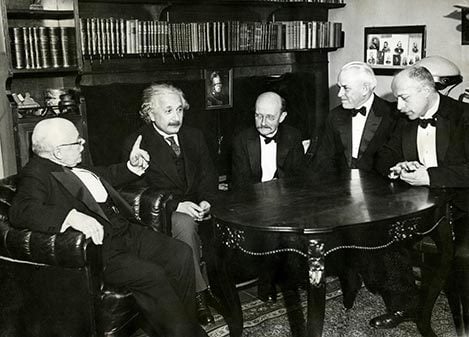
From left to right: Nobel Laureates Walther Nernst, Albert Einstein, Max Planck, Robert A. Millikan and Max von Laue at a dinner given by Professor von Laue in Berlin, 11 November 1931.
Source: Nationaal Archief Photographer unknown Public domain via Wikimedia Commons
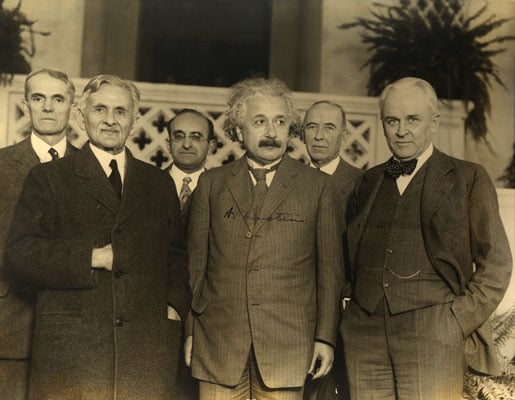
Three Nobel Laureates in Physics standing in front of the Athenaeum at California Institute of Technology (Caltech), 1931. Front row from left: Albert A. Michelson, Albert Einstein and Robert A. Millikan.
Source: Smithsonian Institution Libraries Photographer unknown Public domain via Wikimedia Commons
Robert A. Millikan – Biographical
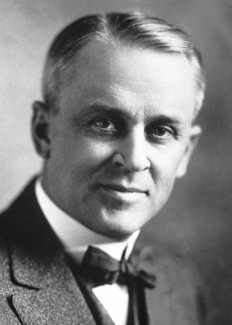
Robert Andrews Millikan was born on the 22nd of March, 1868, in Morrison, Ill. (U.S.A.), as the second son of the Reverend Silas Franklin Millikan and Mary Jane Andrews. His grandparents were of the Old New England stock which had come to America before 1750, and were pioneer settlers in the Middle West. He led a rural existence in childhood, attending the Maquoketa High School (Iowa). After working for a short time as a court reporter, he entered Oberlin College (Ohio) in 1886. During his undergraduate course his favourite subjects were Greek and mathematics; but after his graduation in 1891 he took, for two years, a teaching post in elementary physics. It was during this period that he developed his interest in the subject in which he was later to excel. In 1893, after obtaining his mastership in physics, he was appointed Fellow in Physics at Columbia University. He afterwards received his Ph.D. (1895) for research on the polarization of light emitted by incandescent surfaces – using for this purpose molten gold and silver at the U.S. Mint.
On the instigation of his professors, Millikan spent a year (1895-1896) in Germany, at the Universities of Berlin and Göttingen. He returned at the invitation of A. A. Michelson, to become assistant at the newly established Ryerson Laboratory at the University of Chicago (1896). Millikan was an eminent teacher, and passing through the customary grades he became professor at that university in 1910, a post which he retained till 1921. During his early years at Chicago he spent much time preparing textbooks and simplifying the teaching of physics. He was author or co-author of the following books: A College Course in Physics, with S.W. Stratton (1898); Mechanics, Molecular Physics, and Heat (1902); The Theory of Optics,with C.R. Mann translated from the German (1903); A First Course in Physics, with H.G. Gale (1906); A Laboratory Course in Physics for Secondary Schools,with H.G. Gale (1907); Electricity, Sound, and Light,with J. Mills (1908); Practical Physics – revision of A First Course(1920); The Electron(1917; rev. eds. 1924, 1935).
As a scientist, Millikan made numerous momentous discoveries, chiefly in the fields of electricity, optics, and molecular physics. His earliest major success was the accurate determination of the charge carried by an electron, using the elegant “falling-drop method”; he also proved that this quantity was a constant for all electrons (1910), thus demonstrating the atomic structure of electricity. Next, he verified experimentally Einstein’s all-important photoelectric equation, and made the first direct photoelectric determination of Planck’s constant h (1912-1915). In addition his studies of the Brownian movements in gases put an end to all opposition to the atomic and kinetic theories of matter. During 1920-1923, Millikan occupied himself with work concerning the hot-spark spectroscopy of the elements (which explored the region of the spectrum between the ultraviolet and X-radiation), thereby extending the ultraviolet spectrum downwards far beyond the then known limit. The discovery of his law of motion of a particle falling towards the earth after entering the earth’s atmosphere, together with his other investigations on electrical phenomena, ultimately led him to his significant studies of cosmic radiation (particularly with ionization chambers).
Throughout his life Millikan remained a prolific author, making numerous contributions to scientific journals. He was not only a foremost scientist, but his religious and philosophic nature was evident from his lectures on the reconciliation of science and religion, and from his books: Science and Life(1924); Evolution in Science and Religion (1927); Science and the New Civilization (1930); Time, Matter, and Values (1932). Shortly before his death he published Electrons (+ and –), Protons, Photons, Neutrons, Mesotrons, and Cosmic Rays (1947; another rev. ed. of The Electron, previously mentioned,) and his Autobiography(1950).
During World War I, Millikan was Vice-Chairman of the National Research Council, playing a major part in developing anti-submarine and meteorological devices. In 1921, he was appointed Director of the Norman Bridge Laboratory of Physics at the California Institute of Technology, Pasadena; he was also made Chairman of the Executive Council of that institute. In 1946 he retired from this post. Professor Millikan has been President of the American Physical Society, Vice-President of the American Association for the Advancement of Science, and was the American member of the Committee on Intellectual Cooperation of the League of Nations, and the American representative at the International Congress of Physics, known as the Solvay Congress, at Brussels in 1921. He held honorary doctor’s degrees of some twenty-five universities, and was a member or honorary member of many learned institutions in his country and abroad. He has been the recipient of the Comstock Prize of the National Academy of Sciences, of the Edison Medal of the American Institute of Electrical Engineers, of the Hughes Medal of the Royal Society of Great Britain, and of the Nobel Prize for Physics 1923. He was also made Commander of the Legion of Honour, and received the Chinese Order of Jade.
Millikan was an enthusiastic tennis player, and golf was also one of his recreations.
Professor Millikan married Greta Erwin Blanchard in 1902; they had three sons: Clark Blanchard, Glenn Allen, and Max Franklin.
He died on the 19th of December, 1953, in San Marino, California.
This autobiography/biography was written at the time of the award and first published in the book series Les Prix Nobel. It was later edited and republished in Nobel Lectures. To cite this document, always state the source as shown above.
The Nobel Foundation's copyright has expired.Robert A. Millikan – Facts
Award ceremony speech
Presentation Speech by Professor A. Gullstrand, Chairman of the Nobel Committee for Physics of the Royal Swedish Academy of Sciences, on December 10, 1923
Your Majesty, Your Royal Highnesses, Ladies and Gentlemen.
The Royal Academy of Sciences has awarded this year’s Nobel Prize for Physics to Doctor Robert Andrews Millikan for his work on the elementary charge of electricity and on the photoelectric effect.
We speak of an electric charge when electricity is accumulated on a body, and of an electric current when it spreads along a metallic wire. But when electricity passes through water or water solutions there is no current in the same sense of the word; there is a convection of charges combined with chemical decomposition – electrolysis. Thus water is decomposed into its constituents, hydrogen and oxygen, and metallic silver is deposited from solutions of silver salts. If one and the same current is used to cause these decompositions, the weight of hydrogen liberated in a certain time bears the same ratio to the weight of silver deposited as the atomic weight of hydrogen to the atomic weight of silver, and a current of a given strength in a given time always causes the appearance of a constant quantity of hydrogen and the depositing of a corresponding quantity of silver. As the strength of the current indicates the quantity of electricity passing through the fluids in a given time, it follows that the hydrogen atom and the silver atom carry the same charge, and this charge is what is meant by the unit of electric charge. The same laws hold good for all electrolytic processes, different atoms carrying as many units as are indicated by their valency. The charged atoms are called ions, but this word is used also in a wider signification.
It follows from these laws of electrolysis that it was possible to calculate the unit of electric charge with the same degree of probability with which the number of atoms in a gram of hydrogen could be estimated, and as early as 1874 an approximate value of the unit was arrived at in this way, equalling about two thirds of the exact value now known through the researches of Millikan. The word electron was proposed later as a name for the unit of charge, but now that the discovery of cathode rays has brought to our knowledge free units of negative electricity, an electron means an amount of negative electricity equalling the unit of charge.
Electricity does not pass through gases under normal conditions, but when a gas is exposed to X-rays it acquires the power of transmitting a current. It was soon proved that under the influence of these rays, positive and negative ions are formed, conveying charges of electricity in the same way as in the case of electrolysis. The discovery of radioactive elements provided still more powerful means for such an ionization of gases.
With the methods that were now available it could be shown that the unit of charge of the gas ions was approximately the same as the unit known from electrolysis. Ionization was also observed in monatomic inert gases, which proves that the unit of electric charge is a constituent of the atom that is liberated from it by ionization. Eager attempts were now made to obtain a more exact value for the unit of charge, but the results were not much better than before – until Millikan took up the problem.
Millikan’s aim was to prove that electricity really has the atomic structure, which, on the base of theoretical evidence, it was supposed to have. To prove this it was necessary to ascertain, not only that electricity, from whatever source it may come, always appears as a unit of charge or as an exact multiple of units, but also that the unit is not a statistical mean, as, for instance, has of late been shown to be the case with atomic weights. In other words it was necessary to measure the charge of a single ion with such a degree of accuracy as would enable him to ascertain that this charge is always the same, and it was necessary to furnish the same proofs in the case of free electrons. By a brilliant method of investigation and by extraordinarily exact experimental technique Millikan reached his goal.
In his fundamental experiments he had two horizontal metal plates, one a short distance above the other, and by means of a switch he could join them with the poles of a source of high-tension current or short-circuit them. The air between the plates was ionized by radium that could be screened off. There was a minute pin-hole in the middle of the top plate, and over it he had arranged a spray of oil droplets with a radius of about one thousandth of a millimeter. Sooner or later such an oil droplet must fall through the pin-hole and enter the space between the plates, where it was illuminated in such a way that Millikan could see it in a telescope like a bright star on a black background. In the eyepiece of this telescope were placed three cross-hairs, and Millikan measured the time which the droplet required to pass between them. In this way he measured the velocity of fall, which for such small droplets is only a fraction of a millimeter a second. The droplet had been charged with electricity by the frictional process involved in blowing the spray, and when it had fallen down, Millikan switched on the source of current so as to cause the drop to be pulled up by the attraction of the upper plate. The droplet rose, and its velocity was measured during its rise; then the plates were short-circuited, and the drop turned again and began to fall. In this way he kept the drop travelling up and down, many times during several hours, and measured its velocity again and again by means of a stopwatch or, later, a chronoscope. The velocity of fall was constant, but on the way up the velocity varied, which means that the drop had captured one or more of the ions spread in the air between the plates. Now in this experiment the difference of velocity is proportional to the charge captured, and the results showed that the difference of velocity always had the same value or an exact multiple of that value. In other words: the drop had caught one or more units of electrical charge, all exactly equal, however the experiments were varied. In this way the charge of a single ion could be measured in a very large number of cases, and it was determined with an exactitude of one in a thousand.
When the source of current is switched on, the positive ions are driven with a high speed towards the negative plate, and vice versa. Thus Millikan only needed to have the droplet near one of the plates at the moment when he switched on the source of current, if he wished to expose it to a shower of positive or negative ions and in this way alter its charge. By this method he proved that the electric charge which the drop had acquired by friction was an exact multiple of the unit.
To give unimpeachable proof Millikan was obliged to make similar experiments with cathode rays and with alpha- and beta-rays and, moreover, to investigate the law of fall of small bodies through gases and the law of their Brownian movements.
Even leaving out of consideration the fact that Millikan has proved by these researches that electricity consists of equal units, his exact evaluation of the unit has done physics an inestimable service, as it enables us to calculate with a higher degree of exactitude a large number of the most important physical constants.
In justifying the reward of Millikan the Academy has not omitted to refer also to his investigations of photoelectric effect. Without going into details I will only state that, if these researches of Millikan had given a different result, the law of Einstein would have been without value, and the theory of Bohr without support. After Millikan’s results both were awarded a Nobel Prize for Physics last year.