Louis de Broglie – Nominations
Louis de Broglie – Nobel Lecture
Nobel Lecture, December 12, 1929
The Wave Nature of the Electron
Read the Nobel Lecture
Pdf 72 kB
Louis de Broglie – Other resources
Links to other sites
Fondation Louis de Broglie (in French)
Louis de Broglie. A Biography at the MacTutor History of Mathematics archive
Louis de Broglie – Banquet speech
Louis de Broglie’s speech at the Nobel Banquet in Stockholm, December 10, 1929 (in French)
Altesses Royales, Mesdames, Messieurs.
Je veux avant tout adresser mes remerciements les plus sincères et les plus émus à l’Académie des sciences de Suède et à la Suède toute entière pour le très grand honneur que l’on m’a fait en me décernant le prix Nobel de physique pour 1929.
Chaque année, en exécution des volontés d’Alfred Nobel votre beau pays qui a tant contribué lui-même et qui contribue tant chaque jour au développement de la Science, joue le rôle d’arbitre entre toutes les nations en décernant à un physicien la plus haute distinction que le mérite scientifique puisse recevoir. Celui qui l’obtient est naturellement amené à faire un retour sur lui-même et à se demander s’il est digne d’un pareil honneur. En apprenant, il y a un mois, que c’était sur moi que votre choix s’était porté pour 1929, je me suis demandé avec inquiétude si mes mérites étaient en proportion d’une telle récompense. Et comme vraiment je n’ose pas le croire, je veux surtout voir dans l’honneur que vous m’avez fait une marque nouvelle de l’estime que la Suède a toujours témoignée depuis le temps de Descartes pour la pensée et pour la science françaises et une preuve nouvelle de l’amitié traditionnelle qui unit nos deux pays.
Ce qui m’encourage particulièrement à donner à mon prix Nobel cette signification et à me considérer pour un instant comme un trait d’union entre la Suède et la France, c’est que, dans mes veines, au sang français se mêle un peu de sang suédois puisque je descends de M. de Staël qui fut ambassadeur de Suède en France à l’époque de la Révolution française et que je suis apparenté à la famille suédoise des Rosen.
Ainsi donc je suis ici ce soir le représentant de l’amitié franco-suédoise et je suis aussi, avec mon éminent collègue le professeur Richardson, le représentant de la physique contemporaine. A ce double titre qu’il me soit permis de joindre à mes sincères remerciements mes vœux les plus chaleureux pour ces deux grandes choses dont le prix Nobel symbolise l’union: le progrès de la Science et la gloire de la Suède!
Louis de Broglie – Documentary
Louis de Broglie – Photo gallery
Nobel Prize award ceremony in Stockholm, Sweden, 10 December 1929. From left: Owen Willans Richardson, physics laureate 1928; Louis de Broglie, physics laureate 1929; Arthur Harden and Hans von Euler-Chelpin, chemistry laureates 1929; Sir Frederick Hopkins, medicine laureate 1929 and Thomas Mann, literature laureate 1929. Photo: A. Malmström. Public domain, via Wikimedia Commons. Source: Digitala stadsmuseet.
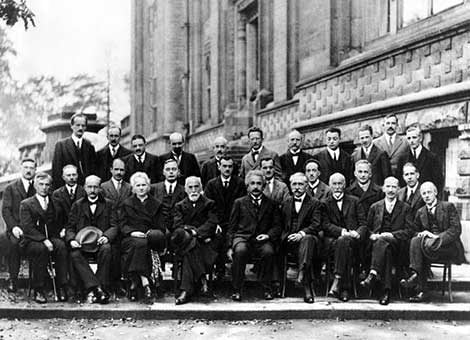
The fifth Solvay International Conference on Electrons and Photons, was held in October 1927. Prominent physicists from all the world met to discuss the newly formulated quantum theory. 17 of the 29 participants were or became Nobel Laureates. Back row, left to right: Auguste Piccard, Émile Henriot, Paul Ehrenfest, Édouard Herzen, Théophile de Donder, Erwin Schrödinger, Jules-Émile Verschaffelt, Wolfgang Pauli, Werner Heisenberg, Ralph Howard Fowler, Léon Brillouin.
Middle row, left to right: Peter Debye, Martin Knudsen, William Lawrence Bragg, Hendrik Anthony Kramers, Paul Dirac, Arthur Compton, Louis de Broglie, Max Born, Niels Bohr. Front row, left to right: Irving Langmuir, Max Planck, Marie Skłodowska Curie, Hendrik Lorentz, Albert Einstein, Paul Langevin, Charles-Eugène Guye, Charles Thomson Rees Wilson, Owen Willans Richardson.
Photo: Benjamin Couprie, Institut International de Physique Solvay, Brussels, Belgium.
Public domain via Wikimedia Commons
The Nobel Prize in Physics 1929
Louis de Broglie – Biographical
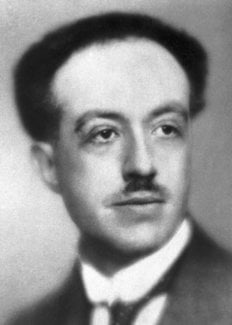 Prince Louis-Victor de Broglie of the French Academy, Permanent Secretary of the Academy of Sciences, and Professor at the Faculty of Sciences at Paris University, was born at Dieppe (Seine Inférieure) on 15th August, 1892, the son of Victor, Duc de Broglie and Pauline d’Armaillé. After studying at the Lycée Janson of Sailly, he passed his school-leaving certificate in 1909. He applied himself first to literary studies and took his degree in history in 1910. Then, as his liking for science prevailed, he studied for a science degree, which he gained in 1913. He was then conscripted for military service and posted to the wireless section of the army, where he remained for the whole of the war of 1914-1918. During this period he was stationed at the Eiffel Tower, where he devoted his spare time to the study of technical problems. At the end of the war Louis de Broglie resumed his studies of general physics. While taking an interest in the experimental work carried out by his elder brother, Maurice, and co-workers, he specialized in theoretical physics and, in particular, in the study of problems involving quanta. In 1924 at the Faculty of Sciences at Paris University he delivered a thesis Recherches sur la Théorie des Quanta (Researches on the quantum theory), which gained him his doctor’s degree. This thesis contained a series of important findings which he had obtained in the course of about two years. The ideas set out in that work, which first gave rise to astonishment owing to their novelty, were subsequently fully confirmed by the discovery of electron diffraction by crystals in 1927 by Davisson and Germer; they served as the basis for developing the general theory nowadays known by the name of wave mechanics, a theory which has utterly transformed our knowledge of physical phenomena on the atomic scale.
After the maintaining of his thesis and while continuing to publish original work on the new mechanics, Louis de Broglie took up teaching duties. On completion of two year’s free lectures at the Sorbonne he was appointed to teach theoretical physics at the Institut Henri Poincaré which had just been built in Paris. The purpose of that Institute is to teach and develop mathematical and theoretical physics. The incumbent of the chair of theoretical physics at the Faculty of Sciences at the University of Paris since 1932, Louis de Broglie runs a course on a different subject each year at the Institut Henri Poincaré, and several of these courses have been published. Many French and foreign students have come to work with him and a great deal of doctorate theses have been prepared under his guidance.
Between 1930 and 1950, Louis de Broglie’s work has been chiefly devoted to the study of the various extensions of wave mechanics: Dirac’s electron theory, the new theory of light, the general theory of spin particles, applications of wave mechanics to nuclear physics, etc. He has published numerous notes and several papers on this subject, and is the author of more than twenty-five books on the fields of his particular interests.
Since 1951, together with young colleagues, Louis de Broglie has resumed the study of an attempt which he made in 1927 under the name of the theory of the double solution to give a causal interpretation to wave mechanics in the classical terms of space and time, an attempt which he had then abandoned in the face of the almost universal adherence of physicists to the purely probabilistic interpretation of Born, Bohr, and Heisenberg. Back again in this his former field of research, he has obtained a certain number of new and encouraging results which he has published in notes to Comptes Rendus de l’Académie des Sciences and in various expositions.
After crowning Louis de Broglie’s work on two occasions, the Academie des Sciences awarded him in 1929 the Henri Poincaré medal (awarded for the first time), then in 1932, the Albert I of Monaco prize. In 1929 the Swedish Academy of Sciences conferred on him the Nobel Prize for Physics “for his discovery of the wave nature of electrons”. In 1952 the first Kalinga Prize was awarded to him by UNESCO for his efforts to explain aspects of modern physics to the layman. In 1956 he received the gold medal of the French National Scientific Research Centre. He has made major contributions to the fostering of international scientific co-operation.
Elected a member of the Academy of Sciences of the French Institute in 1933, Louis de Broglie has been its Permanent Secretary for the mathematical sciences since 1942. He has been a member of the Bureau des Longitudes since 1944. He holds the Grand Cross of the Légion d’Honneur and is an Officer of the Order of Leopold of Belgium. He is an honorary doctor of the Universities of Warsaw, Bucharest, Athens, Lausanne, Quebec, and Brussels, and a member of eighteen foreign academies in Europe, India, and the U.S.A.
Professor de Broglie’s most important publications are:
Recherches sur la théorie des quanta (Researches on the quantum theory), Thesis Paris, 1924.
Ondes et mouvements (Waves and motions), Gauthier-Villars, Paris, 1926.
Rapport au 5e Conseil de Physique Solvay, Brussels, 1927.
La mécanique ondulatoire (Wave mechanics), Gauthier-Villars, Paris, 1928.
Une tentative d’interprétation causale et non linéaire de la mécanique ondulatoire: la théorie de la double solution, Gauthier-Villars, Paris, 1956.
English translation: Non-linear Wave Mechanics: A Causal Interpretation, Elsevier, Amsterdam, 1960.
Introduction à la nouvelle théorie des particules de M. Jean-Pierre Vigier et de ses collaborateurs, Gauthier-Villars, Paris, 1961.
English translation: Introduction to the Vigier Theory of elementary particles, Elsevier, Amsterdam, 1963.
Étude critique des bases de l’interprétation actuelle de la mécanique ondulatoire, Gauthier-Villars, Paris, 1963.
English translation: The Current Interpretation of Wave Mechanics: A Critical Study, Elsevier, Amsterdam, 1964.
This autobiography/biography was written at the time of the award and first published in the book series Les Prix Nobel. It was later edited and republished in Nobel Lectures. To cite this document, always state the source as shown above.
Louis de Broglie died on March 19, 1987.
Louis de Broglie – Facts
Award ceremony speech
Presentation Speech by Professor C.W. Oseen, Chairman of the Nobel Committee for Physics of the Royal Swedish Academy of Sciences, on December 10, 1929
Your Majesty, Your Royal Highnesses, Ladies and Gentlemen.
The question as to the nature of light rays is one of the oldest problems in physics. In the works of the ancient philosophers are to be found an indication and a rough outline of two radically different concepts of this phenomenon. However, in a clear and definite form they appear at the time when the foundations of physics were laid, a time that bears the stamp of Newton’s genius. One of these theories asserts that a light ray is composed of small particles, which we may term corpuscles, which are projected into space by light-emitting substances. The other states that light is a wave motion of one type or another. The fact that these two theories, at this elementary stage, are equally possible, is attributable to their explaining equally well the simplest law governing a light ray, viz. conditions being undisturbed it propagates in a straight line.
The 19th century sealed the victory of the wave theory. Those of us whose studies coincide with that period have certainly all learned that light is a wave motion. This conviction was based on the study of a series of phenomena which are readily accounted for by the wave theory but which, on the other hand, cannot be explained by the corpuscular theory. One of these phenomena is the diffraction undergone by a light beam when it passes through a small hole in an opaque screen. Alongside the diffracted ray there are alternate light and dark bands. This phenomenon has long been considered a decisive proof of the wave theory. Furthermore, in the course of the 19th century a very large number of other, more complex, light phenomena had been learnt of which all, without exception, were completely explainable by the wave theory, while it appeared to be impossible to account for them on the basis of the corpuscular theory. The correctness of the wave theory seemed definitely established.
The 19th century was also the period when atomic concepts have taken root into physics. One of the greatest discoveries of the final decades of that century was the discovery of the electron, the smallest negative charge of electricity occurring in the free state.
Under the influence of these two currents of ideas the concept which 19th century physics had of the universe was the following. The universe was divided into two smaller worlds. One was the world of light, of waves; the other was the world of matter, of atoms and electrons. The perceptible appearance of the universe was conditioned by the interaction of these two worlds.
Our century taught us that besides the innumerable light phenomena which testify to the truth of the wave theory, there are others which testify no less decisively to the correctness of the corpuscular theory. A light ray has the property of liberating a stream of electrons from a substance. The number of electrons liberated depends on the intensity of the ray. But the velocity with which the electrons leave the substance is the same whether the light ray originates from the most powerful light source that can be made, or whether it originates from the most distant fixed stars which are invisible to the naked eye. In this case everything occurs as if the light ray were composed of corpuscles which traversed the spaces of the universe unmodified. It thus seems that light is at once a wave motion and a stream of corpuscles. Some of its properties are explained by the former supposition, others by the second. Both must be true.
Louis de Broglie had the boldness to maintain that not all the properties of matter can be explained by the theory that it consists of corpuscles. Apart from the numberless phenomena which can be accounted for by this theory, there are others, according to him, which can be explained only by assuming that matter is, by its nature, a wave motion. At a time when no single known fact supported this theory, Louis de Broglie asserted that a stream of electrons which passed through a very small hole in an opaque screen must exhibit the same phenomena as a light ray under the same conditions. It was not quite in this way that Louis de Broglie’s experimental investigation concerning his theory took place. Instead, the phenomena arising when beams of electrons are reflected by crystalline surfaces, or when they penetrate thin sheets, etc. were turned to account. The experimental results obtained by these various methods have fully substantiated Louis de Broglie’s theory. It is thus a fact that matter has properties which can be interpreted only by assuming that matter is of a wave nature. An aspect of the nature of matter which is completely new and previously quite unsuspected has thus been revealed to us.
Hence there are not two worlds, one of light and waves, one of matter and corpuscles. There is only a single universe. Some of its properties can be accounted for by the wave theory, others by the corpuscular theory.
In conclusion I would like to point out that what applies to matter applies also to ourselves since, from a certain point of view, we are part of matter.
A well-known Swedish poem has as its opening words “My life is a wave”. The poet could also have expressed his thought by the words: “I am a wave”. Had he done so, his words would have contained a premonition of man’s present deepest understanding of the nature of matter.
Monsieur Louis de Broglie. When quite young you threw yourself into the controversy raging round the most profound problem in physics. You had the boldness to assert, without the support of any known fact, that matter had not only a corpuscular nature, but also a wave nature. Experiment came later and established the correctness of your view. You have covered in fresh glory a name already crowned for centuries with honour. The Royal Academy of Sciences has sought to reward your discovery with the highest recompense of which it is capable. I would ask you to receive from the hands of our King the Nobel Physics Prize for 1929.