Enrico Fermi – Nobel Lecture
Nobel Lecture, December 12, 1938
Artificial Radioactivity Produced by Neutron Bombardment
Read the Nobel Lecture
Pdf 36 kB
Enrico Fermi – Other resources
Links to other sites
On Enrico Fermi Biography from Atomic Heritage Foundation
“Enrico Fermi: Commemorating the Centennial of His Birth” from U.S. Department of Energy
On Enrico Fermi from National High Magnetic Field Laboratory
Enrico Fermi – Nominations
Enrico Fermi – Photo gallery
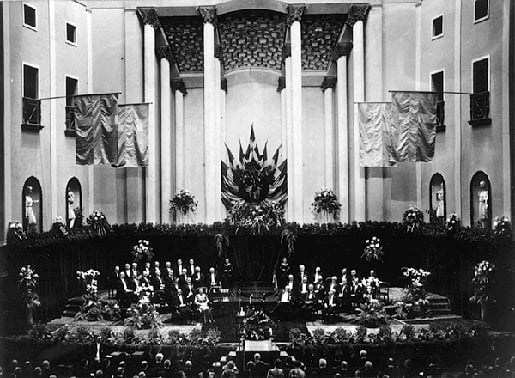
At the Nobel Prize Award Ceremony at the Stockholm Concert Hall on 10 December 1938 only two Nobel Laureates were present: Enrico Fermi, Physics Laureate, and Pearl Buck, Literature Laureate.
Source: University of Pennsylvania. Photographer: Karl Sandels. Public domain via Wikimedia Commons

Physicist Enrico Fermi pictured in the laboratory in 1934.
Photo by Keystone-France\Gamma-Rapho via Getty Images

The three physics laureates Wolfgang Pauli, Werner Heisenberg and Enrico Fermi on a boat on Lake Como, Italy, in September 1927 .
Photo: CERN / © Franco Rasetti
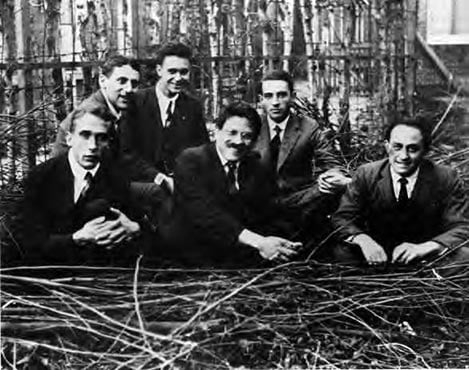
Ehrenfest's students, Leiden 1924. Left to right: Gerhard Heinrich Dieke, Samuel Abraham Goudsmit, Jan Tinbergen, Paul Ehrenfest, Ralph Kronig, and Enrico Fermi.
Source: Emilio Segrè Visual Archives Photographer unknown Public domain via Wikimedia Commons
Enrico Fermi – Biographical
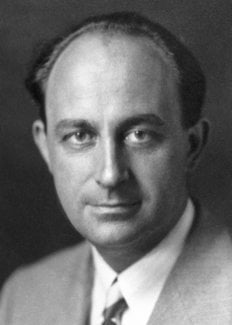
Enrico Fermi was born in Rome on 29th September, 1901, the son of Alberto Fermi, a Chief Inspector of the Ministry of Communications, and Ida de Gattis. He attended a local grammar school, and his early aptitude for mathematics and physics was recognized and encouraged by his father’s colleagues, among them A. Amidei. In 1918, he won a fellowship of the Scuola Normale Superiore of Pisa. He spent four years at the University of Pisa, gaining his doctor’s degree in physics in 1922, with Professor Puccianti.
Soon afterwards, in 1923, he was awarded a scholarship from the Italian Government and spent some months with Professor Max Born in Göttingen. With a Rockefeller Fellowship, in 1924, he moved to Leyden to work with P. Ehrenfest, and later that same year he returned to Italy to occupy for two years (1924-1926) the post of Lecturer in Mathematical Physics and Mechanics at the University of Florence.
In 1926, Fermi discovered the statistical laws, nowadays known as the «Fermi statistics», governing the particles subject to Pauli’s exclusion principle (now referred to as «fermions», in contrast with «bosons» which obey the Bose-Einstein statistics).
In 1927, Fermi was elected Professor of Theoretical Physics at the University of Rome (a post which he retained until 1938, when he – immediately after the receipt of the Nobel Prize – emigrated to America, primarily to escape Mussolini’s fascist dictatorship).
During the early years of his career in Rome he occupied himself with electrodynamic problems and with theoretical investigations on various spectroscopic phenomena. But a capital turning-point came when he directed his attention from the outer electrons towards the atomic nucleus itself. In 1934, he evolved the ß-decay theory, coalescing previous work on radiation theory with Pauli’s idea of the neutrino. Following the discovery by Curie and Joliot of artificial radioactivity (1934), he demonstrated that nuclear transformation occurs in almost every element subjected to neutron bombardment. This work resulted in the discovery of slow neutrons that same year, leading to the discovery of nuclear fission and the production of elements lying beyond what was until then the Periodic Table.
In 1938, Fermi was without doubt the greatest expert on neutrons, and he continued his work on this topic on his arrival in the United States, where he was soon appointed Professor of Physics at Columbia University, N.Y. (1939-1942).
Upon the discovery of fission, by Hahn and Strassmann early in 1939, he immediately saw the possibility of emission of secondary neutrons and of a chain reaction. He proceeded to work with tremendous enthusiasm, and directed a classical series of experiments which ultimately led to the atomic pile and the first controlled nuclear chain reaction. This took place in Chicago on December 2, 1942 – on a squash court situated beneath Chicago’s stadium. He subsequently played an important part in solving the problems connected with the development of the first atomic bomb (He was one of the leaders of the team of physicists on the Manhattan Project for the development of nuclear energy and the atomic bomb.)
In 1944, Fermi became an American citizen, and at the end of the war (1946) he accepted a professorship at the Institute for Nuclear Studies of the University of Chicago, a position which he held until his untimely death in 1954. There he turned his attention to high-energy physics, and led investigations into the pion-nucleon interaction.
During the last years of his life Fermi occupied himself with the problem of the mysterious origin of cosmic rays, thereby developing a theory, according to which a universal magnetic field – acting as a giant accelerator – would account for the fantastic energies present in the cosmic ray particles.
Professor Fermi was the author of numerous papers both in theoretical and experimental physics. His most important contributions were:
“Sulla quantizzazione del gas perfetto monoatomico”, Rend. Accad. Naz. Lincei, 1935 (also in Z. Phys., 1936), concerning the foundations of the statistics of the electronic gas and of the gases made of particles that obey the Pauli Principle.
Several papers published in Rend. Accad. Naz. Lincei, 1927-28, deal with the statistical model of the atom (Thomas-Fermi atom model) and give a semiquantitative method for the calculation of atomic properties. A resumé of this work was published by Fermi in the volume: Quantentheorie und Chemie, edited by H. Falkenhagen, Leipzig, 1928.
“Uber die magnetischen Momente der AtomKerne”, Z. Phys., 1930, is a quantitative theory of the hyperfine structures of spectrum lines. The magnetic moments of some nuclei are deduced therefrom.
“Tentativo di una teoria dei raggi ß”, Ricerca Scientifica, 1933 (also Z. Phys., 1934) proposes a theory of the emission of ß-rays, based on the hypothesis, first proposed by Pauli, of the existence of the neutrino.
The Nobel Prize for Physics was awarded to Fermi for his work on the artificial radioactivity produced by neutrons, and for nuclear reactions brought about by slow neutrons. The first paper on this subject “Radioattività indotta dal bombardamento di neutroni” was published by him in Ricerca Scientifica, 1934. All the work is collected in the following papers by himself and various collaborators: “Artificial radioactivity produced by neutron bombardment”, Proc. Roy. Soc., 1934 and 1935; “On the absorption and diffusion of slow neutrons”, Phys. Rev., 1936. The theoretical problems connected with the neutron are discussed by Fermi in the paper “Sul moto dei neutroni lenti”, Ricerca Scientifica, 1936.
His Collected Papers are being published by a Committee under the Chairmanship of his friend and former pupil, Professor E. Segrè (Nobel Prize winner 1959, with O. Chamberlain, for the discovery of the antiproton).
Fermi was member of several academies and learned societies in Italy and abroad (he was early in his career, in 1929, chosen among the first 30 members of the Royal Academy of Italy).
As lecturer he was always in great demand (he has also given several courses at the University of Michigan, Ann Arbor; and Stanford University, Calif.). He was the first recipient of a special award of $50,000 – which now bears his name – for work on the atom.
Professor Fermi married Laura Capon in 1928. They had one son Giulio and one daughter Nella. His favourite pastimes were walking, mountaineering, and winter sports.
He died in Chicago on 28th November, 1954.
This autobiography/biography was written at the time of the award and first published in the book series Les Prix Nobel. It was later edited and republished in Nobel Lectures. To cite this document, always state the source as shown above.
Enrico Fermi – Facts
Award ceremony speech
Presentation Speech by Professor H. Pleijel, Chairman of the Nobel Committee for Physics of the Royal Swedish Academy of Sciences, on December 10, 1938
Your Majesty, Your Royal Highnesses, Ladies and Gentlemen.
With what we know today of the structure of atoms, we understand perfectly the hopeless task undertaken by alchemists of old, striving to transmute the different elements one to another, and to transform lead and mercury into gold. With the means at their command, they could not work on the essential part of the atom, that is to say the nucleus. The chemical binding forces and most of the physical phenomena, such as radiation, etc., originate in the outermost parts of the atom, in the light, negatively charged electrons orbiting around the nucleus. The characteristic feature of atoms and what makes atoms different from each other, however, is the number of positive unit charges of electricity, or the number of protons, contained in the nucleus. It is this charge which holds together the light, negative electrons that spread, like the planets round the sun, in circular layers round the central nucleus.
At the present level of our knowledge, everything points to the fact that the nuclei of the atoms are composed of particles of two types, one being a heavy particle that has been given the name of neutron as it lacks electric charge, and the other being called proton, of the same mass as the neutron but with a positive unit charge. A proton is nothing but the nucleus of the lightest atom, i.e. hydrogen. A helium nucleus has two protons and two neutrons; the atom of carbon has six protons and six neutrons, and so on. The atoms are numbered according to the number of protons, or unit charges in the nucleus, with hydrogen as number 1 and uranium as number 92, which is the heaviest element known to date.
Meanwhile, it has been found that the nucleus of an atom can contain a number of neutrons less than or in excess of the normal. These atoms, that present the same physical and chemical qualities as the normal atom except that the weight is different, have received the name of isotopes. As an example of an isotope, we can cite the heavy-hydrogen atom discovered by Urey which is a constituent of so-called heavy water. There exist hydrogen isotopes with one or two neutrons in the nucleus.
After all the fruitless attempts at the transmutation of one element into another, the firm conviction grew last century that the different atoms, 92 in number, were indestructible and immutable units of the structure of matter. There was thus great sensation when the Frenchman Becquerel, in 1892, discovered that the element uranium distintegrated giving off strong radiation. Research on this radiation proved that it consisted among others of the helium nuclei that were emitted at very high speed from the uranium atoms. Thus, when one part of the uranium nuclei disintegrates explosively, new substances are formed that disintegrate in their turn, giving off radiations, and so on, until a final stable product is formed which is found to be lead. Among the substances included in this chain, there is the highly radioactive substance radium, which Madame Curie discovered and succeeded in producing. Soon after the radioactivity of uranium was discovered, it was established that this same characteristic occurred in another element, thorium, and later it appeared that this was also the case with the element called actinium. The end-product of the disintegration of these two last-named elements is lead also. However, the lead obtained in these three series is not identical, in so far as the number of constituent neutrons is concerned. The lead that comes from the uranium has 124 neutrons in the nucleus, that which comes from thorium has 126 and that which comes from actinium has 125. So we have three isotopes of lead. Lead as found in nature is usually a mixture of these three types.
It must be noted in this respect that however strong the effect of a substance that is radioactive, it is in many instances only a very small part of the number of atoms that disintegrates. Thus, for a half of the number of uranium atoms to disintegrate, it would take four and a half thousand million years. For radium, the corresponding length of time would be one thousand six hundred years. Other radioactive materials would by contrast only take seconds or days for half of the number of atoms to disintegrate.
As the idea of immutability of the atoms of the elements had to be abandoned, one was back at the age-old problem of the alchemists, the transmutation of the elements. Lord Rutherford was the first to put forward the idea that it would be possible, with the help of the heavy-helium nuclei that are thrown off at great speed by the natural radioactive substances, to split atoms. He met with success in several cases. For the sake of example, we will be content to mention that if a nitrogen nucleus has been struck by the bombarding helium nuclei, a hydrogen nucleus is ejected from the former, and that the rests together with the captured helium nucleus form an oxygen nucleus. By this means helium and nitrogen were thus changed into oxygen and hydrogen. The atom of oxygen that was obtained by this method was however not the ordinary oxygen atom, an atom that has eight neutrons in the nucleus, but an oxygen atom with nine neutrons. This meant that an oxygen isotope had been obtained. This occurs in nature, although rarely; among 12,500 ordinary oxygen atoms, one oxygen isotope is found.
Rutherford’s experiments on the splitting of atoms have later been continued by the husband-and-wife team Joliot-Curie, among others, who also used helium nuclei as projectiles. They found that often when new isotopes were formed, these isotopes were radioactive, and distintegrated emitting radioactive radiations. This discovery was of great importance, for it opened up the possibility of obtaining, by artificial processes, substances capable of replacing radium, a material that was both very costly and hard to come by.
Using helium nuclei and also hydrogen nuclei as projectiles, however, one can not split atoms with atomic numbers higher than 20; therefore, only part of the lighter elements of the series of atoms can so be split.
It was granted to today’s Nobel Prize winner, Professor Fermi, to succeed in shattering even the heavier and the heaviest elements in the Periodic System.
Fermi used neutrons as projectiles in his experiments.
We have earlier spoken of the neutron as one of the two building-stones in atom nuclei. The existence of the neutron is however only a recent discovery. Rutherford had suspected the existence of a heavy particle without electric charge and had even given it the name neutron; it was given to one of his pupils, Chadwick, to find the neutron in the extremely strong radiation given off by beryllium subjected to the effect of a radioactive substance. The neutron has qualities that make it particularly suitable as a projectile in atomic fission*. Both the helium nucleus and the hydrogen nucleus carry electric charges. The strong electric forces of repulsion developed when such a charged particle comes within reach of an atomic nucleus, deflect the projectile. The neutron being uncharged continues on its course without suffering any hindrance until it is stopped by direct impact on a nucleus. As the dimensions of the nuclei are extremely small compared with the distances that separates the different parts of the atoms, such impacts are of rare occurrence. As a result, beams of neutrons, experiment has shown, can pass through armour-plates metres thick without appreciable reduction in speed taking place.
The result which Fermi was able to achieve by using neutron bombardments have proved to be of inestimable value, and have shed new light on the structure of atom nuclei.
At first, the source of radiation was a mixture of beryllium powder and a radioactive substance. Today, neutrons are artificially produced by bombarding beryllium or lithium with heavy-hydrogen nuclei, whereby these substances emit neutrons with high energy. The neutron beams so produced are particularly powerful.
When using neutrons as projectiles, these are captured in the nucleus. In the case of the lighter elements, a hydrogen nucleus or a helium nucleus is ejected instead. With the heavier elements, however, the forces that interlink the atomic parts are so strong that, at least with neutron speeds that can be obtained by present methods, there is no ejection of any material part. The surplus energy disappears in the form of electromagnetic radiations (gamma-radiations). As there is no variation in the charge, an isotope is obtained of the initial substance. This isotope, in many cases unstable, disintegrates giving off radioactive radiations. Radioactive materials are thus obtained as a rule.
It was some six months after their first experiment with neutron irradiation that Fermi and his co-workers came by chance on a new discovery which proved to be of the greatest importance. They observed namely that the effect of neutron irradiation was often extremely increased, when the rays were allowed to pass through water or paraffin. Minute study of this phenomenon showed that the speed of the neutrons was slowed down on impact with the hydrogen nuclei which were present in these substances. Contrary to what one had reasons to believe, it appeared that the slow neutrons had a much more powerful effect than the fast neutrons. It was further found that the strongest effect was achieved at a certain speed, which is different for different substances. This phenomenon has therefore been compared with resonance found in optics and acoustics.
With low-speed neutrons, Fermi and his co-workers were successful in producing radioactive isotopes of all the elements with the exception of hydrogen and helium and part of the radioactive substances. More than four hundred new radioactive substances have thus been obtained. A certain number of these has effects stronger than radium as regards radioactivity. Of these substances, more than half were products of bombardment by neutrons. The half-lives of these artificial radioactive substances appear comparatively short, varying from one second to several days.
As we have said, during the irradiation of heavy elements by neutrons, the neutrons are captured and incorporated in the nucleus, and an isotope is thus formed of the primary substance, and this isotope is radioactive. When the isotope decays, however, negative electrons – as can be proved – are projected and new substances are formed with higher positive charges, and therefore substances with higher rank number.
This general pattern that Fermi has found to be the rule when heavy substances are subjected to irradiation by neutrons, took on special interest when applied by him to the last element in the series of elements, viz. uranium, which has rank number 92. Following this process, the first product of disintegration should be an element with 93 positive electric charges and a new element would thus have been found, lying outside the old series. Fermi’s researches on uranium made it most probable that a series of new elements could be found, which exist beyond the element up to now held to be the heaviest, namely uranium with rank number 92. Fermi even succeeded in producing two new elements, 93 and 94 in rank number. These new elements he called Ausenium and Hesperium.
Along with Fermi’s significant discoveries, and to a certain extent equivalent, can be placed his experimental skill, his brilliant inventiveness and his intuition. These qualities have found expression in the creation of refined research methods which made it possible to demonstrate the existence of these newly formed substances, which occur in extremely small quantities. The same goes for the measurement of the speed at which the different radioactive products disintegrate, particularly since in many cases several disintegration products with different half-lives are simultaneously involved.
Professor Fermi. The Royal Swedish Academy of Sciences has awarded you the Nobel Prize for Physics for 1938 for your discovery of new radioactive substances belonging to the entire field of the elements and for the discovery, which you made in the course of your studies, of the selective powers of the slow neutrons.
We offer our congratulations and we express the most vivid admiration for your brilliant researches, which throw new light on the structure of atomic nuclei and which open up new horizons for the future development of atomic investigation.
We ask you now to receive the Nobel Prize from the hands of His Majesty the King.
Editors note: this speech was originally held in Swedish, and the word fission was not used then. This English translation is of later date, when the word was in common usage.