Wolfgang Pauli – Nobel Lecture
Nobel Lecture, December 13, 1946
Exclusion Principle and Quantum Mechanics
Read the Nobel Lecture
Pdf 78 kB
Wolfgang Pauli – Nominations
Wolfgang Pauli – Other resources
Links to other sites
On Wolfgang Pauli from National High Magnetic Field Laboratory
Wolfgang Pauli – Photo gallery

Physics laureates Sir Chandrasekhara Venkata Raman (left) and Wolfgang Pauli (right) at the 6th Nobel Laureate meeting in Lindau, June 1956.
Photo: CERN / © Franz Thorbecke, Lindau.

Telegramme sent on June 14 1956 from physicists Fred Reines and Clyde Cowan to Wolfgang Pauli announcing the detection, for the first time, of neutrinos. The Nobel Prize in Physics 1995 was awarded to Reines for this discovery.
Photo: © 2006-2022 CERN. CERN PhotoLab / Life at CERN. Photograph: Maximiliem Brice.

The three physics laureates Wolfgang Pauli, Werner Heisenberg and Enrico Fermi on a boat on Lake Como, Italy, in September 1927 .
Photo: CERN / © Franco Rasetti
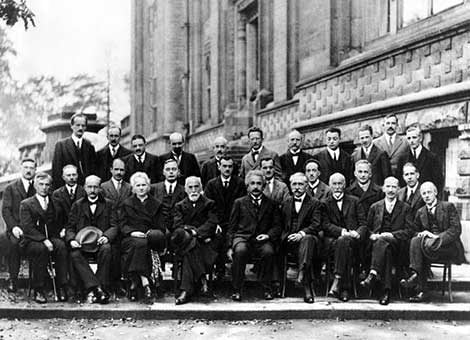
The fifth Solvay International Conference on Electrons and Photons, was held in October 1927. Prominent physicists from all the world met to discuss the newly formulated quantum theory. 17 of the 29 participants were or became Nobel Laureates. Back row, left to right: Auguste Piccard, Émile Henriot, Paul Ehrenfest, Édouard Herzen, Théophile de Donder, Erwin Schrödinger, Jules-Émile Verschaffelt, Wolfgang Pauli, Werner Heisenberg, Ralph Howard Fowler, Léon Brillouin. Middle row, left to right: Peter Debye, Martin Knudsen, William Lawrence Bragg, Hendrik Anthony Kramers, Paul Dirac, Arthur Compton, Louis de Broglie, Max Born, Niels Bohr. Front row, left to right: Irving Langmuir, Max Planck, Marie Skłodowska Curie, Hendrik Lorentz, Albert Einstein, Paul Langevin, Charles-Eugène Guye, Charles Thomson Rees Wilson, Owen Willans Richardson.
Photo: Benjamin Couprie, Institut International de Physique Solvay, Brussels, Belgium. Public domain via Wikimedia Commons

Wolfgang Pauli at 2 years and 8 months. The portrait was taken in December 1902.
Photo: CERN / © L Grillich, Wien.
Wolfgang Pauli – Facts
Award ceremony speech
Presentation Speech by Professor I. Waller, member of the Nobel Committee for Physics, on December 10, 1945
Your Majesty, Royal Highnesses, Ladies and Gentlemen.
Rutherford gave an impulse of fundamental importance to research in atomic structure when in 1911 he found that an essential part of an atom is a positively charged nucleus in which practically the whole of the mass of the atom is concentrated, the electrons, which were discovered earlier, being grouped around the nucleus. During the first two decades following on Rutherford’s discovery, the attention of most atomic physicists was focussed on the phenomena connected with the electronic configuration. According to the theory established by Bohr in 1913, and afterwards developed by him and by other scientists, we may describe those states of the atom for which its energy has a definite value by saying that each electron revolves around the nucleus. The energy corresponding to an electron orbit is defined by whole numbers, called “quantum numbers”, which so to speak enumerate the energy states of the electrons. The famous theory of the atomic structure of all atoms advanced by Bohr in 1921 asserts that the electrons of an atom are arranged in groups which have different mean distances from the nucleus and are each characterized by two quantum numbers.
Important contributions to the solution of the problem of electronic configuration were made in the following years by Landé and Stoner.
At this stage of the development of atomic theory, Wolfgang Pauli made a decisive contribution through his discovery in 1925 of a new law of Nature, the exclusion principle or Pauli principle. The 1945 Nobel Prize in Physics has been awarded to Pauli for this discovery.
Pauli based his investigation on a profound analysis of the experimental and theoretical knowledge in atomic physics at the time. He found that four quantum numbers are in general needed in order to define the energy state of an electron. He then pronounced his principle, which can be expressed by saying that there cannot be more than one electron in each energy state when this state is completely defined. Three quantum numbers only can be related to the revolution of the electron round the nucleus. The necessity of a fourth quantum number proved the existence of interesting properties of the electron.
Other physicists found that these properties may be interpreted by stating that the electron has a “spin”, i.e. that it behaves to some extent as if it were rapidly rotating round an axis through its centre of gravity.
Pauli showed himself that the electronic configuration is made fully intelligible by the exclusion principle, which is therefore essential for the elucidation of the characteristic physical and chemical properties of different elements. Among those important phenomena for the explanation of which
the Pauli principle is indispensable, we mention the electric conductivity of metals and the magnetic properties of matter.
In 1925 and 1926 essential progress of another kind was made in the quantum theory, which is the foundation of atomic physics. New and revolutionary methods were developed for the description of the motion of particles. The fundamental importance of Pauli’s discovery could now be seen more clearly. His principle proved to be an independent and necessary complement to the new quantum theory. Another way of expressing the principle, simpler and of wider applicability than the original one, was given. In this respect Pauli himself made an important contribution which has also had other far-reaching consequences.
During the last two decades atomic research has been more and more focussed on the properties of the atomic nuclei. In this connection it has been even more fully confirmed than before that the Pauli principle must be characterized as a fundamental law of Nature. The principle, first discovered for electrons, has proved to be valid for the nuclei of hydrogen, called protons, and also for the neutrons which are formed in many nuclear reactions. The neutrons are particles which have no charge but have approximately the same masses as the protons. According to present views any atomic nucleus consists of protons and neutrons. The Pauli principle is therefore essential for the description of the properties of atomic nuclei.
Pauli occupies a leading position in present theoretical physics. He has made many other important contributions to different branches of his science, among them several to nuclear physics.
The Royal Swedish Academy of Sciences much regrets that Professor Pauli has not had the opportunity of being present on this occasion to receive in person his Nobel Prize. The prize will now instead be delivered to the chargé d’affaires of the Legation of the United States of America.
Mr. Ravndal. Permit me to request you to receive on behalf of Professor Pauli the Nobel Prize in Physics from the hands of His Majesty.
The Nobel Prize in Physics 1945
Wolfgang Pauli – Biographical
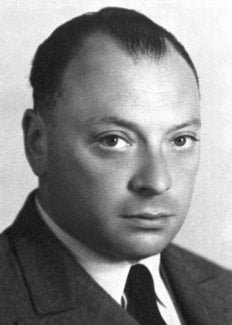
Wolfgang Pauli was born on April 25th, 1900 in Vienna. He received his early education in Vienna before studying at the University of Munich under Arnold Sommerfeld. He obtained his doctor’s degree in 1921 and spent a year at the University of Göttingen as assistant to Max Born and a further year with Niels Bohr at Copenhagen. The years 1923-1928 were spent as a lecturer at the University of Hamburg before his appointment as Professor of Theoretical Physics at the Federal Institute of Technology in Zurich. During 1935-1936, he was visiting Professor at the Institute for Advanced Study, Princeton, New Jersey and he had similar appointments at the University of Michigan (1931 and 1941) and Purdue University (1942). He was elected to the Chair of Theoretical Physics at Princeton in 1940 but he returned to Zurich at the end of World War II.
Pauli was outstanding among the brilliant mid-twentieth century school of physicists. He was recognized as one of the leaders when, barely out of his teens and still a student, he published a masterly exposition of the theory of relativity. His exclusion principle, which is often quoted bearing his name, crystallized the existing knowledge of atomic structure at the time it was postulated and it led to the recognition of the two-valued variable required to characterize the state of an electron. Pauli was the first to recognize the existence of the neutrino, an uncharged and massless particle which carries off energy in radioactive ß-disintegration; this came at the beginning of a great decade, prior to World War II, for his centre of research in theoretical physics at Zurich.
Pauli helped to lay the foundations of the quantum theory of fields and he participated actively in the great advances made in this domain around 1945. Earlier, he had further consolidated field theory by giving proof of the relationship between spin and”statistics” of elementary particles. He has written many articles on problems of theoretical physics, mostly quantum mechanics, in scientific journals of many countries; his Theory of Relativity appears in the Enzyklopaedie der Mathematischen Wissenschaften, Volume 5, Part 2 (1920), his Quantum Theory in Handbuch der Physik, Vol. 23 (1926), and his Principles of Wave Mechanics in Handbuch der Physik, Vol. 24 (1933).
Pauli was a Foreign Member of the Royal Society of London and a member of the Swiss Physical Society, the American Physical Society and the American Association for the Advancement of Science. He was awarded the Lorentz Medal in 1930.
Wolfgang Pauli married Franciska Bertram on April 4th, 1934. He died in Zurich on December 15th, 1958.
This autobiography/biography was written at the time of the award and first published in the book series Les Prix Nobel. It was later edited and republished in Nobel Lectures. To cite this document, always state the source as shown above.