Hideki Yukawa – Photo gallery

Hideki Yukawa with his wife Sumiko and two sons Harumi and Takaaki. Photo taken in November 1949.
Photo: Bettmann /Getty Images
Hideki Yukawa – Nobel Lecture
Nobel Lecture, December 12, 1949
Meson Theory in Its Developments
Read the Nobel Lecture
Pdf 55 kB
Hideki Yukawa – Banquet speech
Hideki Yukawa’s speech at the Nobel Banquet in Stockholm, December 10, 1949
The Nobel-Foundation and the Royal Swedish Academy of Sciences gave a great benefit not only to myself, but also to all the Japanese, because they were all extremely rejoiced by the decision of the Academy and they were very much encouraged by it on their way of reconstruction of Japan as a peaceful and cultural country.
Prior to the speech, Carl Skottsberg, President of the Royal Academy of Sciences, addressed the laureate: “Hideki Yukawa, your brain is your laboratory, paper and pen your instruments. Your speculative mind dwells in the loftiest regions of thinking, where few of us can follow you. Your fellow-workers in atomic research recognize the high intrinsic value of what you have done, and that’s the reason why you are here today, the first Japanese to receive a Nobel prize. You have told us already what this means, not only to you personally, but also to scientific life in Japan, an enlivening stimulation in these days of great distress. We can understand this. And are you not the very best example of the importance of science in bringing nations and races together? Not many years ago Japan and the United States stood against each other, armed to the teeth, bent upon destruction. Today you work happily in the midst of American colleagues.”
Hideki Yukawa – Nominations
Award ceremony speech
Presentation Speech by Professor I. Waller, member of the Nobel Committee for Physics
Royal Highnesses, Ladies and Gentlemen.
For many ages, an important aim of science has been to explain the phenomena we observe by the properties of fundamental particles. In modern physics this problem is of first importance. During the last decade, fundamental particles called “mesons” have turned out to be particularly interesting. The mesons are particles heavier than the electrons but lighter than the nuclei of the hydrogen atoms, i.e. the protons.
The mesons were entirely unknown until Hideki Yukawa in 1934 predicted their existence on the basis of a theoretical investigation of the nuclear forces. This is the achievement which has now been rewarded by the Nobel Prize in Physics.
From earlier research by Heisenberg and others one knew that an atomic nucleus, i.e. the central core of an atom, is composed of protons and of other particles which have the same mass as the protons but no charge. These building elements of the atomic nuclei are called “nucleons” and are held together by the so-called nuclear forces.
Attacking the problem of the nature of the nuclear forces, Yukawa used the electromagnetic field as a model. He found that this field could be modified so as to give forces which like the nuclear forces have a short range. He therefore assumed that the new field corresponds to the nuclear forces. Each field of force is, according to modern theories, associated with some kind of particles. Yukawa discovered that there is a simple relation between the range of the forces and the mass of the corresponding particles. He estimated the range from known experimental data and found that the new particles should be about 200 times heavier than the electrons. The name of mesons for these particles was not introduced until later. According to Yukawa’s theory, the nuclear forces can be traced back to an exchange of mesons between the nucleons. These are continually emitting and absorbing mesons.
Yukawa also studied the important question of whether the mesons can appear outside the nuclei. He found that the mesons can be created during the interaction of nucleons if these can deliver a sufficient amount of energy. Therefore, mesons cannot be created in ordinary nuclear reactions. Yukawa emphasized, however, that they can be expected to appear in the cosmic radiation, in which particles of great energy are found.
Yukawa assumed that mesons can have both positive and negative charge and that the magnitude of the charge is the same as that of the electron. A theory of Fermi, which had been proposed some years earlier, led Yukawa to the assumption, that a meson can be transformed into an electron and a light particle without charge called “neutrino”. As was pointed out later, free mesons could therefore be supposed to exist only for a very short time, some millionth of a second or less.
As Yukawa had suggested, the study of the cosmic radiation gave the first experimental evidence of the existence of mesons. This evidence was given in 1937 by Anderson and Neddermeyer and other American physicists. Since that time, the mesons in the cosmic radiation have been very much studied. These investigations have been guided by the theory of Yukawa. A new period in meson research began about three years ago. The British physicist Powell and his collaborators then found that there exist two kinds of mesons. The mesons of one kind are those found in 1937, whereas the mesons of the other kind are somewhat heavier and different also in other respects. Mesons can now be produced in the large cyclotron in Berkeley, California. This has greatly increased the possibilities of studying them.
These experimental investigations have shown, that the masses of both kinds of mesons agree with Yukawa’s prediction as far as the order of magnitude is concerned. The heavier mesons, but not the lighter ones, have an interaction with the nucleons about as strong as Yukawa had postulated. The fact that particles of this kind have been found experimentally provides a brilliant vindication of Yukawa’s fundamental ideas. The electric charge of both kinds of mesons agree with Yukawa’s prediction. It has also been experimentally confirmed, that the mesons can exist only for a very short time. A heavy meson lives only for about one hundredth of a millionth of a second and is then transformed into a light meson and probably a neutrino. The light meson disappears after a few millionths of a second, and electrons are then created and probably also neutrinos.
After experimental evidence of the existence of mesons had been given the interest in Yukawa’s theory rose quickly. Much effort was expanded in developing the theory and investigating its consequences. In this work Yukawa and his Japanese collaborators took the lead. Among other things, they found theoretically that neutral mesons exist besides the charged ones.
It has not yet been possible to give a theory for the nuclear forces, which yields results that are in good quantitative agreement with the experiments. Yukawa’s theory has, however, led to many important qualitative results about the nuclei. The theory has also proved to be of great value in cosmic-ray research. It was e.g. possible to understand, that mesons can be created in the upper layers of the atmosphere by the primary cosmic radiation falling on the earth.
The research on mesons will probably lead to new discoveries. The meson theory may develop into other forms. By having predicted the existence of the mesons and many of their essential properties Yukawa has accomplished pioneering research of utmost importance. His ideas have proved to be an enormous stimulus to the research in theoretical as well as experimental physics.
Professor Hideki Yukawa. In 1934, when you were only 27 years old, you boldly predicted the existence of new particles, now called “mesons”, which you anticipated to be of fundamental importance for the understanding of the forces acting in the atomic nucleus. Recent experiments have provided brilliant support for your essential ideas. These ideas have been exceedingly fruitful and are a guiding star in present-day theoretical and experimental work on atomic nuclei and on cosmic rays. You have also contributed much to other problems in basic theory and you have played a great role in bringing your country to its very high position in modern physical research.
On behalf of the Royal Swedish Academy of Sciences, I wish to congratulate you on your ingenious work, and I now ask you to receive your Nobel Prize from the hands of His Royal Highness the Crown Prince.
The Nobel Prize in Physics 1949
Hideki Yukawa – Biographical
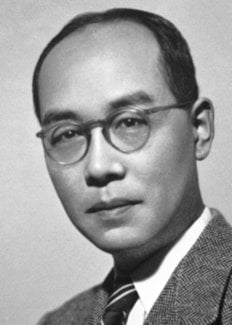
Hideki Yukawa was born in Tokyo, Japan, on 23rd January, 1907, the third son of Takuji Ogawa, who later became Professor of Geology at Kyoto University. The future Laureate was brought up in Kyoto and graduated from the local university in 1929. Since that time he has been engaged on investigations in theoretical physics, particularly in the theory of elementary particles.
Between 1932 and 1939 he was a lecturer at the Kyoto University and lecturer and Assistant Professor at the Osaka University. Yukawa gained the D.Sc. degree in 1938 and from the following year he has been, and still is, Professor of Theoretical Physics at Kyoto University. While at Osaka University, in 1935, he published a paper entitled “On the Interaction of Elementary Particles. I.” (Proc. Phys.-Math. Soc. Japan, 17, p. 48), in which he proposed a new field theory of nuclear forces and predicted the existence of the meson. Encouraged by the discovery by American physicists of one type of meson in cosmic rays, in 1937, he devoted himself to the development of the meson theory, on the basis of his original idea. Since 1947 he has been working mainly on the general theory of elementary particles in connection with the concept of the “non-local” field.
Yukawa was invited as Visiting Professor to the Institute for Advanced Study at Princeton, U.S.A., in 1948, and since July, 1949 he has been Visiting Professor at Columbia University, New York City.
The learned societies of his native land have recognised his ability and he is a member of the Japan Academy, the Physical Society and the Science Council of Japan, and is Emeritus Professor of Osaka University. As Director of the Research Institute for Fundamental Physics in Kyoto University he has his office in the Yukawa Hall, which is named after him. He is also a Foreign Associate of the American National Academy of Sciences and a Fellow of the American Physical Society.
The Imperial Prize of the Japan Academy was awarded to Yukawa in 1940; he received the Decoration of Cultural Merit in 1943, and the crowning award, the Nobel Prize for Physics, in 1949.
A large number of scientific papers have been published by him and many books, including Introduction to Quantum Mechanics (1946) and Introduction to the Theory of Elementary Particles (1948), both in Japanese, have come from his pen. He has edited a journal in English, Progress of Theoretical Physics, since 1946.
An honorary doctorate of the University of Paris and honorary memberships of the Royal Society of Edinburgh, the Indian Academy of Sciences, the International Academy of Philosophy and Sciences, and the Pontificia Academia Scientiarum have marked the recognition he has earned in world scientific circles.
A civic honour was awarded to him when he was created Honorary Citizen of the City of Kyoto, Japan.
In 1932 he married, and he and his wife Sumiko have two sons, Harumi and Takaaki.
This autobiography/biography was written at the time of the award and first published in the book series Les Prix Nobel. It was later edited and republished in Nobel Lectures. To cite this document, always state the source as shown above.
Hideki Yukawa died on September 8, 1981.