Ernest T.S. Walton – Nobel Lecture
Nobel Lecture, December 11, 1951
The Artificial Production of Fast Particles
Read the Nobel Lecture
Pdf 392 kB
Ernest T.S. Walton – Banquet speech
Ernest T.S. Walton’s speech at the Nobel Banquet in Stockholm, December 10, 1951
Your Majesty, Your Royal Highnesses, Your Excellencies, Ladies and Gentlemen,
I wish to thank the Royal Swedish Academy of Sciences very sincerely for the great honour they have done me. It is an honour so great that even yet it is difficult for me to believe that it is true. I have tried to think of any honour which I would prefer to this one and I have failed to do so.
The high esteem in which the Nobel Prizes are held is undoubtedly due to the conscientious way in which the Committees have discharged a heavy responsibility.
I must not weary you by telling you all what this award means to me but will conclude by saying that my wife and I will for ever remember with gratitude and pleasure the great kindness and honour shown to us during this wonderful week in Sweden.
Prior to the speech, Einar Löfstedt, member of the Royal Academy of Sciences, addressed the laureate: “Brilliant, too, is the work that has been carried out in the field of nuclear physics and nuclear chemistry by this year’s four prize-winners. You, Sir John Cockcroft and Professor Walton, have, at an early stage, through your ingenious ideas and experiments, pointed the way to fundamental enlightenment on the structure of atomic nuclei. You have thereby opened up an extremely fruitful field of research, which has since been ardently developed and which at the present day is of greater current interest than ever. No less an authority than Lord Rutherford has said with reference to your work: it is the first step which counts. You have done a real pioneering work, and we are glad to see it crowned, not only by fame, but also by the Nobel Prize.”
John Cockcroft – Nobel Lecture
Nobel Lecture, December 11, 1951
Experiments on the Interaction of High-Speed Nucleons with Atomic Nuclei
Read the Nobel Lecture
Pdf 501 kB
John Cockcroft – Banquet speech
John Cockcroft’s speech at the Nobel Banquet in Stockholm, December 10, 1951
Your Majesty, Your Royal Highnesses, Your Excellencies, Ladies and Gentlemen.
The award of the Nobel Prize is the greatest honour which can come to a member of the scientific world and I hardly need tell you how proud I am and with what sense of exaltation I have come to this great assembly, gathered together to do honour to Arts and Sciences. I have been most happy also to visit this country again, a country which combines in such an outstanding way the highest developments of Science and Technology with the Arts of Living, as we have seen today.
When I look round this great hall I feel that I have been transported into a magical world by the genie of Alfred Nobel. How did it come about that we were chosen to represent Science? I, personally, have been doubly fortunate – first because I have been able to work in the past with some of the great men of the Scientific and Technical world in Britain and particularly with Lord Rutherford, whom you honoured here over 40 years ago, and whom you transformed in a single night from a Physicist into a Chemist, as you have done with Edward MacMillan today. On one side of the Nobel Medal you can see the genie of Science lifting the veil which obscures the Goddess of Nature. I was fortunate in working in the Cavendish Laboratory in the 1930’s when the time was ripe for a further lifting of the veil, since new ideas in theoretical physics combined with the development of technology in physics made possible the many great discoveries of that “annus mirabilis” of 1932. At that time we did not foresee how important the developments in nuclear physics would be for the world and indeed Rutherford, in his last lecture, could not foresee the practical consequences. And yet within a few months of his death the veil was lifted a little further and the enormous power of nuclear forces became apparent. Since that time many people have wished perhaps that the genie and with him the scientist could be put back in the bottle and have blamed science for the troubles of our time. I feel myself that the overwhelming evil and danger comes not from science but from political ideas which reject the freedom of the human spirit and the values and rights of individual human beings. In these difficult times science can be one of the strongest shields of our Western Civilisation. The honour which you have rendered to scientists today will fortify us at a time when more than ever we need understanding.
Prior to the speech, Einar Löfstedt, member of the Royal Academy of Sciences, addressed the laureate: “Brilliant, too, is the work that has been carried out in the field of nuclear physics and nuclear chemistry by this year’s four prize-winners. You, Sir John Cockcroft and Professor Walton, have, at an early stage, through your ingenious ideas and experiments, pointed the way to fundamental enlightenment on the structure of atomic nuclei. You have thereby opened up an extremely fruitful field of research, which has since been ardently developed and which at the present day is of greater current interest than ever. No less an authority than Lord Rutherford has said with reference to your work: it is the first step which counts. You have done a real pioneering work, and we are glad to see it crowned, not only by fame, but also by the Nobel Prize.”
Ernest T.S. Walton – Nominations
John Cockcroft – Nominations
John Cockcroft – Biographical
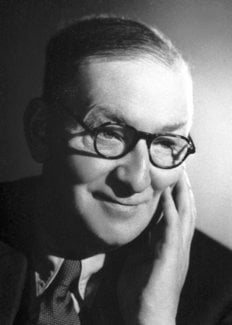
John Douglas Cockcroft was born at Todmorden, England, on May 27th, 1897. His family had for several generations been cotton manufacturers.
He was educated at Todmorden Secondary School and studied mathematics at Manchester University under Horace Lamb in 1914-1915. After serving in the First World War in the Royal Field Artillery he returned to Manchester to study electrical engineering at the College of Technology under Miles Walker. After two years apprenticeship with Metropolitan Vickers Electrical Company he went to St. John’s College, Cambridge, and took the Mathematical Tripos in 1924. He then worked under Lord Rutherford in the Cavendish Laboratory.
He first collaborated with P. Kapitsa in the production of intense magnetic fields and low temperatures. In 1928 he turned to work on the acceleration of protons by high voltages and was soon joined in this work by E.T.S. Walton. In 1932 they succeeded in transmuting lithium and boron by high energy protons. In 1933 artificial radioactivity was produced by protons and a wide variety of transmutations produced by protons and deuterons was studied. In 1934 he took charge of the Royal Society Mond Laboratory in Cambridge.
In 1929 he was elected to a Fellowship in St. John’s College and became successively University demonstrator, lecturer and in 1939 Jacksonian Professor of Natural Philosophy.
In September 1939 he took up a war-time appointment as Assistant Director of Scientific Research in the Ministry of Supply and started to work on the application of radar to coast and air defence problems. He was a member of the Tizard Mission to the United States in the autumn of 1940. After this he was appointed Head of the Air Defence Research and Development Establishment. In 1944 he went to Canada to take charge of the Canadian Atomic Energy project and became Director of the Montreal and Chalk River Laboratories until 1946 when he returned to England as Director of the Atomic Energy Research Establishment, Harwell.
For the period 1954-1959 he was scientific research member of the U.K. Atomic Energy Authority and has since continued this function on a part time basis. Election to Master, Churchill College, Cambridge, followed in October 1959. In addition he is Chancellor of the Australian National University, Canberra, and a past President of the Institute of Physics, the Physical Society (1960 to 1962) and the British Association for the Advancement of Science (1961 to 1963).
He has received honorary doctorates from some 19 universities and is a fellow or honorary member of many of the principal scientific societies. In addition, numerous honours and awards have also been bestowed upon him.
He married Eunice Elizabeth Crabtree in 1925 and has four daughters and a son.
This autobiography/biography was written at the time of the award and first published in the book series Les Prix Nobel. It was later edited and republished in Nobel Lectures. To cite this document, always state the source as shown above.
John Cockcroft died on September 18, 1967.
Ernest T.S. Walton – Other resources
Links to other sites
Award ceremony speech
Presentation Speech by Professor I. Waller, member of the Nobel Committee for Physics
Your Majesties, Royal Highnesses, Ladies and Gentlemen.
By giving the Nobel Prize in Physics of this year to Sir John Cockcroft, Director of the Atomic Energy Research Establishment at Harwell, and Professor Ernest Walton of Dublin University, the Swedish Academy of Sciences has rewarded a discovery which stands out as a milestone in nuclear research.
At the beginning of this century, the study of the naturally radioactive substances had shown that their property of emitting radiation is connected with spontaneous transmutations of their atoms. It appeared, however, to be beyond human power to influence the course of these processes.
The radiation emitted by a radium source contains swiftly moving and positively charged helium atoms. By investigating the way in which these particles are deflected by other atoms, the great nuclear scientist Rutherford found in 1911 that an atom has a positive nucleus which is very small compared to the whole atom but contains most of its mass. Besides the nucleus, the atom contains negative electrons, moving around the nucleus.
Continuing these investigations, Rutherford was able in 1919 to produce transmutations of atomic nuclei by bombarding nitrogen with helium nuclei from a radium source. Some of the helium nuclei had enough energy to overcome the repelling electric field and to penetrate into the nitrogen nucleus, in those rare cases when they struck such a nucleus. The nitrogen nucleus thereupon turned into an oxygen nucleus, while a hydrogen nucleus was emitted.
Thus it became possible by external means to transform nitrogen into oxygen, i.e., to transmute one element into another.
However, only a very few nuclear transmutations could be produced by these natural projectiles, the helium nuclei from radioactive substances. In order to produce nuclear transmutations on a larger scale, and thus obtain further insight into the structure of atomic nuclei, a more powerful stream of projectiles was needed.
Accordingly, the end of the 1920’s saw investigations of the possibility of accelerating charged particles to high energies, with the ultimate aim of using these particles to produce nuclear transmutations. This year’s Nobel Laureates in Physics were the first to succeed in this task, by their joint work at the Cavendish Laboratory in Cambridge, of which Rutherford was at that time the director. In planning this work, they realized the importance of certain contemporary theoretical studies by Gurney and Condon, and by Gamow. This work had shown that, because of the wave properties of matter, there is a certain probability for a positively charged particle to penetrate into a nucleus even if, according to ordinary mechanical concepts, the velocity of the particle does not suffice to overcome the electric repulsion from the nucleus. Cockcroft had emphasized that the conditions are particularly favourable if hydrogen nuclei are used as projectiles, and that an accelerating voltage of only a few hundred thousand volts should suffice to give observable transmutations of light elements.
The work of Cockcroft and Walton was a bold thrust forward into a new domain of research. Great difficulties had to be overcome before they were able to achieve their first successful experiments at the beginning of 1932. By then, they had constructed an apparatus which, by multiplication and rectification of the voltage from a transformer, could produce a nearly constant voltage of about six hundred thousand volts. They had also constructed a discharge tube in which hydrogen nuclei were accelerated. Causing these particles to strike a lithium layer, Cockcroft and Walton observed that helium nuclei were emitted from the lithium. Their interpretation of this phenomenon was that a lithium nucleus into which a hydrogen nucleus has penetrated breaks up into two helium nuclei, which are emitted with high energy, in nearly opposite directions. This interpretation was later fully confirmed.
Thus, for the first time, a nuclear transmutation was produced by means entirely under human control.
In order to get a detectable transmutation of lithium, a voltage of little more than one hundred thousand volts was required. The number of transmutations rose quickly as the voltage was increased. The corroboration obtained in this way for the theory which Gamow and others had propounded, and which was referred to above, was of great importance.
The analysis made by Cockcroft and Walton of the energy relations in a transmutation is of particular interest, because a verification was provided by this analysis for Einstein’s law concerning the equivalence of mass and energy. Energy is liberated in the transmutation of lithium, because the total kinetic energy of the helium nuclei produced is greater than that of the original nuclei. According to Einstein’s law, this gain in energy must be paid for by a corresponding loss in the mass of the atomic nuclei. This assertion was satisfactorily confirmed by Cockcroft and Walton, experimental errors being taken into consideration. Somewhat later, more exact investigations based on the same principles gave a complete verification of Einstein’s law. Thus a powerful method was obtained for comparing masses of atomic nuclei.
In subsequent work, Cockcroft and Walton investigated the transmutations of many other atomic nuclei. Their techniques and results remain a model for nuclear research. As projectiles, they also used the nuclei of heavy hydrogen, which had then just been discovered. As end products, several atomic nuclei were obtained which had not been known previously. Following the discovery of artificially radioactive elements, by Frédéric and Irène Joliot-Curie, they found that such elements can also be produced by irradiation with hydrogen nuclei.
The investigations of Cockcroft and Walton disclosed a new and fertile domain of research, consisting of the study of nuclear transmutations of various types.
Their discoveries initiated a period of rapid development in nuclear physics. Besides the apparatus of Cockcroft and Walton, the cyclotron constructed by Lawrence, and various other particle accelerators played important roles. By its stimulation of new theoretical and experimental advances, the work of Cockcroft and Walton displayed its fundamental importance. Indeed, this work may be said to have introduced a totally new epoch in nuclear research.
Sir John Cockcroft, Professor Ernest Walton. The great nuclear scientist Rutherford, with whose work your discovery is closely connected, sometimes used to say: “it is the first step that counts”. This saying may be applied in the truest sense to your discovery of the transmutations of atomic nuclei by artificially accelerated particles. Indeed, this work of yours opened up a new and fruitful field of research which was eagerly seized upon by scientific workers the world over. It has profoundly influenced the whole subsequent course of nuclear physics. It has been of decisive importance for the achievement of new insight into the properties of atomic nuclei, which could not even have been dreamt of before. Your work thus stands out as a landmark in the history of science.
On behalf of the Royal Swedish Academy of Sciences may I extend to you our warmest congratulations. I now ask you to receive your Nobel Prize from the hands of His Majesty the King.