Murray Gell-Mann – Nominations
Murray Gell-Mann – Interview
Interview transcript
Welcome to this interview, Professor Murray Gell-Mann.
Murray Gell-Mann: Well, thank you.
Actually I don’t know, maybe I could speak Swedish to you, because the story goes that when you got the news about the Nobel Prize in 1969, in October, you prepared your speech in Swedish for the December date when the ceremony was. Is it true?
Murray Gell-Mann: Well, one thing about winning this award is that it increases the number of stories that people make up about you.
Yes? This is one more, yes?
Murray Gell-Mann: This is one more. No, what happened was that when I talked at the banquet, after the awards ceremony, one paragraph was in Swedish.
But you speak lots of languages. How many languages can you speak?
Murray Gell-Mann: Well, that’s not actually true. That’s another story they make up about me. I’m very interested in languages and I know something about the relations among languages, about the entomologies, about sound changes from one language to another and so on and so forth. Very interested in that, and even in helping a little bit to work on it. But as to speaking languages, any European waiter could do much better than I.
OK. You are a physicist.
Murray Gell-Mann: I’m a physicist, and I speak my native language fairly well, American English. I can speak French moderately well, like [INAUDIBLE] and so on, but I do make mistakes now and then. And Spanish, Italian, much weaker, especially the vocabulary. Danish I can speak a little bit. But when I’m in Sweden I try to convert it to Swedish with sometimes with some success and sometimes with much less success.
But you’re interested in languages, I would say …
Murray Gell-Mann: But I can read these, I can read these languages moderately well.
You have found that one word that has got the fame, I would say, and also was named in another prize, and that is quark and quarks. What does that come from?
Murray Gell-Mann: Well, let’s see. In the citation for the award, it was barely mentioned. But I did propose that the neutron and proton and the related barions were composed, roughly speaking, of three quarks each, and that the quarks were the fundamental entities, they are analogous to the electron, and that the neutron, proton and so on were not elementary. The word I had first as a sound, quark. It might have been spelled K W O R K, for example. But then I thought it was the right sound for the fundamental constituents of nuclei. Sounds, sounds good.
Quark.
Murray Gell-Mann: Quark. But then I discovered the Word quark, in Finnegan’s Wake.
Oh, James Joyce, yeah.
Murray Gell-Mann: Right, and with the number three also, and there are roughly speaking three Quarks to a nucleon, or barion, and I thought well, perhaps I could use the spelling there, Q U A R K. So there it is.
Yeah. So we haven’t lived with the Quarks for more than 30 years now, but you have moved your interest from theoretical physicist to broader interest of complexity.
Murray Gell-Mann: Simplicity and complexity, regularities and randomness.
Yes.
Murray Gell-Mann: Yes. And this subject, which I call plectics, the study of the simple and the complex. Includes a good deal that has to do with physics, plectics comes from the common root of the word simple, the word simplicity and the word complexity, without distinguishing, without specifying whether you’re talking about the simple or the complex. I used to work on the simple only. That is the fundamental laws of nature which we believe are fundamentally simple.
Quarks are simple.
Murray Gell-Mann: Right. We see around us a great deal of individuality. We see around us adaptive evolution, as in biological evolution, for example. But also cultural evolution, evolution of ideas and so on and so forth. A great deal of individuality. These are not things that one finds directly in the fundamental laws of physics where, for example, every electron is exactly with every other electron in the universe, and where we believe, at least, that the laws don’t change with time, the fundamental laws are immutable. In fact, some people now have claimed just in the last few months that they have found some evidence that some of the supposed constants of nature are actually changing very slowly, but that’s a, if true, that would be a very slow cosmological effect. But in the world around us we see lots of individuality, and a great deal, a great many kinds of evolution and so on and so forth, and we see a lot of complexity. So where does that come from? And in my book, Quarken och Jaguaren, The Quark and the Jaguar, I discussed this question, but the point is the fundamental laws are simple but they are not deterministic.
Even at the fundamental level they are not deterministic, because of quantum mechanics, but besides that they fail to be deterministic because no observer anywhere in the universe can have access to all the necessary for predicting the future.
You mean deterministic in the …
Murray Gell-Mann: In other words, any observer sees only a coarse grained version of the universe, and the coarse grained state at a given time does not determine the coarse grain state of the next time. Only probabilistically. So we have to look at all the alternative possible histories of the universe as a branching tree of possibilities, with probabilities at the branchings. And the great writer, the Argentine writer, Jorge Luis Borges wrote a story about somebody who made a model of the branching alternative histories of, alternative possible histories of the universe, in the form of a garden of forking paths. El jardin de senderos que se bifurcan. And this, this idea of alternative possible histories of the universe, coarse grained, of course, form a branching tree, means that the history that is actually seen is co-determined by the simple fundamental laws, and by an inconceivably long sequence of accidents or chance events, which can come out in various ways and in advance one can predict only the probabilities of the different outcomes. So there, of course, is the source of complexity. Now, some of these accidents produce a great deal of regularity in the future. And those we can call frozen accidents. Things that at least locally in space and time create new regularities, in addition to the fundamental laws. Now, fundamental physics relates to the basic laws, but the rest of physics and chemistry, and especially other sciences like biology and geology and so on, and observational astronomy and so on, all of these depend a great deal on the accident, not just on the fundamental laws, but on the, all the rest of the information that contributes to the history of the universe.
So how can you make models or series of these histories that are based on accidents?
Murray Gell-Mann: Well, we, the fundamental laws give you the probabilities. But you have to adjoin to that information a lot of information about the accidents that have already occurred, and especially these important ones which we can call frozen accidents which create a great deal of regularity in the future. And by complexity, then, what I call effective complexity, we mean the length of a very concise description of the regularities of something.
If I change the subject for a while, you have travelled to the tropics, and you were also engaged in environmental issues?
Murray Gell-Mann: Yes, very much, in trying to preserve the heritage of biological diversity. I’m also somewhat interested in the preservation of cultural diversity, although that involves a great many more paradoxes and contradictions. But I’ve worked hard on trying to help with the preservation of biological diversity around the world, and of course on land the greatest diversity is found in the tropics, and also the tropics are full of poor and, in many cases, overpopulated countries.
So these are the main obstacles.
Murray Gell-Mann: So what is most important to preserve is in the tropics, at least, on land, and also the dangers are greatest in the tropics, so a lot of our work is concentrated on the tropics. I’ve worked mostly through the John D. and Catherine T. MacArthur Foundation, based in Chicago.
This was maybe not so bad for you to travel, because you are so interested in ornithology.
Murray Gell-Mann: Oh yes, and it was a very great field ornithologist, Ted Parker, who joined me in, over a camp fire, in Venezuela, when we invented the idea of the rapid assessment programme, which has been quite useful in nature conservation. The idea is if a certain tract of land is considered for possible preservation as a national park or whatever, how to evaluate the diversity that is present, and the quality of the environment, to what extent is this a natural area worth preserving. Now, the old fashioned way, of course, of looking at an area, was to have skilled botanists and skilled zoologists of various kinds spend many years cataloguing the various species and their interactions with one another and so on and so forth. The trouble is, by the time you do that the area may not exist any more. So what we did was to champion the notion of having certain very special field biologists, like Ted himself, form teams to go in and rather quickly and approximately to evaluate the diversity and the quality represented by the area.
I have one last question about the birds. What is your dream now that you would like to encounter?
Murray Gell-Mann: Oh, there are many species. I’ve seen less than 4,000 out of 9,600 or something like that. Almost 10,000 species that are recognised in the world. But there are a few special ones that it would be wonderful to see. The Congo peacock, for example.
Which lives in Congo?
Murray Gell-Mann: Yes.
Ah, I see.
Murray Gell-Mann: For a long time nobody could believe there was a peacock in Africa, and …
Nobody has seen it.
Murray Gell-Mann: No outsider, no European, had actually seen one alive until quite recently.
So I hope that you one day will see one.
Murray Gell-Mann: But I saw one in the Regent’s Park Zoo which is probably the only place in the world where you can see a Congo peacock in captivity. But it would be wonderful to see one in the wild.
I hope you will find it. Thank you very much for taking your time with us. Thank you.
Did you find any typos in this text? We would appreciate your assistance in identifying any errors and to let us know. Thank you for taking the time to report the errors by sending us an e-mail.
Murray Gell-Mann – Banquet speech
Murray Gell-Mann’s speech at the Nobel Banquet in Stockholm, December 10, 1969
Your Majesty, Your Royal Highnesses, Your Excellencies, Ladies and Gentlemen:
As a theoretical physicist, I feel at once proud and humble at the thought of the illustrious figures that have preceded me here to receive the greatest of all honors in science, the Nobel prize. I think also of my colleagues in elementary particle theory in many lands, and feel that in some measure I am here as a representative of our small, informal, international fraternity.
We are driven by the usual insatiable curiosity of the scientist, and our work is a delightful game. I am frequently astonished that it so often results in correct predictions of experimental results. How can it be that writing down a few simple and elegant formulae, like short poems governed by strict rules such as those of the sonnet or the waka, can predict universal regularities of Nature? Perhaps we see equations as simple because they are easily expressed in terms of mathematical notation already invented at an earlier stage of development of the science, and thus what appears to us as elegance of description really reflects the interconnectedness of Nature’s laws at different levels.
For me, the study of these laws is inseparable from a love of Nature in all its manifestations. The beauty of the basic laws of natural science, as revealed in the study of particles and of the cosmos, is allied to the litheness of a merganser diving in a pure Swedish lake, or the grace of a dolphin leaving shining trails at night in the Gulf of California, or the loveliness of the ladies assembled at this banquet.
Detta lands folk har visat kärlek och hänsyn till skönheten som den framträder i alla dessa former; i synnerhet kan man gratulera svenskarna till att ha värdesatt och bevarat sitt naturliga arv. Nu lyssnar vi i Förenta Nationerna till Sveriges uppmaning till hela världen att undersöka hur vi alla kan bidra till att bevara och återställa det naturliga tillståndet på var blåa planet, som ser så inbjudande ut fjärran ifrån.
För mig är det ett stort personligt nöje att åter besöka Sverige och att för första gången få besöka dess vänliga huvudstad. På min kära hustru Margarets, min brors, och mina egna vägnar: ett hjärtligt tack for all gästfrihet mot oss. Tack!
Murray Gell-Mann – Nobel Lecture
Nobel Lecture, December 11, 1969
Symmetry and Currents in Particle Physics
[Professor Gell-Mann has presented his Nobel Lecture, but did not submit a manuscript for inclusion in this volume.]
Murray Gell-Mann – Biographical
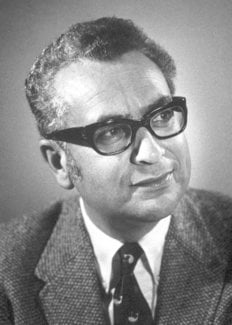
Murray Gell-Mann was born on 15th September 1929, in New York City. He obtained his B.Sc. at Yale University in 1948, and his Ph.D. in 1951 at the Massachusetts Institute of Technology. In 1952 he became a member of the Institute for Advanced Study, during 1952-1953 he was instructor at the University of Chicago, from 1953 to 1954 he was Assistant Professor, in 1954 he was appointed Associate Professor for research on dispersion relations. In this period he developed the strangeness theory and the eightfold way theory. In 1956 he was appointed Professor, his research then turned more to the theory of weak interactions.
In 1959 Professor Gell-Mann was awarded the Dannie Heineman Prize of the American Physical Society. He is a Fellow of this society and a member of the National Academy of Sciences.
Murray Gell-Mann was in 1955 married to J. Margaret Dow; they have a daughter, Elizabeth, and a son, Nicholas.
This autobiography/biography was written at the time of the award and first published in the book series Les Prix Nobel. It was later edited and republished in Nobel Lectures. To cite this document, always state the source as shown above.
Addendum, May 2007
Murray Gell-Mann is one of today’s most prominent scientists. He is currently Distinguished Fellow at the Santa Fe Institute as well as the Robert Andrews Millikan Professor Emeritus at the California Institute of Technology, where he joined the faculty in 1955. In 1969 he received the Nobel Prize in Physics for his work on the theory of elementary particles. He is the author of The Quark and the Jaguar, published in 1994, in which his ideas on simplicity and complexity are presented to a general readership.
Among his contributions to Physics was the “eightfold way” scheme that brought order out of the chaos created by the discovery of some 100 kinds of particles in collisions involving atomic nuclei. Gell-Mann subsequently found that all of those particles, including the neutron and proton, are composed of fundamental building blocks that he named “quarks,” with very unusual properties. That idea has since been fully confirmed by experiment. The quarks are permanently confined by forces coming from the exchange of “gluons.” He and others later constructed the quantum field theory of quarks and gluons, called “quantum chromodynamics,” which seems to account for all the nuclear particles and their strong interactions.
Professor Gell-Mann was a director of the J.D. and C.T. MacArthur Foundation from 1979–2002 and is a board member of the Wildlife Conservation Society. From 1974 to 1988, he was a Citizen Regent of the Smithsonian Institution. He belongs to the National Academy of Sciences, the American Academy of Arts and Sciences, the American Philosophical Society, and the Council on Foreign Relations; he is also a Foreign Member of the Royal Society of London. He was on the U.S. President’s Science Advisory Committee from 1969 to 1972 and the President’s Committee of Advisors on Science and Technology from 1994 to 2001.
In 1988 Professor Gell-Mann was listed on the United Nations Environmental Program’s Roll of Honor for Environmental Achievement (The Global 500). He also shared the 1989 Ettore Majorana “Science for Peace” prize. Earlier, he was given the Ernest O. Lawrence Memorial Award of the Atomic Energy Commission, the Franklin Medal of the Franklin Institute, the Research Corporation Award, and the John J. Carty Medal of the National Academy of Sciences. In 2005 Gell-Mann was awarded the Albert Einstein Medal. He has received honorary degrees from many universities, including Yale, Columbia, the University of Chicago, Cambridge, and Oxford. In 1994 the University of Florida awarded him an honorary degree in Environmental Studies.
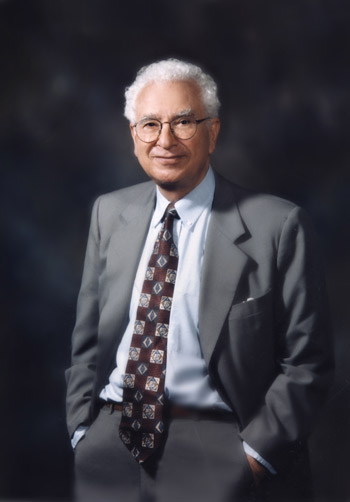
Gell-Mann’s interests extend to historical linguistics, archeology, natural history, the psychology of creative thinking, and other subjects connected with biological and cultural evolution and with learning. Much of his recent research at the Santa Fe Institute has focused on the theory of complex adaptive systems, which brings many of those topics together. Currently Professor Gell-Mann is spearheading the Evolution of Human Languages Program at the Santa Fe Institute. Another focus of his work relates to simplicity, complexity, regularity, and randomness. He is also concerned with how knowledge and understanding are to be extracted from the welter of “information” that can now be transmitted and stored as a result of the digital revolution. Professor Gell-Mann lives in Santa Fe, New Mexico and he teaches from time to time at the University of New Mexico in Albuquerque.
Murray Gell-Mann died on 24 May 2019.
Murray Gell-Mann – Other resources
Links to other sites
MIT Digital Thesis Library – ‘Coupling strength and nuclear reactions’ by Murray Gell-Mann
Videos
Murray Gell-Mann: ‘Beauty, truth and … physics?’ from TED Talks.
Murray Gell-Mann: ‘The ancestor of language’ from TED Talks.
Award ceremony speech
Presentation Speech by Professor Ivar Waller, member of the Nobel Committee for Physics
Your Majesty, Your Royal Highnesses, Ladies and Gentlemen.
Elementary particle physics which is now so vigorous was still in its infancy when Murray Gell-Mann in 1953 published the first of the papers which have been honoured with this years Nobel Prize in physics.
The physicists were, however, already then acquainted with a rather large number of particles which apparently were indivisible and therefore elementary building stones of all matter. The elementary particle known for the longest time was the electron.
New particles were added when the atomic nuclei were explored. It was found that the atomic nuclei consist of positively charged protons and electrically neutral neutrons. These particles are held together in the atomic nuclei by enormously strong forces called nuclear forces which do not distinguish between protons and neutrons. This symmetry of the nuclear forces was expressed by saying that the nuclear forces are charge-independent. A proton and a neutron have further very nearly the same mass. They form a doublet of particles and have been given the common name of nucleons.
An increase already expected and desired occurred in the family of elementary particles at the end of the 1940’s, when new particles called pi-mesons were discovered. They were named mesons because they have a mass between the electron and the nucleon masses. The pi-mesons had been predicted by the Japanese physicist Yukawa. They form a triplet of particules having nearly the same mass but different charges which are + 1, 0 and -1 in units of the proton charge. Their interaction with the nucleons is strong and charge-independent. Their most important task is to be an intermediary agent for the strong interactions between the nucleons.
A very remarkable discovery which marked a new area in particle physics was made by the British physicists Rochester and Butler about the same time. They found new unstable particles which did not fit in with the theoretical ideas developed so far. Some of the new particles are heavier than the nucleons and were grouped together with them under the common name of baryons. The others were lighter than the nucleons but heavier than the electrons and were called K-mesons. The new particles were copiously produced when high-energy pi-mesons collide with nucleons and were therefore assumed to interact strongly with other particles. But they had such a long lifetime that some law must exist which prevent the strong forces to act when they disintegrate into other particles. Gell-Mann discovered this law after some preliminary results had been found by Pais.
It had been assumed earlier that the new baryons from doublets like the nucleons and that the K-mesons form triplets like the pi-mesons. Gell-Mann made the fundamental new assumption that the new baryons instead form a singlet, a triplet and a doublet, the latter being different from the nucleon doublet, and that the new mesons form two kinds of doublets, one consisting of the antiparticles of the other. Gell-Mann assumed further that the principle of charge-independence was generally valid for strong interactions. He could thereby explain the mysterious properties of the new particles. He introduced a new fundamental characteristic of a multiplet called its hypercharge. This is defined as twice the mean value of the charges in the multiplet. Gell-Mann’s proposed the new rule: Elementary particles can be transformed in others by the strong and the electromagnetic interactions only if the total hypercharge is conserved. This rule reminds of the law of conservation of the electric charge. It should be remarked that Gell-Mann initially used instead of the hypercharge a closely related number called the strangeness.
This discovery by Gell-Mann was admirable considering in particular the very meagre experimental material available to him. In the predicted baryon multiplets there occurred empty places. Gell-Mann could on this ground predict two new baryons. One of them was soon discovered but the other not until six years later.
This classification of the elementary particles and their interaction discovered by Gell-Mann has turned out to applicable to all strongly interacting particles found later and these are practically all particles discovered after 1953. His discovery is therefore fundamental in elementary particle physics.
It should be added that two Japanese physicists, Nakano and Nishijima, published a similar classification some months later than Gell-Mann.
Many theoretical physicists tried during the following years to find new symmetries which should give relations between the particle multiplets. Initiated by Sakata a series of papers were published in particular by Japanese physicists. They indicated that a certain kind of symmetry could be of interest. Gell-Mann showed in a new fundamentally important paper of 1961 that this symmetry which had since long been studied in pure mathematics could be used for the classification of all strongly interacting particles. Assuming the validity of the new symmetry which includes the symmetry corresponding to charge-independence, Gell-Mann found that his earlier multiplets could be brought together into larger groups called supermultiplets each containing all baryons or all mesons which have the same spin and the same parity, i. e. have the same measure for their rotation around their axes and are transformed in the same way by reflections. Gell-Mann called this classification “The Eightfold Way”. The nucleons were found to belong to a supermultiplet of eight particles i.e. an octet. For the mesons an octet was proposed were the pi- and K-mesons filled seven places. Because one place was empty a new meson was predicted. Its existence had been suspected already by some of the Japanese physicists mentioned above. It was soon discovered which meant that Gell-Mann’s theory was strongly supported. Still more famous is Gell-Mann’s prediction in 1962 of a new baryon called omega minus.
A similar classification was proposed by Y. Néeman somewhat later than Gell-Mann.
Gell-Mann has also found that “The Eightfold Way” can be described very simply by assuming that all particles which interact strongly with each other are composed of only three kinds of particles which he called quarks and of the corresponding antiparticles. The quarks are peculiar in particular because their charges are fractions of the proton charge which according to all experience up to now is the indivisible elementary charge. It has not yet been possible to find individual quarks although they have been eagerly looked for. Gell-Mann’s idea is none the less of great heuristic value.
And interesting application of “The Eightfold Way” is the so-called current algebra which was founded by Gell-Mann. It has e.g. made evident that there are important connections between the different kinds of elementary particle interactions.
Gell-Mann has given many fundamental contributions to the theory of elementary particles besides those which have been mentioned here. He has during more than a decade been considered as the leading scientist in this field.
Professor Gell-Mann. You have given fundamental contributions to our knowledge of mesons and baryons and their interactions. You have developed new algebraic methods which have led to a far-reaching classification of these particles according to their symmetry properties. The methods introduced by you are among the most powerful tools for further research in particle physics.
On behalf of the Royal Swedish Academy of Science, I congratulate you on your successful work and ask you to receive your Nobel Prize from the hands of His Majesty the King.