David M. Lee – Photo gallery

1 (of 10) David M. Lee receiving his Nobel Prize from His Majesty King Carl XVI Gustaf of Sweden at the Stockholm Concert Hall, 10 December 1996.
Photo from the Lars Åström archive

2 (of 10) All laureates assembled at the Nobel Prize award ceremony in the Stockholm Concert Hall on 10 December 1996. From left: physics laureates David M. Lee, Douglas D. Osheroff and Robert C. Richardson, chemistry laureates Robert F. Curl Jr., Sir Harold W. Kroto and Richard E. Smalley, medicine laureates Peter C. Doherty and Rolf M. Zinkernagel, literature laureate Wislawa Szymborska and economic sciences laureate James A. Mirrlees.
Photo from the Lars Åström archive

3 (of 10) David M. Lee after the Nobel Prize award ceremony at Konserthuset Stockholm on 10 December 1996.
Nobel Foundation. Photo: Lars Åström

4 (of 10) David M. Lee and Sweden's Queen Silvia at the Nobel Banquet, 10 December 1996.
Photo from the Lars Åström archive

5 (of 10) David M. Lee delivering his speech of thanks at the Nobel Prize banquet in the Stockholm City Hall, 10 December 1996.
Photo from the Lars Åström archive

6 (of 10) David M. Lee photographed during Nobel Week in Stockholm, Sweden, December 1996.
Nobel Foundation. Photo: Lars Åström

7 (of 10) David M. Lee, Robert C. Richardson and Douglas D. Osheroff at a press conference at the Royal Swedish Academy of Sciences, 1996.
Photo: Boo Jonsson

8 (of 10) From left: David M. Lee, Robert C. Richardson, Douglas D. Osheroff, Robert F. Curl Jr and Sir Harold Kroto during a press conference in Stockholm, Sweden, December 1996.
Nobel Foundation. Photo: Lars Åström

9 (of 10) Ten Nobel Laureates of 1996 assembled in Stockholm in December 1996. Back row: Sir Harold W. Kroto, Douglas D. Osheroff, Rolf M. Zinkernagel, James A. Mirrlees, Robert F. Curl Jr. and Richard E. Smalley. Front row: Peter C. Doherty, Wisława Szymborska, David M. Lee and Robert C. Richardson.
Photo from the Lars Åström archive

10 (of 10) Nine Nobel Laureates of 1996 assembled in Stockholm in December 1996. Back row: Sir Harold W. Kroto, Rolf M. Zinkernagel, Richard E. Smalley. Peter C. Doherty, Douglas D. Osheroff. Front row: James A. Mirrlees, Robert F. Curl Jr., David M. Lee and Robert C. Richardson.
Nobel Foundation. Photo: Lars Åström
Robert C. Richardson – Photo gallery
1 (of 9) All laureates assembled at the Nobel Prize award ceremony in the Stockholm Concert Hall on 10 December 1996. From left: physics laureates David M. Lee, Douglas D. Osheroff and Robert C. Richardson, chemistry laureates Robert F. Curl Jr., Sir Harold W. Kroto and Richard E. Smalley, medicine laureates Peter C. Doherty and Rolf M. Zinkernagel, literature laureate Wislawa Szymborska and economic sciences laureate James A. Mirrlees.
Photo from the Lars Åström archive
2 (of 9) David M. Lee, Robert C. Richardson and Douglas D. Osheroff at a press conference at the Royal Swedish Academy of Sciences, 1996.
Photo: Boo Jonsson

3 (of 9) Robert C. Richardson at a press cenference, 1996.
Photo: Boo Jonsson
4 (of 9) From left: David M. Lee, Robert C. Richardson, Douglas D. Osheroff, Robert F. Curl Jr and Sir Harold Kroto during a press conference in Stockholm, Sweden, December 1996.
Nobel Foundation. Photo: Lars Åström

5 (of 9) Robert C. Richardson photographed during Nobel Week in Stockholm, Sweden, December 1996.
Nobel Foundation. Photo: Lars Åström

6 (of 9) Douglas D. Osheroff, Robert C. Richardson and David M. Lee photographed during Nobel Week, December 1996.
Nobel Foundation. Photo: Lars Åström
7 (of 9) Ten Nobel Laureates of 1996 assembled in Stockholm in December 1996. Back row: Sir Harold W. Kroto, Douglas D. Osheroff, Rolf M. Zinkernagel, James A. Mirrlees, Robert F. Curl Jr. and Richard E. Smalley. Front row: Peter C. Doherty, Wisława Szymborska, David M. Lee and Robert C. Richardson.
Photo from the Lars Åström archive
8 (of 9) Nine Nobel Laureates of 1996 assembled in Stockholm in December 1996. Back row: Sir Harold W. Kroto, Rolf M. Zinkernagel, Richard E. Smalley. Peter C. Doherty, Douglas D. Osheroff. Front row: James A. Mirrlees, Robert F. Curl Jr., David M. Lee and Robert C. Richardson.
Nobel Foundation. Photo: Lars Åström
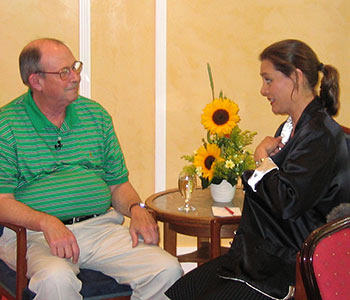
9 (of 9)
Professor Robert C. Richardson with freelance journalist Marika Griehsel during
an interview at the 54th meeting of Nobel Laureates in Lindau,
Germany, 2004.
Copyright © Nobel Media AB 2004
Photo: Jonas Rosén
Douglas D. Osheroff – Other resources
Links to other sites
Douglas D. Osheroff’s page at Stanford University
On Douglas D. Osheroff from the Lindau Mediatheque
‘David Lee, Douglas Osheroff, Superfluidity, and Helium 3’ from DOE R&D Accomplishments
Robert C. Richardson – Other resources
Links to other sites
Obituary from Cornell University
Robert C. Richardson – Nobel Lecture
Nobel Lecture, December 7, 1996
The Pomeranchuk Effect
Read the Nobel Lecture
Pdf 1.78 MB
Robert C. Richardson – Interview
Interview transcript
It’s very nice to have you here with us, professor, I’m very happy.
Robert C. Richardson: Thank you.
I just thought I would start off by asking you … During the banquet, the speech that your co-laureate was holding, Professor David Lee, he said that it was a very exciting time there in the beginning of the 1970s, those months that you were working together on the experiments. How would you describe those days, those months?
Robert C. Richardson: I have to agree with Dave. It was a very, very exciting and surprising. Dave Lee recruited me to go to Cornell to work on experiments that were designed to do something entirely different, but they were related. It was to try to cool liquid and solid helium to very low temperatures and look for a phase transition in solid helium-3, and we were doing these experiments. I came and helped start a part of the program and my speciality was nuclear magnetic resonance. Then we had this fantastic graduate student named Douglas Osheroff that came and took over the project. In the American tradition the graduate student’s hands are the ones that have to do the work and I’m not permitted to take the soldering iron out of the graduate students’ hands. It’s just a joy to interact with Doug. When these unusual and bizarre experimental results came along, we would just stay up sometimes until six in the morning and then I’d have a lecture to give in a class at eight o’clock. I would just be thinking about it and worrying about where it was going and what it meant. In the spring of 1972, I can remember just not feeling tired at all, but just elated because night after night it would be thinking and talking. We had a spectacular aurora borealis in our part of New York in the summer of 1972 and Doug and I would talk about it in the morning as we were going home. Looking up in the sky, it was as though there was some special reward that was coming because of the excitement that we were having in it.
That must have been amazing times. When did you really feel that you had something that you could present and what made you …?
Robert C. Richardson: Almost from the beginning. We of course made a mistake, we identified the result of the experiment because we thought we had found this sought after a phase transition in solid helium-3, where it will be the first example of spontaneous nuclear magnetism. Eventually we did find that too, but we misidentified it and instead we found something that was actually in the catalogue of scientific phenomena, something that was even more interesting and had bigger ramifications.
The working together, the co-working between the three of you, the working together, how important is that do you think to really move on and be creative?
Robert C. Richardson: There are certain areas of science where people work in very, very large teams. In high energy physics there might be hundreds of people because they’re building very big detectors and things. Our work was still manageable, that is there were little pieces of equipment like this that could get made on the lathe by the graduate students themselves and developed techniques for making bellows move and creating magnetic field gradients and so forth. A big team’s not important but having a constant interaction to look back and forth, Yes, let’s do this and Let’s call this that, it really made it fun. I cannot imagine how it would be any fun at all to be working alone. It was more fun in discussion.
I can understand. How did you come up with the idea to become a scientist? Was it something that you wanted right from a small age, or was it something that happened during your student years?
Robert C. Richardson: That’s a very interesting and complicated question. I went to a public school in Virginia in a Washington suburb. It was a very good school. I made pretty good grades. I went to a public college in my state, at Virginia, Virginia Polytechnic Institute. I had a vague thought, I can do these math things, I’ll be an engineer maybe. I started taking engineering and I really found that there was too much repetition in that and my favourite subjects were English literature and history and mathematics, so maybe I’ll be a chemistry major. I started taking chemistry courses, some were required. I was taking one course and I’d made very good grades, without really having to work very hard by the way, in chemistry. I was taking one course called quantitative analysis where you’re supposed to figure out just how much of a certain compound is in a mixture. In order to get the right result, you had to do something called titration where you would release a certain amount, a drop at a time, a colour indicator, phenolphthalein into the solution, and tell exactly when it turned from pink to blue. I’m colour blind and I couldn’t see when it turned from pink to blue. This was in 1955, I guess.
Did you know about that then, or you did find out during this course?
Robert C. Richardson: That I was colour blind?
Yes.
Robert C. Richardson: I had found out, probably suspected it all along, but there’s sort of a self-deception. I have the kind of colour blindness that 12 percent of all Caucasian males have, so it’s not like a black and white tv – this is a beautiful yellow flower right here. I had a colour I called red and one of them called green, but it’s a common defect. I had taken a test to see if I could get a scholarship from the United States Navy, a Navy ROTC scholarship and there I was disqualified because I was colour blind. But anyhow, I fell way behind in this course and I went to the professor and I knew they had a machine that you could put two electrodes in a solution and you could tell when exactly it turned from being acid to base to the nearest drop. I said, Can I use that? He looked at me and said, No, I’m sorry. If you’re colour blind, you should not be a chemist and you should find another career. It was essentially, Tough luck, kid. When I tell chemists about these days they’re horrified.
Then I took physics and I found that it wasn’t very hard. I became very active in student government and student activities and discovered girls and social things. I found that I had time to read and I loved literature. I could without great effort make a B average in physics courses. Now my ambition after graduation was to get a MBA masters in business administration and I had this vision of going to say Harvard and then afterwards being a giant in industry, president of General Motors or something like that. I came along in the days of the conscription in the United States and the college I went to in those days – many of the state universities had requirement that one take the officer training for at least two years – so anyhow I could continue that, and I graduated in 1958. There weren’t any wars going on and the military in the United States had a cut back in funding so they couldn’t afford to have all of their officers go for training for two years or three years. They had an option that you could have six months of active duty for training and then have to be in the reserves for seven years. I opted for that and I had a delay for a year. In those days it was impossible to get a job if they knew that you were going to go off in a year, a permanent job. I stayed for another year and took some more courses, but I really intended after I got out of the army to get a master’s degree in business. When I was in the army they were training me in the ordnance core to run a platoon that would repair tanks and jeeps, which is an important thing for the military to do and have officers that could do that sort of thing. I discovered I really hated the officer training. I didn’t mind wearing a uniform and learning to fire a rifle and the military discipline, that didn’t bother me at all. It was the courses they were teaching me. I thought about it and I said, Look, ever since the days of course wits and in the Kaiser’s army, the best training for people in how to run small businesses has been done by the military and if you don’t like it, this is the wrong career.
You got put off.
Robert C. Richardson: I decided that it wasn’t the fault of the army, it was just my personality. I said, OK, let’s go to graduate school in physics and see what you can do on research. Now unfortunately, I’d burned all my bridges behind me, I couldn’t get off to take the required graduate record exams and so forth. I couldn’t even get advice and I knew that I wouldn’t be able to get into the most difficult and competitive universities. There’s no way that I could have been admitted to Cornell where I’ve been a professor for more than 30 years. I had to pick a topic that is called a niche topic, the one where it seemed very interesting, but it would not be highly competitive and looked for a school where it was a special strong reputation.
But you had tried for Cornell already at that time?
Robert C. Richardson: No, it was just that was one of the ones I looked at. I looked at Harvard and Princeton and Stanford and all those fancy places. At Duke university they had this program in low temperature physics and low temperatures had a lot of appeal for me because it seemed like … It’s like explorers. If you’re one of the first explorers to go to Antarctica, you can have a mountain named after you maybe, and that was going to very low temperatures, that sort of opportunity. They had a very famous theorist named Fritz London and a spectacular experimentalist named William Fairbank, so I would try to go there. I got a warm letter from a very nice man named Horst Meyer who said he would love to have me come work with him and I said, OK, that will be fun and I can see all these great people at Duke. When I got to Duke after I was out of the army I discovered that Fitz London had been dead for five years and Bill Fairbank, the famous experimentalist, had gone to Stanford. But I went to work with Horst Meyer and we became great friends and started a thesis project that made the prediction about this nuclear magnetic phase transition in helium-3 at low temperatures. That was that, that led Dave Lee to come see me and say, Hey, why don’t you come with me and work with me at Cornell and we’ll see if we can do that work?’ Then that led to the work super fluid helium-3, so I had a lot of happy accidents. But if you had ever asked me even when I was in college, Are you going to spend your life as a professor doing research in a very specialised field? I would have said, No, you’re crazy that’s not what I want to do.
Yet you seem very, very happy with this.
Robert C. Richardson: Of course, but what’s the moral is that you ought to think about your life and really pursue what you want. I didn’t expect to make lots of money in that career. It was just something that would be satisfying.
You obviously choose to stay on as a professor. You could have, I’m sure, gone into the industry.
Robert C. Richardson: Yes, but once I had done the PhD research and I was hired as a research associate at Cornell, they kept me on through all the professor ranks; assistant professor, associate professor and full professor. There was no point in that time where I was even remotely tempted to go into industry even though the income could have been greater.
What made you stay on as a teacher?
Robert C. Richardson: Because it was fun. I enjoyed working with the students and had summer programs for high school students and I discovered I was more of a ham actor than I thought. I loved to give these big luxury demonstration courses and make things go pop and sparks and tell corny jokes of the kind of professors tell. The students would politely laugh and maybe even remember them in the future. The whole purpose of the luxury demonstration course is to persuade to seduce the students into thinking that there is something there that might be worth understanding and pursue a little bit further.
It sounds like you chose exactly what you wanted, but yet if you had gone into industry, it might have been more money for you personally, it might have been more money for research, applied research, but you stayed on. Has it been difficult to get money to do research, more basic research at the university? How have you worked on that field?
Robert C. Richardson: The people that especially follow the small group research path have increasingly had to scramble and the competition for the most open-ended research with say the National Science Foundation is very stiff, but roughly only one person in three that writes the proposal gets funded. I think that young people starting up right now have a harder time than I did at the beginning. But generally people say, OK, I have to write three proposals to get one funded, that’s what I’ll do.
Do you encourage them as well to do that if they come and ask your advice?
Robert C. Richardson: We give a lot of advice in mentoring young people. One good trend is a lot more of multi-party, multi-disciplinary research. We have groups of people who get together and think about research in a given topic area and get together and figure out how they can make contributions to the whole and a pattern of research. That’s great fun.
You have written books for young students.
Robert C. Richardson: Yes. There are two books. One is a book and they have remarkable titles. One is called Experimental Techniques In Condensed Matter Physics At Low Temperatures. That one had the help of graduate students that were working with me in a graduate course where I assigned topics to the graduate students and they each wrote a chapter. Then I blended it together and edited, and that did pretty well. I think we might have sold 900 copies of that book, which is still in print. I put a great deal of effort in it. Another project that I became involved in through my wife, is a freshman physics book. Let me tell you about that. Betty also has a PhD in physics. We met at Duke. Our two daughters were born while we were there in graduate work. When we went up to Cornell, she stayed home with the children and after they finished elementary school she went to work in the physics department at Cornell as a lecturer. That’s not a tenure track job, but it’s a course that she became the master of. It’s the introductory course that physics 101 and 102 taken by premedical students and it doesn’t require calculus. One of her collaborators, co-instructor in the course, he’s named Alan Giambattista, started writing a textbook. After a first chapter he turned to a publisher. This is now 1974, I think was when it started. They said, This needs to be a little bit more people friendly. A good friend of ours who was a literary agent went to Betty and said, Why don’t you work with Alan on this? I looked over her shoulder and we had great fun in thinking of different examples. A typical criticism of physics books is that if they’re all sort of masculine things; how fast does a bullet go and how does a baseball work and so forth. In developing this book first Betty and Alan put in lots of biological examples. It was irresistible so I got involved with it and it was supposed to be making a cd-rom that went with it as an instructor’s role to show demonstrations and support that part of the course. Then the Nobel Prize came along and I had other obligations that became sort of overwhelming so I fell far behind on my share of that. But I made up lots of the homework problems and suggestions and wrote parts of the chapters.
I’m sure it was very good.
Robert C. Richardson: Three of us are the authors on it, but it took seven years for that book to come to press and that’s an enormous amount of work. The publisher McGraw Hill spent a million and a half dollars on the development of it, that’s quite an enterprise. But it’s doing pretty well and its first year of sales it had the best sales of any introductory science book that McGraw Hill had done in 20 years.
I’m sure it wasn’t a …
Robert C. Richardson: We’re very happy about that, but it is a real significant endeavour in your life once that’s undertaken. Betty worked 30 hours a week on the average all year around and I would maybe … My help would be on it maybe five hours a week. But Betty and Alan put a lot into it.
That’s great that it’s done so well, and I am sure it was also good for the publishing of the book that you were a Nobel Laureate. Am I wrong? Does it come with certain obligations, expectations to have won the prize?
Robert C. Richardson: Now there is another piece of it too, that I have worked in a very successful graduate school. At almost every major university in the United States there is a former student, maybe not of me but of somebody close to me, that knew me and interacted with me and would be willing to actually ‘Hey, the Richardsons were involved in this book’ and would take a look at it and give a hearing, so that helped too.
Does it come with obligations to have won the prize, to have the prize?
Robert C. Richardson: Some people think so and some not, but I felt I did. I mean I was 59 when I won the prize and I felt that the system, the country, a science report and my university had given me a lot and I’d had a very happy and successful career. I’ve tried to return that now and have participated and I accepted an administrative job at Cornell. I’m the senior research officer at Cornell and I’ve been on a number of panels and boards and science policy groups in the time since then.
To round up this interview I just would like to ask a more personal question. I have read that you are a great fan of the outdoor activities. You were a scout; you like to watch birds. Can you tell us a little bit about that?
Robert C. Richardson: I guess that was the closest part of being involved in science. I was a boy scout and I came along when you had to be 12 to be a boy scout and I became an eagle scout, the highest rank in the minimum time; appointed great pride to my mother who encouraged me. She encouraged me a lot of things. I took piano lessons from the age of six until I graduated from high school. I was not a great pianist, but I enjoyed it. Three summers that I was in high school I had summer jobs in a boy scout camp on the Chesapeake Bay, Camp Roosevelt. I was a nature counsellor and I loved it. My job was to take kids on bird hikes and that part of Maryland on the Chesapeake Bay has a lot of marshes and we’d go on canoe trips and be in the marshes at sunrise in the morning to be able to see the birds. I learned where the birds would be and they became like friends. I learned the birds by their songs and I would point to the top of an oak tree there and I’d say, Do you see that, that’s a red eyed vireo and you can tell the difference between the red eyed and the white eyed vireo. We had binoculars, but you couldn’t see the difference, they have a different colour ring around it. I would then imitate the song and we saw wonderful things. There’s a very famous painting by Audubon, the great naturalist in America, of an osprey, that’s a fish hawk holding a fish between his claws, or just dropping one and an American eagle swooping down on him. One of the tricks that the eagle had to get food was he’d wait for the osprey to catch a fish and then he would swoop down from above and catch it. We saw that.
Fantastic.
Robert C. Richardson: I would tell the story because we saw it, in those days you could see both eagles and ospreys coming out of the cliffs in Maryland. But one morning we actually saw the osprey with the fish and the eagle come down to get it. The other end of the day I would stay up late at night and had an astronomy lesson and I’d point out all the constellations and we’d talk about astronomy. In general science, I certainly enjoyed that a lot.
Is it important to you to be able to combine the two, your love for the nature and your obvious interest in the research and finding out more about what we are doing here on this earth?
Robert C. Richardson: Yes, that’s true. There’s that, that’s part of life and how it fits. If I had come along maybe four or five years later after it was clear what the discovery Watson and Crick had made in DNA, I might have decided to go into biology, but from my point of view at the time I was going to college, biology seemed more like a library science, cataloguing this and that and the other whereas the physical sciences had more clearly defined steps one could take in both research and in the applications.
Just to round off, any advice to young students. Out in the nature and back in to the laboratory very quickly to do the research. What shall they do?
Robert C. Richardson: My advice for young children and parents is to encourage them to be very broad and to have enough of their training in the key courses like mathematics at an early age, so that the options aren’t cut off. A central thing in flexibility and career is learning mathematics and pursuing that and recognising that it’s not just being able to fill out your tax forms and income statements and so forth. A key path in creativity is understanding mathematics and having mathematical training at an early age. Then after that, my recommendation is to find something you like and pursue it with all your heart and have the guts to change when you change your mind.
Great. Thank you so much Professor Richardson. Thank you.
Robert C. Richardson: Thank you.
Very nice to meet you.
Robert C. Richardson: Very nice to meet you too.
Did you find any typos in this text? We would appreciate your assistance in identifying any errors and to let us know. Thank you for taking the time to report the errors by sending us an e-mail.
David M. Lee – Nobel Symposia
Presentation at the Nobel Centennial Symposia, 2001: Condensation and Coherence in Condensed Systems
December 4-7, 2001, Chalmers University of Technology, Göteborg
Impurity-Helium Solids – Quantum Gels?
Read the Presentation
Pdf 3.55 MB
David M. Lee – Other resources
Links to other sites
David M. Lee’s page at Cornell University
‘David Lee, Douglas Osheroff, Superfluidity, and Helium 3’ from DOE R&D Accomplishments
David M. Lee – Banquet speech
David M. Lee’s speech at the Nobel Banquet, December 10, 1996
Majesties, Your Royal Highness, Ladies and Gentlemen,
It has been a great pleasure to have participated in an exciting journey of discovery with my friends and colleagues, Douglas Osheroff and Robert Richardson. I speak on behalf of the three of us in expressing our deep gratitude to the Nobel Committee for selecting us to share the 1996 Nobel Prize in Physics.
The discovery of superfluid 3He took place over a seven month period. It is difficult to imagine a more stimulating time as more and more phenomena were revealed on an almost daily basis. I fervently wish that every young scientist could experience this at some time in his or her career.
There are surely more exciting discoveries ahead. It has lately become fashionable for the doomsayers to predict that we shall soon know everything we can know and need to know, and that the demise of science is imminent. I take issue with this view. In the words of the famous American author, Mark Twain, “The reports of my death are greatly exaggerated”. The same can be said for science.
We live in an age when we all enjoy the benefits of science and technology. We mindlessly turn on our television sets and computers, forgetting all of the complex electronics inside, based on the transistor. We make use of the benefits bestowed to medical science by the discovery of DNA, X rays and magnetic resonance. All of these and other essential ingredients of modern living are based on Nobel Prize winning discoveries. Basic science provides long-term benefits for ourselves and our fragile planet and should be supported by all the world’s societies. When the famous British physicist Michael Faraday was asked by Prime Minister Gladstone what his researches on electricity and magnetism were good for, he replied, “Some day, Sir, you will tax it”.
In the past few weeks we have received letters from friends in the low temperature physics community which have expressed pride that a discovery in our field would be given this recognition. We are delighted that they share our joys and once again, on behalf of the three of us, I thank the Nobel Foundation and the Royal Swedish Academy of Sciences for this honor.
David M. Lee – Nobel Lecture
Nobel Lecture, December 7, 1996
The Extraordinary Phases of Liquid 3He
Read the Nobel Lecture
Pdf 3.54 MB