William F. Sharpe – Photo gallery

William F. Sharpe receiving his prize from H.M. King Carl XVI Gustaf of Sweden at Konserthuset Stockholm on 10 December 1990.
Nobel Foundation. Photo: Lars Åström

William F. Sharpe after receiving his prize from H.M. King Carl XVI Gustaf of Sweden at Konserthuset Stockholm on 10 December 1990.
Nobel Foundation. Photo: Lars Åström

All 1990 Nobel Prize laureates assembled on stage at the Nobel Prize award ceremony in Stockholm, Sweden on 10 December 1990: physics laureates Jerome I. Friedman, Henry W. Kendall and Richard E. Taylor, Chemistry laureate Elias James Corey, medicine laureates Joseph E. Murray and E. Donnall Thomas, literature laureate Octavio Paz and economic sciences laureates Harry M. Markowitz, Merton H. Miller and William F. Sharpe.
Nobel Foundation. Photo: Lars Åström

William F. Sharpe at the Nobel Banquet at the Stockholm City Hall, 10 December 1990.
Nobel Foundation. Photo: Lars Åström

William F. Sharpe photographed during Nobel Week in Stockholm, Sweden, December 1990.
Nobel Foundation. Photo: Lars Åström

William F. Sharpe delivering his prize lecture on 7 December 1990.
Nobel Foundation. Photo: Lars Åström

William F. Sharpe during during Nobel Week in Stockholm, Sweden, December 1990.
Nobel Foundation. Photo: Lars Åström
William F. Sharpe – Biographical
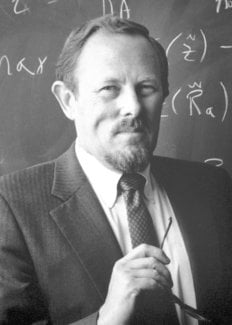
I was born on June 16, 1934 in Boston, Massachusetts. At that time my parents had completed their undergraduate educations – my father in English literature, my mother in science. My father was then employed at Harvard University, working in the placement office.
In 1940, world events led to the activation of my father’s National Guard unit and a move to Texas. The subsequent outbreak of World War II required further moves to northern California and finally to southern California.
The majority of my pre-college education was completed in the public schools of Riverside, California, which were excellent. I benefitted there from stimulating teachers and challenging curricula.
In 1951 I enrolled at the University of California at Berkeley, with a plan to major in science en route to a medical degree. A year of the associated courses convinced me that my preferences lay elsewhere. To change both curriculum and locale I transferred to the University of California at Los Angeles with a declared major in Business Administration.
In my first semester at UCLA I took Accounting and Economics–two courses that were required for the Business degree. Both had a major influence on my career. The accounting course dealt primarily with bookkeeping, while the economics course focused on microeconomic theory. I found bookkeeping tedious and light on intellectual content. But I was greatly attracted to the rigor and relevance of microeconomic theory. Hence, I changed my major to Economics. I have since learned to appreciate Accounting on both pragmatic and intellectual grounds, but am delighted that my first brush with it helped turn me towards the field in which I have worked happily throughout my professional life.
I took two degrees in Economics at UCLA before serving in the Army. I received the Bachelor of Arts degree in 1955 and the Master of Arts degree in 1956. While working for the former I was named to Phi Beta Kappa.
Two professors at UCLA had a profound influence on my career.
I was fortunate to serve as a research assistant for J. Fred Weston, a professor of finance in the Business School, and also to take courses from him. Fred first introduced me to the work of Harry Markowitz and to the rest of the challenging and rigorous research that was beginning to revolutionize finance. As part of my PhD program I was subsequently able to take a field in finance with Fred, greatly broadening my understanding of the subject.
Armen Alchian, a professor of economics, was my role model at UCLA. He taught his students to question everything; to always begin an analysis with first principles; to concentrate on essential elements and abstract from secondary ones; and to play devil’s advocate with one’s own ideas. In his classes we were able to watch a first-rate mind work on a host of fascinating problems. I have attempted to emulate his approach to research ever since. When I returned to pursue the PhD degree, I took a field in microeconomics with Armen and he also served as chairman of my dissertation committee.
After a short period in the Army, I joined the RAND Corporation in 1956 as an Economist. RAND was an almost ideal place for anyone interested in performing research that was both aesthetically pleasing and also pragmatic. During this period path-breaking work in computer science, game theory, linear programming, dynamic programming and applied economics was being done at RAND, both by permanent staff and visitors from major universities. The atmosphere was collegial and the schedule flexible. Most research projects were chosen by the investigators, and additional work on more fundamental issues was encouraged and generously supported. Among other things, I learned computer programming at RAND. Professional editors and colleagues also helped me improve my communication skills, both written and oral.
While at RAND I pursued a PhD degree in Economics at UCLA. I received the degree in 1961. After completing my field examinations in 1960 I began work on a dissertation concerning the economics of transfer prices. At the suggestion of Armen Alchian, my preliminary results were reviewed by another faculty member who had previously done research on the subject. He thought that I should consider some other topic. Fred Weston suggested that I might see if Harry Markowitz, who was then at RAND, had any ideas. He had, and I proceeded to work closely with him on the topic Portfolio Analysis Based on a Simplified Model of the Relationships Among Securities. Although Harry was not on my committee, he filled a role similar to that of dissertation advisor. My debt to him is truly enormous. The dissertation was approved in 1961, at which time I received the PhD degree.
In the dissertation I explored a number of aspects of portfolio analysis based on a model first suggested by Markowitz. At the time I called it the “single index model”, although it is now generally termed a “one-factor model”. Key is the assumption that security returns are related to each other solely through responses to one common factor. In the dissertation I addressed both normative and positive results. The final chapter, A Positive Theory of Security Market Behavior, included a result similar to that now termed the security market line relationship of the Capital Asset Pricing Model, but was obtained in the limited environment in which returns are generated by a one-factor model.
In 1961 I moved to Seattle to take a position in Finance at the School of Business at the University of Washington. Once settled, I prepared a paper summarizing the normative results from my dissertation; the paper was subsequently published in Management Science in 1963. More importantly, I began work on a generalization of the equilibrium theory contained in the final chapter of the dissertation. By the fall of 1961 I had discovered that a very similar set of results could be obtained without making any assumptions about the number of factors influencing security returns. I first presented this approach at the University of Chicago in January 1962. Shortly thereafter I submitted a paper on the subject to the Journal of Finance. An initially negative report from a referee plus a change in editorship delayed publication until September of 1964. Both in content and title, this paper provided much of the basis for what is now termed the Capital Asset Pricing Model (CAPM).
The CAPM is built using an approach. familiar to every microeconomist. First, one assumes some sort of maximizing behavior on the part of participants in a market; then one investigates the equilibrium conditions under which such markets will clear. Since Markowitz had provided a model for the requisite maximizing behavior, it is not surprising that I was not alone in exploring its implications for market equilibrium. Sometime in 1963, I received an unpublished paper from Jack Treynor containing somewhat similar conclusions. In 1965, John Lintner published his important paper with very similar results. Later, Jan Mossin published a version that obtained the same relationships in a more general setting.
I was at the University of Washington from 1961 through 1968, with the exception of a year spent on leave at RAND. At Washington I taught a wide-ranging set of subjects, covering material from the fields of microeconomics, finance, computer science, statistics, and operations research. As is so often the case, I found that the best way to learn a subject was to teach it. Hopefully, the students did not suffer overmuch from their participation in the process.
My research during this period was as eclectic as my teaching. I worked on extensions of the CAPM and empirical tests of its implications. I also published books on the economics of computers (based on research supported by RAND) and on computer programming.
My years at Washington were busy but highly productive. While I relied heavily on colleagues at RAND and at other universities during this period, I was fortunate to have interested and supportive colleagues in Seattle–most importantly, George Brabb, Stephen Archer and Charles D’Ambrosio.
In 1968, I moved to the University of California at Irvine to participate in an experiment involving the creation of a School of Social Sciences with an interdisciplinary and quantitative focus. For various reasons the expectations of many who participated in the experiment were not fulfilled, leading some of us to go elsewhere. I was fortunate to be invited to take a position at the Stanford University Graduate School of Business, to which I moved in 1970. Before doing so, however, I completed a book, Portfolio Theory and Capital Markets , summarizing both normative and positive work in these areas.
My years at Stanford have been all that anyone with interests in both research and teaching could have desired. Throughout, I have had the benefit of stimulating colleagues and students. Much of my knowledge of finance was gained when I participated in a team of three, teaching the first PhD seminar in the field at Stanford in the early 1970’s. Alan Kraus, Bob Litzenberger and I shared not only our experience and knowledge but also an interest in sailing–a sport in which we indulged fairly frequently.
I also learned a great deal from two colleagues, now departed, in the 1970’s. Alex Robichek combined a traditionalist’s view of finance with a thirst for new ideas; Paul Cootner came to the field with totally fresh and innovative views. Both placed a premium on useful theory. Both contributed much, through research and teaching. Their premature deaths caused a tremendous loss for the field of finance, for Stanford and for me.
Other finance colleagues, presently or formerly at Stanford, from whom I learned much include Anat Admati, Doug Breeden, John Cox, Darrell Duffie, Allan Kleidon, Mike Gibbons, Jack McDonald, George Parker, Paul Pfleiderer, Myron Scholes, and Jim Van Home. Finance students with whom I worked closely included Marcus Bogue, Guy Cooper, Krishna Ramaswamy, and Howard Sosin.
In 1973 I was named the Timken Professor of Finance at Stanford.
In the 1970s I concentrated most of my research effort on issues connected with equilibrium in capital markets and the implications thereof for investors’ portfolio choices. Following the passage of key legislation in the U.S. in 1974, I began to study the role of investment policy for funds designed to fulfill pension obligations. I also wrote a textbook, Investments, designed to include institutional, theoretical and empirical material in a form accessible to students in undergraduate and graduate programs. The first edition, published in 1978, met with considerable success. The book, now co-authored by Gordon Alexander, is currently in its fourth edition. I am especially gratified by the fact that a number of universities still consider it appropriate for its intended purpose. A variant, Fundamentals of Investments, also coauthored with Gordon Alexander, published in 1989, has also been well received.
In the course of preparing and revising the Investments text, I found it necessary to extend prior theory, create new theory, and perform new empirical analyses. Perhaps the most fruitful example of this activity is the creation of the binomial option pricing procedure, first published in the 1978 edition of Investments. It provides a discrete-state analogue of the Black-Scholes procedure which assumes a continuous time setting. Given today’s computer power, the binomial procedure offers a practical method for evaluating instruments with complex embedded options, and is widely-used.
During this period I served as a consultant first to Merrill Lynch, Pierce, Fenner and Smith and then to Wells Fargo Investment Advisors. In each case my goal was to help put into practice some of the ideas of financial economics.
At Merrill Lynch I was involved primarily in designing services for estimating beta values on a continuing basis for a large set of common stocks and for providing risk-adjusted portfolio performance measurement.
At Wells Fargo I helped with the creation of index funds, passive portfolios tailored to meet investor objectives, estimation of Security Market Lines (and Planes) using forecasts of future cash flows, assessment of portfolio risk, choice of optimal portfolios to track selected indices, and so on. In my opinion, the people at Wells Fargo at the time were among the most creative and innovative in the industry. From them I learned much about the real world of investment. Such knowledge informed my teaching and research in countless ways. Undoubtedly, my greatest debt in this connection is to Bill Fouse, whose vision made Wells Fargo such an exciting and stimulating organization at the time.
I spent the 1976-1977 academic year at the National Bureau of Economic Research as a member of a team studying issues of bank capital adequacy under the direction of Sherman Maisel. My focus was on the relationship between deposit insurance and default risk. The results, published in the Journal of Financial and Quantitative Analysis in 1978, supported the notion of risk-based insurance premia. Empirical work with Laurie Goodman also showed that market values of securities of financial institutions can reveal important information about capital adequacy. The NBER project strongly advocated greater concern with the risk of financial institutions and warned that a system of fixed insurance rates and de facto unlimited coverage with imperfect monitoring and enforcement procedures provides dangerous incentives for those running such institutions to take excessive risk. Would that our results had been heeded by those concerned with savings and loan institutions in the United States in the subsequent decade!
In the latter part of the 1970s I developed a simple yet effective method for finding approximate solutions to a class of portfolio analysis problems. The procedure, described in a Stanford working paper and in my textbook, has been widely implemented, although final publication of the paper describing the algorithm was delayed until 1987, due to confusion at a journal that had planned to publish it.
In 1980 I was elected President of the American Finance Association. I chose as the topic of my Presidential Address, Decentralized Investment Management. My goal was to provide some structure for analyzing the widespread custom of large institutional investors to divide funds among a number of professional investment managers. The subject is interesting both theoretically and practically, and my work on it continues.
In the 1980s I continued to work on issues relating to pension plan investment policy. A theoretical paper on the subject with J. Michael Harrison was completed in 1983. I also became interested in the return-generating process in the U.S. equity market, a subject pioneered by Barr Rosenberg, then at the University of California at Berkeley. This led to an empirical paper on factors in New York Stock Exchange security returns, published in 1982. I also began to focus much of my effort on asset allocation – the allocation of an investor’s funds among major asset classes. To make both the ideas and the technology more widely available, I prepared a package that included a book, optimization software and databases, under the title, Asset Allocation Tools. First published in 1985, it is now offered both by the original publisher and by Ibbotson Associates in conjunction with their much larger set of databases.
In 1983, I helped Stanford establish a program in international investment Management, offered jointly, initially, with the International Management Institute in Geneva, and later, with the London Graduate School of Business. The program, extending over a week, is designed for senior investment professionals wishing to obtain a thorough grounding in financial economic theory and the associated empirical research. I served as Co-Director of the program through 1986 and have participated in subsequent years. Independently, I also helped create a three-week program for the Nomura School of Advanced Management, designed to bring much of the same material to investment professionals in Japan, and taught in the program for five years. I also assisted Sidney Cottle, of Financial Research Associates, in preparing seminars designed to communicate the results of recent research to investment practitioners.
In 1986, I took a two-year leave from Stanford to found Sharpe-Russell Research, a firm chartered to perform research and to develop procedures to help pensions, endowments and foundations select asset allocations appropriate to their circumstances and objectives. Supported by several major pension funds and by the Frank Russell Company, and assisted by a talented group of professionals, I was able to bring previous results from the field of financial economics to bear on these important issues and to provide new theoretical and empirical material of relevance. Subsequent to this period, the firm’s charter was broadened to include consulting for pensions, endowments and foundations in the area of asset allocation. Published work resulting from these activities covered the areas of integrated asset allocation, dynamic strategies for asset allocation, factor models for evaluating manager styles and performance, and liability hedging.
In 1989, I chose to change status, becoming Timken Professor Emeritus of Finance at Stanford, in order to devote more of my time to research and consulting activities at William F. Sharpe Associates, as my firm is now known. While this involves giving up regular teaching, I have the great fortune to be able to continue to participate in the intellectual life of the school. In addition, I can pursue research with a fine group of colleagues and to provide assistance to (and learn from) a highly sophisticated group of clients.
It has been my great good luck to be able to work with a number of organizations in the investment industry. I served as a Trustee of the College Retirement Equities Fund from 1975 through 1983 and currently serve a trustee for the Research Foundation of the Institute of Chartered Financial Analysts, a committee member for the Institute of Quantitative Research in Finance, and a member of the Council on Education and Research of the Institute of Chartered Financial Analysts. I also serve as a Strategic Advisor for Nikko Securities’ Institute of Investment Technology and the Institutional Portfolio Management division of the Union Bank of Switzerland.
I have also received awards from diverse constituencies. I am especially proud to have been the recipient of the American Assembly of Collegiate Schools of Business award for outstanding contribution to the field of business education in 1980 and the Financial Analysts’ Federation Nicholas Molodovsky Award for outstanding contributions to the [finance] profession in 1989.
In the course of this long and demanding career, I have enjoyed the influence and example of my parents and step-parents, all of whom pursued further education in mid-career. My father retired as a college president, my mother as an elementary school principal, and my step-father as a public defender. They taught me by example the joys associated with learning and with communicating the results of that learning to others.
I am also fortunate to have two fine children, Deborah and Jonathan, now grown. Both share a love of learning and of communicating knowledge to others, although they have chosen fields far removed from my own. In 1986 I married my wife Kathryn, an accomplished painter, who shares both my personal and my professional life – the latter in her capacity as Administrator of William F. Sharpe Associates. Without her help, encouragement, and support I truly could not have accomplished what I have in the last five years. We enjoy sailing, opera and Stanford football and basketball games, especially when the weather is good, the music well performed and the opponents vanquished.
This autobiography/biography was written at the time of the award and later published in the book series Les Prix Nobel/ Nobel Lectures/The Nobel Prizes. The information is sometimes updated with an addendum submitted by the Laureate.
William F. Sharpe – Other resources
Links to other sites
William F. Sharpe’s personal homepage at Stanford University
William F. Sharpe’s page at Stanford Graduate School of Business
William F. Sharpe – Prize Lecture
Lecture to the memory of Alfred Nobel, December 7, 1990
Capital Asset Prices
with and without Negative Holding
Read the Lecture
Pdf 324 kB
William F. Sharpe – Interview
Interview transcript
Professor William Sharpe, most welcome to this interview.
William F. Sharpe: Thank you very much; it’s a delight to be here.
Very pleased to see you here. How did you react that morning, I think it would have been, when they called you and said that you had been awarded the Economic Prize in Memory of Alfred Nobel?
William F. Sharpe: Well, it was eventful. My wife and I were at a conference in Arizona and the phone rang about four o’clock in the morning, and by coincidence there had been some chap, in Belgium I believe, who was trying to get me to speak at a conference or something, and he’d been calling at very strange times, and so my first reaction when I first heard someone on the other end of the line was that it was this guy from Belgium. And then, you know, I was immediately reassured, and so I was pretty sure … and then, of course, your second thought is it’s a hoax, one of your friends or colleagues, and so I was 99% sure it was real.
After we’d finished the chat we turned on CNN and within about five minutes the first announcement came across, and it had many inaccuracies in terms of there were three of us, but nonetheless there was enough there that we were pretty sure that it was real. So needless to say we were both elated and we ordered room service and sat on the balcony looking at the sun coming up across the desert before everything broke loose and became crazy. But it was … and then I had not even been paying attention to the fact that this was the date for the announcement, so it was very much a surprise, a very welcome one.
Any particular memory from the celebration in Stockholm that you would like to share with us?
William F. Sharpe: Yes, we took an extended family, and my father was not well, but all of his doctors gathered together to find ways to get him there and in good health, and he absolutely revelled in it. He marvelled about everything, and as it turned out there were 11 in our party ultimately, and it turned out all of us got colds and were sick to varying degrees, except my father who went strong the entire time through and just had the time of his life, as did all of us, it was truly magical, there’s no other word for it.
In which way has it changed your life, if it has, professionally? Privately? After the award?
 The standards are so much higher because of the prize …
William F. Sharpe: I think there’s a period, and talking to others I think this happens a lot, in which you almost are unable to function because you feel that people expect so much, you know, out of the next paper. The standards are so much higher because of the prize that it’s almost impossible to write a paper and feel it’s good enough to submit for a publication, so there’s some of that. One gets over that. You certainly, especially in financial economics where there is a tie to the real world and to the world of commerce, you tend to get invited to, you know, ever so many lectures or talks or whatever you want to call them, and you have to have the good sense to limit that and to get back to work if you will. So it’s difficult, there’s no danger of being lionised by your colleagues, because your colleagues know exactly who you are, so that doesn’t change at all.
And so I think it’s basically trying to determine what balance you’re going to strike between, you know, among the things that you’ve always done. Some people feel that they have a /- – -/ and that they should use the position to go out and try to effect policy. Some, to some extent, commercialise it, you know, or take commercial advantage, let me say, of the position, but I think the majority of prize winners try to keep doing pretty much what they’ve been doing, with probably more focus on things that are for the public good perhaps, than they might have put otherwise.
Have you felt that you had to kind of use this award in a way that would benefit more people?
William F. Sharpe: My research had been moving towards … My research has always had a substantial, pragmatic aspect towards helping people make sensible investment decisions, trying to understand the determination of asset prices and helping people then understand that and then make good decisions. Conditional on that, and I’d been focused heavily on institutional decision making by large pension funds for example, because that was the major vehicle, public and private pension funds. That was the major vehicle for saving and investment and sort of life time consumption planning, if you will. Up to the early 1990’s, but then as the shift accelerated towards putting more onus on the individual to make saving and investment decisions for retirement. I wanted to turn my research in that direction because there was going to be a huge need to help individuals do it right and sensibly. So that was the direction my research would have taken in any event. And it seemed to me then and it seems to me even more so now that that’s an area in which financial economics has to really help people.
In the Western World particularly? Or right across the board do you think?
William F. Sharpe. Well certainly in the Western developed world and many in the, you know, in the middle ground, I mean the Mexico’s and Chile’s of the world, in the countries that are really just beginning to develop, who are probably quite a way from that, but you’re certainly starting to see this as an issue in China for example. But then where you will in the process, so I think just increasingly that’s, rightly or wrongly, you know, the social programmes are covering a certain level, but even the social programmes, in Sweden for example, are now adding a substantial amount of decision making on the part of the individual.
Which has been very difficult for many individuals to accept, I think.
William F. Sharpe: I’m absolutely certain and there are some very serious issues as to how much latitude you want to give people, at least for a minimalist level of protection, there are some very, very important social issues, yes.
Do you think we are at some kind of turning point there? I mean with the Western World and governments in the Western World has to rethink?
… we need to figure out an appropriate way to share risk across those generations …William F. Sharpe: I think it needs to be thought through much more carefully. My belief is that the driving force is the demographic shift towards so many more older people per younger person, basically, in so many of our countries, and we need to figure out an appropriate way to share risk across those generations and of course within the generations as well, and I don’t think we’re anywhere near the point of having understood or thought through, especially at a political level, what the trade offs are. And so I think far more needs to be done to inform public policy, but there’s a lot of fundamental, financial, economics work to be done as well.
In the meantime they need to try to take what we think we understand about asset prices and bring it to bear on the decisions that individuals are making and are increasingly making and help them one way or the other to make those decisions intelligently.
It’s a fascinating field and so much still to be done, I would like to come back to that a little bit further down in our interview, but as a child, were you thinking that you would go into this field? I know that you like sailing for example, I don’t know whether that was later in your life, but as a child were you interested in maths, for example?
William F. Sharpe: No, well I mean, you know, if you go straight through high school as I was, I enjoyed the technical courses, chemistry and physics and mathematics to an extent. My mother wanted me to be a doctor, so I started out in college in a pre-medical programme, didn’t like chemistry in college, for whatever reason, and shifted to a business major, knowing nothing about business majors or business for that matter. My parents had both been educators, and so the first course I took was the required beginning economics course and until my sophomore year I didn’t know anything about economics, economics was not in the high school curriculum in California in my day, and I loved this course, you know, I loved …
Why?
William F. Sharpe: I loved the beauty of it, I loved the logic of the theory, I loved the practical aspects of it and it just, I just really enjoyed it, and I thought, well, I don’t really know what economists do, I suppose I’ll work for a government or something, but I had to take more of this, so I switched to an economics major. And never looked back.
I can understand that it must be fascinating. The other thing that you did was also to … you were early going into computers and learning about computer programming. Did you at that time foresee in which way we would be depending on computers, particularly in the financial field?
William F. Sharpe: Absolutely not no. Again, I think, I went into computer programming partly out of necessity, but I was at a very exciting place in RAND corporation, where some of the most important early work on the computer programming and computer software, if you will, and algorithms was being done. And I’d learned programming both to help me in my own research so I could do my own research processing, but also it was, sort of, like the economics experience. I just loved the logic and the practicality of it and the fact that, you know, it’s very Pavlovian in that you do something here and then you get an immediate response to the stimulus, so you get rewarded very, very quickly if you do it right. So how much of it, my interest in programming, was pragmatic and how much was just, you know, liking the logic and the practicality of it, I can’t tell you, but I continue to programme to this day, many, many hours. Again, it’s very rewarding.
And the financial market, I mean, we can sit anywhere in the world and do huge transactions or small transactions, does it scare you or is it a useful tool in today’s financial market?
William F. Sharpe: I would say “yes” to both questions. It’s frightening, on the other hand it’s extremely useful, and there’s so much we can do to allocate risk officially across regions, across individuals, across institutions. But with that comes danger. You have to learn how to use the tools and you have to build the institutions that can at least minimise, never probably avoid, the risks associated with people making honest mistakes and people doing dishonest things, because both happen. And they’re very, very powerful incentives in the financial world to do things dishonestly, and so it’s very dangerous, but it’s such a force for good if used appropriately, that I think we’ve just got to find a way to minimise the bad things and be able to enjoy the good aspects.
I’ve just read that during your student days everything must be questioned, that was one advice that you were given, everything has to be questioned, every …
William F. Sharpe: Armen Alchian. My mentor, yes.
Every theory that you’re coming up with you should be your own devil’s advocate … Have you continued to have that, brought that with you in your daily life?
Question not only everybody else’s work, but question your own work …William F. Sharpe: Yes indeed. Because of the jetlag I was awake for several hours last night and working on some theory that I’ve turned my attention to, and I was doing exactly that: Let’s see, I think I can make the following simplification and then say, you know, if I were the reviewer, if somebody had given that paper with that method and I were the reviewer, whose job was to find fault with it, what would I try to find that was wrong with the argument or wrong with the algorithm. I think that’s absolutely essential. Question not only everybody else’s work, but question your own work as you do it, let alone after it’s done.
The model that you got the prize for, so to speak, the capital asset pricing model, has been part of many students’ text books over the year. Today, how valid is it? And obviously it’s used a lot, but do you see that it needs to be revised at times? How do you look at that theory that you then brought up, so to speak?
William F. Sharpe: That’s a question that it’s hard to answer in less than 200 pages, but let me take a crack at it. The original capital asset pricing model made a great many, very simplifying assumptions as theories do, but especially the first theory that tries to tackle a particular area and in some ways it was, again others were working within similar areas, I’m not saying that I was the only one, but it was really simple, it was simple, and then that’s a great strength, but it’s also a great weakness. In the period since the early 1960’s people have looked at a lot more elements of what happens in the real world when asset prices are determined. My most recent work has actually started from a different place, started from the Arrow–Debreu view of the world, which is different than the Markowitz view of the world, and tried to explore a lot of the aspects of quote reality. In that setting, that exploration, if you look at the simpler cases that motivated the CAPM, produces the CAPM, in the more complex cases it produces something that would be more nuance than have more complexity.
What continues to come through pretty strongly, sort of the fundamental, economic insight that the risk that is rewarded with higher expected return, it was generally risk associated with doing badly in bad times, that’s sort of the key insight, and that is preserved, not perfectly, but reasonably well in quite broad settings, where you take into account many other aspects: people have jobs, people have houses, people differ in their predictions of the future etc. And so I’ve been working in that area, I have a book in draft form exploring some of that, using simulation technology actually. Computer programming and stuff. So yes, is the CAPM too simple? Yes. Can we do better? Yes. Have we done better? Yes. That is not to say that it’s a simple matter to empirically differentiate among the possible candidates for a broader approach, but I don’t tend to think of the alternatives as replacements for the CAPM, but more realistic models building off the same basic idea of prices being determined by people coming into market and interacting with one another and doing trades and setting prices until equilibrium’s determined.
I would think that the world has also changed? I mean …
William F. Sharpe: Oh yes, yes.
… It’s more a complex economic situation in the world today since the first model was presented or the first draft or the model or the version.
William F. Sharpe: That’s interesting, it raises an interesting point. There was a period in the late 1980’s in which I was working with some models which took into account the stylised fact that it was probably difficult or costly or possibly impossible for people to take so called short positions, to take negative positions in assets. And I’ve gotten some rather nice results, but I more or less, and I described some of that in my Nobel speech, but to some extent I’ve convinced myself that because of the modern developments in risk sharing, with derivatives and exotic financial instruments. Probably the world is closer to the simple CAPM in some ways than it was when I did the CAPM, because now it is possible to take different positions, vis à vis risk, using financial derivatives where before it was very difficult for people who wanted to do that in certain circumstances, to take short positions and engage and get their broker to load them stock etc. So to some extent, I think that the increase in financial technology, broadly construed, has actually brought us closer to some of the “perfect world” in some of the simpler economic models, be they Arrow-Debreu or CAPM type.
You have yourself gone between the economic world and the so called real world, working as a consultant, starting up your own firm. How important has that been for you, to be able then to test and to verify and to learn as well, I presume, from the so called real world?
William F. Sharpe: In financial economics at least, I certainly won’t speak for other fields, but in financial economics I think that each side can inform and improve the other. I think that it’s really helpful when you’re doing academic research, to know something about the instruments that are available and some of the transactions costs if you will, and institutional impediments in the real world, and also some of the motivations, if you will, of the people who are players in the real world. I think academic research can be informed first of all as you can focus on unimportant problems, and then you have a better notion of what’s important, and you can build more realistic models of the people who are interacting, creating the worlds that you’re trying to understand.
I think the real world can considerably inform the academic research …I think the real world can considerably inform the academic research, and of course I have to think that the academic research can be of huge value in the real world, I do think that, and that’s been my experience, and I think the experience of many. I think in fact it’s a bit of a conceit for a financial economist, but I think we think, many of us, that we have had more impact on actual practice than a number of fields both in economics and perhaps in other disciplines. I don’t know about other disciplines, and certainly I think that in many of fields of what’s called business, administration of business education, I think the impact of economists on the financial practice in the world has been really quite profound.
I think, whether you want to do academic work only, or you want to do practical application only, spending time on both sides of the street is helpful. My personal circumstances that I, what I really want to do is understand the world and help people, you know, make better decisions in the world, so given that particular utility function, it was imperative that I spent time on both sides, and what I’ve been trying to do over the course of my career is get the balance right. Sometimes it’s too much on one side, sometimes it’s too much on the other side and so it’s a delicate balancing act.
What advice do you give to young students who are looking into the field of research? People that you have met and that you are meeting, maybe right now? Are there any particular fields that one should look into? Given what you said earlier about the way that the individual today, particularly in the Wstern World, has to really think about ones finances and particularly in the
pension schemes, for example.
William F. Sharpe: I think there are two issues. If you’re advising a PhD student as what to do and the student wants to have an academic career, there are certain things which will give you a better chance of going to a top university or research institution, and they tend to be more abstract, they tend to be more technical, they tend to be in areas that are particularly demanding, technically demanding, at least that’s my experience. On the other hand, if you want to do something that’s going to change the world in important ways, then you do want to look at the big problems, that are both big and hard, and potentially problems that you can contribute to solving …
For example?
William F. Sharpe: Well, again my personal preference at the moment is helping individuals or helping societies decide how to balance the demands of those who want to consume, be they old, retired people or young working people, and those who have to produce. So how are we going to take the amount of production that we can get out of the society and distribute it among the people in the society? And that has of course a temporal aspect as the traditional way is that you work when you’re young and then you consume less than you produce, and then when you’re old you consume more than you produce, and how we’re going to work all that out given huge uncertainties and particular uncertainties on the mortality, healthcare side which are, I mean grave uncertainties for the individual but even societal.
And that of course has huge implications for distribution of production and consumption across the globe between the less developed world, where we’re still getting population increases, and the developed world where the population at least, add some immigration, is either stagnant or actually going to be decreasing apparently. So there are huge issues to be dealt with there, it cuts across many, many fields of economics and many fields that aren’t economics, and so that’s an area that I find fascinating and is clearly important and the area that I spend most of my time thinking about. But that doesn’t mean everybody should.
That does lead me to the last question really, and it’s been fascinating to listen to you, and that is if we just look at US economy today, for example, the huge budget deficit and obviously taking on in a politically huge commitment outside America, I’m thinking about Iraq, for example. How volatile is the world economy when we have all these uncertain factors, and when you can see one of the largest economies in the world having such huge economical problems as we are now seeing in America?
William F. Sharpe: First let me give you a caveat, macroeconomics and monetary economics, for that matter international economics are not my fields, so my opinion is not a very informed opinion, I’ll give it to you anyway. I’m very disturbed obviously, as is everyone, with what’s going on, things that you mentioned. I’m not at all convinced that our responses politically or economically have been the best responses to the situations that we’ve been in the last few years, and I’m speaking of the United States. In fact, I have fairly strong opinions to the contrary, but again, I don’t want to say that those are deeply informed opinions from a professional standpoint, but I think the general issue of the increased uncertainty, one of the fascinating issues, and it’s a sort of a knee jerk reaction when you’re asked the question, is to think about allocating that risk across the global world.
Take a trivial example. Let’s say we know that there will be a level x of terrorist incidents across the globe, but we don’t know where they’ll be or perhaps what form they’ll take, but the law of large numbers is such that we can predict, with quite some accuracy in some abstract way, the level. Then presumably we could set up various kinds of insurance or financial contracts across the globe to pool that risk so that obviously the people who are directly and personally affected get the pool of risk, of being injured or killed. But nonetheless you can ensure some of the economic effects, so it’s possible that with good risk pooling procedures, and we’re better at that now than we used to be for all the reasons we’ve spoken about, that we can ameliorate the impact of that on any given person rather than having a situation where you’re attacked and suffer badly and I’m not attacked and I’m fine.
… the idea of global terror insurance is something that comes naturally to mind …We can pool the risk so we’ll both suffer to some extent but not differentially other than the direct personal costs of attacks, so the idea of global terror insurance is something that comes naturally to mind for somebody thinking about risk sharing and risk pooling. That can help ameliorate the uncertainty and perhaps dampen the impact in terms of a global meltdown. But nonetheless it’s terribly concerning even with the best risk sharing in the world, and of course from a human standpoint everything that’s going on. And I’m worried, obviously you alluded to the issue of deficit financing, I’m worried the inner generational issues, which I think are not trivial at all, and have not been thought through that well by politicians, and certainly have not been brought to the level in political discourse, at least not in the United States, to allow anything like an informed decision. I despair of politically informed decisions given the nature of our politics at least, on much of anything, so I think there’s much more that needs to be done, and it’s a very frightening time. Very frightening. And I think economics can help! Can’t solve all the problems by any means but I think it can help. Good economics.
Because when you see the huge disparity in the world, I mean, between the developed and the developing world, there’s another huge concern, of course, which we could … I mean, what is feeding, what is feeding the terrorist attacks that we are seeing as well, and that’s a huge political question obviously but I think as well not economical question.
William F. Sharpe: I mean even if you take, you know, the classic economic person argument where everyone cares only about his or her welfare, you know, narrowly construed, which is a terrible view to have to take, but even if you take that view, I think, you know, what you’re suggesting I believe makes great sense. It undoubtedly is worthwhile for people in the highly developed countries to do more than they’re doing now, to redress some of the disparity between highly developed and highly undeveloped or far less developed countries, just as a matter of pure self interest. Now, of course, if you add to that some concern for other people, then you’d get an even stronger case, so I do not think, and I will say mea culpa especially in the case of the United States. I don’t’ think we’re doing anywhere near enough from a humanitarian developmental aspect, strictly from a self interest standpoint, and of course I would think we should do more than that, but that’s my personal preferences. Shall we.
Thank you so much Professor, I really enjoyed speaking to you and I’m looking forward to hear more during this.
William F. Sharpe: Thank you it’s been a great pleasure.
Did you find any typos in this text? We would appreciate your assistance in identifying any errors and to let us know. Thank you for taking the time to report the errors by sending us an e-mail.
William F. Sharpe – Facts
Eugene F. Fama – Banquet speech
Eugene F. Fama’s speech at the Nobel Banquet in the Stockholm City Hall, 10 December 2013.
Your Majesties, Your Royal Highnesses, Your Excellencies, Honored Laureates, Ladies and Gentlemen
Let me begin by thanking the committee for granting this year’s prize in Economic Sciences to me, my colleague Lars Peter Hansen, and Robert Shiller.
I have learned much over the years from Lars’s work and from listening to his penetrating comments on the work of others in the University of Chicago’s many research workshops. I have also learned a great deal from Bob’s writings and from his presentations at Chicago over the years. Bob and I agree on many things in finance, we disagree on others, but always cordially and with an eye toward learning more from someone with a different viewpoint.
Important to me personally is the recognition the Prize gives to the standing of finance in economics. When I started in the early 1960s, finance as a serious research area was just getting started. We had Harry Markowitz‘ magnificent Chicago Ph.D. thesis on portfolio theory, and we had the theorems of Merton Miller and Franco Modigliani on the irrelevance of the financing decisions of firms. Spurred by the coming of computers, empirical research on what became the theory of efficient markets was getting underway. That was it in terms of major paradigms, there were no good research journals in finance, and almost all the serious action in finance was at two places, Chicago and MIT.
Research in finance exploded over the next 20 years. William Sharpe, John Lintner, Robert Merton, Robert Lucas, Douglas Breeden, and others developed our major asset pricing models – prescriptions about how risk should be measured and the relation between risk and expected return. Fischer Black, Myron Scholes and Robert Merton developed the first rigorous options pricing model. Equally important, an army of excellent young empirical researchers (Lars and Bob are among the best) entered finance, and all the major theoretical paradigms were put through the empirical wringer many times.
Today, research in finance continues its impressive growth. Most major universities have first rate research faculties in finance. There are now at least five excellent research journals in finance and there are others that are better than anything we had in the 60s. The major paradigms of finance are familiar to Ph.D. students in other areas of economics, and (due to the work of people like Lars and Bob) finance now has a major role in macroeconomics.
In my view, after 50+ years of vertiginous growth, finance is now comfortably first among the areas of economics in which there is a rich interplay between theory, empirical tests, and the development of models to accommodate the challenges raised by evidence.
In the applied domain, finance is far and away the most successful area of economics in terms of penetration of theory and evidence into real world applications. The expansion of the finance industry over the last 50 years parallels the development of academic research in finance and has borrowed heavily from it.
Research in finance has been and continues to be a great ride. It has been incredibly satisfying to participate in the growth of finance and to know and learn from all the old giants who created the field and the new giants (like Lars and Bob) who continue to push its boundaries.
Merton H. Miller – Photo gallery

Merton H. Miller receiving his prize from H.M. King Carl XVI Gustaf of Sweden at the Stockholm Concert Hall, on 10 December 1990.
Nobel Foundation. Photo: Lars Åström
All 1990 Nobel Prize laureates assembled on stage at the Nobel Prize award ceremony in Stockholm, Sweden on 10 December 1990: physics laureates Jerome I. Friedman, Henry W. Kendall and Richard E. Taylor, Chemistry laureate Elias James Corey, medicine laureates Joseph E. Murray and E. Donnall Thomas, literature laureate Octavio Paz and economic sciences laureates Harry M. Markowitz, Merton H. Miller and William F. Sharpe.
Nobel Foundation. Photo: Lars Åström
Harry M. Markowitz – Photo gallery

Harry M. Markowitz receiving his prize from H.M. King Carl XVI Gustaf of Sweden at the Stockholm Concert Hall, on 10 December 1990.
Nobel Foundation. Photo: Lars Åström
All 1990 Nobel Prize laureates assembled on stage at the Nobel Prize award ceremony in Stockholm, Sweden on 10 December 1990: physics laureates Jerome I. Friedman, Henry W. Kendall and Richard E. Taylor, Chemistry laureate Elias James Corey, medicine laureates Joseph E. Murray and E. Donnall Thomas, literature laureate Octavio Paz and economic sciences laureates Harry M. Markowitz, Merton H. Miller and William F. Sharpe.
Nobel Foundation. Photo: Lars Åström

Harry M. Markowitz delivering his banquet speech at the Nobel Banquet at the Stockholm City Hall, 10 December 1990.
Nobel Foundation. Photo: Lars Åström
Richard E. Taylor – Photo gallery

Richard E. Taylor receiving his Nobel Prize from H.M. King Carl XVI Gustaf of Sweden at the Stockholm Concert Hall, on 10 December 1990.
Nobel Foundation. Photo: Lars Åström
All 1990 Nobel Prize laureates assembled on stage at the Nobel Prize award ceremony in Stockholm, Sweden on 10 December 1990: physics laureates Jerome I. Friedman, Henry W. Kendall and Richard E. Taylor, Chemistry laureate Elias James Corey, medicine laureates Joseph E. Murray and E. Donnall Thomas, literature laureate Octavio Paz and economic sciences laureates Harry M. Markowitz, Merton H. Miller and William F. Sharpe.
Nobel Foundation. Photo: Lars Åström

Richard E. Taylor after the award ceremony at the Stockholm Concert Hall, on 10 December 1990.
Nobel Foundation. Photo: Lars Åström

Richard E. Taylor delivering his banquet speech at the Nobel Banquet at the Stockholm City Hall, 10 December 1990.
Nobel Foundation. Photo: Lars Åström