Dennis Gabor – Nominations
Dennis Gabor – Nobel Lecture
Nobel Lecture, December 11, 1971
Holography, 1948-1971
Read the Nobel Lecture
Pdf 2.50 MB
Dennis Gabor – Banquet speech
Dennis Gabor’s speech at the Nobel Banquet in Stockholm, December 10, 1971
Your Royal Highnesses, Ladies and Gentlemen,
I am honoured and rewarded far beyond my most sanguine expectations. My thanks go to the Nobel Committee, and also to that great, unhappy man who has given me this great happiness; Alfred Nobel.
Alfred Nobel’s personality has interested and intrigued me for a long time. In some ways I feel a kinship to him. He too was an inventor and an introvert. But an introvert with a wonderful grasp of realities which I have never possessed, and which enabled him to amass a great fortune in the ferocious business jungle of the nineteenth century. He was one of the great heroes of that epoch, which left us the heritage of basic technology; steel, the railways, the steam ship and dynamite. In the end he crowned his life’s work as a technological inventor with a brilliant social invention; the Nobel Foundation and the Nobel Prizes. This was very much in his character, because Alfred Nobel was of a type not at all rare among great introverts; he did not like people, but he loved humanity, for which he felt a deep responsibility.
Seventy-five years have now passed since Alfred Nobel’s death. We have progressed by what one could call a whole day of creation beyond the basic technology which he and his contemporaries have created. We now have electricity, the motor car, jet planes, computers and a great medical science. But we have also reached the stage which Alfred Nobel has prophetically foreseen, when two great armies can annihilate each other in seconds, with explosives a million times stronger than dynamite. The social consequences of the new technology are immense. In the highly industrialised one quarter of the world the simple man now enjoys a level of material comfort which was undreamt of in Alfred Nobel’s time. Yet, this wealth, which has poured out of the cornucopia of applied science, has not made us proud, happy and confident. We are far from the complacent self-satisfaction of the belle époque, the epoch of Alfred Nobel’s last years. Any thinking man or woman must feel deeply uneasy when contemplating the future of our civilisation. Alfred Nobel was deeply distrustful of human nature. We, with the memory of two World Wars, and with the insights of the new psychology, are even more so. Many of us strongly suspect that Man’s nature was admirably adapted for bringing us from the jungle and the cave to the present high stage of industrial civilisation – but not for staying long and happily on this height.
In his epoch Alfred Nobel was a very wise man by endowing what he considered as pursuits of eternal values; science, pure and applied, idealistic literature, peace. I sometimes wonder what he would have done if he had lived seventyfive years later? I think that he would have been highly satisfied to see what physics, chemistry and medicine have done to make the world a better place for men, but he would have been deeply unhappy to see that it has failed to make the world a safer place. I do not presume to guess what his inventive genius might have done, but I feel that he would have put the emphasis on the study of man’s nature, and of the social institutions which may protect him for himself.
Yes, science and art, truth and beauty, are eternal values for any civilisation which deserves this name, but they can flourish only if they are protected by wise social institutions against the fighting animal in man, which safeguard peace, social and international. My wish is that the talents of the whole next generation should recognize this as their first priority.
Dennis Gabor – Biographical
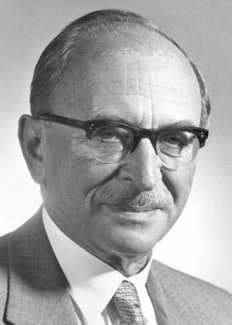
I was born in Budapest, Hungary, on June 5, 1900, the oldest son of Bertalan Gabor, director of a mining company, and his wife Adrienne. My life-long love of physics started suddenly at the age of 15. I could not wait until I got to the university, I learned the calculus and worked through the textbook of Chwolson, the largest at that time, in the next two years. I remember how fascinated I was by Abbe’s theory of the microscope and by Gabriel Lippmann’s method of colour photography, which played such a great part in my work, 30 years later. Also, with my late brother George, we built up a little laboratory in our home, where we could repeat most experiments which were modern at that time, such as wireless X-rays and radioactivity. Yet, when I reached university age, I opted for engineering instead of physics. Physics was not yet a profession in Hungary, with a total of half-a-dozen university chairs – and who could have been presumptuous enough to aspire to one of these?
So I acquired my degrees, (Diploma at the Technische Hochschule Berlin, 1924, Dr-Ing. in 1927), in electrical engineering, though I sneaked over from the TH as often as possible to the University of Berlin, where physics at that time was at its apogee, with Einstein, Planck, Nernst and v. Laue. Though electrical engineering remained my profession, my work was almost always in applied physics. My doctorate work was the development of one of the first high speed cathode ray oscillographs and in the course of this I made the first iron-shrouded magnetic electron lens. In 1927 I joined the Siemens & Halske AG where I made my first of my successful inventions; the high pressure quartz mercury lamp with superheated vapour and the molybdenum tape seal, since used in millions of street lamps. This was also my first exercise in serendipity, (the art of looking for something and finding something else), because I was not after a mercury lamp but after a cadmium lamp, and that was not a success.
In 1933, when Hitler came to power, I left Germany and after a short period in Hungary went to England. At that time, in 1934, England was still in the depths of the depression, and jobs for foreigners were very difficult. I obtained employment with the British Thomson-Houston Co., Rugby, on an inventor’s agreement. The invention was a gas discharge tube with a positive characteristic, which could be operated on the mains. Unfortunately, most of its light emission was in the short ultraviolet, so that it failed to give good efficiency with the available fluorescent powders, but at least it gave me a foothold in the BTH Research Laboratory, where I remained until the end of 1948. The years after the war were the most fruitful. I wrote, among many others, my first papers on communication theory, I developed a system of stereoscopic cinematography, and in the last year, 1948 I carried out the basic experiments in holography, at that time called “wavefront reconstruction”. This again was an exercise in serendipity. The original objective was an improved electron microscope, capable of resolving atomic lattices and seeing single atoms. Three year’s work, 1950-53, carried out in collaboration with the AEI Research Laboratory in Aldermaston, led to some respectable results, but still far from the goal. We had started 20 years too early. Only in recent years have certain auxiliary techniques developed to the point when electron holography could become a success. On the other hand, optical holography has become a world success after the invention and introduction of the laser, and acoustical holography has now also made a promising start.
On January 1, 1949 I joined the Imperial College of Science & Technology in London, first as a Reader in Electronics, later as Professor of Applied Electron Physics, until my retirement in 1967. This was a happy time. With my young doctorands as collaborators I attacked many problems, almost always difficult ones. The first was the elucidation of Langmuir’s Paradox, the inexplicably intense apparent electron interaction, in low pressure mercury arcs. The explanation was that the electrons exchanged energy not with one another, by collisions, but by interaction with an oscillating boundary layer at the wall of the discharge vessel. We made also a Wilson cloud chamber, in which the velocity of particles became measurable by impressing on them a high frequency, critical field, which produced time marks on the paths, at the points of maximum ionisation. Other developments were: a holographic microscope, a new electron-velocity spectroscope an analogue computer which was a universal, non-linear “learning” predictor, recognizer and simulator of time series, a flat thin colour television tube, and a new type of thermionic converter. Theoretical work included communication theory, plasma theory, magnetron theory and I spent several years on a scheme of fusion, in which a critical high temperature plasma would have been established by a 1000 ampere space charge-compensated ion beam, fast enough to run over the many unstable modes which arise during its formation. Fortunately the theory showed that at least one unstable mode always remained, so that no money had to be spent on its development.
After my retirement in 1967 I remained connected with the Imperial College as a Senior Research Fellow and I became Staff Scientist of CBS Laboratories, Stamford, Conn. where I have collaborated with the President, my life-long friend, Dr. Peter C. Goldmark in many new schemes of communication and display. This kept me happily occupied as an inventor, but meanwhile, ever since 1958, I have spent much time on a new interest; the future of our industrial civilisation. I became more and more convinced that a serious mismatch has developed between technology and our social institutions, and that inventive minds ought to consider social inventions as their first priority. This conviction has found expression in three books, Inventing the Future, 1963, Innovations, 1970, and The Mature Society, 1972. Though I still have much unfinished technological work on my hands, I consider this as my first priority in my remaining years.
| Honours |
| Fellow of the Royal Society, 1956. |
| Hon. Member of the Hungarian Academy of Sciences, 1964. |
| D.Sc. Univ. of London, 1964, Hon. D.Sc. Univ. of Southampton, 1970, and Technological University Delft, 1971. |
| Thomas Young Medal of Physical Society London, 1967. Cristoforo Colombo Prize of Int. Inst. Communications, Genoa, 1967. |
| Albert Michelson Medal of The Franklin Institute, Philadelphia, 1968. Rumford Medal of the Royal Society, 1968. |
| Medal of Honor of the Institution of Electrical and Electronic Engineers,1970. Prix Holweck of the French Physical Society, 1971. Commander of the Order of the British Empire, 1970. |
| Married since 1936 to Marjorie Louise, daughter of Joseph Kennard Butler and Louise Butler of Rugby. |
This autobiography/biography was written at the time of the award and later published in the book series Les Prix Nobel/ Nobel Lectures/The Nobel Prizes. The information is sometimes updated with an addendum submitted by the Laureate.
Dennis Gabor died on February 8, 1979.