Milton Friedman
Facts
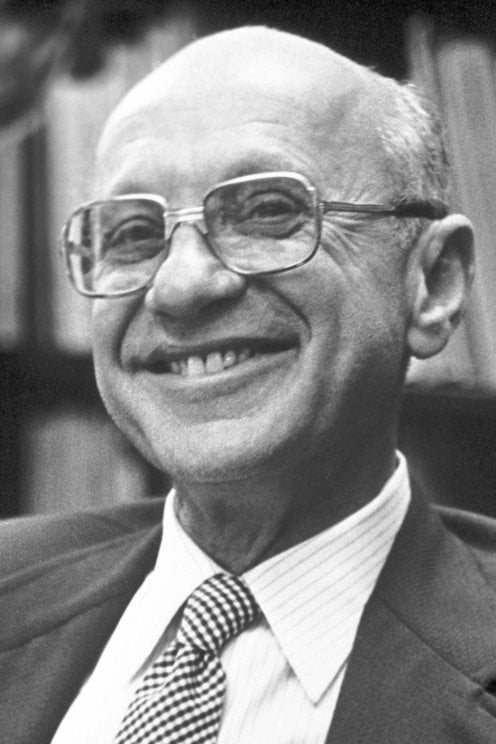
Photo from the Nobel Foundation archive.
Milton Friedman
Sveriges Riksbank Prize in Economic Sciences in Memory of Alfred Nobel 1976
Born: 31 July 1912, Brooklyn, NY, USA
Died: 16 November 2006, San Francisco, CA, USA
Affiliation at the time of the award: University of Chicago, Chicago, IL, USA
Prize motivation: “for his achievements in the fields of consumption analysis, monetary history and theory and for his demonstration of the complexity of stabilization policy”
Prize share: 1/1
Life
Milton Friedman was born in Brooklyn, New York, USA. His parents were immigrants from present-day Ukraine. In 1932, Friedman graduated from Rutgers University. From there, he went on to the University of Chicago, where he accepted an offer to teach economic theory in 1946. An influential economist of the second half on the 20th century, he became one of the leaders of the Chicago school of economics. His works include books, articles, magazine columns and television programs.
Work
Milton Friedman’s best-known contributions are in the realm of monetary economics, where he is regarded as the founder of monetarism. Friedman promoted the theory that changes in the money supply affect real economic activity in the short run and the price level in the long run, a theory he stated in his Study in the Quantity of Money (1956). An articulate spokesman for free markets, his book Capitalism and Freedom (1962) brought him international attention outside academia.
