The Nobel Prize in Physics 2001

  The Nobel Prize in Physics 2001     
 
 
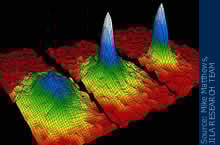
The density of the atomic cloud is shown, with temperature decreasing from left to right. The high peak, the Bose-Einstein condensate, emerges above the other atoms. The picture is from the JILA laboratory.


…coldest!

Eric A. Cornell joined Wieman as a co-worker in the BEC project. Great progress was made and excitement grew as the temperature of the gas sank. Finally Cornell solved the remaining problem: that atoms tended to flow out of the pit at its centre. There they lost their magnetic orientation because the magnetic field was zero. By rotating the magnetic field of the atom trap, the hole could be shut, and in June 1995 the researchers achieved BEC of a few thousand rubidium atoms with mass number 87.


To cite this section
MLA style: The Nobel Prize in Physics 2001. NobelPrize.org. Nobel Prize Outreach 2025. Fri. 5 Dec 2025. <https://www.nobelprize.org/prizes/physics/2001/9848-the-nobel-prize-in-physics-2001-2001/>

Nobel Prizes and laureates

Six prizes were awarded for achievements that have conferred the greatest benefit to humankind. The 14 laureates' work and discoveries range from quantum tunnelling to promoting democratic rights.

See them all presented here.

Illustration

Explore prizes and laureates

Look for popular awards and laureates in different fields, and discover the history of the Nobel Prize.