Gary Ruvkun
Podcast
Nobel Prize Conversations
“When we’re doing genetics, we are tapping into that mythic power of change.”
In this conversation with molecular biologist Gary Ruvkun, we discover his scientific journey and find out that the world of genetics still has many fields left to explore.
A natural storyteller, Ruvkun also shares some of his favourite tales with us – from his gap year in Latin America to how his grandparents emigrated to the United States. For Ruvkun, travelling has given him more stories than he could have ever imagined – and he tries to share them whenever he has the chance.
This conversation was published on 26 June, 2025. Podcast host Adam Smith is joined by Karin Svensson.
Below you find a transcript of the podcast interview. The transcript was created using speech recognition software. While it has been reviewed by human transcribers, it may contain errors.
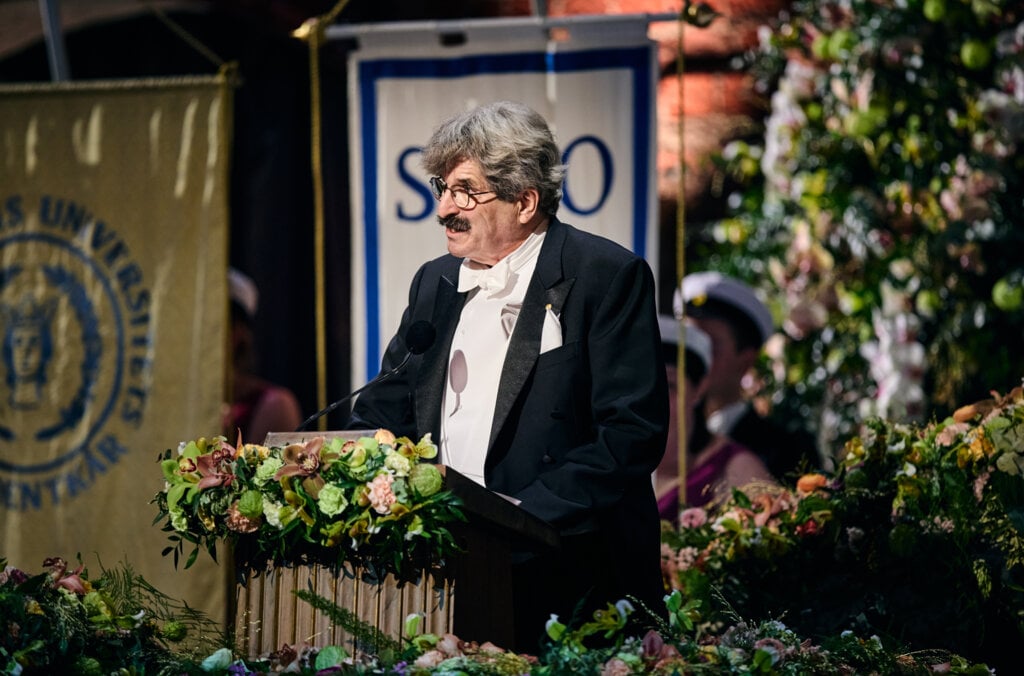
Gary Ruvkun: When we’re doing genetics, we are tapping into that mythic power of change. We’re exploring the plasticity of biology.
Adam Smith: I really like that quote from Gary Ruvkun describing the astounding power of genetics to explore so many mysteries of biology that have previously been hidden and are opened up by this extraordinary field. So many great scientists talk about the importance of getting the right tool to address the question you are interested in. Of course, one normally thinks of that in terms of a specific technology, a specific technique. In this case, Ruvkun is referring to the whole field of genetics and its power to open up biology. This is a theme that we very much explore in the conversation. So do join me please in listening to Gary Ruvkun.
MUSIC
Karin Svensson: This is Nobel Prize Conversations and our guest is Gary Ruvkun, recipient of the 2024 Nobel Prize in Physiology or Medicine. He was awarded for the discovery of microRNA and its role in post transcriptional gene regulation. He shared the prize with Victor Ambros. Your host is Adam Smith, Chief Scientific Officer at Nobel Prize Outreach. This podcast was produced in cooperation with Fundación Ramón Areces. Gary Ruvkun is Professor of Genetics at Harvard Medical School. He talks to Adam about how traveling rough helped shape his career. The blurry line between plants and people, and his suspicion that life on earth originated in space. This conversation takes place in the early summer of 2025, in the midst of a clash between the U.S. presidency and some of the most respected institutions in higher education.
MUSIC
Smith: This brave stance that Harvard is taking must be a source of pride.
Ruvkun: It is a source of pride. And Alan Garber, who’s the president of Harvard, is a friend of ours and I kept saying, “Boy, if I was you, I would quit like a year ago”. But now he’s in there pugilistic as hell and hiring good lawyers. Harvard knows its way around the legal profession. They’re doing a good job and yes, I think Trump picked the wrong fight.
Smith: Let’s hope so. Anyway, strange place to start.
Ruvkun: It’s everywhere. It’s like a gray cloud over this town.
Smith: Yes. And presumably your students who are also worrying whether they can stay and all the rest of it.
Ruvkun: Yes. We’ve had meeting upon meeting about this stuff and what it means to their careers.
Smith: Terrible distraction from the business of being curious and getting on with it, which is what led to all these wonderful things. And that’s the thing about your prize. They’re all celebrations of curiosity driven research, but in a way your discovery so unexpected, so marvelous and so sort of unintended. It’s such a lovely example of how things come out if you just keep looking.
Ruvkun: Yes. It’s also very much empowered by the genome projects and that is a case of government support. England did a third of it. The U.S. did a third of it and it was very efficiently done. The people in charge of it were very aware that it was expensive and they did it in record time. It really starts in the late eighties. It starts with John Sulston in England who’s this quiet guy working on worms in his little room with a lab of one or two.
Smith: Exactly. Deeply unassuming.
Ruvkun: Part of this Nobel Prize business is going over my manila folders of things. I have handwritten letters from him in 1984 because he’s helping us do a what’s called a chromosome walk to get to the gene which this Nobel Prize noted. He’s helping us do it as well as a hundred other people do the same thing. He realises that he’s set up a framework. Just he and Alan Colson, two guys working together, both incredibly competent workaholics at the LMB. He sent me letters saying, “Here’s a 50 kilobase region, it’s next to this 50 kilobase region. This is in the region of the gene. Good luck”. He sent the same letter to other regions and other persons, a hundred people were be getting this. Then he ramps up to do the genome project and goes from a lab of two to a lab of 200 again in this totally soft spoken way, demanding public release of the data every night.
Smith: It’s a beautiful story, actually. Prize after prize strings together, all of this.
Ruvkun: Yes. I got to see Sulston at the Nobel Prize.
Smith: Did you come in 2002?
Ruvkun: As a guest, not as an honoree. I was a nobody. But I was a guest, not of him, of Bob Horvitz, who was my postdoc advisor. Bob came to our Nobel Prize six months ago and Sulston at the after party was wearing American cowboy chaps, and fake pistols at some kind of pistol range that the Karolinska grad students set up. Sulston was a party animal so he was partying heavily that night. It was really fun.
Smith: The Brit wheel out. In your case in particular, I suppose your curiosity came at a good time coinciding with the development of the technology. One thing I wanted to ask you about was the animal you work on, C. elegans allows you to be so explorative because its turnover is so fast and it’s so accessible. Does it allow you to be more inventive, more curious?
Ruvkun: Oh yes. The fact that it’s cheap to work on means everything. Our genetics is incredibly fast these days. What used to take a mega lab of 20 people with Howard Hughes Medical Institute support, which I don’t have, I’m still jealous of people who have that. But it used to take a big lab sort of 20 years to flesh out a pathway with genomics and genome sequencing. Now we get our mutants in a week, we get the genome sequences of them a couple of weeks later and we stare at the genome sequences and figure out what our mutations are. One person can flesh out a whole pathway. I have three examples of postdocs who did sort of a 20 year operation in two years now. That’s all because of genomics. The genetics is ever more powerful now.
MUSIC
Svensson: Hey Adam. I now feel very excited about genomics, but I’m not entirely sure what it is.
Smith: Genomics is simply the study of all the genes in an organism and the way they interact with their environment. I say simply that’s a pretty complicated thing to study. But yes, it’s exciting.
Svensson: And Gary Ruvkun pays tribute to an important person in this field, John Sulston. Why was he important?
Smith: For a start, he worked on this beloved organism of Gary Kuvkun, C. elegans, this roundworm nematode. It’s about a millimeter long and there’s a community of people who work on it. John Sulston was one of the early exponents of working on this worm. He got his Nobel Prize for studying the lineage of particular cell type in those worms. Then he was thrust into the public eye by becoming the leader for the British side of the Human Genome Project. Starting just before the millennium, and produced about a third of the sequence of the human genome. He not only led that project, he also fiercely defended the need to keep the data from the Human Genome Project in the public domain. He’s much celebrated for being a real advocate for public accessibility of science and data.
Svensson: A pair of scientists that often mentioned by Ruvkun and others in connection to this is James Watson and Francis Crick. What was their contribution?
Smith: Their original and much fated contribution was their proposal of a structure for DNA, the double helix, which together with Maurice Wilkins got them the Nobel Prize in 1962. They’ve continued to be hugely influential figures, very different people and very much on all geneticist mind.
Svensson: Both of them seem a little bit bonkers, don’t they?
Smith: Yes. Maybe it takes a bit of being bonkers to be a great scientist. I think that’s probably true. But I think it certainly applies to them. Francis Crick, I suppose he might have been a little bit bonkers in later life to go off and work on consciousness because you couldn’t have picked a harder problem. And I think it’s fair to say that he didn’t get very far, but nobody gets very far with consciousness. It’s early days. But his contributions to whatever he was interested in were always very thought provoking. He absolutely adored asking questions. He’s very famous for asking questions at seminars. They could be brilliant questions. They could be very simple questions, but he liked to ask questions. Then when it comes to Jim Watson. I think bonkers again would work. A very influential scientist respected by so many people. He has brought a great deal of criticism upon himself, also for his very controversial statements about so many issues frequently based in his understanding of the science. But going into areas that most people just would never talk about. He speaks on issues such as the genetic basis of race, which is incredibly controversial. That has made him a very contentious figure in science.
Svensson: Another really interesting character in this field is of course Gary Ruvkun. Can you explain a bit about why he got the Nobel Prize?
Smith: He and Victor Ambros were co-discoverers of this system of regulating gene expression (previously completely unknown) by very small species of RNA called microRNAs. When they found it, they thought it was perhaps a system that was peculiar to their worms. These beloved C. elegans that they study. But, in particular, it was Gary Ruvkun’s work a few years later that showed that this was far more ubiquitous than that. It’s present in practically all organisms and is a really important way that the cell uses to regulate gene expression at the post transcriptional level which means that after the messenger has been produced from the DNA that’s going off to tell the cell what protein to make you then stop that in its tracks using these microRNAs. The ramifications are enormous and there are potentially all sorts of therapeutic approaches based around that.
Svensson: This is also part of the great collaboration within genetics, isn’t it?
Smith: Yes, it is. In their case, they were working in parallel and finding common ground and talking to each other and collaborating where necessary. That’s very common, especially among the worm community. There’s a great common feeling in a sharing of information.
Svensson: And the love of the worm.
Smith: Yes. The love of the wormhole binds people together. We all need common interests right?
Svensson: And pets.
Smith: And pets. I don’t know if they go as far as that. These things don’t live very long. I wouldn’t invest all your emotional baggage in a worm. Anyway, let’s listen to Gary Ruvkun talk about how geneticists continue to build upon each other’s work.
MUSIC
Ruvkun: Now the beauty that very few people appreciate but more should, is that we get our mutant hits. Almost every time it’s a list of 20 genes that I know nothing about. But because of the tree of life, somebody has worked on a homolog of those genes in a plant or a frog or a bacterium. You just have to be willing to sort of dive into what the other genetic systems and genome systems tell you. It’s so educational. Reading the literature becomes even more important.
Smith: It’s still referencing back to that Sulston sharing his thoughts with you, it’s still very much a community of sharing.
Ruvkun: Except this is publishing, right? They don’t know I’m looking at their papers.
Smith: No, not quite, but it’s kind of an extension of that community.
Ruvkun: Yes. The currency of biology is on the order of 20,000 genes, which we have and a worm has and a plant has, but they have basically that same currency. Half our genes are shared with plants. There’s 500,000 molecular biologists like me, and we’re all studying the same 20,000 genes. Every gene’s been studied somewhere.
Smith: Does it surprise you that that we’re also alike? We’re so alike with plots and everything else?
Ruvkun: No, it’s sort of been hinted at from the very first time people started using nucleic acid sequences. The ribosomal RNA is sort of the clock that’s used to all the trees of life that you constantly see everywhere. Every third paper has a tree of life. That tree is generated by doing phylogenetic comparisons of ribosomal RNA. In fact, just for the people in the humanities who might be listening to this, this idea of trees that Darwin is so famous for, the linguist figured this out for languages before Darwin. I think we stole it from the comparative linguistics people, as a community.
Smith: Am I right in thinking that it makes you a little suspicious when you look at the tree of life that life did not originate here on earth?
Ruvkun: Yes. That’s my take on it. It is totally uncelebrated by people who think about the origin of life on earth. I constantly talk at NASA about this stuff and go to various origin of life conferences every so often. But that whole community really thinks I’m stupid on this idea.
Smith: How nice. Let’s talk about that then. It sounds like we’re getting into the wacky side of things. It’s fun.
Ruvkun: It’s panspermia, which is the idea that life spreads between planets, has a checkered past of scientists who go psychotic late in life, believing that life came in from other places.
Smith: Fred Hoyle was a great champion of it, wasn’t he?
Ruvkun: He was. He sort of believed viruses came from space. But Francis Crick also believed that life came from outer space and he was never wrong about anything.
Smith: Maybe even he would’ve been right about consciousness if he’d had enough time to look at it.
Ruvkun: Yes. That was a bad life decision to work on consciousness. The failure rate for that is infinite.
Smith: I fear that’s true. There are other great scientists who like the idea of life from elsewhere.
Ruvkun: Yes. It’s not well celebrated. The reason I like it is that if you go to the base of the tree, most people would say bacteria, they’re pretty primitive, but they are far from primitive. They have the ribosome, which is the heda making proteins. They had already figured out the genetic code. They’re not like this sort of clunky, barely working horse drawn carriage. They are a full on everything we associate with life they have. That’s present as soon as the earth cools down.
Smith: Given what we know now, what do you think would be the way of backing up the idea of panspermia?
Ruvkun: Finding DNA on other planets outside the solar system and good luck on that. But like the people who look for messages from extraterrestrials, they look for them to send the number Pi or the number E, but really you should just look for a ribosomal RNA sequence. If I was going to send a message of who we are, I would send out the E coli 16 sRNA sequence that says everything about who we are on Earth.
Smith: Yes. Possibly too much though.
Ruvkun: Yes. The other view is you should send out a shark’s genome sequence to say we are tough motherfuckers.
Smith: Space has always intrigued you, in fact you and Victor Ambros were both very much switched on by the space race in the U.S.
Ruvkun: Yes. In fact we went to the Stellafane homemade telescope Congress in Vermont about 10 years ago. You show up at 10:00 PM and everybody who’s made a homemade telescope is pointing it at something else. You walk from one telescope to the next and it’s all night long in Vermont. It was fantastic.
Smith: Wow. Have you made a homemade telescope?
Ruvkun: I made a homemade telescope, yes.
Smith: Gosh, is it hard?
Ruvkun: I was sort of working as a tech, this is before grad school in San Francisco. There was something called the San Francisco Sidewalk Astronomers run by John Dobson who is famous for the Dobson telescope that he designed which is totally simple. It’s not an equatorial mount, you make it with plywood and it’s very hard to aim at anything. But he ran telescope making courses in San Francisco in his basement in a really crummy neighbourhood of San Francisco. He taught us how to grind our own mirrors. Again, I didn’t know any of this. It’s in a concrete tube. It’s about six feet tall. The funny story of that scope is when I was moving to Boston for graduate school, 1976, I happened to stop and see a friend in Detroit and then went through Canada, which looked like the shorter route with my Dodge van. Coming in at Niagara Falls, the guy opens up and looks in the back of the van and finds a basket of weavings from South America and figures I’m running drugs. But the first thing I take out is my six foot tall telescope. He goes, “What’s that?” This is the customs guy. I said, “Oh, that’s my homemade scope”. He goes, “You can go” because he’s like no way you’re running drugs if you made your own telescope.
Smith: You are a nerd. We can see.
Ruvkun: Exactly.
MUSIC
Smith: You mentioned the Dodge Van and South America. You are the sort of person who builds telescopes in your basement or in somebody else’s basement and is endlessly curious in the laboratory. You sound like you were sort of set for science from the very beginning, but you did take time out and do other things. I know people are intrigued by this because nowadays people are so directed and feel they haven’t got time to stop and all the rest of it.
Ruvkun: My generation, remember I graduated from college in 1973 and that’s the hippie dippy generation. Everyone’s going back to farms. I planted trees in Oregon living in my van. I found that job by going to Max’s Tavern on peanut night in Eugene, Oregon. There were like, a lot of people were talking, this place was hiring.
Smith: I like the idea of peanut night. What is peanut night?
Ruvkun: They serve peanuts and beer. There’s all these peanut shells on the floor of Max’s tavern. Max’s still has peanut night, by the way. Even today in Eugene, Oregon. Then I went and worked for a year. But that was part of sort of going back to nature. I never wanted to be a farmer and live on a commune that never attracted me one bit. Maybe for a day, but never for a life. Then going to Latin America, that was really probably driven that my dad worked in Latin America a lot. He built steel mills and cement factories and he was a big industrial guy. He had an engineering firm and he was in charge of Latin America for this Kaiser engineers, which is a big company in Oakland, California. He would go to Latin America all the time. My mother actually learned Spanish to be the good wife. We did our homework together when I was in high school and she was like underlying Don Quixote for her homework. She was getting her college degree when I was getting graduated from high school.
Smith: But that’s fantastic that you were just sort of co-learning as co-scholars.
Ruvkun: My parents sort of let me be, they were unhappy with my citizenship grades, “he’s a bit of a troublemaker kind of thing”. They didn’t like that because they were both very un-troublemakers. They wanted me to improve in that regard.
Smith: Keep that quiet in the current climate.
Ruvkun: Yes.
Smith: Okay. But you survived citizenship.
Ruvkun: Yes, that all worked out. I had been an electronics nerd in high school. Ham radio was a big part of what I did. That was part of my social network. There were a bunch of nerdy kids who would be on the radio talking to each other. That was a community. It wasn’t worldwide, it was sort of more local people, San Francisco and Oakland. But they were really inspiring to me more so than the kids I went to school with. That became a community. It’s almost like a early social network.
Smith: Yes, of course. You needed a certain technical prowess to be part of it.
Ruvkun: Yes. It was vacuum tubes, which sucked.
Smith: I suppose I’m attracted by the idea that you weren’t at that point in life at least, so driven that you couldn’t take time out to see other things to travel in Latin America. To plant trees and just sort of, I suppose discover who you were.
Ruvkun: It taught me a lot about navigation. I don’t mean physical navigation, but just sort of complicated journeys and how to take care of yourself and how to not get taken advantage of. It gave me a library of stories. I have a thousand stories I can tell and I’ve told many of them. They mutate over time. Like the bus driver that we knocked out in Bolivia because he was drunk. He started swinging at me when I said “Esquina esquina” which is what you call out in a city bus, which means next corner. This was an intercity bus and he’s going, “No esquina”. But he was clearly drunk. It was a fiesta in this small town outside of Cochabamba, Bolivia. He throws a punch. In my retelling of the story, I kicked him in the chest and knocked him out. But in fact it was the guy I was traveling with. There were three of us traveling. He did that, which I only discovered by rereading the letters I wrote to my family about these things.
Smith: It’s a fantastic story whichever way you tell it. But isn’t it interesting how things mutate?
Ruvkun: Yes, in my favour.
Smith: Yes, maybe that’s the general direction. Maybe that’s the evolutionary pressure there.
Ruvkun: By the way, the people on the bus was a marching band because it was a fiesta and they were laughing their heads off that the gringo had just knocked out their bus driver. They just thought this was the funniest thing ever.
Smith: One has to ask, was the bus moving at the time when this happened?
Ruvkun: No, no, no. He had pulled over to let me out and then some guy with epaulettes and he was dressed up like a marching band. He took over driving the bus three more hours back to town. These are adventures, right? These are stories and they’re survival. There’s survivor bias that I didn’t have a head on collision because I was smart enough to say pull over.
Smith: Absolutely. It may be too much of an extension, but I suppose when you get into real science and you’re having adventures with your mind, you are then telling stories about them and it’s all kind of the same thing.
Ruvkun: It’s navigating the unknown and being comfortable with it. Travel I think is really important.
Smith: What was it though that taught you to be as inventive a scientist as you are and as questioning a scientist? I think it’s fair enough to say that you don’t take safe paths, that you tend to live a little bit on the fringes, testing out slightly outside ideas.
Ruvkun: When I got to graduate school in 1976, I was in way over my head. There were people who knew a lot more of the sort of nuts and bolts of molecular biology than I did because I hadn’t had that level of a background. But so many examples of superb science and both my professors and my fellow students. It was beautiful to me that in Stockholm four of the people I hung out with in grad school were there with us. We came of age together and learned what it is to be scientists. I always think that training was sort of like a hundred seminars that I went to. Not just of people who were at Harvard, these are people who came as guests. It helps to have a name like Harvard that they would all say yes to give a talk there because it was sort of one of four or five centers in the world. At that moment there was sort of just a few places that were really great at molecular biology. Now there’s hundreds that are really great. That’s because the field is a hundred fold bigger and better than it was. But it used to be just a small number of places where it was being invented at that moment. I didn’t realise it at the time, but in fact when I’m writing up the things I’m working on now, it’s all about the genetic code in our newest projects. The code was only eight years old at that point. It had barely been discovered because DNA was 1953. But figuring out like what are the 61 letters of the genetic code that all happened in the mid 60s. I took a course in it in 1970. It was four years old when I took the course. It was all new. I didn’t know that.
Smith: You say when you arrived as a graduate student it was all a bit overwhelmingly good. There were just marvelous people around you. How did you, if you like, build the confidence to realise that you fitted in and knew that this was the place you wanted to be? I think a lot of people find that they go and they’re a bit overwhelmed by the pace of ideas and just how good people are.
Ruvkun: Yes. I didn’t feel like I was way better than everyone else. That’s for sure. I was sort of part of the pack, but it wasn’t a huge pack. It’s not like there were hundreds of students floating around. Everybody had a name and it was a very finite number. There’s like a dozen labs each with say a dozen people. The labs got much bigger later as the explosive discoveries happened. Not just at Harvard but many places. There was lots of moments of, “I’m not assured of success, right?” I think I had good instincts of picking systems that are fast and cheap. What things cost makes a big difference. If you do stuff with mice, you’re paying whatever it is, $5 a day just to keep them housed. You spend a lot of time writing grants just so your mice can eat. Our little worms are incredibly cheap. By the way, that was part of Sidney Brenner’s genius. He was a bacterial geneticist and he goes, “I want to work on an animal that I can do bacterial like genetics”. He picked the worm for like 10 different reasons for that. I am happy he did. I barely knew the guy. I exchanged a hundred words with him in my whole life. I very much appreciate his taste in science
Smith: That’s the phrase. That’s really what I was trying to get to with you. What gave you good taste in science?
Ruvkun: It’s connoisseurship, right? It’s like how do you know what’s great? You just know it. It’s seeing lots of good examples.
Smith: So with Victor, when you published, was it -93, your 22 nucleotide microRNAs? You knew that that was absolutely extraordinary.
Ruvkun: No, we didn’t know that at -93. We knew it was kind of interesting, but we were worried that it was a weirdiness of worms.
Smith: I suppose that’s where I was getting to. Within the worm it was an extraordinary thing to have discovered.
Ruvkun: We expected it to be more normal. Because we were doing genetics and we had a gene that did a process and we kind of thought it would be like other genes doing other processes. We hoped it would be as cool as the homeo box in Drosophila.
Smith: Right. It took time for it to sort of be universally realised that it is so important. It was your work later that really extended the application across all filer. But I just wondered whether you were sort of surprised by the fact that people didn’t jump on it more at the time.
Ruvkun: There was a little bit of the language that was used in worm developmental genetics with the lineage was very bizarre to other developmental biologists. We were jumping into a field that had been around for a hundred years but using our own sort of private language. There was an installed base of developmental biologists who were not geneticists except for the fly groups were somewhat resistant. There was an arrogance of the C. elegans group. Part of that was so many British accents, sorry. There was a certain resistance, but it wasn’t nasty. But it was just a sort of natural resistance. I wasn’t sort of surprised but then, as soon as we showed that it was conserved in humans, that helped a lot. Then the small RNAs being involved in RNA silencing and plants (David Balkan’s wonderful work) happened at that exact moment. That was sort of a double mushroom cloud that said, “Oh my god, there’s a tiny RNA world that’s doing all kinds of things we didn’t imagine”. That all happened at 1999 and 2000, that’s when the whole thing exploded.
Smith: It did indeed. On this gap between the publication and the wider acceptance, what I’d been thinking about was that the publication of the proposed structure of DNA in -53, when people talk about it, they talk about it as if the world changed that day. But it didn’t. It really didn’t. One measure of that is that there wasn’t even a nomination for the Nobel Prize for that work until 1960.
Ruvkun: I did not know that. We had a lab reunion to celebrate the Nobel Prize like a month ago. Part of my preparation for talking to everybody in the lab was to go over the citations of all the papers we’ve published because we publish in a lot of different fields besides microRNAs. We do insulin signaling and other things. I was interpreting it before I was going to present it to them. I said, “No, I need to look up Watson and Crick and see what that was like”. It was astounding that the number of references to it, if you go to the citation index was about a dozen a year until 1960. There was just nothing. I thought for sure that it would’ve been celebrated. Everybody believed it. I think it was just so convincing. There was nothing to talk about.
Smith: Everybody was disheartened.
Ruvkun: What I was trying to use that for was to normalise for the number of molecular biologists because if your field in 1960 was one, 1000th the size, which I think is about the right number, then basically one citation is worth a thousand today. I just thought we should at least have that in our minds when we talk about this sort of thing. But I was stunned by that. Then the late citations on Watson and Crick, they’ve probably been canceled because of Watson’s horrendous eructations on intelligence and stuff. Jim is a friend of mine, I go and visit him. To me being in the same room with Watson, I get goosebumps. You couldn’t write a more poetic life story to discover the double helix and then be in charge of the genome project. How does that happen? It’s amazing.
Smith: It is.
Ruvkun: There were small RNA meetings right at the moment of the explosion at Cold Spring Harbour. To have him in that audience listening to it, it was so poetic to me. It was like Yahweh was in the audience.
MUSIC
Smith: You’ve mentioned a little bit about your childhood. Your family had come from Russia, is that right?
Ruvkun: Both sides, my mother’s parents and my father’s parents, I don’t think they spoke Russian. I think they spoke Yiddish at home. For sure English was a very distant second language to them. So my parents grew up, I would guess speaking Yiddish. But we would go to Sunday dinner, I guess it was at my father’s parents’ house probably every Sunday or every other Sunday. It was about an hour’s drive out of Oakland, California. Stockton is where they were, which is not where you expect to see a bunch of Jews. They had a junkyard that was next to the house and they had a truck and they had a section of the yard for sinks and a section for engines. Being in the junk business during the depression was a good business. They weren’t wealthy but they weren’t poor.
Smith: That would’ve been my heaven as a child to be taken to a junkyard.
Ruvkun: Yes, it was good. I liked the porcelain section, I don’t know why.
Smith: There must have been such treasures to be found.
Ruvkun: My father and his father would go around with his model Ford through the Central Valley buying stuff. I’ve never heard stories of antisemitism. I think grandpa was respected for his honesty. There were stories again, I don’t know that my grandmother, during the depression, would give people food for off the back steps? There was a whole sense of outreach and community that they had. Then my dad went to Berkeley as an undergrad. He comes from the Stockton high school system, which is probably not all that elevated. He thought he had gone to heaven getting to Berkeley at age 18. That’s California at its finest. The tuition at Berkeley at that point, this is in 1937, it’s probably $50 a year. It was nothing. My tuition when I went to Berkeley, guess why I went to Berkeley? Because my dad went to Berkeley. My tuition was $600 a year.
Smith: Gosh. That’s how it should be.
Ruvkun: No scholarship. That’s just what tuition costs if you’re a Californian resident at that point. Now, I guess it’s 20,000 a year, something like that.
Smith: It sounds like they were good people, your grandparents and parents.
Ruvkun: Yes. Then my mother’s parents in Seattle again spoke Yiddish at home. I think they were illegal aliens because they came in through Canada somehow. Their entry papers have them coming into Canada through Winnipeg, which is as far as I know, is not on the ocean. I don’t know how the hell you get from Riga, Latvia (I think is where the ship left from) and how you get to Canada in 1905 in Winnipeg. I got no clue. At one point, 10 years ago I apologised to my cousins in Seattle, my mother’s side of the family for not being able to spell the name Gervidge properly. That’s my mother’s maiden name. They said, “Oh no, there’s a reason why you can’t spell it. Grandpa would misspell it on all the census forms so that the angel of death couldn’t find him”. That was the story. But the revisionist history says he was trying to not get deported.
Smith: Yes. I go with the first explanation.
Ruvkun: But I don’t know how a Russian Jewish family ends up in the Central Valley. There’s not a large Jewish presence.
Smith: This ability to survive in different environments and work hard and be good and down the generations, it has its effect.
Ruvkun: People who have the boldness to emigrate 10,000 miles, that’s a selection of type. My mother came with her sister to San Francisco at age 16 or something like that. She graduated high school really young. I just learned that last year. I had no idea that she was like sort of a precocious kid in high school and never thought to go to college. YWCA is where proper Christian women would go and there was a Jewish equivalent, the young Hebrew Women’s Association. So they were in San Francisco and my mother went with her sister Ann, who was a great seamstress and she wanted to be a Hollywood seamstress. Somehow going to San Francisco wasn’t quite going to Hollywood. Maybe they didn’t know the difference.
Smith: Close.
Ruvkun: So they lived in this young Hebrew women’s thing in downtown San Francisco. Then met my father’s sister and one thing led to another. Then my parents got together and they got married. My dad proposed to my mother on 7 December, 1941 because they were sitting in his 1934 Ford in Alameda. They heard on the radio that Japan had attacked and my dad goes “So what do you think?” This was his proposal of marriage.
Smith: It’s a hell of a moment to choose.
Ruvkun: I think she said yes. I only heard this like five years ago.
Smith: Going around telling people at that moment everyone must have been somewhat distracted by other things that were happening.
Ruvkun: Yes. He was working at the Kaiser shipyards in Richmond, which was a humongous thing. That was a bold move by Kaiser to bring assembly line technology to building liberty ships, which were really important for the Lendlease Act that saved England. Richmond went from nobody being there to a hundred thousand workers in like a year. How do you do that? They would have a train leaving Penn Station in New York and there’d be a ad in the newspaper. Here’s the hourly pay, the train’s gonna fill up. This is your job if you go to Richmond. The train would carry 2000 workers a week or a day, I don’t know what it was. But that’s how they got their ship builders.
Smith: Wow.
Ruvkun: What he was doing there was very important because they built 800 ships that brought all the arms to England for the Battle of Britain. When he walked the streets of the Bay Area in 1943, all the young men were gone. He felt like he was a coward. So he enlisted in the Navy and what he did in the Navy wasn’t nearly as important as what he was doing in Richmond. But he felt good about it.
MUSIC
Smith: Your current work, the microRNA field, has blossomed enormously. Now microRNAs are in clinical trials for various diseases. This turns out to be an incredibly important regulation mechanism. But you continue to find new bits of biology. I suppose that I would say that your system keeps on surprising you in wonderful ways. Describe what that’s like, to work with something that constantly tells you something about the way that life works.
Ruvkun: I think geneticists undersell genetics. The metaphor that we use to describe genetics is that a geneticist figures out how something works by breaking it in a thousand different ways. What that misses is that the important things about genetics is not so much that your DNA encodes how to build an organism, but it encodes how to build an organism that can respond to a million different insults. Both physiologically in terms of what the organism, like me as a person, I can survive or you can survive. But also how you can produce variants that might be able to actually not go extinct. The tree of life is full of extinction in branches that died, the dinosaurs, etc. But there’s a lot of different branches that have ramified. Its adaptability is why we are here and why everything so complicated is here. When we’re doing genetics, we are tapping in to that mythic power of change. So it really undersells it to say we’re breaking things in a thousand different ways. It’s much more, we are exploring the adaptability of organisms in our hands. That’s why when I do genetics, often the mutants we pull out or sort of genes that would be downregulated to respond to this or that insult and we’ve just insulted the worm or a bacterium or a plant in a way that it’s kind of evolved to be able to handle. We’re exploring the plasticity of biology. Genetics is just way more interesting than we’ve given it credit for. We’ve taught it wrong for a hundred years.
Smith: I’ve never heard that description before. It’s beautiful. You are, in a way, inviting the organisms to show their colours to show what they can do.
Ruvkun: Yes. How much variation they can handle and they can do it. We are so adaptable. Organisms do go extinct but some don’t. I’m totally enthralled with it. Our genetics leads us in totally interesting ways. Right now I’m back to exploring Francis Crick and the wobble hypothesis. That’s a long time ago. How base pairing of tRNAs that they use wobble base pairing to be able to read degenerate codons. This is 1966 papers. There’s a lot more to the genetic code than we’ve given it credit for. So I’m back with Francis Crick and working on wobble and that all came out of our genetics.
MUSIC
Svensson: I think I need some more help here. Adam, what is the wobble hypothesis?
Smith: Yes. We’re going to have to get into a bit of biology for that. When information is being transferred from the DNA where it’s stored, to producing proteins in the cell, which has gone to make us what we are, we go through this intermediate step where we produce what’s called the messenger RNA, which is the intermediate step between the DNA and the protein. In order to read the message in the messenger RNA, it needs to interact with another sort of RNA, which is called transfer RNA. The message in the RNA is contained in these codons, which are three nucleotide base sequences always described as three letter code sequences, which contain the information for an individual amino acid. Those three letter codes have to interact with three letter codes in the transfer RNA. You’d have thought that for that registration to take place, you’d need a one-to-one correspondence between the codes in the tRNA and the codes in the messenger RNA. There are 64 possible codes in the mRNA so you would expect that you need 64 possible codes in the tRNA. Turns out you don’t find 64 tRNAs, you find maximum 45. Somehow you don’t need as many as you thought. The wobble hypothesis proposes that the tRNA doesn’t actually need to be all that precise in reading the mRNA.
Svensson: So it wobbles basically.
Smith: It wobbles in molecular terms in that third base pairing. So the first two bases, they can’t wobble. They have to precisely align. You’ve got your tRNA coming up to your mRNA numbers one and two, they have to precisely lock in with a kind of Lego-like fit. But for the third one we can afford a little bit of wobble in that interaction. It can move around so we can fit with this one and it can also fit with this one.
Svensson: It made me think of dancing, bits of pieces sort of moving.
Smith: Many chemists do think of their interactions between molecules as dancing. It’s a really nice way of putting it. I think there should be more dance in chemistry.
Svensson: To something completely different then, Gary Ruvkun has also worked on ideas for COVID vaccines.
Smith: Yes. I gather that during COVID when he was just stuck at home, it occurred to him that work he had been doing on protein glycosylation, which is modification of proteins and the way that that can lead to editing of the proteins had of potential relevance for COVID because the spike protein on the virus was known to also be glycosylated. He published a paper in bio archive and then he presented to the team developing the vaccines on this piece of work that he never expected to have any input into at all. But that’s the nice thing about science that you never know where it’s going to lead you. Let’s hear Gary Ruvkun himself speak about why he spent lockdown doing this work.
MUSIC
Ruvkun: Comparative genomics, computational biology you can do at home when you’re locked at home. It was a way to deal with it. I also just knew that there’s ain’t nobody else thinking this way about it and it might not be right. I’m not trying to trumpet it more than it deserved.
Smith: There ain’t nobody else going to think about it in this way – is that the kind of guiding principle in the lab? Is that what you’re trying to find unoccupied territory where you can perhaps be original?
Ruvkun: Yes, I like having open space to ourselves and not people sort of nipping at our heels. I’m not interested in competing with people because then it’s obvious. If 10 other groups are doing it, you’re not adding that much.
Smith: Would that be your advice to people if you’re going to go into this?
Ruvkun: Yes. There’s a ton on herd behaviour in life in general, but for sure in science there is a lot of it. If you do genetics you get sent into territory. The thing about genetics, there are 20,000 different ways to go because there are 20,000 genes. I know a lot maybe about 1,000 genes, 5%, but 95% I don’t know squat about but I know how to look it up.
Smith: Good advice. Thank you very much indeed. We’ve been all over the place. A bit of a traveling conversation.
Ruvkun: Thank you, Adam. This was fun.
Svensson: You just heard Nobel Prize Conversations. If you’d like to learn more about Gary Ruvkin, you can go to nobelprize.org where you’ll find a wealth of information about the prizes and the people behind the discoveries. Nobel Prize Conversations is a podcast series with Adam Smith, a co-production of Filt and Nobel Prize Outreach. The producer for this episode was me, Karin Svensson. The editorial team also includes Andrew Hart and Olivia Lundqvist. Music by Epidemic Sound. If telescopes are your thing, check out our earlier episode with 2018 physics laureate and stargazer Andrea Ghez. You can find previous seasons and conversations on Acast or wherever you listen to podcasts. Thanks for listening.
Nobel Prize Conversations is produced in cooperation with Fundación Ramón Areces.
Nobel Prizes and laureates
Six prizes were awarded for achievements that have conferred the greatest benefit to humankind. The 14 laureates' work and discoveries range from quantum tunnelling to promoting democratic rights.
See them all presented here.