Abdus Salam
Facts
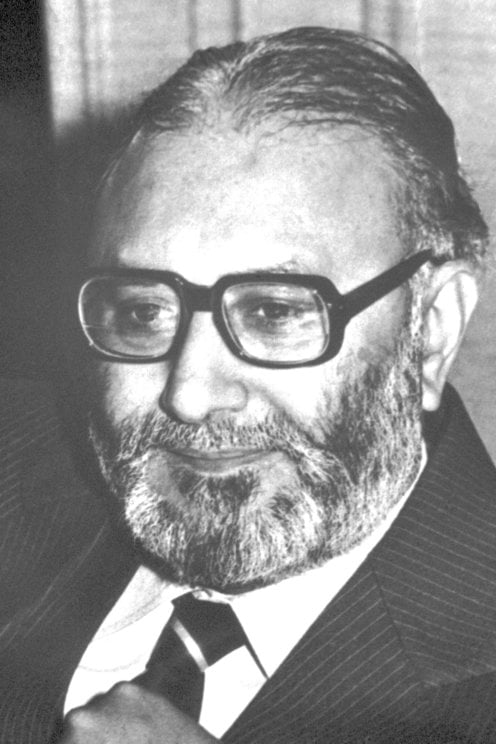
Photo from the Nobel Foundation archive.
Abdus Salam
Nobel Prize in Physics 1979
Born: 29 January 1926, Jhang Maghiāna, India (now Pakistan)
Died: 21 November 1996, Oxford, United Kingdom
Affiliation at the time of the award: International Centre for Theoretical Physics, Trieste, Italy; Imperial College, London, United Kingdom
Prize motivation: “for their contributions to the theory of the unified weak and electromagnetic interaction between elementary particles, including, inter alia, the prediction of the weak neutral current”
Prize share: 1/3
Work
According to modern physics, four fundamental forces exist in nature. Electromagnetic interaction is one of these. The weak interaction—responsible, for example, for the beta decay of nuclei—is another. Thanks to contributions made by Abdus Salam, Sheldon Glashow,and Steven Weinberg in 1968, these two interactions were unified to one single, called electroweak. The theory predicted, for example, that weak interaction manifests itself in “neutral weak currents” when certain elementary particles interact. This was later confirmed.
Six prizes were awarded for achievements that have conferred the greatest benefit to humankind. The 10 laureates' work and discoveries range from optogenetics to efforts to promote peace and international law.
See them all presented here.