Speed read: Recognizing DNA’s voice
Lying between your genes and you are molecular machines that allow the otherwise silent information wrapped-up in your DNA to speak. Working in turn to select, transmit, read and decipher the DNA code, they drive the production of all the components needed for life.
Roger Kornberg’s research focuses on the earliest phases of this process, during which DNA is packaged into accessible forms and chosen segments are then converted into the messenger molecules that carry the instructions on towards the next stage. His painstaking observations of the structures of the molecular complexes involved in these operations, and his success in searching for new pieces of the puzzle, are giving us a developing picture of the elegant cellular machinery that controls which pages of the book of life are to be read.
His studies of this process have extended over thirty years, with many milestones of discovery along the way, culminating more recently with his discovery of the intricate details of one of the most complicated molecular assemblies ever seen. No less than sixty different protein molecules function together to perform the transcription process, during which DNA is converted into messenger RNA molecules. The apparatus he has been able to study, which not only builds new molecules but also checks them for accuracy and corrects for errors along the way, is taken from a ‘model’ organism often used by cell biologists, simple baker’s yeast. However, the cast of characters building these machines turns out to be extraordinarily similar in all animals, plants and fungi, and what he has observed in yeast appears to hold true for all eukaryotic, or higher organisms, including humans.
Roger Kornberg’s father, Arthur Kornberg, was awarded the Nobel Prize in Physiology or Medicine in 1959 for discovering how our cells synthesize DNA. Only the sixth ever father/son pair to be awarded a Nobel Prize – genes clearly run in the family.
Useful Links / Further Reading

| The Nobel Laureate |
| Roger D. Kornberg, Stanford University School of Medicine |
| Transcription |
| Film of transcription, The Dolan DNA learning center – genes in education (Media showcase; Transcription: DNA codes for mRNA, 3D animation) |
| Original scientific articles |
| Cramer, P., Bushnell, D.A. and Kornberg, R.D. (2001) Structural basis of transcription: RNA polymerase II at 2.8 ångstrom resolution. Science 292, 1863-1876. |
| Gnatt, A.L., Cramer, P., Fu, J., Bushnell, D.A. and Kornberg, R.D. (2001) Structural basis of transcription: An RNA polymerase II elongation complex at 3.3 Å resolution. Science 292, 1876-1882. |
| Bushnell, D.A., Westover, K.D., Davis, R.E. and Kornberg, R.D. (2004) Structural basis of transcription: An RNA polymerase II – TFIIB cocrystal at 4.5 angstroms. Science 303, 983-988. |
| Review article |
| Boeger, H., Bushnell, D.A., Davis, R., Griesenbeck, J., Lorch, Y., Strattan, J.S., Westover, K.D. and Kornberg, R.D. (2005). Structural basis of eukaryotic gene transcription. FEBS Lett. 579, 899-903. |
Roger D. Kornberg – Other resources
Links to other sites
The Roger D. Kornberg Laboratory at Stanford University
‘Roger D. Kornberg, Polymerase, DNA, RNA, and Transcription’ from DOE R&D Accomplishments
Press release
English
Swedish
4 October 2006
The Royal Swedish Academy of Sciences has decided to award the Nobel Prize in Chemistry for 2006 to
Roger D. Kornberg
Stanford University, CA, USA
“for his studies of the molecular basis of eukaryotic transcription”.
A family story about life
In order for our bodies to make use of the information stored in the genes, a copy must first be made and transferred to the outer parts of the cells. There it is used as an instruction for protein production – it is the proteins that in their turn actually construct the organism and its function. The copying process is called transcription. Roger Kornberg was the first to create an actual picture of how transcription works at a molecular level in the important group of organisms called eukaryotes (organisms whose cells have a well-defined nucleus). Mammals like ourselves are included in this group, as is ordinary yeast.
Transcription is necessary for all life. This makes the detailed description of the mechanism that Roger Kornberg provides exactly the kind of “most important chemical discovery” referred to by Alfred Nobel in his will.
If transcription stops, genetic information is no longer transferred into the different parts of the body. Since these are then no longer renewed, the organism dies within a few days. This is what happens in cases of poisoning by certain toadstools, like the death cap, since the toxin stops the transcription process. Understanding of how transcription works also has a fundamental medical importance. Disturbances in the transcription process are involved in many human illnesses such as cancer, heart disease and various kinds of inflammation.
The capacity of stem cells to develop into different types of specific cells with well-defined functions in different organs, is also linked to how the transcription is regulated. Understanding more about the transcription process is therefore important for the development of different therapeutic applications of stem cells.
Forty-seven years ago, the then twelve-year-old Roger Kornberg came to Stockholm to see his father, Arthur Kornberg, receive the Nobel Prize in Physiology or Medicine (1959) for his studies of how genetic information is transferred from one DNA-molecule to another. Kornberg senior had described how genetic information is transferred from a mother cell to its daughters. What Roger Kornberg himself has now done is to describe how the genetic information is copied from DNA into what is called messenger-RNA. The messenger-RNA carries the information out of the cell nucleus so that it can be used to construct the proteins.
Kornberg’s contribution has culminated in his creation of detailed crystallographic pictures describing the transcription apparatus in full action in a eukaryotic cell. In his pictures (all of them created since 2000) we can see the new RNA-strand gradually developing, as well as the role of several other molecules necessary for the transcription process. The pictures are so detailed that separate atoms can be distinguished and this makes it possible to understand the mechanisms of transcription and how it is regulated.
| Read more about this year’s prize |
| Information for the Public |
| Advanced information |
| Links and Further Reading |
Roger D. Kornberg, born 1947 (59) in St Louis, MO, USA (US citizen). PhD from Stanford University, CA, USA. Mrs. George A. Winzer Professor in Medicine at Stanford University School of Medicine, CA, USA.
The Prize amount: SEK 10 million.
Contact persons: Malin Lindgren, Information Officer, Phone +46 86739522, +46 709 88 60 04, [email protected]
Ulrika Björkstén, Scientific editor, Phone +46 8 673 95 00, +46 702 06 67 50, [email protected]
Pressmeddelande: Nobelpriset i kemi 2006
English
Swedish
4 October 2006
Kungl. Vetenskapsakademien har beslutat utdela Nobelpriset i Kemi år 2006 till
Roger D. Kornberg
Stanford University, CA, USA
“för hans studier av den molekylära grunden för eukaryot transkription”.
En släkthistoria om livet
För att kroppen ska kunna använda den information som finns lagrad i arvsanlagen måste den först kopieras, så att den kan föras ut i cellerna. Kopian används som ritning för att skapa de proteiner som i sin tur bygger upp kroppens struktur och funktion. Kopieringsprocessen kallas transkription. Roger Kornberg var först med att skapa en verklig bild av hur transkriptionen ser ut på molekylnivå hos så kallade eukaryoter (vars celler har en avgränsad cellkärna) – dit såväl vanlig bagerijäst som däggdjur, inklusive vi själva, räknas.
Transkription är oundgänglig för allt liv, därför är Kornbergs detaljbeskrivning av hur den går till just en sådan “vigtigaste kemiska upptäckt” som Alfred Nobel talar om i sitt testamente.
Om transkriptionen upphör förs genernas information inte längre ut i kroppen och inom några dagar dör organismen, då dess beståndsdelar inte längre förnyas. Detta är vad som händer exempelvis vid förgiftning av vit flugsvamp, eftersom giftet stoppar just transkriptionen. Förståelse av hur transkriptionen går till har alltså en grundläggande medicinsk betydelse och störningar i denna process är inblandad i en rad sjukdomar som cancer, hjärtsjukdom och olika inflammationer.
Stamcellers förmåga att utvecklas till olika typer av specifika celler med given funktion i olika organ hänger också ihop med hur transkriptionen regleras. Därför är en förståelse av transkriptionsprocessen viktig även för att kunna utveckla tillämpningar av stamceller.
För fyrtiosju år sedan kom den då 12-årige Roger Kornberg till Stockholm för att vara med då hans far, Arthur Kornberg, mottog Nobelpriset i fysiologi eller medicin (1959) för studier av hur den genetiska informationen överförs från en DNA-molekyl till en ny DNA-molekyl som byggs upp med den gamla som mall. Kornberg senior hade alltså beskrivit hur den genetiska informationen överförs från en modercell till dottercellerna. Vad Roger Kornberg själv nu har gjort är att i sin tur kartlägga hur den genetiska information kopieras från DNA till så kallat budbärar-RNA som för ut informationen från cellkärnan, så att den kan användas för att bygga upp kroppens proteiner.
Kulmen på Roger Kornbergs bidrag är att han för första gången har lyckats skapa kristallografiska bilder av transkriptionsapparaten i en eukaryot cell på molekylnivå. På hans bilder (samtliga tagna under 2000-talet) syns hur DNA-molekylen kopieras och RNA-strängen växer fram, samt hur flera av de övriga molekyler som är nödvändiga för transkriptionen fungerar. Bilderna är så detaljerade att till och med enstaka atomer kan urskiljas, vilket gör det möjligt att i detalj förstå mekanismerna för transkription och dess reglering.
| Läs mer om årets kemipris |
| Populärvetenskaplig information |
| Advanced information |
| Länkar och lästips |
Roger D. Kornberg, född 1947 (59 år) i St Louis, MO, USA (amerikansk medborgare). PhD vid Stanford University, CA, USA. Mrs. George A. Winzer Professor in Medicine vid Stanford University School of Medicine, CA, USA.
Prissumma: 10 miljoner svenska kronor.
Kontaktpersoner: Malin Lindgren, informatör, tel. 08-673 95 22, 0709-88 60 04, [email protected]
Ulrika Björkstén, vetenskaplig redaktör, tel. 08-673 95 00, 0702-06 67 50, [email protected]
Roger D. Kornberg – Banquet speech
Your Majesties, Your Royal Highnesses, Ladies and Gentlemen
I am deeply grateful for the honor bestowed on me by the Royal Swedish Academy of Sciences. It is an honor I share with many collaborators. My wife Yahli has been my closest collaborator. She has borne a double burden. She is the wife of a scientist, and herself a scientist without a wife. Beyond her participation she has also been a source of inspiration in our work.
Because the work took a long time, more than 20 years, it involved an especially large number of collaborators, some 50 at Stanford, and others around the world, in Israel, Europe, the Orient, and of course the Americas. I might add that the Chemistry Prize recognizes not only our own work, but also one of the most active areas of research in chemistry and molecular biology today.
We have enjoyed the privilege of devoting our lives to the pursuit of basic knowledge. This is an extraordinary privilege. We owe it to public support of science. We are also indebted to the Swedish Academy of Sciences in this regard, because the Prize increases public awareness, and thus public support of science. We must furthermore acknowledge both the Academy and the Nobel Foundation for their great skill in not only preserving but enhancing the importance of the Prize.
There is perhaps a deeper significance. In a world beset by irrational influences, with often devastating consequences, the Nobel Prizes call attention to the triumph of reason. They salute our search for understanding. They celebrate discovery of the most basic facts of nature.
Even as we celebrate, and savor this moment, the work goes on. I am reminded of some lines from the American poet, Robert Frost. During the long, arduous effort of the past 20 years, I often repeated these lines to myself. I view them as a kind of metaphor for science and our ongoing commitment to it.
The woods are lovely, dark and deep,
But I have promises to keep,
And miles to go before I sleep,
And miles to go before I sleep.
Yahli joins me in thanking everyone responsible for this glittering event. Once again, my heartfelt thanks to my collaborators, to the Swedish Academy of Sciences, and to the Nobel Foundation. And thank you all.
Copyright © The Nobel Foundation 2006Roger D. Kornberg – Prize presentation
Watch a video clip of the 2006 Nobel Laureate in Chemistry, Roger D. Kornberg, receiving his Nobel Prize medal and diploma during the Nobel Prize Award Ceremony at the Concert Hall in Stockholm, Sweden, on 10 December 2006.
Roger D. Kornberg – Nobel Symposia
Roger D. Kornberg – Photo gallery
Roger D. Kornberg receiving his Nobel Prize from His Majesty King Carl XVI Gustaf of Sweden at the Stockholm Concert Hall, 10 December 2006.
Copyright © The Nobel Foundation 2006
Roger D. Kornberg after receiving his Nobel Prize at the Stockholm Concert Hall, 10 December 2006.
Copyright © The Nobel Foundation 2006
Roger D. Kornberg with his wife, Yahli Lorch, and children, Guy (left) and Gil and Maya (right), after the Nobel Prize Award Ceremony.
Copyright © Anki Berglin 2006
Nobel Laureate Roger D. Kornberg (left) with wife, Yahli Lorch, at the Nobel Banquet, 10 December 2006.
Copyright © The Nobel Foundation 2006
Photo: Torbjörn Zadig
Roger D. Kornberg delivering his banquet speech. © Nobel Media AB 2006.
Photo: Hans Mehlin.
Their Majesties Queen Silvia and King Carl XVI Gustaf of Sweden posing with Roger D. Kornberg and his wife, Yahli Lorch, at the Nobel Banquet, 10 December 2006.
Copyright © The Nobel Foundation 2006
Photo: Torbjörn Zadig
Roger D. Kornberg and his wife, Yahli Lorch, with the Royal Swedish siblings: Crown Princess Victoria (left), Prince Carl Philip and Princess Madeleine, at the Nobel Banquet, 10 December 2006.
Copyright © The Nobel Foundation 2006
Photo: Torbjörn Zadig
All the 2006 Nobel Laureates assembled for a group photo during their visit to the Nobel Foundation, 12 December 2006. Left to right: John C. Mather, Edmund S. Phelps, Roger Kornberg, Dipal Chandra Barua (representing Grameen Bank), Orhan Pamuk, Andrew Z. Fire, Craig C. Mello, Muhammad Yunus, and George F. Smoot.
Copyright © The Nobel Foundation 2006
Photo: Torbjörn Zadig
Roger D. Kornberg during the Nobel Foundation reception at the Nordic Museum in Stockholm, 9 December 2006.
Copyright © Nobel Media AB 2006
Roger D. Kornberg delivering his Nobel Lecture at the Aula Magna, Stockholm University, 8 December 2006.
Copyright © Nobel Media AB 2006
Roger D. Kornberg showing the transcription process when delivering his Nobel Lecture at the Aula Magna, Stockholm University, 8 December 2006.
Copyright © Nobel Media AB 2006
Roger D. Kornberg, like many Nobel Laureates before him,
autographs a chair at Kafé Satir at the Nobel Museum in Stockholm,
6 December 2006.
Copyright © The Nobel Museum 2006
Photo: Fredrik Persson
Roger D. Kornberg (left) at the interview in Stockholm, 6 December 2006. The interviewer is Adam Smith, Editor-in-Chief of Nobelprize.org.
Copyright © Nobel Media AB 2006
Roger Kornberg spoke with reporters and well wishers from his office on Wednesday morning.
Copyright © Stanford News Service 2006
Photo: Linda A. Cicero

Photo: Hans Mehlin

Photo: Hans Mehlin


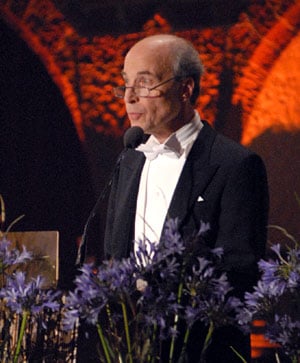


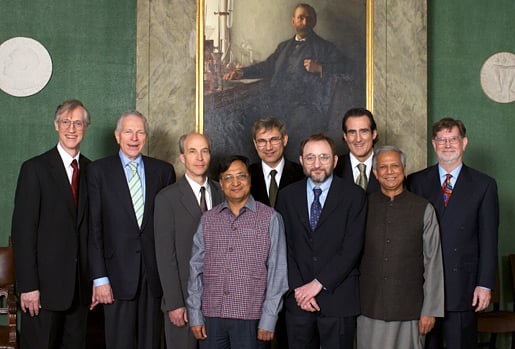
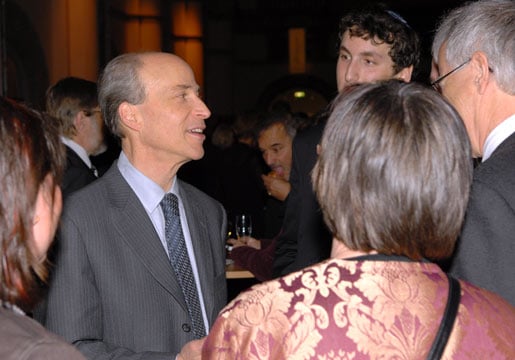
Photo: Hans Mehlin

Photo: Mirek Labedzki
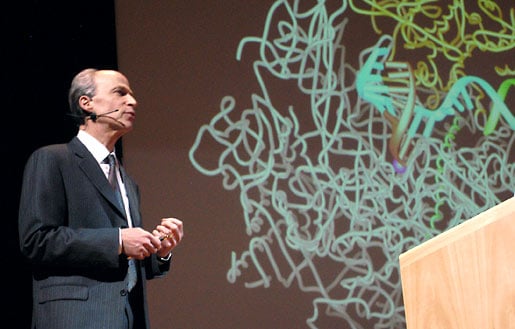
Photo: Mirek Labedzki

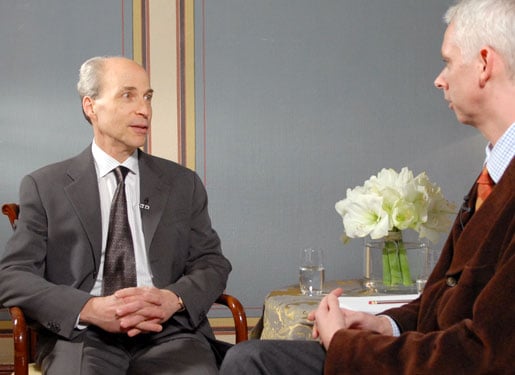
Photo: Hans Mehlin

Roger D. Kornberg – Nobel Lecture
Roger Kornberg delivered his Nobel Lecture on 8 December 2006 at Aula Magna, Stockholm University. He was introduced by Professor Håkan Wennerström, Chairman of the Nobel Committee for Chemistry.
Roger Kornberg held his Nobel Lecture December 8, 2006, at Aula Magna, Stockholm University. He was presented by Professor Håkan Wennerström, Chairman of the Nobel Committee for Chemistry.
Lecture Slides
Pdf 552 kB
Copyright © Roger D. Kornberg 2006
Read the Nobel Lecture
Pdf 552 kB