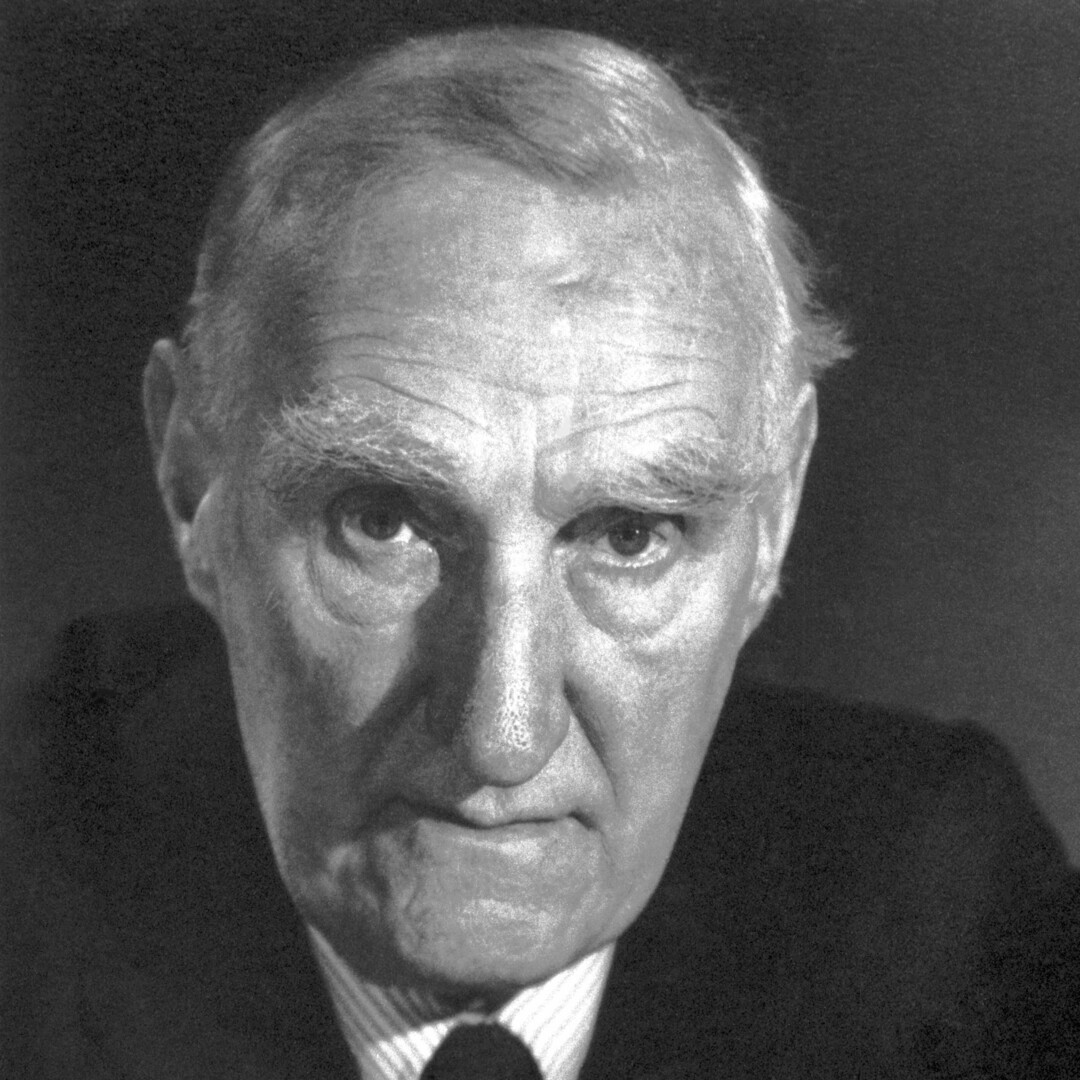
John Boyd Orr was awarded the Nobel Peace Prize for his lifelong efforts to improve the world’s food situation.
Lord Boyd Orr Photo from the Nobel Foundation archive.
Full name: John Boyd Orr, Baron Boyd-Orr of Brechin Mearn Born: 23 September 1880, Kilmaurs, Scotland Died: 25 June 1971, Edzell, Scotland Date awarded: 10 December 1949
Father of the FAO
John Boyd Orr, a Scottish physician and biologist, distinguished himself in the inter-war years as one of the UK’s leading experts on nutrition. Boyd Orr took part in League of Nations efforts to develop an international nutrition policy. During WWII he introduced the idea of a “world food plan” to US President Roosevelt. In 1945 he was appointed director-general of the UN Food and Agriculture Organisation (FAO). Boyd Orr believed that food and prosperity for all would bring world peace. Boyd Orr supported international cooperation to ensure peace and argued for the creation a supra-national government based on international law. Boyd Orr received a knighthood in 1949 for his lifelong efforts.
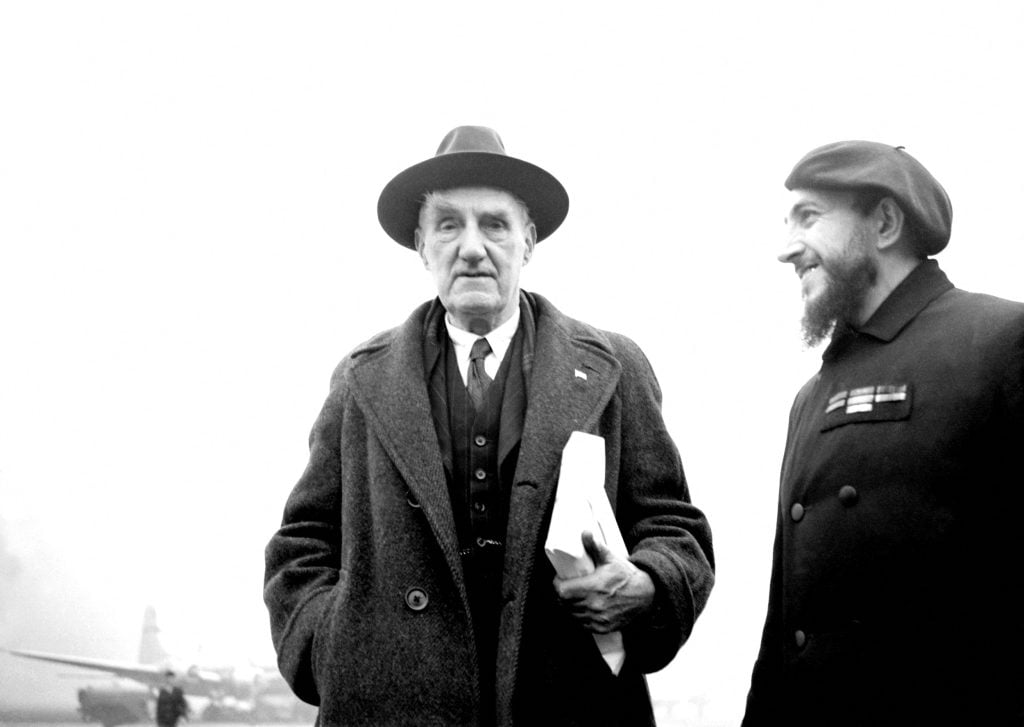
John Boyd Orr on his arrival at the Oslo airport to be awarded the Nobel Peace Prize, December 1949. Next to him is
Abbé Pierre, originator of the Emmaus movement. Photo by STF/AFP via Getty Images
“We are now physically, politically, and economically one world and nations so interdependent that the absolute national sovereignty of nations is no longer possible. However difficult it may be to bring it about, some form of world government, with agreed international law as means of enforcing the law, is inevitable.”
John Boyd Orr, Nobel Prize lecture, 12 December 1949.
Boyd Orr reluctantly agreed to be a delegate to the UN conference that established the Food and Agriculture Organisation (FAO) in 1945. He had planned instead to focus on his duties as a newly elected member of the British Parliament. But at the UN conference Boyd Orr could not refrain from speaking. He later said that he had held only two good speeches in his life, and this was one of them. He affirmed that international cooperation on food policy had to be based on people’s needs. Boyd Orr’s speech made a powerful impression, and he was elected as the first secretary-general of FAO.
Frustration combined with optimism for the future
Boyd Orr’s first task as director of the FAO was to solve the post-war food crisis. He established the International Emergency Food Council, which he maintained saved millions of people from death by starvation. Long-term goals were important to Boyd Orr. He fought to establish of a World Food Board, but to no avail. The USA and the UK opposed the concept of such a powerful and binding organisation. As a result, Boyd Orr resigned his post as secretary-general. Boyd Orr’s farewell speech was optimistic nonetheless. He noted that although the world was mired in political conflict, the FAO brought nations together to discuss ways to provide enough food to people throughout the world. He believed this would promote peace.
John Boyd Orr was born in Kilmaurs, Ayrshire, Scotland. His father, R.C. Orr, was a pious and intelligent man whose sudden enthusiasms led to frequent reversals of fortune, but, although his finances were often depleted, he and his wife and their seven children enjoyed a pleasant life in their rural community …
Disclaimer: Every effort has been made by the publisher to credit organisations and individuals with regard to the supply of photographs. Please notify the publishers regarding corrections.
The award of the Nobel Peace Prize is an international event of the first importance. It arouses the interest of the people of all countries and focuses attention on the objects of the organization or the views of the individual selected to receive this great honour. It is fitting, therefore, that in the lecture which, in accordance with statutes, the recipient must deliver, he should give his views on the prospects of peace and the best means of attaining it. In this lecture I wish to consider the possibility of eliminating the causes of war and bringing in a new era of world unity and peace by the intelligent application of the new knowledge and new powers over the forces of nature which modern science has given mankind.
The Long Tradition of War
The history of our civilization has been one of intermittent war. In the last five or six thousand years, empires one after another have arisen, waxed powerful by wars of conquest, and fallen by internal revolution or attack from without. But though the centre of power moved from one country to another, the general pattern of the political and economic structure has suffered no radical change. The increase of territory and power of empires by force of arms has been the policy of all great powers, and it has always been possible to get the approval of their state religion. The destruction of the false gods of the enemy, which threaten the true religion, has always justified propaganda of fear and hatred to overcome the natural reluctance of soldiers to kill their fellowmen with whom indeed they had no quarrel. Some wars have been due to the lust of rulers for power and glory, or to revenge to wipe out the humiliation of a former defeat. Most however have had an economic basis: the conquest of foreign territory in the interest of trade, or of land with rich agricultural or other resources. At the present time the control of oil-bearing land is an important factor in the foreign policy of some governments.
If the view I am going to express be true, we have reached the end of the age of competing empires because what Alfred Nobel foresaw has happened. Science has produced such powerful weapons that in a war between great powers there would be neither victor nor vanquished. Both would be overwhelmed in destruction. Our civilization is now in the transition stage between the age of warring empires and a new age of world unity and peace.
Science Molds Society
Though the general principles of statecraft have survived the rise and fall of empires, every increase in knowledge has brought about changes in the political, economic, and social structure. Thus, for example, the use of gunpowder ended the feudal system in Europe. The invention of the steam engine1 led to the mechanical industrial revolution, with all the resulting economic and social changes. Even more important has been the birth of new ideas. The Renaissance with the invention of printing2 spread the revolutionary idea of the dignity and rights of the individual from which arose the democratic system of government in Europe, America, and the British Dominions. These few examples are sufficient to illustrate the effects of the growth of knowledge on the structure of human society. Our civilization has evolved through the continuous adjustment of society to the stimulus of new knowledge.
But major adjustments do not take place without a struggle. Every impending change which threatens vested interests or tends to undermine authority based on orthodox beliefs is resisted by those who hold power. When the fabric of society is so rigid that it cannot change quickly enough, adjustments are achieved by social unrest and revolutions. It needed a civil war in England to establish the new doctrine that the rights of a king were no more divine than those of a common man3. It needed a French revolution to convince a hereditary aristocracy that the day of its despotic power was past4, and a Russian revolution to get rid of a medieval form of government which had become obsolete5. When the Industrial Revolution of the nineteenth century brought a rapid increase in wealth, the demand of workers for a fair share of the wealth they were creating was conceded only after riots and strikes.
The Powers of Modern Science
In the last fifty years science has advanced more than in the 2,000 previous years and given mankind greater powers over the forces of nature than the ancients ascribed to their gods. The thunderbolt of Jove was a pip-squeak compared to the atomic bomb; Mercury, the messenger of the gods with wings on his heels, a slow coach compared with the radio; the magic flying carpet of the fairy tale, a crude method of travel compared with a transatlantic air liner. In biological science the advance has been as wonderful though not so spectacular.
At the same time as mankind has gained these new powers the idea of the rights of the individual, which originated and caused such changes in Europe, has spread among the coloured races which have become dynamic, demanding freedom and a political status and standard of living equal to that of the white race.
The present worldwide revolution is due to the difficulty of adjusting human society to this terrific impact of modern science. Changes commensurate with the magnitude of the new forces are inevitable.
We Are Now One World
The most important change is the one made necessary by the radio and the airplane. Measured in time of transport and communication, the whole round globe is now smaller than a small European country was a hundred years ago. The world is now so small that a major event in any country affects all. A civil war in Greece or China involves the active intervention of foreign governments, not as arbiters to make peace, but for the defeat of the side whose victory would be against the interest of the intervening power. An election in Italy is not so much a purely national matter as a local contest between two groups of nations, each afraid of the spread of the political ideologies of the other, and is of almost as much interest in Washington, London, and Moscow as in Rome. The United Kingdom devalues the pound. Within a few days twenty other nations are forced to devalue their currencies, and all nations to adjust their finance and trade to a decision made by a few men in one country. We are now physically, politically, and economically one world and nations so interdependent that the absolute national sovereignty of nations is no longer possible. However difficult it may be to bring it about, some form of world government, with agreed international law and means of enforcing the law, is inevitable.
Modern Technology
As I have tried to show, science, in producing the airplane and the wireless, has created a new international political environment to which governments must adjust their foreign policies. Almost as important are the new industrial conditions science has created. With the advance of technology, more and more goods can be produced with less and less labour. After the First World War the economic problem was no longer one of production. It was the problem of finding markets to get the output of industry and agriculture dispersed and consumed.
The only solution nineteenth-century economics could offer was to cut down production to the level of economic demand. Land went out of cultivation while the people were hungry. Factories were idle while people urgently needed the things they could produce. Unemployment increased to over ten millions in the United States, nearly three millions in the United Kingdom, and six millions in Germany. World trade decreased to a fraction of its former level. The economic system broke down because it could not carry the great wealth which modern science can create.
At an economic conference in 19336 Viscount Bruce7 warned governments that an economic system which for its own preservation restricted the production and distribution of the things which the majority of mankind urgently need, is one that cannot endure. He predicted disaster. It came. Unemployment was cured, first in Germany and then in other countries, by the production of armaments for the Second World War.
During the last war when there was a market for everything that could be produced, the production capacity of Canada and the United States, which were outside the battle area, increased one hundred percent. What the U.S.A. and Canada have done, all countries can do. Nearly every country in the world is now becoming industrialized as rapidly as it can. Already the acute post-war shortage of goods has been made good, and the fight for markets has begun. What will the position be when Germany and Japan regain and surpass their pre-war capacity for export, when China and other countries, whose workers will be glad of a standard of living much lower than that of American or European workers, become industrialized and join the fight for an export market Shall we again adjust supply to affective economic demand, and cure unemployment by preparation for another world war, or will governments cooperate in a new world economic system which will provide an assured market for all that modern science can produce?
If the target of output were the satisfaction of human needs, there would be no difficulty about markets. When the United States was battling with unemployment, the late President Roosevelt said that there were so many people ill-fed, ill-clothed, and ill-housed that if their needs were to be satisfied, there would be work for every man and woman willing to work8. If that were true of the United States, how much truer is it of the whole world in which two out of every three people suffer premature death for the lack of the primary necessities of life. The upsurge in Asia, which is liable to spread to all coloured races, is fundamentally a revolt against hunger and poverty. There can be no peace in the world so long as a large proportion of the population lack the necessities of life and believe that a change of the political and economic system will make them available. World peace must be based on world plenty.
Annexation by Conquest Must Change to Union by Consent
If the views I have expressed be right, we can think of our civilization evolving with the growth of knowledge from small wandering tribes to large settled communities which were integrated by law, with a government with power to enforce the law. As the means of transport and communication improved and each community grew larger, the territory under its law increased in size. Thus arose great states or empires, each with its own laws, religions and traditions, and armies to extend its territory by conquest or defend itself against the attack of neighbouring states. So empires have grown by wars of conquest. In recent times, European nations, with the use of gunpowder and other technical improvements in warfare, controlled practically the whole world. One, the British Empire, brought under one government a quarter of the earth and its inhabitants.
Empires won by conquest have always fallen either by revolt within or by defeat by a rival. We are now moving from conquest to union by consent, each state with a government controlling its own internal affairs but united by a central government, with laws to regulate interstate affairs and put an end to war within the union. As we have seen, the wireless and the airplane have made the world so small and nations so dependent on each other that the only alternative to war is the United States of the World.
Attempt to Form a World State
During the First World War the suggestion for a world government in the form of a League of Nations came from America. It would be wrong to belittle the League. The conception was so sound that it nearly succeeded. To the disappointment of the many millions who thought it would bring in a new era of peace, it failed9.
Two reasons may be given for its failure. European governments, with their long tradition of economic conflict and war, were more concerned with their own selfish interest than with the contribution they could make to the building up of a world state, and they were too much concerned with politics and too little with economics. A world community can arise only through a community of interest. The road to peace lies only through the cooperation of governments in developing the vast potential wealth of the earth for the benefit of all. It is significant that the work of the League which survived was that dealing with non-political cooperation, such as the International Labour Office10 and preliminary work on a World Food Plan, which was renewed in 1943 by the Hot Springs Conference11 called by the President of the United States.
The great conception of the League was premature because politicians, highly skilled in the old diplomacy of foreign affairs, did not realize that nineteenth-century politics and economics will not carry twentieth-century science. They reconstituted the post-war shattered world on the old model. It wobbled in the 1929 economic crisis and crashed in a second world war.
The United Nations Organization
After the Second World War another attempt was made to form a world government. The United Nations is a better organization than the League. In addition to the Assembly and the Security Council, where the delegates of the foreign offices meet, there are the specialized agencies – the Food and Agriculture Organization, the World Health Organization, and the Economic and Social Council, through which nations can cooperate to apply science to develop the resources of the earth. And there is the World Bank to provide the necessary credits to enable them to do their work12. Here at last mankind has the machinery through which governments can join in eliminating hunger, poverty, and disease, and in creating prosperity in agriculture, industry, and trade which will be permanent, because based on the needs of the people which do not fluctuate in booms and slumps.
Concrete plans of development need not conflict with any political ideology. They have the further advantage that they can be discussed in well-defined terms, like tons of wheat or standards of timber on which there can be no misunderstanding, such as occurs when politicians talk in ill-defined abstract terms like democracy or socialism or capitalism, which can be used to mean almost anything. Further, cooperation in the work of these international agencies would bring about a better understanding and a friendship which would facilitate the solution of political problems. These agencies could grow to World Ministries of Food, Health, Labour, Trade and Finance, and a World Government could evolve through the development of the functions of governments.
Unfortunately, these United Nations agencies have neither the authority nor the funds they need to enable them to do the job for which they were established. If the sixty governments which adhere to these and have given the great ideal of cooperation lip service, would agree that out of every twenty units of their currency they are devoting to preparation for war, one would be taken for an international fund for the development of the work of these agencies, and also agree to give them a little authority to act without interfering in the internal affairs of any country except on request, I venture to predict that within a few years the political issues which divide nations would become meaningless and the obstacles to peace disappear.
Mr. Henry Wallace, the former vice-president of the United States13, was caricatured as saying that the job of the United Nations was to give every Hottentot mother a pint of milk a day. That indeed would be in accordance with the highest ideal of a World Government. When the time comes that so-called Christian nations are prepared to recognize the common brotherhood of man and follow the example of the great Prince of Peace in feeding the hungry, relieving misery and disease, there will be such a new spirit in the world that the very thought of war would be abhorrent.
United Nations Alternative to War
Some think that because the United Nations has not fulfilled the high hopes of 1946 it, like the League, has failed. As a matter of fact, though but an infant organization, it has already a record of achievement both in stopping local wars and in getting nations to cooperate in regional, agricultural, and economic development. When we consider that the new policy of the cooperation of nations is diametrically opposed to the old policy of competition for power in the past five thousand years of the Age of Empires, it is not surprising that there should be resistance to change on the part of those who have been trained in the orthodox politics of the past. Those who regard world unity as an unattainable and indeed an undesirable ideal, should consider that a continuation of power politics will end in war, for which, indeed, governments are now preparing with feverish haste. Let us face the facts and not stumble into a war without counting the cost.
It is stated on the highest authority that the atomic bomb will kill ten to twenty millions in a month, and it may be assumed that the enemy also will have some skill in the new art of wholesale murder. Man will soon surpass this achievement. An American senator has stated that there is a prospect of an atomic bomb a thousand times as powerful as the one that fell on Hiroshima. Then it is stated that biological weapons are much more efficient instruments of death than the atomic bomb. They can kill more than fifty percent of the population in the area against which they are directed. We have been warned that a war with these weapons would leave us with a world in which civilization, as we know it, could not continue.
Some think the worst horrors of war might be avoided by an international agreement not to use atomic bombs. This is a vain hope. When gunpowder was introduced, it was considered such a barbaric weapon that it was banned by the church except, of course, against heretics. That did not prevent the use of artillery. No religious or moral principle will prevent the use of any weapon in war which itself is the denial of the fundamental principles of all great religions. The only restraint is the fear of reprisals. In the last war the U.S.A., which had no fear of reprisals, did use it. In another war those in power, with the memory of the fate of Hitler and his associates in Berlin and in the Nuremberg trials, will not hesitate in a last desperate effort to throw in every weapon in their power. A limited war is an impossibility. It would be easier to outlaw war itself than to outlaw any special weapon.
It is said that those whom the gods wish to destroy they first make mad. It may well be that a war neurosis stirred up by propaganda of fear and hatred is the prelude to destruction. European civilization, like the dinosaurs which loaded themselves up with great armour-plating for defence, in failing to adjust itself to the new environment which modern science has created, may disappear and leave the leadership in the evolution of human society to a rejuvenated and more peace loving Asiatic civilization.
The Road to World Unity and Peace
If those who hold the destiny of nations in their hands are not restrained from war by ethical or religious principles, they must surely be restrained by intelligent self-interest. In a war with modern weapons and in the subsequent chaos, it is doubtful whether any of the present leaders would remain in power or many of them alive. While preparing for a war of defence, they will not lightly take the first offensive. The danger is that in an inflamed political atmosphere an otherwise trifling incident may start a war which nobody wants.
The first step towards peace must be an easing of the present political tension. This might be brought about by a consideration of the facts of the present dangerous situation in the calm light of reason. The main tension is between communist Russia and capitalist America. Both say they want peace. Let them get rid of their fear of each other by realizing that the world will never be dominated by either Moscow or Washington. The lessons of Yugoslavia and China are obvious. Nor will either the capitalistic or the communistic ideology be destroyed by direct attack or by fifth column infiltration from within.
The present tension cannot be relieved by propaganda of fear and hate. It might be relieved by a new approach, in which each power, beginning with the one which feels surest of its own position, would give full and even flattering credit to every worthwhile achievement in the other, ignoring, as far as they can be ignored, issues which cause disagreement.
Thus, for example, let our communist friends admit that the worst evils of a ruthless capitalism, which Karl Marx saw in England14 and rightly hated, have disappeared. The capitalist system is being transformed from within and is proving so successful in creating wealth and raising the standard of living, while at the same time enlarging the individual freedom of the workers, that there is little hope of people exchanging their way of life under which they are doing so well for an alien ideology. Foolish attempts to undermine it by a propaganda of half-truths merely rallies people to its support and alienates many friends of Russia.
Let our friends in Russia give the democratic countries credit for the great advance they have made and realize that this course of peaceful evolution will be followed in all countries where the people are educated and have freedom to read what they like and to discuss and criticize governments.
On the other hand, let the Western countries give full credit to what the U.S.S.R. has done against appalling difficulties, including the hostility of capitalist countries, in its great expansion of technical education, in its public health work in some aspects of which it seems to be in advance of almost any country, and in its astonishing agricultural and industrial development. Young people who have been indoctrinated with the communist ideal and know little or nothing of the achievements of other countries believe that they are building a new and better world, and, compared with the conditions of the old medieval rule of the Czars, they have some ground for their enthusiasm. Attack on the system merely strengthens their faith, and the fear that their work may be destroyed by attack by the capitalist countries makes them willing to make any sacrifice in the preparation of a war of defence.
The real evil of the Russian communist state is not communism. It is the secret police and the concentration camp. But that absolute totalitarian form of government is the only form of government the men of the Kremlin know. Some of them have spent a good part of their lives in prison. The masses have been conditioned to state control by an historical and psychological background which the people of the West, who enjoy the freedom of the individual, find difficult to understand. But let us in the West not be too self-righteous. It is not so long ago that we had our slave plantations and a short shrift for anyone who threatened to undermine the authority of the state. The hope is that Russia will evolve along the same lines as the Western democracies. It is probable that the threat of war acting as a pressure from without consolidates the present system and delays its inevitable transformation.
It is just possible that a new generous sympathetic approach might meet with a response which would help to dissipate the fear of war and lead to a better understanding in the clear light of reason and truth, which would promote cooperation in worldwide developments of benefit to all countries.
Economic Cooperation
But permanent peace cannot be attained merely by efforts to prevent war. We will be on the road to world unity and peace when nations begin to cooperate on a world scale to apply science to develop the resources of the earth for the benefit of all. The means of cooperation are ready and waiting in the specialized agencies of the United Nations to which all the great powers adhere. Though doing good work, they are not functioning to their full capacity because governments are devoting too much energy to preparing for a war which will most probably never come and to political issues which will never be settled by controversy.
The difficulty is to get a real beginning. Why should they not consider some concrete measure like the elimination of preventable disease through the World Health Organization or doubling the world food supply to meet all human needs through the joint work of the other agencies, with all nations contributing through the World Bank in proportion to their wealth to provide the necessary funds? In working together on a concrete world plan for the benefit of all countries, the present misunderstandings which divide nations would gradually become meaningless.
The nation or group of nations which will make a great new gesture of friendship and an offer to collaborate with all governments in a simple and concrete world plan of development would win the allegiance of the people of all countries who are sick to death of political conflict and preparation for war. The government which is strongest and surest of itself is the one which should take the lead in this road to peace. Such an offer would be an acid test of the intentions of governments. Any which refused to collaborate could with truth be ostracized from the family of nations until they were willing to put the welfare of all before their own selfish interests.
The People’s Movement
In the last resort the decision of peace or war lies with the people. Even in totalitarian countries the leader must now justify his actions in the eyes of the people. If a world plebiscite were taken, there would be ten thousand votes for world unity and peace, for one for war. The people of the world are now getting together in international organizations. At Stockholm last summer about 350 delegates from about twenty different international organizations met in the Parliament House. They had no remit from governments and so could express their views with complete freedom. In commissions they discussed a few of the real problems of the world, such as the food supply, refugees, and the colonial question, and the means whereby the peoples of the world could help in promoting world government. These delegates of all races, colours, and creeds from Japan in the East to California in the West debated in a spirit of goodwill and reached conclusions based on the facts, unbiased by political prejudices15.
If this people’s movement continues to grow as it has done in the last few years and delegates from all countries meet in conference, it will make a great contribution to an international spirit of friendship and will strengthen every movement for peace. Peace loving governments will feel that in working for world unity they have the support not only of their own peoples but of many millions in other countries.
If the peoples of the world get together and with one united voice demand world unity and peace, they will get it. It is the duty of every person of intelligence and goodwill to support one or other of these international people’s organizations.
Some Kind of Peace Inevitable
I have tried to show that any advance in science brings about changes in the structure of human society, and major changes involve conflict and confusion. Society is now trying to adjust itself to the unprecedented advance of the last fifty years. A necessary change is a world government able to keep the peace and get nations to cooperate in harnessing the great powers of science to serve mankind. That would put an end to the 5,000-year-old policy of conquest by war.
We must not delude ourselves that this great transition phase of our civilization will be easy. Some politicians are still haunted by atavistic dreams of empires and hate the thought of submerging any of their absolute sovereignty in a world government. But the new powers which science has let loose cannot be bottled up again. They must be used for constructive ends or they will break loose in another world war which will destroy our European civilization, with all its magnificent achievements. For Europe at least, peace is inevitable. It can be either the peace of the grave, the peace of the dead empires of the past, which lost their creative spirit and failed to adjust themselves to new conditions, or a new dynamic peace applying science in a great leap forward in the evolution of human society to a new age in which hunger, poverty, and preventable diseases will be eliminated from the earth – an age in which the people in every country will rise to a far higher level of intellectual and cultural well-being, an age in which “iron curtains” will disappear and people, though intensely patriotic for their own country, will be able to travel freely as world citizens. That is the hope science sets before us.
Let there be less talk of war, which inspires fear and panic, and more talk of the great new age struggling to be born. Let all of us work for it. Let the churches which believe in the eternal and unchangeable truth proclaimed by Jesus of Nazareth redouble their efforts for peace so that we in our day may see the beginning of the building of the new and better world which our children shall inherit.
* Lord Boyd Orr delivered this lecture in the auditorium of the Norwegian Nobel Institute. This text is taken from Les Prix Nobel en 1949.
1. The first practical steam engine was invented by James Watt, Scottish inventor, in 1769.
2. In Europe the first book was printed about 1456 at Mainz by Johann Gutenberg, inventor of a movable type.
3. The Civil War (1642-1649) ended when Parliament executed King Charles I.
4. The French Revolution (1789-1795) overthrew the Bourbon monarchy and enacted a Declaration of the Rights of Man (1791).
5. The February Revolution of 1917 in Russia overthrew the czarist government.
6. World Monetary and Economic Conference in London (June 12-July 27, 1933).
7. Stanley Melbourne Bruce, first Viscount Bruce of Melbourne (1883-1967), prime minister of Australia (1923-1929), high commissioner for Australia in London (1933- 1945); Australian representative at the Economic Conference.
8. Franklin Delano Roosevelt (1882-1945), U.S. president (1933-1945), said in his Second Inaugural Address: “I see one-third of a nation ill-housed, ill-clad, ill-nourished.”
9. The League of Nations was founded in 1919 and dissolved in 1946, its real estate and remaining services being transferred to the United Nations.
10. Recipient of the Nobel Peace Prize for 1969.
11. This Conference set up the Interim Commission which made the preliminary plans for establishing the FAO.
12. The FAO was established in 1945 to improve production and distribution of agricultural products and raise world standards of nutrition; WHO became a permanent organization of the UN in 1948, its objective being to raise world standards of health; the Economic and Social Council was created by the Charter of the UN to make studies of and recommendations on world economic, social, cultural, educational, and scientific matters; the International Bank for Reconstruction and Development (commonly known as the World Bank), established in 1945 as an autonomous body affiliated with the UN, provides loans to member nations and funds to facilitate investment, encourage foreign trade, and discharge international debts.
13. Henry A. Wallace (1888-1965), U.S. secretary of agriculture (1933-1941); U.S. vice-president (1941-1945).
14. Karl Marx (1818-1883), German political philosopher and radical socialist leader; lived in London from 1850 until his death.
15. The Third Annual Congress of the World Movement for World Federal Government, a movement started in 1947 of which the laureate was president, was held in Stockholm in late August and early September of 1949.
*Disclaimer
Every effort has been made by the publisher to credit organizations and individuals with regard to the supply of audio files. Please notify the publishers regarding corrections.
Lord Boyd Orr – Acceptance Speech
Lord Boyd Orr’s Acceptance Speech, on the occasion of the award of the Nobel Peace Prize in Oslo, December 10, 1949
Your Majesty, Mr President, Ladies and Gentlemen, no one standing in the position I am in this day, could be otherwise than embarrassed by grave doubts of being worthy to receive this Nobel Peace Prize, in my opinion, the greatest honour any man can get.
In my case the embarrassment is somewhat relieved by the thought that the award is not so much to me personally as to the movements with which I have been connected.
These are, first the one to get nations to co-operate in applying modern science to develop the vast potential resources of the earth to put an end to hunger and poverty and bring economic prosperity to the peoples of all countries. This would put an end to one of the main causes of social unrest and war, and be an important step towards international agreement and peace.
The other is the more direct though more difficult road to peace by the formation of a world government with power to replace international anarchy by international law which all countries whatever their national ideology would obey.
I hope that all those who have worked for these complementary approaches to World Unity and Peace will regard me as their representative and feel encouraged to redouble their efforts which have been sealed with the approval of the Committee making this award.
Now, may I say one word about this Nobel Peace Prize. In the past honours have been given to successful leaders in war. And, indeed, until recently, it was possible to think of glory and chivalry being associated with War. But, as Alfred Nobel foresaw the advance of science has made the former kind of war fought only by soldiers, no longer possible. There can be nothing glorious or chivalrous about a war with atomic bombs and the more terrifying biological weapons. A war with these weapons would be wholesale massacre of civilians old and young, from which few in Europe would escape, for, as has been truly said there would be “nowhere to hide”.
Alfred Nobel’s greatest contribution to the welfare of humanity was not high explosives which have been of great value in mining and other industries. That would have been invented soon, in any case, by some chemist. It was his prophetic foresight which enabled him to see that the advance of science would make war so disastrous that no government of sane men would consider war as a means of settling international disputes. The establishment of a prize to encourage efforts for peace was the natural outcome of this visionary of the future.
And, now, in conclusion, I wish to thank you Mr. President and the members of your Committee for the great honour you have done me in choosing me as the recipient of the Nobel Peace Prize, an honour enhanced by the presence here today of His Majesty The King and other members of The Royal Family.
Lord Boyd Orr – Biographical
John Boyd Orr (September 23, 1880-June 25, 1971) was born in Kilmaurs, Ayrshire, Scotland. His father, R.C. Orr, was a pious and intelligent man whose sudden enthusiasms led to frequent reversals of fortune, but, although his finances were often depleted, he and his wife and their seven children enjoyed a pleasant life in their rural community. Having begun his education in the village school, John at the age of thirteen was sent to Kilmarnock Academy, twenty miles away, but he was more interested in the life of the navvies and quarrymen who worked in his father’s quarry than in his education and so was returned to the village school. There he became a member of the staff as a «pupil teacher», earning £20 a year by the time he was eighteen.
Aided by scholarships, he was able to attend simultaneously a teachers’ training college and Glasgow University. Of these student days he says in his autobiography that he worked hard in the arts curriculum but that his most vivid recollections are of the sights and sounds of the old Glasgow slums which he would prowl on Saturday nights1.
Finding the three years he spent teaching in a secondary school neither financially profitable nor intellectually satisfying, he returned to Glasgow University in 1905, enrolling for a degree in medicine and for one in the biological sciences. Degrees in hand in record time, he served as a ship’s surgeon for four months and for six weeks as a replacement for a vacationing doctor, but he forsook the practice of medicine for research, accepting a two-year Carnegie research fellowship in physiology.
On April 1, 1914, Dr. Boyd Orr arrived in Aberdeen to assume direction of the Nutrition Institute, only to be told that there was no Institute in reality, only an approved scheme of research. Within a month, Boyd Orr had drawn up plans for an impressive research facility, too impressive, indeed, to be financed. The compromise he made is symbolic of the nature of the man: he was willing to delay the building of the total structure provided that the first wing be made of granite, not of wood as originally suggested.
His work was interrupted by World War I during which he served first in the Royal Army Medical Corps, earning two decorations for bravery in action, then in the Royal Navy, and finally, simultaneously in both, for he was loaned by the Navy to the Army to do research in military dietetics.
After the war Boyd Orr returned to the Institute and in the next decade or so, put to work a hitherto unsuspected talent for money raising. The first new building of Rowett Research Institute – the name now given to the Institute in honor of a major donor – was dedicated by Queen Mary in 1922; there followed the Walter Reid Library in 1923-1924, the thousand-acre John Duthie Webster Experimental Farm in 1925, Strathcona House, to accommodate research workers and visiting scientists, in 1930. In 1931 he founded and became editor of Nutrition Abstracts and Reviews.
Time-consuming as his various administrative duties were, he was still able to direct fundamental research in nutrition, primarily in animal nutrition in these early days of the Institute. His influential Minerals in Pastures and Their Relation to Animal Nutrition (1929) was published in this period. During the 1930’s, however, after extensive experiments with milk in the diet of mothers, children, and the underprivileged, and after large-scale surveys of nutritional problems in many nations throughout the world, Boyd Orr’s interests swung to human nutrition, not only as a researcher but also as a propagandist for healthful diets for all peoples everywhere. His report of 1936, Food, Health and Income, revealed the «appalling amount of malnutrition» among the people of Great Britain regardless of economic status2 and became the basis for the later British policy on food during World War II, which he helped to formulate as a member of Churchill‘s Scientific Committee on Food Policy.
At war’s end, Boyd Orr, aged sixty-five, retired from Rowett Institute, but accepted three new positions: a three-year term as rector of Glasgow University, a seat in the Commons representing the Scottish universities, and the post of director-general of the Food and Agriculture Organization of the United Nations.
Boyd Orr found his work with the FAO exasperating because of the FAO’s lack of authority and funds, but he energetically pursued every avenue for improving the world production and equitable distribution of food. In 1946, under the aegis of the FAO, he set up an International Emergency Food Council, with thirty-four member nations, to meet the postwar food crisis. He traveled extensively throughout the world trying to get support for a comprehensive food plan and was bitterly disappointed when his proposal for the establishment of a World Food Board failed in 1947 when neither Britain nor the United States would vote for it.
Believing that the FAO could not, at that point, become a spearhead for a movement to achieve world unity and peace, Boyd Orr resolved to resign as director-general and to go into business. Within three years he earned a bigger net income from directorships than he had ever had from scientific research, and with capital gains made on the Stock Exchange, he established a comfortable personal estate. It was symbolic of this period of his life that he should have been informed of his Nobel Peace Prize award by his banker. The prize money, however, he donated to the National Peace Council, the World Movement for World Federal Government, and various other such organizations.
In the years following the Second World War, Boyd Orr was associated with virtually every organization that has agitated for world government, in many instances devoting his considerable administrative and propagandistic skills to the cause.«The most important question today», he says in his autobiography, «is whether man has attained the wisdom to adjust the old systems to suit the new powers of science and to realize that we are now one world in which all nations will ultimately share the same fate. »3
John Boyd Orr, himself a scientist-adjuster of old systems, died at his home in Scotland in June, 1971, at the age of ninety.
Selected Bibliography
Boyd Orr, Lord John, As I Recall, with an Introduction by Ritchie Calder. London, MacGibbon & Kee, 1966.
Boyd Orr, Lord John, Fighting for What? London, Macmillan, 1942.
Boyd Orr, Lord John, Food and the People. London, Pilot Press, 1943.
Boyd Orr, Lord John, Food, Health and Income. London, Macmillan, 1936.
Boyd Orr, Lord John, Food: The Foundation of World Unity. London, National Peace Council, 1948.
Boyd Orr, Lord John, International Liaison Committee of Organisations for Peace: A New Strategy of Peace. London, National Peace Council, 1950.
Boyd Orr, Lord John, Minerals in Pastures and Their Relation to Animal Nutrition. London, Lewis, 1929.
Boyd Orr, Lord John, The National Food Supply and Its Influence on National Health. London, King, 1934.
Boyd Orr, Lord John, «Nutritional Science and State Planning», in What Science Stands For, ed. by John Boyd Orr et al. London, Allen & Unwin, 1937.
Boyd Orr, Lord John, The White Man’s Dilemma: Food and the Future. With the cooperation of David Lubbock. London, Allen & Unwin, 1953. (2nd ea., 1964.)
Boyd Orr, Lord John, The Wonderful World of Food: The Substance of Life. Garden City, N.Y., Garden City Books, 1958.
Boyd Orr, Lord John, and David Lubbock, Feeding the People in Wartime. London, Macmillan, 1940.
Calder, Ritchie, «The Man and his Message», in Food for a Hungry World, a special issue of Survey Graphic, 37 (March, 1948) 99-104.
Current Biography, 7 (1946). New York, Wilson.
Hambidge, Gove, The Story of FAO. New York, Van Nostrand, 1955.
Vries, Eva de, Life and Work of Sir John Boyd Orr. Wageningen, The Netherlands, Veenman, 1948.
1. John Boyd Orr, As I Recall, p. 42.
2. Ibid., pp. 114-118.
3. Ibid., p. 288.
This autobiography/biography was written
at the time of the award and first
published in the book series Les Prix Nobel.
It was later edited and republished in Nobel Lectures. To cite this document, always state the source as shown above.
Award ceremony speech
Presentation Speech by Gunnar Jahn*, Chairman of the Nobel Committee
Lord Boyd Orr occupies a unique place among the many men and women who have received the Peace Prize over the years. For while most others have been statesmen or politicians, or international lawyers, or persons associated with peace organizations, John Boyd Orr is not an international lawyer, nor a politician, nor a statesman, nor can it even be said that he has been an active participant in peace organizations for long periods in his life. His work has been devoted to the study of nutrition, the diet of animals and men.
But however great his scientific contributions may have been, they alone would not have earned him the Peace Prize, for scientific discoveries cannot, in themselves, create peace. It is only when they are employed to promote cooperation between nations that they become a valuable factor in the cause of peace. For John Boyd Orr the purpose of his scientific work is to find ways of making men healthier and happier so as to secure peace; he believes that healthy and happy men have no need to resort to arms in order to expand and acquire living space. «We must», to quote his own words, «conquer hunger and want, because hunger and want in the midst of plenty are a fatal flaw and a blot on our civilization. They are one of the fundamental causes of war. But it is no use trying to build the new world from the top down, with political ideas of spheres of influence and so on. We have to build it from the bottom upwards, and provide first the primary necessities of life for the people who have never had them, and build from the slums of this country upwards.»1 Elsewhere he says: «Agreements between nations not to go to war have never lasted, and will never be enough to maintain the peace. The nations must construct peace through daily cooperation, with a positive goal in view, a goal which is seen to be mutually advantageous. Only this can remove the principal causes of war.» For Boyd Orr, Roosevelt’s words «freedom from want»2 have become the very foundation of peace between nations.
John Boyd Orr is first of all a realist as all of his work testifies. Born in 1880, he is descended from a Scottish farming family and has strong roots in farming life and practical agriculture. But apart from being a farmer, he is a university professor and a scientist. He began his medical studies at the University of Glasgow, later qualifying as a doctor. His scientific turn of mind prompted him to take an early interest in research, and the first problem to claim his attention was that of the nutrition of domestic animals. In 1914 he was appointed director of the Institute of Animal Nutrition in Aberdeen.
His work, however, was interrupted by the First World War in which he served as a doctor. After the war, in 1919, he became director of the Rowett Research Institute in Aberdeen, a position he held until 1945 when he became professor of agriculture at Aberdeen University. That same year he became director general of the Food and Agriculture Organization of the United Nations, better known as the FAO, a post he relinquished last year.
During his term of office at the Rowett Institute, Boyd Orr laid the foundations for the agricultural and nutritional policies which he was later to pursue in the FAO. He published an impressive number of papers while he was director of the Rowett Institute, confining his work until 1928 to studies on the nutrition of domestic animals. His first work devoted to human nutrition, Milk Consumption and the Growth of School Children, which appeared in 1928, was based on dietary experiments carried out among schoolchildren in the mining districts. This publication marked the beginning of a whole series of papers dealing with the subject of the human diet: Diet and Illness, Diet, Health and Agriculture, and many others. In 1936 he published Food, Health and Income, a work which more than any other helped to stimulate discussion of nutritional problems and to lay the foundation for a positive nutritional policy.
The originality of this investigation lay neither in its method nor in its general findings concerning the consumption of food in relation to different income groups. Earlier research carried out in this field in several countries had revealed that a greater proportion of the income in lower income groups was spent on food and that the nature of the diet varied from one income group to another. But this had become dead knowledge and was not used when it came to formulating nutritional policy.
What was original in Boyd Orr’s research was the fact that, by analyzing the composition of the diet, he was able to indicate its nutritive value for each income group. Furthermore, he calculated the nutritional level of the various income groups for the whole British population. His results were so surprising they created a sensation. They showed that even in Great Britain, where the standard of living was higher than in most countries, the diet of a very large part of the population was inferior to that accepted by nutritional physiologists as adequate. Boyd Orr showed that a substantial increase in agricultural production was essential if the population was to receive reasonable nourishment. An increase in agricultural production would be of considerable benefit for, by providing improved nourishment for the population, it would enable the population in its turn to raise productivity in general. What had to be done, therefore, was to formulate and put into practice a policy which would satisfy these two requisites.
It is no coincidence that Boyd Orr thereafter devoted himself to the coordination of agricultural and nutritional policies, not only in order to free mankind from want, but also to create a basis for peaceful cooperation between classes, nations, and races. Originally, it was no doubt his deep compassion for those living in poverty – as a doctor he had seen many of them in the slums of Glasgow – that induced him to study the problems of human nutrition. He had been acquainted with agriculture since childhood and as early as the 1920’s he was keenly aware of the importance of having an efficient, rational husbandry together with a food policy which would bring agricultural produce within reach of everyone’s pocket. He has always been opposed to any agricultural policy based on restricted production.
Continuing to develop his ideas, he gave them concrete expression in a proposal he put forward when he became secretary of the Scottish Committee of 1932, established by the National Council for the Development of Scotland. These were the ideas which later prevailed when it came to the framing of a food policy for Great Britain.
Boyd Orr’s ideas have left their mark on British agricultural and food policies. Had his work stopped there, it would have been of little or no importance to international cooperation. But his ideas soon spread beyond the boundaries of Great Britain, for agricultural and nutritional problems exist in every country, today as always in the past.
Yet the propagation of an idea does not necessarily mean that it will determine the solution of problems. The problems of nutrition were left untackled until the harsh reality of the period following the First World War impelled responsible men to seek an answer. For the world was facing a situation in which famine was decimating entire populations while agricultural crises were arising from overabundance of agricultural produce which those who needed it were unable to purchase. And at the same time the people in some of the agricultural countries could not afford to buy the products of their industrial counterparts because the farmers were too poor.
This was one of the problems highlighted at the World Economic Conference held at Geneva in 1927, but no further progress was made at that time. It was not until 1934, upon the initiative of Australian High Commissioner Stanley Bruce, that the League of Nations Assembly took up the question, appointing an international committee of nutritional physiologists to establish the food requirements of the world. Boyd Orr was a member of this committee, which presented its report3 in 1936. Later in the same year a committee composed of nutritional physiologists, agricultural experts, and economists was asked to investigate the relationships among diet, health, agriculture, and economics. Although Boyd Orr was not a member of this latter committee, he exerted considerable influence on its work. The report4 was submitted in 1937. However, the Second World War broke out soon afterwards, bringing these efforts of the League of Nations to an end.
War gives little opportunity for international cooperation, but it often happens in an individual country that things which would seem impossible in peacetime manage to get done in time of war. And so it was on this occasion. By means of rationing and other appropriate economic measures, the British people were given as adequate a diet as can be provided in a time of scarcity. This application of Boyd Orr’s ideas resulted in a far higher level of health among the population than anyone had expected.
This was a step forward. But more important still was the fact that, even in time of war, there were men whose eyes were turned toward the future, men who could plan for the postwar era when the devastation of war could be repaired and the world led forward once again along the path of peace. Boyd Orr was such a man. In 1942 he visited the United States as a private individual to canvass support for his ideas. There can be no doubt that the Hot Springs Conference held in the spring of 1943 was strongly influenced by his views. The conference endorsed the necessity of coordinating food and agricultural policies, and proposed the creation of an international organization to study these questions. The problems that would need an immediate solution after the end of the war were defined, as was the policy which would have to be pursued if the whole world were eventually to be freed from want. The resolutions of the conference were wholly in accordance with the line taken by Boyd Orr.
The organization proposed at Hot Springs, the FAO, was launched at a conference in Quebec in the autumn of 1945. Boyd Orr, who took part in this conference, was appointed director-general of the organization. It was this post which gave him the opportunity to make his most valuable contribution in the international field.
Boyd Orr regarded the establishment of this organization as one of the most important steps that had ever been taken to construct a better world and to lay the foundation of a lasting peace. In his own words: «All nations must accept the responsibility of assuring their own people the food which is necessary to maintain life and health. Governments must cooperate to ensure that this goal is attained by people in all countries. This is the first step on the road to fulfilling the Atlantic Charter’s promise of freedom from want.»
One of the most important tasks of the FAO after the war was to ensure an equitable distribution among the nations of the world of the food products which were in short supply. The International Emergency Food Council set up for this purpose was a kind of international rationing directorate whose operations continued until the summer of 1949. This rationing arrangement was undoubtedly responsible for preventing the famine which threatened many countries in the postwar period.
But such work does not constitute the main responsibility of the FAO. Its most important function is to assist agricultural development and the production of nutritional raw materials in all countries of the world. Under Boyd Orr’s direction the FAO has become the most efficient organization in this field. It has taken up a series of technical and economic problems which must be solved before any real progress in the development of agriculture can be made. In numerous ways it has assisted the introduction of new farming methods. This is in itself a vast undertaking, for not only is it necessary to teach farmers modern methods, it is also necessary to make their adoption economically feasible. All this can be difficult enough in countries where agriculture has reached a comparatively advanced stage of development. But anyone who is at all familiar with the methods practiced in the more primitive countries, to the detriment of both the farmers themselves and of the world, will readily appreciate the enormity of the task. And it is precisely in those countries that action is most needed.
But Boyd Orr did not stop at that. For it was not enough merely to increase agricultural production; it was essential also to arrest sharp fluctuations in prices and to prevent the accumulation of surpluses which remained unsold. He had himself lived through the 1930’s. «Governments must», he says, «ensure the existence of a market with reasonable prices, not just for the sake of the farmers but because it is to the benefit of commerce, industry, and the whole people». Accordingly, he proposed the creation of a World Food Board which would assume wide responsibilities. It was to stabilize food prices on the world markets, to create reserves of food to meet shortages and to counteract increases in price in the event that harvests should fail, to raise capital to finance the sale of surpluses to countries with the greatest need, and finally to cooperate with organizations such as the World Bank, which could provide credit for the development of agriculture, industry, and the economy as a whole, with a view to more rapid progress toward the appointed goal.
The World Food Board, which was to be invested with strong executive power, never became reality. It was too big a step to be taken all at once. In its stead the World Food Council, an advisory body with no executive authority, was established within the framework of FAO.
In the summer of 1948 Boyd Orr resigned his position as director-general of the FAO, but this is not to say that he has retired from active life. He has continued to work for his ideas which have gradually become more and more comprehensive in scope. In his early years he began the study of agricultural problems, approaching the subject from the point of view of a farmer and of a nutritional physiologist. Even as a young man he investigated the relationships among men’s diet, their health, and their life. He saw the connection between agriculture, which provides the means, and human beings, who should use these means to improve their health and standard of living. He fought for his ideas first in his own country, Scotland, and in England. But he reached out beyond national boundaries and embarked on international work under the auspices of the League of Nations. And so, after the last war, the opportunity came his way of devoting some years to laying the foundation of the organization which should turn his ideas into reality.
Boyd Orr never loses sight of the principal objective. He emphasizes more and more strongly how important international cooperation in economic matters is for peace and he attaches more and more weight to promoting rapid economic progress in the underdeveloped countries. He says: «This will increase productivity and purchasing power and create wider markets for both agriculture and industry. Such a development is not only necessary to the welfare of countless human beings, but also to the continued existence of our scientific and technological civilization, and to the establishment of a lasting peace.»
He points out that science, which has placed in our hands the means of achieving every possible technical advance, has brought people closer together in a way which today renders geographical distances meaningless. But at the same time there continue to exist national economic systems still isolated from each other as if nothing has happened; indeed, our twentieth century sees them more isolated than in the past. If I have understood Boyd Orr correctly, it is what we might call the tension resulting from the disparity between the standards of living in different countries that is now the great danger, a danger which could trigger a new war.
And what is the position today? The greater part of the population of the world lives in countries which are economically underdeveloped. The population of these countries is increasing more rapidly than ever before because medical science is now able to counteract the vast epidemics of former ages. But a primitive economy cannot support a growing population which in many places now lives on the brink of famine. In contrast to these countries we have those with a sound economy and a low birthrate. In these countries the standard of living of the population as a whole has improved and continues to rise steadily.
This disparity creates tension between countries which is felt all the more these days now that progress in communication has brought nations closer together. Conditions in the wealthier countries have also become better known to the rest of the world since many citizens of underdeveloped countries have been pursuing their education in Europe or in the United States. Having once seen how people can live, these citizens naturally determine that their own countries should reach a similar standard in a very short time. Unless we devote all our resources to help the economy of these backward countries, the tension may one day build up to the point of explosion.
Boyd Orr has realized this perhaps more clearly than most men, and it has been his life’s work to find ways to reduce this tension. Being the realist that he is, he has laid plans on the material and practical level: «Let nations get together and discuss concrete, practical questions which they understand are for the benefit of mankind; then they can talk and reach agreement. If they start by discussing frontiers and spheres of influence, they will never succeed.»
This thought is similar to that which Jane Addams, also a winner of the Peace Prize, expresses in her book Peace and Bread, when she says: «A genuine Society of Nations may finally be evolved by millions of earth’s humblest toilers, whose lives are consumed in securing the daily needs of existence for themselves and their families.»
Boyd Orr has never forgotten how the average man thinks and feels. He knows the farmer too well for that. He knows that the man in the street hates war and all it stands for. He hates it too, and as the years have passed, the idea of peace has gained an increasingly greater hold over him. In 1945 he was elected president of the National Peace Council, which represents more than fifty British peace organizations, and this year he has accepted the post of president of the new World Union of Peace Organizations. He is also president of the World Movement for World Federal Government.
His membership in these peace organizations is fully consistent with all his other activity. He has always been opposed to those who attach too much significance to national frontiers, those who place their sovereign rights above all else. He never resorts to grand words when talking of peace. What he says is plain and simple.
But his accomplishment is immense. Few can claim to have planned and carried through a work as important to the human race as his, a work which clearly paves the way for peace.
For this great work in the service of mankind which, once begun, can never be halted, he richly merits the Nobel Peace Prize.
* Mr. Jahn, also at this time director of the Bank of Norway, delivered this speech at noon on December 10, 1949, in the Auditorium of the University of Oslo. The laureate was present to receive the prize and responded in a brief speech of acceptance. This translation is based on the Norwegian text in Les Prix Nobel en 1949, which also contains a French translation.
1. John Boyd Orr, Welfare and Peace, (London: National Peace Council, 1945) p. 8.
2. From Franklin Delano Roosevelt’s «Four Freedoms» speech, Jan. 6, 1941.
3. Report on the Physiological Bases of Nutrition (League of Nations Document No. A. 12 (a). 1936. II. B.).
4. Final report of the Mixed committee of the League of Nations on the Relation of Nutrition to Health, Agriculture, and Economic Policy (League of Nations Document No. A. 13. 1937. II. A.).