Speed read: Illuminating information sharing
If you’re reading this online, and if you have just been surveying portraits of the new Nobel Laureates, then it’s safe to say that you’re benefitting directly from the two achievements rewarded with the 2009 Nobel Prize in Physics. The optical fibers along which this Speed read is travelling, and the digital imaging which underlies practically all modern photography, are the direct consequences of that work, done 40 years ago.
Optical fiber communication is now ubiquitous, but when Charles Kao first suggested that glass fibers could be used for long range information transfer, his ideas were met with scepticism. It had long been understood that glass fibers could act as waveguides for light, allowing, for instance, the development of short range optical fibers for probing the inner recesses of our bodies. But such fibers were thought to be far too inefficient for any long range use, light transmission falling to negligible levels after just a few meters. In a 1966 paper, Kao and his colleague George Hockham put forward the radical suggestion that impurities in the glass were responsible for this inefficiency, and that truly pure glass would give vastly improved light transmission. When, four years later, optical fibers of pure glass were at last fabricated, Kao and Hockham’s prediction was found to be correct, paving the way for the development of today’s ubiquitous, efficient, energy-saving optical cable networks.
Digital image capture, now so much a part of everyday life, got its start from an afternoon’s brainstorming between Willard Boyle and George Smith, colleagues at the famous Bell Laboratories. Working in the semiconductor division, in 1969 they were asked by their boss to come up with a novel technology for information storage. The device they sketched on the board that afternoon was an image sensor based on Albert Einstein’s photoelectric effect, in which arrays of photocells would emit electrons in amounts proportional to the intensity of incoming light. The electron content of each photocell could then be read out, transforming an optical image into a digital one. Their charge-coupled device (CCD), as they named it, proved not to have a future in memory storage, but rather gave rise to an explosion in digital imaging, with the first CCD-based video cameras appearing in the early 1970s. Although CCDs are to some extent now supplemented by competing technologies, their use in applications ranging from digital cameras to the Hubble space telescope has completely transformed image processing.
Illustrated information
Nobel Poster from the Nobel Committee for Physics, web adapted by Nobel Web
Contents
The masters of light
Further reading
Credits
The Royal Swedish Academy of Sciences has decided to award the Nobel Prize in Physics for 2009 with one half to Charles K. Kao, “for groundbreaking achievements concerning the transmission of light in fibres for optical communication” and the other half jointly to Willard S. Boyle and George E. Smith “for the invention of an imaging semiconductor circuit – the CCD sensor“.
The masters of light
Information rushes through highways of glass at the speed of light. Pictures become digital inside the camera. The 2009 Nobel Prize is awarded for two scientific achievements that have helped to shape the foundations of today’s networked societies. They have created many practical innovations for everyday life and provided new tools for scientific exploration.
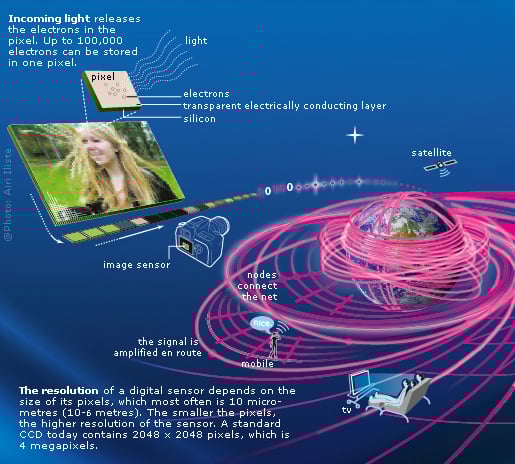
Half of the prize is awarded to Charles Kao who made a discovery that led to a breakthrough for fibre-optic communication. Today optical fibres make up the circulatory system that nourishes our information society. Light flows in threads of glass, as thin as a hair, which carries almost all of the telephony and data traffic in each and every direction. Without optical fibres there would be no internet nor broadband. A large share of the traffic is made up of digital images, which constitute the second part of the award. In 1969 Willard S. Boyle and George E. Smith invented the first successful imaging technology using a digital sensor, a CCD (Charge-Coupled Device). The CCD revolutionized photography, as light could now be captured electronically instead of on film.
The image sensor, CCD, is the advanced digital camera’s electronic eye. Incoming light releases electrons in the CCD’s photocells, the pixels. The more light, the more electrons are collected in
The CCD array is read out row by row. Electrons slide off the array onto an electronic conveyor belt and are subsequently translated into digital ones and zeros. This digital form makes it easy to manipulate and transfer the images.
Every pixel is a silicon mini-capacitor built in layers that collects the electrons. A variable electric voltage is used for reading out the pixels. In this simple but ingenious way, almost the entire area of the sensor is used to collect light, creating the high performance of the CCD.
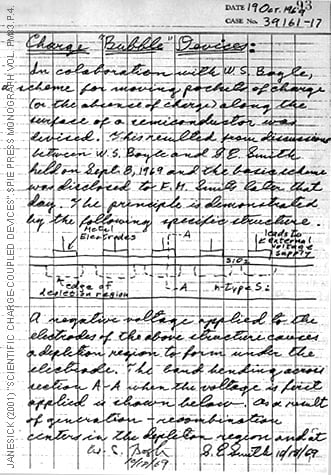
Original notes. During a short brainstorm meeting on September 8, 1969 (according to the notes), Willard Boyle and George Smith made the first sketch of a CCD. Photography was not what they had in mind, but very soon CCD became the first truly successful technology for the digital recording of images.
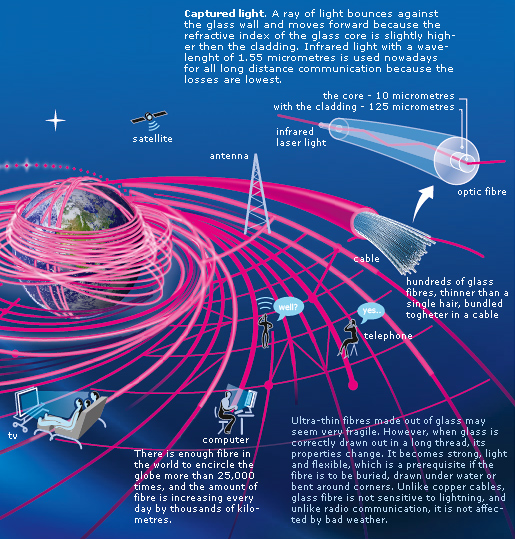
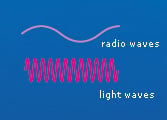
Compared to radio waves, light carries tens of thousands times more information because of its much higher frequencies. But ways to transmit light signals over longer distances were still not known in the first half of the 1960’s. After just 20 metres, only 1 percent of the light that had entered a glass fibre remained. Reducing this loss of light became a challenge for a visionary like Charles Kao.
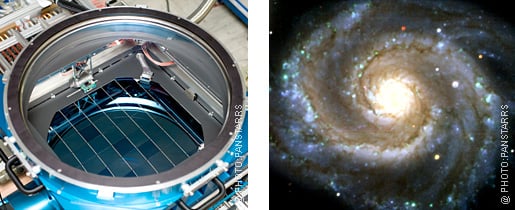
Early on, astronomers realized the advantages of the digital image sensor. It spans the entire light spectrum, from X-ray to infrared. It is a much more sensitive than photographic film: out of 100 incoming light particles, CCD catches up to 90, whereas photographic film will only catch one.
Left: the world’s largest digital camera ever, built at the University of Hawaii. Its 40 square centimetres surface contains 64 x 64 CCDs, 1.4 billion pixels in total. Astronomers hope that telescopes equipped with such cameras will find 5,000 new supernovas as well as detect asteroids in potentially threatening trajectories towards Earth.
Right: spiral galaxy M51 in the constellation Canes Venatici is one of the first images taken with this digital camera.
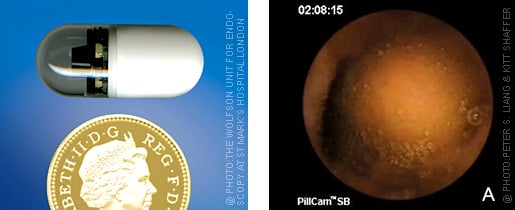
Medicine. CCD technology is used in a host of medical applications, e.g. imaging the inside of the human body, both for surgical operations and for diagnostics such as endoscopy.
Left: endoscopy capsule carrying a digital camera and a radio transmitter. Once swallowed by the patient, the capsule wanders along the digestion system and sends images like this from a 21 year old woman with cancer of the small intestine, right.
 |
||
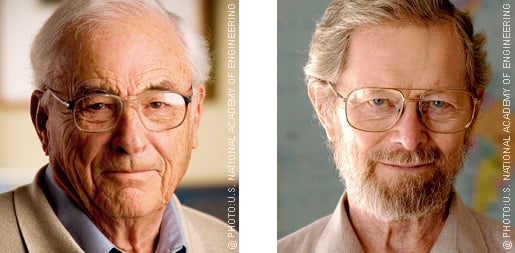
Willard BoyleCanadian and US citizen. Willard Boyle was born in Nova Scotia, Canada, and was educated at home by his mother until the age of 15. He began to work at Bell Labs in 1953, and in the 1960’s he joined the 400,000 scientists in the USA whose efforts were to put the first man on the moon on 20 July 1969. |
George SmithUS citizen. Born 1930 in White Plains, NY, USA. George Smith was hired at Bell Labs in 1959, and took out thirty patents during his time at the company. When he retired in 1986, he could finally dedicate himself fully to his life-long passion – sailing on the great seas, which has brought him around the globe many times. |
|
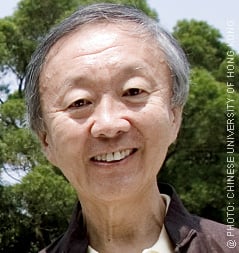
Charles Kao
British and US citizen. Born 1933 in Shanghai, China.
Charles Kao was born in 1933 in Shanghai. He moved to Hong Kong together with his family in 1948. Educated as an electronics engineer, he defended his Ph.D. thesis in 1965 in London. By that time he was already employed at the Standard Telecommunication Laboratories, where he meticulously studied glass fibre together with his young colleague George A. Hockham. In January 1966, he presented his conclusions. It was not imperfections in the fibre thread that was the main problem, instead it was the glass that had to be purified. The goal was to manufacture glass of a transparency that had never been attained before. Four years later the first fibres that fulfilled Kao’s vision were developed. Nowadays, several terabits per second can be transmitted in a single fibre. This represents an increase by a factor of one million to what could be achieved fifty years ago with radio signal transmission.
Further reading!
Information on the Nobel Prize in Physics 2009: http://kva.se, http://nobelprize.org
Smith, G.E. (2009) The invention and early history of the CCD. Nuclear Instruments and Methods in Physics Research A, 607, pp. 1–6.
Janesick, J.R. (2001) Scientific Charge-Coupled Devices. SPIE Press Monograph Vol. PM83.
Hecht, J. (1991) City of Light: The Story of Fiber Optics. Oxford University Press.
Su, F. (1990) Technology of our times: people and innovation in optics and optoelectronics. SPIE Press, pp. 80–95.
Scientific articles:
Kao, C. K., Hockham, G.A. (1966) Dielectric-fibre Surface Waveguides for Optical Frequencies. Proceedings of the Institution of Electrical Engineers-London 113, p. 1151.
Boyle, W.S., Smith, G.E. (1970) Charge Couple Semiconductor Devices. Bell System Technical Journal 49, p. 587.
Link:
www.jyi.org/volumes/volume3/issue1/features/peterson.html
Credits and references for the 2009 Nobel Poster for Physics
Editors: Joseph Nordgren, Chair, Lars Bergström, Secr., Anne L’Huillier and Ingemar Lundström, Members, the Nobel Committee for Physics, Joanna Rose, Science Journalist, Annika Moberg, Editor and Ylva Sjöberg, Nobel Assistant, The Royal Swedish Academy of Sciences.
Illustration: Airi Iliste
Layout: Typoform
Printing: Åtta.45 Tryckeri AB
Copyright © The Royal Swedish Academy of Sciences
Box 50005, SE-104 05 Stockholm, Sweden
Phone:+46 8 673 95 00, fax: +46 8 15 56 70
e-mail: [email protected], http://kva.se/
Posters may be ordered free of charge by e-mail to [email protected], phone or fax.
Web adapted version: Nobelprize.org
Useful Links / Further Reading

| The Nobel Laureates |
| Charles K. Kao, Standard Telecommunication Laboratories, Harlow, UK, and Chinese University of Hong Kong |
| Willard S. Boyle, Bell Laboratories, Murray Hill, NJ, USA |
| George E. Smith, Bell Laboratories, Murray Hill, NJ, USA |
| Popular science |
| Smith, G.E. (2009) The invention and early history of the CCD. Nuclear Instruments and Methods in Physics Research A, 607, p. 1–6. |
| Janesick, J.R. (2002) Duelling Detectors. SPIE’s oemagazine, February, p. 30-33. |
| Janesick, J.R. (2001) Scientific Charge-Coupled Devices. SPIE Press Monograph, Vol. PM83. |
| Hecht, J. (1991) City of Light: The Story of Fiber Optics. Oxford University Press. |
| Su, F. (1990) Technology of our times: people and innovation in optics and optoelectronics. SPIE Press, p. 80–95. |
| Scientific articles |
| Kao, C.K. , Hockham, G.A. (1966) Dielectric-fibre Surface Waveguides for Optical Frequencies. Proceedings of the Institution of Electrical Engineers-London 113, p. 1151. |
| Boyle, W.S., Smith, G.E. (1970) Charge Couple Semiconductor Devices. Bell System Technical Journal 49, p. 587. |
| Links |
| www.fiber-optics.info |
| www.jyi.org/volumes/volume3/issue1/features/peterson.html |
George E. Smith – Banquet speech
Your Majesties, Your Royal Highnesses, Ladies and Gentlemen,
First, Willard Boyle and I would like to sincerely thank the Nobel Committee and the Royal Swedish Academy of Sciences for bestowing this great honor upon us. I am sure that Bill will agree with me that it comes as the supreme highpoint of our professional lives. And I’m certain that Professor Kao feels the same way.
It is heartening for us to see that the use of the CCD as solid state imaging devices initiated a revolution in which photographic film and electron beam imaging tubes were relegated to history. As part of the accelerating rise in information technology, it has helped transform the way we live our lives. Think of snapping a photo with your cell phone and instantly sending it to a friend thousands of miles away instead of finishing the roll of film, having it developed, putting it in an envelope and posting it to a far away country. Much easier to forget about it. The device is being used in many other applications including TV cameras, satellite surveillance and a variety of medical imaging applications. The one application which makes maximum use of the devices characteristics is in astronomy. CCD’s have been used to gaze much deeper and more accurately into the universe than ever before. This has resulted from the increased efficiency, lower noise, and larger dynamic range using CCDs than that which can be attained with photographic film. Also, the fact that you are using the same detector with each exposure allows you to correct for systematic errors in the CCD. No device is ever perfect nor is photographic film. Photographic film is a different detector with every shot. I was once thanked by a young astronomer for originating the device that created an avalanche of new data and made creating an original thesis project much, much easier. I have also been thanked by mobile TV cameraman for the big reduction in weight of their load.
In conclusion, I would like to extend our thanks to Bell Labs for providing the environment in which the inception of the CCD took place and to the Nobel Committee for recognizing this achievement.
George E. Smith – Prize presentation
Watch a video clip of the 2009 Nobel Laureate in Physics, George E. Smith, receiving his Nobel Prize medal and diploma during the Nobel Prize Award Ceremony at the Concert Hall in Stockholm, Sweden, on 10 December 2009.
Charles K. Kao – Photo gallery
Charles K. Kao receiving his Nobel Prize from His Majesty King Carl XVI Gustaf of Sweden at the Stockholm Concert Hall, 10 December 2009.
Copyright © The Nobel Foundation 2009
Charles K. Kao after receiving his Nobel Prize at the Stockholm Concert Hall, 10 December 2009.
Copyright © The Nobel Foundation 2009
Close-up of the Nobel Laureates in Physics (from left to right): Charles K. Kao, Willard S. Boyle and George E. Smith.
Copyright © The Nobel Foundation 2009
The 2009 Nobel Laureates stand for the Swedish national anthem (from left to right): Charles K. Kao, Willard S. Boyle, George E. Smith, Venkatraman Ramakrishnan, Thomas A. Steitz, Ada E. Yonath, Elizabeth H. Blackburn, Carol W. Greider, Jack W. Szostak, Herta Müller, Elinor Ostrom and Oliver E. Williamson.
Copyright © The Nobel Foundation 2009
Charles K. Kao, with his wife Mrs May W. Kao, after the Nobel Prize Award Ceremony.
Copyright © The Nobel Foundation 2009
Charles K. Kao (right), with his wife Mrs May W. Kao left) at the Nobel Banquet in the Stockholm City Hall, 10 December 2009.
Copyright © The Nobel Foundation 2009
From left to right: Crown Princess Victoria, Mrs Betty Boyle, Nobel Laureate Willard S. Boyle, Her Majesty Queen Silvia, His Majesty King Carl XVI Gustaf of Sweden, Nobel Laureate George E. Smith, Princess Madeleine, Nobel Laureate Charles K. Kao, Mrs May W. Kao, Mrs Janet L. Murphy, and Prince Carl Philip at the Nobel Banquet.
Copyright © The Nobel Foundation 2009
Charles K. Kao and his wife, Mrs May W. Kao, photographed by students after the Nobel Lecture in Stockholm, 8 December 2009.
Copyright © The Nobel Foundation 2009
Charles K. Kao, assisted by his wife, Mrs May W. Kao, signing autographs for enthusiastic students after the Nobel Lecture in Stockholm, 8 December 2009.
Copyright © The Nobel Foundation 2009
Charles K. Kao, Willard S. Boyle and George E. Smith after delivering their Nobel Lectures at the Aula Magna, Stockholm University, 8 December 2009. Professor Joseph Nordgren, Chairman of the Nobel Committee for Physics, is standing to the far left.
Copyright © The Nobel Foundation 2009
Charles K. Kao's Nobel Lecture was held by his wife, Mrs May W. Kao, at Aula Magna in Stockholm University on 8 December 2009.
Copyright © The Nobel Foundation 2009
Charles K. Kao and his wife, Mrs May W. Kao, during the reception at the Royal Swedish Academy of Sciences in Stockholm, 7 December 2009.
Copyright © The Nobel Foundation 2009
Mrs May W. Kao and Charles K. Kao during the interview with Nobelprize.org in Stockholm, 6 December 2009. The interviewer is Adam Smith, Editor-in-Chief of Nobelprize.org.
Copyright © Nobel Media AB 2009
Mrs May W. Kao and Charles K. Kao during the interview with Nobelprize.org in Stockholm, 6 December 2009.
Copyright © Nobel Media AB 2009
Charles K. Kao during the interview with Nobelprize.org in Stockholm, 6 December 2009.
Copyright © Nobel Media AB 2009
Like many Nobel Laureates before him, Charles K. Kao assisted by his wife Mrs May W. Kao, autographs a chair at Kafé Satir at the Nobel Museum in Stockholm, 6 December 2009.
Copyright © The Nobel Museum 2009
Photo: Jonas Ekströmer
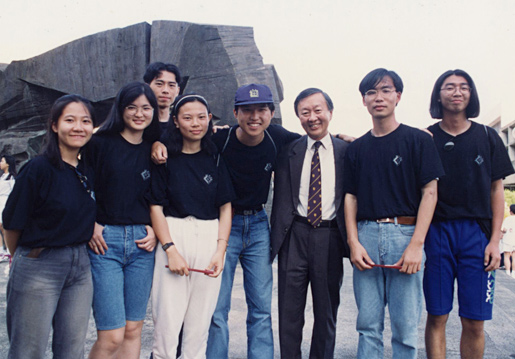
Professor Charles Kao (third from right) poses shoulder-to-shoulder with students from the Chinese University in Hong Kong on the first day of the 1994-95 academic year.
Copyright © The Chinese University of Hong Kong
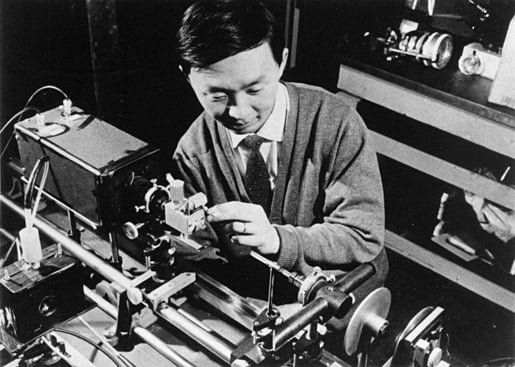
Flashback to 1960s: the then young scientist Charles Kao doing an early experiment on optical fibre at the Standard Telecommunications Laboratory at Harlow, United Kingdom.
Copyright © The Chinese University of Hong Kong
Portrait of Charles K. Kao.
Copyright © The Chinese University of Hong Kong
Photo: Hans Mehlin

Photo: Hans Mehlin
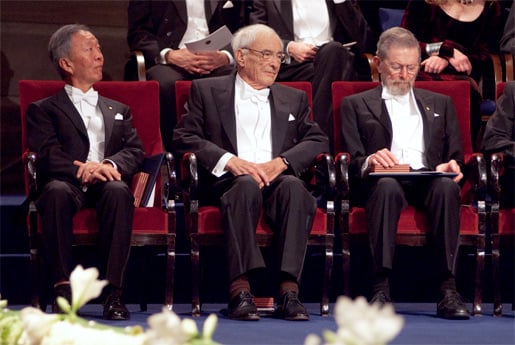
Photo: Hans Mehlin

Photo: Frida Westholm
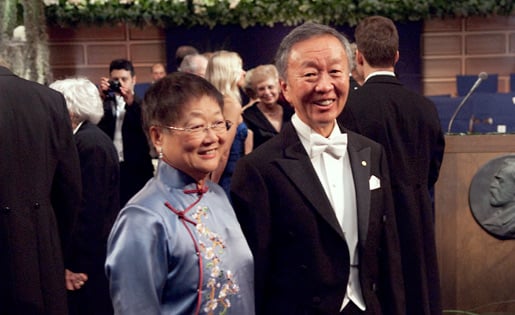
Photo: Hans Mehlin

Photo: Orasisfoto
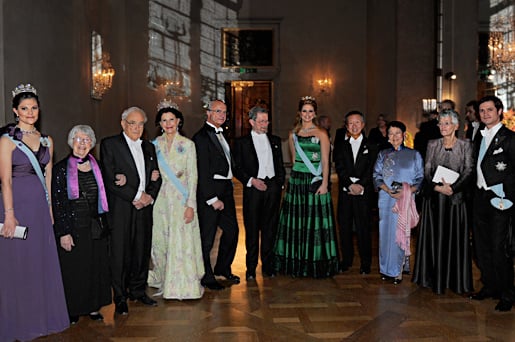
Photo: Orasisfoto
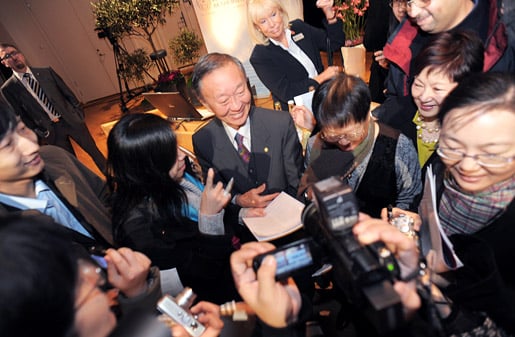
Photo: Orasisfoto
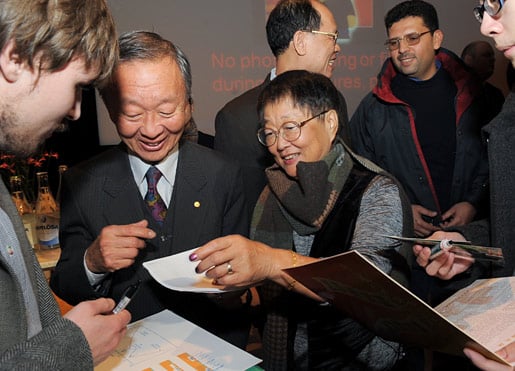
Photo: Orasisfoto
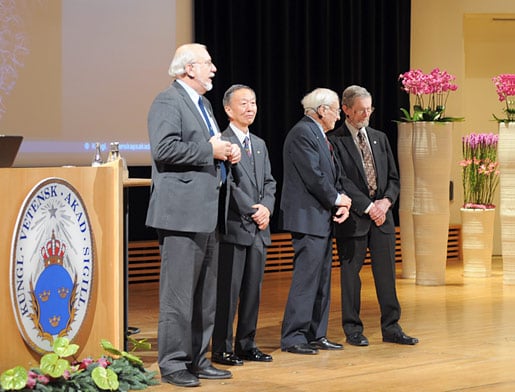
Photo: Orasisfoto

Photo: Orasisfoto

Photo: Orasisfoto

Photo: Niclas Enberg

Photo: Niclas Enberg

Photo: Niclas Enberg


Willard S. Boyle – Nobel diploma
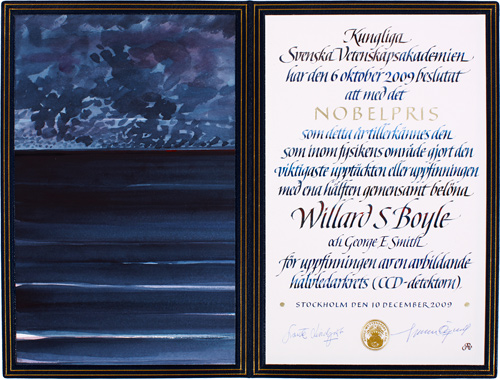
Copyright © The Nobel Foundation 2009
Artist: Sture Berglund
Calligrapher: Annika Rücker
Book binder: Ingemar Dackéus
Photo reproduction: Lovisa Engblom
Charles K. Kao – Nobel diploma
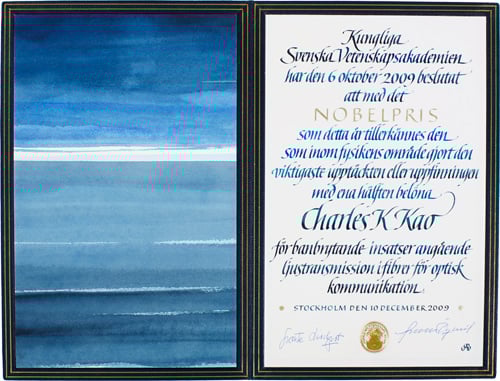
Copyright © The Nobel Foundation 2009
Artist: Sture Berglund
Calligrapher: Annika Rücker
Book binder: Ingemar Dackéus
Photo reproduction: Lovisa Engblom
George E. Smith – Nobel diploma
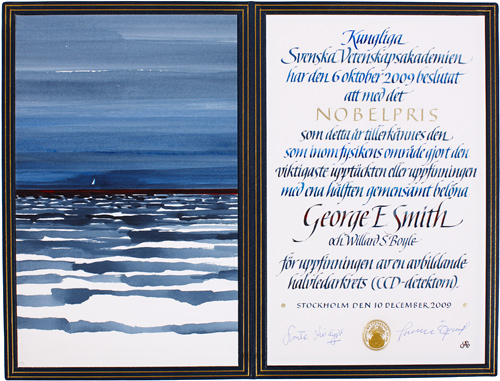
Copyright © The Nobel Foundation 2009
Artist: Sture Berglund
Calligrapher: Annika Rücker
Book binder: Ingemar Dackéus
Photo reproduction: Lovisa Engblom
Willard S. Boyle – Nobel Lecture
Willard S. Boyle delivered his Nobel Lecture on 8 December 2009, at Aula Magna, Stockholm University. He was introduced by Professor Joseph Nordgren, Chairman of the Nobel Committee for Physics.
Willard S. Boyle delivered his Nobel Lecture on 8 December 2009, at Aula Magna, Stockholm University. He was introduced by Professor Joseph Nordgren, Chairman of the Nobel Committee for Physics.
Read the Nobel Lecture
Pdf 1.28 MB