Octavio Paz – Photo gallery

1 (of 17) Octavio Paz receiving his Nobel Prize from H.M. King Carl XVI Gustaf of Sweden at the Stockholm Concert Hall, on 10 December 1990.
Nobel Foundation. Photo: Lars Åström

2 (of 17) Octavio Paz after receiving his Nobel Prize from H.M. King Carl XVI Gustaf of Sweden at the Stockholm Concert Hall, on 10 December 1990.
Nobel Foundation. Photo: Lars Åström

3 (of 17) All 1990 Nobel Prize laureates assembled on stage at the Nobel Prize award ceremony in Stockholm, Sweden on 10 December 1990: physics laureates Jerome I. Friedman, Henry W. Kendall and Richard E. Taylor, Chemistry laureate Elias James Corey, medicine laureates Joseph E. Murray and E. Donnall Thomas, literature laureate Octavio Paz and economic sciences laureates Harry M. Markowitz, Merton H. Miller and William F. Sharpe.
Nobel Foundation. Photo: Lars Åström

4 (of 17) Octavio Paz after the award ceremony at Konserthuset Stockholm on 10 December 1990.
Nobel Foundation. Photo: Lars Åström

5 (of 17) Sweden’s Princess Christina and Octavio Paz at the Nobel Prize banquet at the Stockholm City Hall, 10 December 1990.
Nobel Foundation. Photo: Lars Åström

6 (of 17) Octavio Paz at the Nobel Prize banquet at the Stockholm City Hall, 10 December 1990.
Nobel Foundation. Photo: Lars Åström

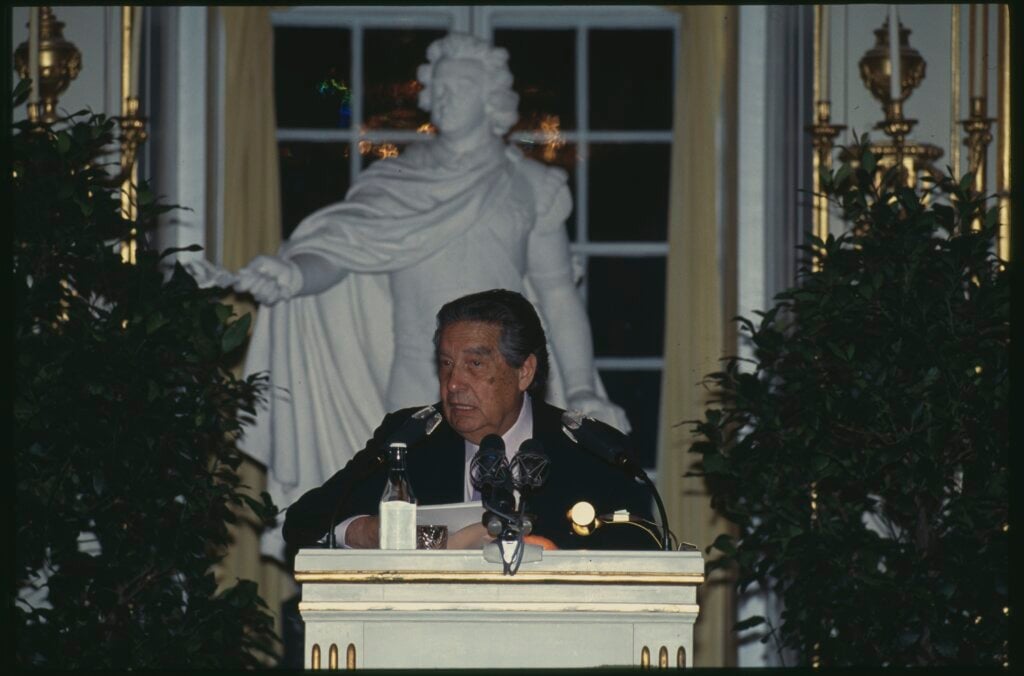
7 (of 17) Octavio Paz delivering his banquet speech at the Nobel Prize banquet at the Stockholm City Hall, 10 December 1990.
Nobel Foundation. Photo: Lars Åström

8 (of 17) Octavio Paz and his wife Marie José Tramini de Paz at the dance floor at the Nobel Banquet at the Stockholm City Hall, 10 December 1990.
Nobel Foundation. Photo: Lars Åström

9 (of 17) Octavio Paz and his wife Marie José Tramini de Paz dancing at the Nobel Banquet at the Stockholm City Hall, 10 December 1990.
Nobel Foundation. Photo: Lars Åström

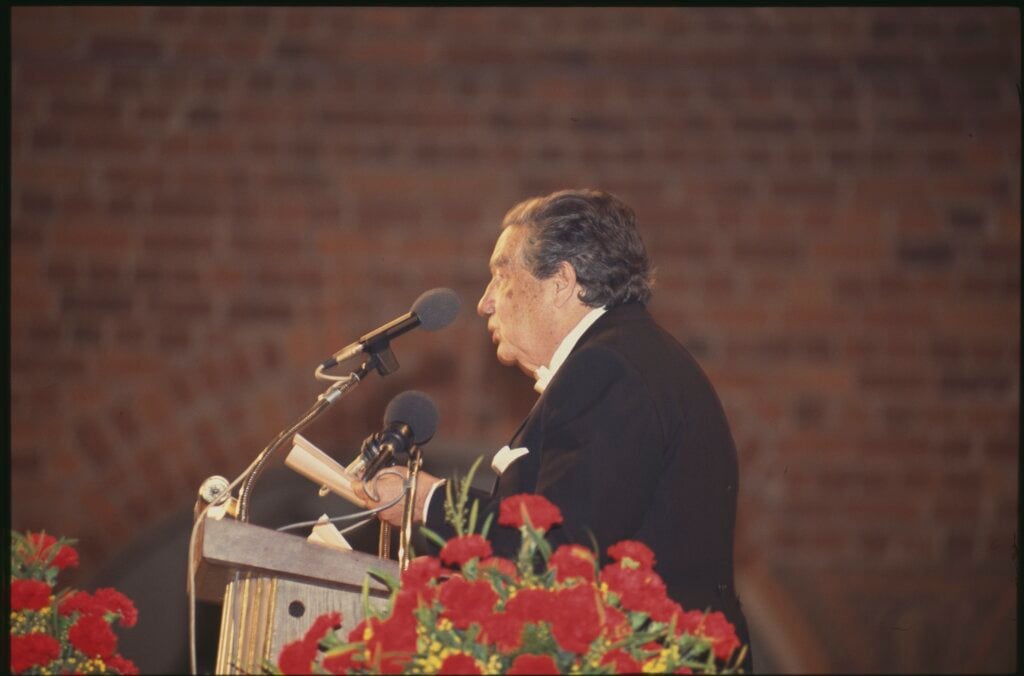
10 (of 17) Octavio Paz delivering his Nobel Prize lecture at the Swedish Academy on 8 December 1990.
Nobel Foundation. Photo: Lars Åström

11 (of 17) Octavio Paz delivering his Nobel Prize lecture.
Nobel Foundation. Photo: Lars Åström

12 (of 17) Octavio Paz photographed during Nobel Week in Stockholm, December 1990.
Nobel Foundation. Photo: Lars Åström

13 (of 17) Octavio Paz photographed during Nobel Week in Stockholm, December 1990.
Nobel Foundation. Photo: Lars Åström

14 (of 17) Octavio Paz signs the Nobel Foundation’s guest book, signed by the laureates since 1952, during his visit to the Nobel Foundation during Nobel Week in Stockholm, Sweden, December 1990.
Nobel Foundation. Photo: Lars Åström

15 (of 17) Octavio Paz takes a closer look at his Nobel Prize diploma during Nobel Week in Stockholm, Sweden, December 1990.
Nobel Foundation. Photo: Lars Åström

16 (of 17) Octavio Paz takes a closer look at his Nobel Prize medal during a visit to the Nobel Foundation during Nobel Week in Stockholm, Sweden, December 1990.
Nobel Foundation. Photo: Lars Åström

17 (of 17) Octavio Paz looking at his Nobel Prize medal during Nobel Week in Stockholm, Sweden, December 1990.
Nobel Foundation. Photo: Lars Åström
Octavio Paz – Nobel Lecture
English
Spanish
Conferencia Nobel 1990
La búsqueda del presente
Comienzo con una palabra que todos los hombres, desde que el hombre es hombre, han proferido: gracias. Es una palabra que tiene equivalentes en todas las lenguas. Y en todas es rica la gama de significados. En las lenguas romances va de lo espiritual a lo físico, de la gracia que concede Dios a los hombres para salvarlos del error y la muerte a la gracia corporal de la muchacha que baila o a la del felino que salta en la maleza. Gracia es perdón, indulto, favor, beneficio, nombre, inspiración, felicidad en el estilo de hablar o de pintar, ademán que revela las buenas maneras y, en fin, acto que expresa bondad de alma. La gracia es gratuita, es un don; aquel que lo recibe, el agraciado, si no es un mal nacido, lo agradece: da las gracias. Es lo que yo hago ahora con estas palabras de poco peso. Espero que mi emoción compense su levedad. Si cada una fuese una gota de agua, ustedes podrían ver, a través de ellas, lo que siento: gratitud, reconocimiento. Y también una indefinible mezcla de temor, respeto y sorpresa al verme ante ustedes, en este recinto que es, simultáneamente, el hogar de las letras suecas y la casa de la literatura universal.
Las lenguas son realidades más vastas que las entidades políticas e históricas que llamamos naciones. Un ejemplo de esto son las lenguas europeas que hablamos en América. La situación peculiar de nuestras literaturas frente a las de Inglaterra, España, Portugal y Francia depende precisamente de este hecho básico: son literaturas escritas en lenguas transplantadas. Las lenguas nacen y crecen en un suelo; las alimenta una historia común. Arrancadas de su suelo natal y de su tradición propia, plantadas en un mundo desconocido y por nombrar, las lenguas europeas arraigaron en las tierras nuevas, crecieron con las sociedades americanas y se transformaron. Son la misma planta y son una planta distinta. Nuestras literaturas no vivieron pasivamente las vicisitudes de las lenguas transplantadas: participaron en el proceso y lo apresuraron. Muy pronto dejaron de ser meros reflejos transatlánticos; a veces han sido la negación de las literaturas europeas y otras, con más frecuencia, su réplica.
A despecho de estos vaivenes, la relación nunca se ha roto. Mis clásicos son los de mi lengua y me siento descendiente de Lope y de Quevedo como cualquier escritor español … pero no soy español. Creo que lo mismo podrían decir la mayoría de los escritores hispanoamericanos y también los de los Estados Unidos, Brasil y Canadá frente a la tradición inglesa, portuguesa y francesa. Para entender más claramente la peculiar posición de los escritores americanos, basta con pensar en el diálogo que sostiene el escritor japonés, chino o árabe con esta o aquella literatura europea: es un diálogo a través de lenguas y de civilizaciones distintas. En cambio, nuestro diálogo se realiza en el interior de la misma lengua. Somos y no somos europeos. ¿Qué somos entonces? Es difícil definir lo que somos pero nuestras obras hablan por nosotros.
La gran novedad de este siglo, en materia literaria, ha sido la aparición de las literaturas de América. Primero surgió la angloamericana y después, en la segunda mitad del siglo XX, la de América Latina en sus dos grandes ramas, la hispanoamericana y la brasileña. Aunque son muy distintas, las tres literaturas tienen un rasgo en común: la pugna, más ideológica que literaria, entre las tendencias cosmopolitas y las nativistas, el europeísmo y el americanismo. ¿Qué ha quedado de esa disputa? Las polémicas se disipan; quedan las obras. Aparte de este parecido general, las diferencias entre las tres son numerosas y profundas. Una es de orden histórico más que literario: el desarrollo de la literatura angloamericana coincide con el ascenso histórico de los Estados Unidos como potencia mundial; el de la nuestra con las desventuras y convulsiones políticas y sociales de nuestros pueblos. Nueva prueba de los límites de los determinismos sociales e históricos; los crepúsculos de los imperios y las perturbaciones de las sociedades coexisten a veces con obras y momentos de esplendor en las artes y las letras: Li-Po y Tu Fu fueron testigos de la caída de los Tang, Velázquez fue el pintor de Felipe IV, Séneca y Lucano fueron contemporáneos y víctimas de Nerón. Otras diferencias son de orden literario y se refieren más a las obras en particular que al carácter de cada literatura. ¿Pero tienen carácter las literaturas, poseen un conjunto de rasgos comunes que las distingue unas de otras? No lo creo. Una literatura no se define por un quimérico, inasible carácter. Es una sociedad de obras únicas unidas por relaciones de oposición y afinidad.
La primera y básica diferencia entre la literatura latinoamericana y la angloamericana reside en la diversidad de sus orígenes. Unos y otros comenzamos por ser una proyección europea. Ellos de una isla y nosotros de una península. Dos regiones excéntricas por la geografía, la historia y la cultura. Ellos vienen de Inglaterra y la Reforma; nosotros de España, Portugal y la Contrarreforma. Apenas si debo mencionar, en el caso de los hispanoamericanos, lo que distingue a España de las otras naciones europeas y le otorga una notable y original fisonomía histórica. España no es menos excéntrica que Inglaterra aunque lo es de manera distinta. La excentricidad inglesa es insular y se caracteriza por el aislamiento: una excentricidad por exclusión. La hispana es peninsular y consiste en la coexistencia de diferentes civilizaciones y pasados: una excentricidad por inclusión. En lo que sería la católica España los visigodos profesaron la herejía de Arriano, para no hablar de los siglos de dominación de la civilización árabe, de la influencia del pensamiento judío, de la Reconquista y de otras peculiaridades.
En América la excentricidad hispánica se reproduce y se multiplica, sobre todo en países con antiguas y brillantes civilizaciones como México y Perú. Los españoles encontraron en México no sólo una geografía sino una historia. Esa historia está viva todavía: no es un pasado sino un presente. El México precolombino, con sus templos y sus dioses, es un montón de ruinas pero el espíritu que animó ese mundo no ha muerto. Nos habla en el lenguaje cifrado de los mitos, las leyendas, las formas de convivencia, las artes populares, las costumbres. Ser escritor mexicano significa oír lo que nos dice ese presente – esa presencia. Oírla, hablar con ella, descifrarla: decirla… Tal vez después de esta breve digresión sea posible entrever la extraña relación que, al mismo tiempo, nos une y separa de la tradición europea.
La conciencia de la separación es una nota constante de nuestra historia espiritual. A veces sentimos la separación como una herida y entonces se transforma en escisión interna, conciencia desgarrada que nos invita al examen de nosotros mismos; otras aparece como un reto, espuela que nos incita a la acción, a salir al encuentro de los otros y del mundo. Cierto, el sentimiento de la separación es universal y no es privativo de los hispanoamericanos. Nace en el momento mismo de nuestro nacimiento: desprendidos del todo caemos en un suelo extraño. Esta experiencia se convierte en una llaga que nunca cicatriza. Es el fondo insondable de cada hombre; todas nuestras empresas y acciones, todo lo que hacemos y soñamos, son puentes para romper la separación y unirnos al mundo y a nuestros semejantes. Desde esta perspectiva, la vida de cada hombre y la historia colectiva de los hombres pueden verse como tentativas destinadas a reconstruir la situación original. Inacabada e inacabable cura de la escisión. Pero no me propongo hacer otra descripción, una más, de este sentimiento. Subrayo que entre nosotros se manifiesta sobre todo en términos históricos. Así, se convierte en conciencia de nuestra historia. ¿Cuando y cómo aparece este sentimiento y cómo se transforma en conciencia? La respuesta a esta doble pregunta puede consistir en una teoría o en un testimonio personal. Prefiero lo segundo: hay muchas teorías y ninguna del todo confiable.
El sentimiento de separación se confunde con mis recuerdos más antiguos y confusos: con el primer llanto, con el primer miedo. Como todos los niños, construí puentes imaginarios y afectivos que me unían al mundo y a los otros. Vivía en un pueblo de las afueras de la ciudad de México, en una vieja casa ruinosa con un jardín selvático y una gran habitación llena de libros. Primeros juegos, primeros aprendizajes. El jardín se convirtió en el centro del mundo y la biblioteca en caverna encantada. Leía y jugaba con mis primos y mis compañeros de escuela. Había una higuera, templo vegetal, cuatro pinos, tres fresnos, un huele-de-noche, un granado, herbazales, plantas espinosas que producían rozaduras moradas. Muros de adobe. El tiempo era elástico; el espacio, giratorio. Mejor dicho: todos los tiempos, reales o imaginarios, eran ahora mismo; el espacio, a su vez, se transformaba sin cesar: allá era aquí: todo era aquí: un valle, una montaña, un país lejano, el patio de los vecinos. Los libros de estampas, particularmente los de historia, hojeados con avidez, nos proveían de imágenes: desiertos y selvas, palacios y cabañas, guerreros y princesas, mendigos y monarcas. Naufragamos con Simbad y con Robinson, nos batimos con Artagnan, tomamos Valencia con el Cid. ¡Cómo me hubiera gustado quedarme para siempre en la isla de Calipso! En verano la higuera mecía todas sus ramas verdes como si fuesen las velas de una carabela o de un barco pirata; desde su alto mástil, batido por el viento, descubrí islas y continentes – tierras que apenas se desvanecían. El mundo era ilimitado y, no obstante, siempre al alcance de la mano; el tiempo era una substancia maleable y un presente sin fisuras.
¿Cuando se rompió el encanto? No de golpe: poco a poco. Nos cuesta trabajo aceptar que el amigo nos traiciona, que la mujer querida nos engaña, que la idea libertaria es la máscara del tirano. Lo que se llama “caer en la cuenta” es un proceso lento y sinuoso porque nosotros mismos somos cómplices de nuestros errores y engaños. Sin embargo, puedo recordar con cierta claridad un incidente que, aunque pronto olvidado, fue la primera señal. Tendría unos seis años y una de mis primas, un poco mayor que yo, me enseñó una revista norteamericana con una fotografía de soldados desfilando por una gran avenida, probablemente de Nueva York. “Vuelven de la guerra”, me dijo. Esas pocas palabras me turbaron como si anunciasen el fin del mundo o el segundo advenimiento de Cristo. Sabía, vagamente, que allá lejos, unos años antes, había terminado una guerra y que los soldados desfilaban para celebrar su victoria; para mí aquella guerra había pasado en otro tiempo, no ahora ni aquí. La foto me desmentía. Me sentí, literalmente, desalojado del presente.
Desde entonces el tiempo comenzó a fracturarse más y más. Y el espacio, los espacios. La experiencia se repitió una y otra vez. Una noticia cualquiera, una frase anodina, el titular de un diario, una canción de moda: pruebas de la existencia del mundo de afuera y revelaciones de mi irrealidad. Sentí que el mundo se escindía: yo no estaba en el presente. Mi ahora se disgregó: el verdadero tiempo estaba en otra parte. Mi tiempo, el tiempo del jardín, la higuera, los juegos con los amigos, el sopor bajo el sol de las tres de la tarde entre las yerbas, el higo entreabierto – negro y rojizo como un ascua pero un ascua dulce y fresca – era un tiempo ficticio. A pesar del testimonio de mis sentidos, el tiempo de allá, el de los otros, era el verdadero, el tiempo del presente real. Acepté lo inaceptable: fui adulto. Así comenzó mi expulsión del presente.
Decir que hemos sido expulsados del presente puede parecer una paradoja. No: es una experiencia que todos hemos sentido alguna vez; algunos la hemos vivido primero como una condena y después transformada en conciencia y acción. La búsqueda del presente no es la búsqueda del edén terrestre ni de la eternidad sin fechas: es la búsqueda de la realidad real. Para nosotros, hispanoamericanos, ese presente real no estaba en nuestros países: era el tiempo que vivían los otros, los ingleses, los franceses, los alemanes. El tiempo de Nueva York, París, Londres. Había que salir en su busca y traerlo a nuestras tierras. Esos años fueron también los de mi descubrimiento de la literatura. Comencé a escribir poemas. No sabía qué me llevaba a escribirlos: estaba movido por una necesidad interior difícilmente definible. Apenas ahora he comprendido que entre lo que he llamado mi expulsión del presente y escribir poemas había una relación secreta. La poesía está enamorada del instante y quiere revivirlo en un poema; lo aparta de la sucesión y lo convierte en presente fijo. Pero en aquella época yo escribía sin preguntarme por qué lo hacía. Buscaba la puerta de entrada al presente: quería ser de mi tiempo y de mi siglo. Un poco después esta obsesión se volvió idea fija: quise ser un poeta moderno. Comenzó mi búsqueda de la modernidad.
¿Qué es la modernidad? Ante todo, es un término equívoco: hay tantas modernidades como sociedades. Cada una tiene la suya. Su significado es incierto y arbitrario, como el del período que la precede, la Edad Media. Si somos modernos frente al medievo, ¿seremos acaso la Edad Media de una futura modernidad? Un nombre que cambia con el tiempo, ¿es un verdadero nombre? La modernidad es una palabra en busca de su significado: ¿es una idea, un espejismo o un momento de la historia? ¿Somos hijos de la modernidad o ella es nuestra creación? Nadie lo sabe a ciencia cierta. Poco importa: la seguimos, la perseguimos. Para mí, en aquellos años, la modernidad se confundía con el presente o, más bien, lo producía: el presente era su flor extrema y última. Mi caso no es único ni excepcional: todos los poetas de nuestra época, desde el período simbolista, fascinados por esa figura a un tiempo magnética y elusiva, han corrido tras ella. El primero fue Baudelaire. El primero también que logró tocarla y así descubrir que no es sino tiempo que se deshace entre las manos. No referiré mis aventuras en la persecusión de la modernidad: son las de casi todos los poetas de nuestro siglo. La modernidad ha sido una pasión universal. Desde 1850 ha sido nuestra diosa y nuestro demonio. En los últimos años se ha pretendido exorcizarla y se habla mucho de la “postmodernidad”. ¿Pero qué es la postmodernidad sino una modernidad aún más moderna?
Para nosotros, latinoamericanos, la búsqueda de la modernidad poética tiene un paralelo histórico en las repetidas y diversas tentativas de modernización de nuestras naciones. Es una tendencia que nace a fines del siglo XVIII y que abarca a la misma España. Los Estados Unidos nacieron con la modernidad y ya para 1830, como lo vio Tocqueville, eran la matriz del futuro; nosotros nacimos en el momento en que España y Portugal se apartaban de la modernidad. De ahí que a veces se hablase de “europeizar” a nuestros países: lo moderno estaba afuera y teníamos que importarlo. En la historia de México el proceso comienza un poco antes de las guerras de Independencia; más tarde se convierte en un gran debate ideológico y político que divide y apasiona a los mexicanos durante el siglo XIX. Un episodio puso en entredicho no tanto la legitimidad del proyecto reformador como la manera en que se había intentado realizarlo: la Revolución mexicana. A diferencia de las otras revoluciones del siglo XX, la de México no fue tanto la expresión de una ideología más o menos utópica como la explosión de una realidad histórica y psíquica oprimida. No fue la obra de un grupo de ideólogos decididos a implantar unos principios derivados de una teoría política; fue un sacudimiento popular que mostró a la luz lo que estaba escondido. Por esto mismo fue, tanto o más que una revolución, una revelación. México buscaba al presente afuera y lo encontró adentro, enterrado pero vivo. La búsqueda de la modernidad nos llevó a descubrir nuestra antigüedad, el rostro oculto de la nación. Inesperada lección histórica que no sé si todos han aprendido: entre tradición y modernidad hay un puente. Aisladas, las tradiciones se petrifican y las modernidades se volatilizan; en conjunción, una anima a la otra y la otra le responde dándole peso y gravedad.
La búsqueda de la modernidad poética fue una verdadera quéte, en el sentido alegórico y caballeresco que tenía esa palabra en el siglo XII. No rescaté ningún Grial, aunque recorrí varias waste lands, visité castillos de espejos y acampé entre tribus fantasmales. Pero descubrí a la tradición moderna. Porque la modernidad no es una escuela poética sino un linaje, una familia esparcida en varios continentes y que durante dos siglos ha sobrevivido a muchas vicisitudes y desdichas: la indiferencia pública, la soledad y los tribunales de las ortodoxias religiosas, políticas, académicas y sexuales. Ser una tradición y no una doctrina le ha permitido, simultáneamente, permanecer y cambiar. También le ha dado diversidad: cada aventura poética es distinta y cada poeta ha plantado un árbol diferente en este prodigioso bosque parlante. Si las obras son diversas y los caminos distintos, ¿qué une a todos estos poetas? No una estética sino la búsqueda. Mi búsqueda no fue quimérica, aunque la idea de modernidad sea un espejismo, un haz de reflejos. Un día descubrí que no avanzaba sino que volvía al punto de partida: la búsqueda de la modernidad era un descenso a los orígenes. La modernidad me condujo a mi comienzo, a mi antigüedad. La ruptura se volvió reconciliación. Supe así que el poeta es un latido en el río de las generaciones.
*
La idea de modernidad es un sub-producto de la concepción de la historia como un proceso sucesivo, lineal e irrepetible. Aunque sus orígenes están en el judeocristianismo, es una ruptura con la doctrina cristiana. El cristianismo desplazó al tiempo cíclico de los paganos: la historia no se repite, tuvo un principio y tendrá un fin; el tiempo sucesivo fue el tiempo profano de la historia, teatro de las acciones de los hombres caídos, pero sometido al tiempo sagrado, sin principio ni fin. Después del Juicio Final, lo mismo en el cielo que en el infierno, no habrá futuro. En la Eternidad no sucede nada porque todo es. Triunfo del ser sobre el devenir. El tiempo nuevo, el nuestro, es lineal como el cristiano pero abierto al infinito y sin referencia a la Eternidad. Nuestro tiempo es el de la historia profana. Tiempo irreversible y perpetuamente inacabado, en marcha no hacia su fin sino hacia el porvenir. El sol de la historia se llama futuro y el nombre del movimiento hacia el futuro es Progreso.
Para el cristiano, el mundo – o como antes se decía: el siglo, la vida terrenal – es un lugar de prueba: las almas se pierden o se salvan en este mundo. Para la nueva concepción, el sujeto histórico no es el alma individual sino el género humano, a veces concebido como un todo y otras a través de un grupo escogido que lo representa: las naciones adelantadas de Occidente, el proletariado, la raza blanca o cualquier otro ente. La tradición filosófica pagana y cristiana había exaltado al Ser, plenitud henchida, perfección que no cambia nunca; nosotros adoramos al Cambio, motor del progreso y modelo de nuestras sociedades. El Cambio tiene dos modos privilegiados de manifestación: la evolución y la revolución, el trote y el salto. La modernidad es la punta del movimiento histórico, la encarnación de la evolución o de la revolución, las dos caras del progreso. Por último, el progreso se realiza gracias a la doble acción de la ciencia y de la técnica, aplicadas al dominio de la naturaleza y a la utilización de sus inmensos recursos.
El hombre moderno se ha definido como un ser histórico. Otras sociedades prefirieron definirse por valores e ideas distintas al cambio: los griegos veneraron a la Polis y al círculo pero ignoraron al progreso, a Séneca le desvelaba, como a todos los estoicos, el eterno retorno, San Agustín creía que el fin del mundo era inminente, Santo Tomás construyó una escala – los grados del ser – de la criatura al Creador y así sucesivamente. Una tras otra esas ideas y creencias fueron abandonadas. Me parece que comienza a ocurrir lo mismo con la idea del Progreso y, en consecuencia, con nuestra visión del tiempo, de la historia y de nosotros mismos. Asistimos al crepúsculo del futuro. La baja de la idea de modernidad, y la boga de una noción tan dudosa como “postmodernidad”, no son fenómenos que afecten únicamente a las artes y a la literatura: vivimos la crisis de las ideas y creencias básicas que han movido a los hombres desde hace más de dos siglos. En otras ocasiones me he referido con cierta extensión al tema. Aquí sólo puedo hacer un brevísimo resumen.
En primer término: está en entredicho la concepción de un proceso abierto hacia el infinito y sinónimo de progreso continuo. Apenas si debo mencionar lo que todos sabemos: los recursos naturales son finitos y un día se acabarán. Además, hemos causado daños tal vez irreparables al medio natural y la especie misma está amenazada. Por otra parte, los instrumentos del progreso – la ciencia y la técnica – han mostrado con terrible claridad que pueden convertirse fácilmente en agentes de destrucción. Finalmente, la existencia de armas nucleares es una refutación de la idea de progreso inherente a la historia. Una refutación, añado, que no hay más remedio que llamar devastadora.
En segundo término: la suerte del sujeto histórico, es decir, de la colectividad humana, en el siglo XX. Muy pocas veces los pueblos y los individuos habían sufrido tanto: dos guerras mundiales, despotismos en los cinco continentes, la bomba atómica y, en fin, la multiplicación de una de las instituciones más crueles y mortíferas que han conocido los hombres, el campo de concentración. Los beneficios de la técnica moderna son incontables pero es imposible cerrar los ojos ante las matanzas, torturas, humillaciones, degradaciones y otros daños que han sufrido millones de inocentes en nuestro siglo.
En tercer término: la creencia en el progreso necesario. Para nuestros abuelos y nuestros padres las ruinas de la historia – cadáveres, campos de batalla desolados, ciudades demolidas – no negaban la bondad esencial del proceso histórico. Los cadalsos y las tiranías, las guerras y la barbarie de las luchas civiles eran el precio del progreso, el rescate de sangre que había que pagar al dios de la historia. ¿Un dios? Si, la razón misma, divinizada y rica en crueles astucias, según Hegel. La supuesta racionalidad de la historia se ha evaporado. En el dominio mismo del orden, la regularidad y la coherencia – en las ciencias exactas y en la física – han reaparecido las viejas nociones de accidente y de catástrofe. Inquietante resurrección que me hace pensar en los terrores del Año Mil y en la angustia de los aztecas al fin de cada ciclo cósmico.
Y para terminar esta apresurada enumeración: la ruina de todas esas hipótesis filosóficas e históricas que pretendían conocer las leyes de desarrollo histórico. Sus (reyentes, confiados en que eran dueños de las llaves de la historia, edificaron poderosos estados sobre pirámides de cadáveres. Esas orgullosas construcciones, destinadas en teoría a liberar a los hombres, se convirtieron muy pronto en cárceles gigantescas. Hoy las hemos visto caer; las echaron abajo no los enemigos idelógicos sino el cansancio y el afán libertario de las nuevas generaciones. ¿Fin de las utopías? Más bien: fin de la idea de la historia como un fenómeno cuyo desarrollo se conoce de antemano. El determinismo histórico ha sido una costosa y sangrienta fantasía. La historia es imprevisible porque su agente, el hombre, es la indeterminación en persona.
Este pequeño repaso muestra que, muy probablemente, estamos al fin de un período histórico y al comienzo de otro. ¿Fin o mutación de la Edad Moderna? Es difícil saberlo. De todos modos, el derrumbe de las utopías ha dejado un gran vacío, no en los países en donde esa ideología ha hecho sus pruebas y ha fallado sino en aquellos en los que muchos la abrazaron con entusiasmo y esperanza. Por primera vez en la historia los hombres viven en una suerte de intemperie espiritual y no, como antes, a la sombra de esos sistemas religiosos y políticos que, simultáneamente, nos oprimían y nos consolaban. Las sociedades son históricas pero todas han vivido guiadas e inspiradas por un conjunto de creencias e ideas metahistóricas. La nuestra es la primera que se apresta a vivir sin una doctrina metahistórica; nuestros absolutos – religiosos o filosóficos, éticos o estéticos – no son colectivos sino privados. La experiencia es arriesgada. Es imposible saber si las tensiones y conflictos de esta privatización de ideas, prácticas y creencias que tradicionalmente pertenecían a la vida pública no terminará por quebrantar la fábrica social. Los hombres podrían ser poseídos nuevamente por las antiguas furias religiosas y por los fanatismos nacionalistas. Sería terrible que la caída del ídolo abstracto de la ideología anunciase la resurrección de las pasiones enterradas de las tribus, las sectas y las iglesias. Por desgracia, los signos son inquietantes.
La declinación de las ideologías que he llamado metahistóricas, es decir, que asignan un fin y una dirección a la historia, implica el tácito abandono de soluciones globales. Nos inclinamos más y más, con buen sentido, por remedios limitados para resolver problemas concretos. Es cuerdo abstenerse de legislar sobre el porvenir. Pero el presente require no solamente atender a sus necesidades inmediatas: también nos pide una reflexión global y más rigurosa. Desde hace mucho creo, y lo creo firmemente, que el ocaso del futuro anuncia el advenimiento del hoy. Pensar el hoy significa, ante todo, recobrar la mirada critica. Por ejemplo, el triunfo de la economía de mercado – un triunfo por default del adversario – no puede ser únicamente motivo de regocijo. El mercado es un mecanismo eficaz pero, como todos los mecanismos, no tiene conciencia y tampoco misericordia. Hay que encontrar la manera de insertarlo en la sociedad para que sea la expresión del pacto social y un instrumento de justicia y equidad. Las sociedades democráticas desarrolladas han alcanzado una prosperidad envidiable; asimismo, son islas de abundancia en el océano de la miseria universal. El tema del mercado tiene una relación muy estrecha con el deterioro del medio ambiente. La contaminación no sólo infesta al aire, a los ríos y a los bosques sino a las almas. Una sociedad poseída por el frenesí de producir más para consumir más tiende a convertir las ideas, los sentimientos, el arte, el amor, la amistad y las personas mismas en objetos de consumo. Todo se vuelve cosa que se compra, se usa y se tira al basurero. Ninguna sociedad había producido tantos desechos como la nuestra. Desechos materiales y morales.
La reflexión sobre el ahora no implica renuncia al futuro ni olvido del pasado: el presente es el sitio de encuentro de los tres tiempos. Tampoco puede confundirse con un fácil hedonismo. El árbol del placer no crece en el pasado o en el futuro sino en el ahora mismo. También la muerte es un fruto del presente. No podemos rechazarla: es parte de la vida. Vivir bien exige morir bien. Tenemos que aprender a mirar de frente a la muerte. Alternativamente luminoso y sombrío, el presente es una esfera donde se unen las dos mitades, la acción y la contemplación. Así como hemos tenido filosofías del pasado y del futuro, de la eternidad y de la nada, mañana tendremos una filosofía del presente. La experiencia poética puede ser una de sus bases. ¿Qué sabemos del presente? Nada o casi nada. Pero los poetas saben algo: el presente es el manantial de las presencias.
En mi peregrinación en busca de la modernidad me perdí y me encontré muchas veces. Volví a mi origen y descubrí que la modernidad no está afuera sino adentro de nosotros. Es hoy y es la antigüedad más antigua, es mañana y es el comienzo del mundo, tiene mil años y acaba de nacer. Habla en náhuatl, traza ideogramas chinos del siglo IX y aparece en la pantalla de televisión. Presente intacto, recién desenterrado, que se sacude el polvo de siglos, sonríe y, de pronto, se echa a volar y desaparece por la ventana. Simultaneidad de tiempos y de presencias: la modernidad rompe con el pasado inmediato sólo para rescatar al pasado milenario y convertir a una figurilla de fertilidad del neolítico en nuestra contemporánea. Perseguimos a la modernidad en sus incesantes metamorfosis y nunca logramos asirla. Se escapa siempre: cada encuentro es una fuga. La abrazamos y al punto se disipa: sólo era un poco de aire. Es el instante, ese pájaro que está en todas partes y en ninguna. Queremos asirlo vivo pero abre las alas y se desvanece, vuelto un puñado de sílabas. Nos quedamos con las manos vacías. Entonces las puertas de la percepción se entreabren y aparece el otro tiempo, el verdadero, el que buscábamos sin saberlo: el presente, la presencia.
* Disclaimer
Every effort has been made by the publisher to credit organizations and individuals with regard to the supply of audio files. Please notify the publishers regarding corrections.
Octavio Paz – Nobel Lecture
English
Spanish
Nobel Lecture, December 8, 1990
(Translation)
In Search of the Present
I begin with two words that all men have uttered since the dawn of humanity: thank you. The word gratitude has equivalents in every language and in each tongue the range of meanings is abundant. In the Romance languages this breadth spans the spiritual and the physical, from the divine grace conceded to men to save them from error and death, to the bodily grace of the dancing girl or the feline leaping through the undergrowth. Grace means pardon, forgiveness, favour, benefice, inspiration; it is a form of address, a pleasing style of speaking or painting, a gesture expressing politeness, and, in short, an act that reveals spiritual goodness. Grace is gratuitous; it is a gift. The person who receives it, the favoured one, is grateful for it; if he is not base, he expresses gratitude. That is what I am doing at this very moment with these weightless words. I hope my emotion compensates their weightlessness. If each of my words were a drop of water, you would see through them and glimpse what I feel: gratitude, acknowledgement. And also an indefinable mixture of fear, respect and surprise at finding myself here before you, in this place which is the home of both Swedish learning and world literature.
Languages are vast realities that transcend those political and historical entities we call nations. The European languages we speak in the Americas illustrate this. The special position of our literatures when compared to those of England, Spain, Portugal and France depends precisely on this fundamental fact: they are literatures written in transplanted tongues. Languages are born and grow from the native soil, nourished by a common history. The European languages were rooted out from their native soil and their own tradition, and then planted in an unknown and unnamed world: they took root in the new lands and, as they grew within the societies of America, they were transformed. They are the same plant yet also a different plant. Our literatures did not passively accept the changing fortunes of the transplanted languages: they participated in the process and even accelerated it. They very soon ceased to be mere transatlantic reflections: at times they have been the negation of the literatures of Europe; more often, they have been a reply.
In spite of these oscillations the link has never been broken. My classics are those of my language and I consider myself to be a descendant of Lope and Quevedo, as any Spanish writer would … yet I am not a Spaniard. I think that most writers of Spanish America, as well as those from the United States, Brazil and Canada, would say the same as regards the English, Portuguese and French traditions. To understand more clearly the special position of writers in the Americas, we should think of the dialogue maintained by Japanese, Chinese or Arabic writers with the different literatures of Europe. It is a dialogue that cuts across multiple languages and civilizations. Our dialogue, on the other hand, takes place within the same language. We are Europeans yet we are not Europeans. What are we then? It is difficult to define what we are, but our works speak for us.
In the field of literature, the great novelty of the present century has been the appearance of the American literatures. The first to appear was that of the English-speaking part and then, in the second half of the 20th Century, that of Latin America in its two great branches: Spanish America and Brazil. Although they are very different, these three literatures have one common feature: the conflict, which is more ideological than literary, between the cosmopolitan and nativist tendencies, between Europeanism and Americanism. What is the legacy of this dispute? The polemics have disappeared; what remain are the works. Apart from this general resemblance, the differences between the three literatures are multiple and profound. One of them belongs more to history than to literature: the development of Anglo-American literature coincides with the rise of the United States as a world power whereas the rise of our literature coincides with the political and social misfortunes and upheavals of our nations. This proves once more the limitations of social and historical determinism: the decline of empires and social disturbances sometimes coincide with moments of artistic and literary splendour. Li-Po and Tu Fu witnessed the fall of the Tang dynasty; Velázquez painted for Felipe IV; Seneca and Lucan were contemporaries and also victims of Nero. Other differences are of a literary nature and apply more to particular works than to the character of each literature. But can we say that literatures have a character? Do they possess a set of shared features that distinguish them from other literatures? I doubt it. A literature is not defined by some fanciful, intangible character; it is a society of unique works united by relations of opposition and affinity.
The first basic difference between Latin-American and Anglo-American literature lies in the diversity of their origins. Both begin as projections of Europe. The projection of an island in the case of North America; that of a peninsula in our case. Two regions that are geographically, historically and culturally eccentric. The origins of North America are in England and the Reformation; ours are in Spain, Portugal and the Counter-Reformation. For the case of Spanish America I should briefly mention what distinguishes Spain from other European countries, giving it a particularly original historical identity. Spain is no less eccentric than England but its eccentricity is of a different kind. The eccentricity of the English is insular and is characterized by isolation: an eccentricity that excludes. Hispanic eccentricity is peninsular and consists of the coexistence of different civilizations and different pasts: an inclusive eccentricity. In what would later be Catholic Spain, the Visigoths professed the heresy of Arianism, and we could also speak about the centuries of domination by Arabic civilization, the influence of Jewish thought, the Reconquest, and other characteristic features.
Hispanic eccentricity is reproduced and multiplied in America, especially in those countries such as Mexico and Peru, where ancient and splendid civilizations had existed. In Mexico, the Spaniards encountered history as well as geography. That history is still alive: it is a present rather than a past. The temples and gods of pre-Columbian Mexico are a pile of ruins, but the spirit that breathed life into that world has not disappeared; it speaks to us in the hermetic language of myth, legend, forms of social coexistence, popular art, customs. Being a Mexican writer means listening to the voice of that present, that presence. Listening to it, speaking with it, deciphering it: expressing it … After this brief digression we may be able to perceive the peculiar relation that simultaneously binds us to and separates us from the European tradition.
This consciousness of being separate is a constant feature of our spiritual history. Separation is sometimes experienced as a wound that marks an internal division, an anguished awareness that invites self-examination; at other times it appears as a challenge, a spur that incites us to action, to go forth and encounter others and the outside world. It is true that the feeling of separation is universal and not peculiar to Spanish Americans. It is born at the very moment of our birth: as we are wrenched from the Whole we fall into an alien land. This experience becomes a wound that never heals. It is the unfathomable depth of every man; all our ventures and exploits, all our acts and dreams, are bridges designed to overcome the separation and reunite us with the world and our fellow-beings. Each man’s life and the collective history of mankind can thus be seen as attempts to reconstruct the original situation. An unfinished and endless cure for our divided condition. But it is not my intention to provide yet another description of this feeling. I am simply stressing the fact that for us this existential condition expresses itself in historical terms. It thus becomes an awareness of our history. How and when does this feeling appear and how is it transformed into consciousness? The reply to this double-edged question can be given in the form of a theory or a personal testimony. I prefer the latter: there are many theories and none is entirely convincing.
The feeling of separation is bound up with the oldest and vaguest of my memories: the first cry, the first scare. Like every child I built emotional bridges in the imagination to link me to the world and to other people. I lived in a town on the outskirts of Mexico City, in an old dilapidated house that had a jungle-like garden and a great room full of books. First games and first lessons. The garden soon became the centre of my world; the library, an enchanted cave. I used to read and play with my cousins and schoolmates. There was a fig tree, temple of vegetation, four pine trees, three ash trees, a nightshade, a pomegranate tree, wild grass and prickly plants that produced purple grazes. Adobe walls. Time was elastic; space was a spinning wheel. All time, past or future, real or imaginary, was pure presence. Space transformed itself ceaselessly. The beyond was here, all was here: a valley, a mountain, a distant country, the neighbours’ patio. Books with pictures, especially history books, eagerly leafed through, supplied images of deserts and jungles, palaces and hovels, warriors and princesses, beggars and kings. We were shipwrecked with Sinbad and with Robinson, we fought with d’Artagnan, we took Valencia with the Cid. How I would have liked to stay forever on the Isle of Calypso! In summer the green branches of the fig tree would sway like the sails of a caravel or a pirate ship. High up on the mast, swept by the wind, I could make out islands and continents, lands that vanished as soon as they became tangible. The world was limitless yet it was always within reach; time was a pliable substance that weaved an unbroken present.
When was the spell broken? Gradually rather than suddenly. It is hard to accept being betrayed by a friend, deceived by the woman we love, or that the idea of freedom is the mask of a tyrant. What we call “finding out” is a slow and tricky process because we ourselves are the accomplices of our errors and deceptions. Nevertheless, I can remember fairly clearly an incident that was the first sign, although it was quickly forgotten. I must have been about six when one of my cousins who was a little older showed me a North American magazine with a photograph of soldiers marching along a huge avenue, probably in New York. “They’ve returned from the war” she said. This handful of words disturbed me, as if they foreshadowed the end of the world or the Second Coming of Christ. I vaguely knew that somewhere far away a war had ended a few years earlier and that the soldiers were marching to celebrate their victory. For me, that war had taken place in another time, not here and now. The photo refuted me. I felt literally dislodged from the present.
From that moment time began to fracture more and more. And there was a plurality of spaces. The experience repeated itself more and more frequently. Any piece of news, a harmless phrase, the headline in a newspaper: everything proved the outside world’s existence and my own unreality. I felt that the world was splitting and that I did not inhabit the present. My present was disintegrating: real time was somewhere else. My time, the time of the garden, the fig tree, the games with friends, the drowsiness among the plants at three in the afternoon under the sun, a fig torn open (black and red like a live coal but one that is sweet and fresh): this was a fictitious time. In spite of what my senses told me, the time from over there, belonging to the others, was the real one, the time of the real present. I accepted the inevitable: I became an adult. That was how my expulsion from the present began.
It may seem paradoxical to say that we have been expelled from the present, but it is a feeling we have all had at some moment. Some of us experienced it first as a condemnation, later transformed into consciousness and action. The search for the present is neither the pursuit of an earthly paradise nor that of a timeless eternity: it is the search for a real reality. For us, as Spanish Americans, the real present was not in our own countries: it was the time lived by others, by the English, the French and the Germans. It was the time of New York, Paris, London. We had to go and look for it and bring it back home. These years were also the years of my discovery of literature. I began writing poems. I did not know what made me write them: I was moved by an inner need that is difficult to define. Only now have I understood that there was a secret relationship between what I have called my expulsion from the present and the writing of poetry. Poetry is in love with the instant and seeks to relive it in the poem, thus separating it from sequential time and turning it into a fixed present. But at that time I wrote without wondering why I was doing it. I was searching for the gateway to the present: I wanted to belong to my time and to my century. A little later this obsession became a fixed idea: I wanted to be a modern poet. My search for modernity had begun.
What is modernity? First of all it is an ambiguous term: there are as many types of modernity as there are societies. Each has its own. The word’s meaning is uncertain and arbitrary, like the name of the period that precedes it, the Middle Ages. If we are modern when compared to medieval times, are we perhaps the Middle Ages of a future modernity? Is a name that changes with time a real name? Modernity is a word in search of its meaning. Is it an idea, a mirage or a moment of history? Are we the children of modernity or its creators? Nobody knows for sure. It doesn’t matter much: we follow it, we pursue it. For me at that time modernity was fused with the present or rather produced it: the present was its last supreme flower. My case is neither unique nor exceptional: from the Symbolist period, all modern poets have chased after that magnetic and elusive figure that fascinates them. Baudelaire was the first. He was also the first to touch her and discover that she is nothing but time that crumbles in one’s hands. I am not going to relate my adventures in pursuit of modernity: they are not very different from those of other 20th-Century poets. Modernity has been a universal passion. Since 1850 she has been our goddess and our demoness. In recent years, there has been an attempt to exorcise her and there has been much talk of “postmodernism”. But what is postmodernism if not an even more modern modernity?
For us, as Latin Americans, the search for poetic modernity runs historically parallel to the repeated attempts to modernize our countries. This tendency begins at the end of the 18th Century and includes Spain herself. The United States was born into modernity and by 1830 was already, as de Tocqueville observed, the womb of the future; we were born at a moment when Spain and Portugal were moving away from modernity. This is why there was frequent talk of “Europeanizing” our countries: the modern was outside and had to be imported. In Mexican history this process begins just before the War of Independence. Later it became a great ideological and political debate that passionately divided Mexican society during the 19th Century. One event was to call into question not the legitimacy of the reform movement but the way in which it had been implemented: the Mexican Revolution. Unlike its 20th-Century counterparts, the Mexican Revolution was not really the expression of a vaguely utopian ideology but rather the explosion of a reality that had been historically and psychologically repressed. It was not the work of a group of ideologists intent on introducing principles derived from a political theory; it was a popular uprising that unmasked what was hidden. For this very reason it was more of a revelation than a revolution. Mexico was searching for the present outside only to find it within, buried but alive. The search for modernity led us to discover our antiquity, the hidden face of the nation. I am not sure whether this unexpected historical lesson has been learnt by all: between tradition and modernity there is a bridge. When they are mutually isolated, tradition stagnates and modernity vaporizes; when in conjunction, modernity breathes life into tradition, while the latter replies with depth and gravity.
The search for poetic modernity was a Quest, in the allegorical and chivalric sense this word had in the 12th Century. I did not find any Grail although I did cross several waste lands visiting castles of mirrors and camping among ghostly tribes. But I did discover the modern tradition. For modernity is not a poetic school but a lineage, a family dispersed over several continents and which for two centuries has survived many sudden changes and misfortunes: public indifference, isolation, and tribunals in the name of religious, political, academic and sexual orthodoxy. Because it is a tradition and not a doctrine, it has been able to persist and to change at the same time. This is also why it is so diverse: each poetic adventure is distinct and each poet has sown a different plant in the miraculous forest of speaking trees. Yet if the works are diverse and each route is distinct, what is it that unites all these poets? Not an aesthetic but a search. My search was not fanciful, even though the idea of modernity is a mirage, a bundle of reflections. One day I discovered I was going back to the starting point instead of advancing: the search for modernity was a descent to the origins. Modernity led me to the source of my beginning, to my antiquity. Separation had now become reconciliation. I thus found out that the poet is a pulse in the rhythmic flow of generations.
*
The idea of modernity is a by-product of our conception of history as a unique and linear process of succession. Although its origins are in Judaeo-Christianity, it breaks with Christian doctrine. In Christianity, the cyclical time of pagan cultures is supplanted by unrepeatable history, something that has a beginning and will have an end. Sequential time was the profane time of history, an arena for the actions of fallen men, yet still governed by a sacred time which had neither beginning nor end. After Judgement Day there will be no future either in heaven or in hell. In the realm of eternity there is no succession because everything is. Being triumphs over becoming. The now time, our concept of time, is linear like that of Christianity but open to infinity with no reference to Eternity. Ours is the time of profane history, an irreversible and perpetually unfinished time that marches towards the future and not towards its end. History’s sun is the future and Progress is the name of this movement towards the future.
Christians see the world, or what used to be called the siècle or worldly life, as a place of trial: souls can be either lost or saved in this world. In the new conception the historical subject is not the individual soul but the human race, sometimes viewed as a whole and sometimes through a chosen group that represents it: the developed nations of the West, the proletariat, the white race, or some other entity. The pagan and Christian philosophical tradition had exalted Being as changeless perfection overflowing with plenitude; we adore Change, the motor of progress and the model for our societies. Change articulates itself in two privileged ways: as evolution and as revolution. The trot and the leap. Modernity is the spearhead of historical movement, the incarnation of evolution or revolution, the two faces of progress. Finally, progress takes place thanks to the dual action of science and technology, applied to the realm of nature and to the use of her immense resources.
Modern man has defined himself as a historical being. Other societies chose to define themselves in terms of values and ideas different from change: the Greeks venerated the polis and the circle yet were unaware of progress; like all the Stoics, Seneca was much concerned about the eternal return; Saint Augustine believed that the end of the world was imminent; Saint Thomas constructed a scale of the degrees of being, linking the smallest creature to the Creator, and so on. One after the other these ideas and beliefs were abandoned. It seems to me that the same decline is beginning to affect our idea of Progress and, as a result, our vision of time, of history and of ourselves. We are witnessing the twilight of the future. The decline of the idea of modernity and the popularity of a notion as dubious as that of “postmodernism” are phenomena that affect not only literature and the arts: we are experiencing the crisis of the essential ideas and beliefs that have guided mankind for over two centuries. I have dealt with this matter at length elsewhere. Here I can only offer a brief summary.
In the first place, the concept of a process open to infinity and synonymous with endless progress has been called into question. I need hardly mention what everybody knows: natural resources are finite and will run out one day. In addition, we have inflicted what may be irreparable damage on the natural environment and our own species is endangered. Finally, science and technology, the instruments of progress, have shown with alarming clarity that they can easily become destructive forces. The existence of nuclear weapons is a refutation of the idea that progress is inherent in history. This refutation, I add, can only be called devastating.
In the second place, we have the fate of the historical subject, mankind, in the 20th Century. Seldom have nations or individuals suffered so much: two world wars, tyrannies spread over five continents, the atomic bomb and the proliferation of one of the cruellest and most lethal institutions known by man: the concentration camp. Modern technology has provided countless benefits, but it is impossible to close our eyes when confronted by slaughter, torture, humiliation, degradation, and other wrongs inflicted on millions of innocent people in our century.
In the third place, the belief in the necessity of progress has been shaken. For our grandparents and our parents, the ruins of history (corpses, desolate battlefields, devastated cities) did not invalidate the underlying goodness of the historical process. The scaffolds and tyrannies, the conflicts and savage civil wars were the price to be paid for progress, the blood money to be offered to the god of history. A god? Yes, reason itself deified and prodigal in cruel acts of cunning, according to Hegel. The alleged rationality of history has vanished. In the very domain of order, regularity and coherence (in pure sciences like physics) the old notions of accident and catastrophe have reappeared. This disturbing resurrection reminds me of the terrors that marked the advent of the millennium, and the anguish of the Aztecs at the end of each cosmic cycle.
The last element in this hasty enumeration is the collapse of all the philosophical and historical hypotheses that claimed to reveal the laws governing the course of history. The believers, confident that they held the keys to history, erected powerful states over pyramids of corpses. These arrogant constructions, destined in theory to liberate men, were very quickly transformed into gigantic prisons. Today we have seen them fall, overthrown not by their ideological enemies but by the impatience and the desire for freedom of the new generations. Is this the end of all Utopias? It is rather the end of the idea of history as a phenomenon, the outcome of which can be known in advance. Historical determinism has been a costly and bloodstained fantasy. History is unpredictable because its agent, mankind, is the personification of indeterminism.
This short review shows that we are very probably at the end of a historical period and at the beginning of another. The end of the Modern Age or just a mutation? It is difficult to tell. In any case, the collapse of Utopian schemes has left a great void, not in the countries where this ideology has proved to have failed but in those where many embraced it with enthusiasm and hope. For the first time in history mankind lives in a sort of spiritual wilderness and not, as before, in the shadow of those religious and political systems that consoled us at the same time as they oppressed us. Although all societies are historical, each one has lived under the guidance and inspiration of a set of metahistorical beliefs and ideas. Ours is the first age that is ready to live without a metahistorical doctrine; whether they be religious or philosophical, moral or aesthetic, our absolutes are not collective but private. It is a dangerous experience. It is also impossible to know whether the tensions and conflicts unleashed in this privatization of ideas, practices and beliefs that belonged traditionally to the public domain will not end up by destroying the social fabric. Men could then become possessed once more by ancient religious fury or by fanatical nationalism. It would be terrible if the fall of the abstract idol of ideology were to foreshadow the resurrection of the buried passions of tribes, sects and churches. The signs, unfortunately, are disturbing.
The decline of the ideologies I have called metahistorical, by which I mean those that assign to history a goal and a direction, implies first the tacit abandonment of global solutions. With good sense, we tend more and more towards limited remedies to solve concrete problems. It is prudent to abstain from legislating about the future. Yet the present requires much more than attention to its immediate needs: it demands a more rigorous global reflection. For a long time I have firmly believed that the twilight of the future heralds the advent of the now. To think about the now implies first of all to recover the critical vision. For example, the triumph of the market economy (a triumph due to the adversary’s default) cannot be simply a cause for joy. As a mechanism the market is efficient, but like all mechanisms it lacks both conscience and compassion. We must find a way of integrating it into society so that it expresses the social contract and becomes an instrument of justice and fairness. The advanced democratic societies have reached an enviable level of prosperity; at the same time they are islands of abundance in the ocean of universal misery. The topic of the market is intricately related to the deterioration of the environment. Pollution affects not only the air, the rivers and the forests but also our souls. A society possessed by the frantic need to produce more in order to consume more tends to reduce ideas, feelings, art, love, friendship and people themselves to consumer products. Everything becomes a thing to be bought, used and then thrown in the rubbish dump. No other society has produced so much waste as ours has. Material and moral waste.
Reflecting on the now does not imply relinquishing the future or forgetting the past: the present is the meeting place for the three directions of time. Neither can it be confused with facile hedonism. The tree of pleasure does not grow in the past or in the future but at this very moment. Yet death is also a fruit of the present. It cannot be rejected, for it is part of life. Living well implies dying well. We have to learn how to look death in the face. The present is alternatively luminous and sombre, like a sphere that unites the two halves of action and contemplation. Thus, just as we have had philosophies of the past and of the future, of eternity and of the void, tomorrow we shall have a philosophy of the present. The poetic experience could be one of its foundations. What do we know about the present? Nothing or almost nothing. Yet the poets do know one thing: the present is the source of presences.
In this pilgrimage in search of modernity I lost my way at many points only to find myself again. I returned to the source and discovered that modernity is not outside but within us. It is today and the most ancient antiquity; it is tomorrow and the beginning of the world; it is a thousand years old and yet newborn. It speaks in Nahuatl, draws Chinese ideograms from the 9th century, and appears on the television screen. This intact present, recently unearthed, shakes off the dust of centuries, smiles and suddenly starts to fly, disappearing through the window. A simultaneous plurality of time and presence: modernity breaks with the immediate past only to recover an age-old past and transform a tiny fertility figure from the neolithic into our contemporary. We pursue modernity in her incessant metamorphoses yet we never manage to trap her. She always escapes: each encounter ends in flight. We embrace her and she disappears immediately: it was just a little air. It is the instant, that bird that is everywhere and nowhere. We want to trap it alive but it flaps its wings and vanishes in the form of a handful of syllables. We are left empty-handed. Then the doors of perception open slightly and the other time appears, the real one we were searching for without knowing it: the present, the presence.
Translated by Anthony Stanton.
Octavio Paz – Banquet speech
English
French
Octavio Paz’ speech at the Nobel Banquet, December 10, 1990 (in Spanish)
Majestades, Señoras y Señores:
Seré breve. Sin embargo, como el tiempo es elástico, ustedes tendrán que oírme durante ciento ochenta largos segundos.
Vivimos no sólo el fin de un siglo sino de un período histórico. ¿Qué nacerá del derrumbe de las ideologías? ¿Amanece una era de concordia universal y de libertad para todos o regresarán las idolatrías tribales y los fanatismos religiosos, con su cauda de discordias y tiranías? Las poderosas democracias que han conquistado la abundancia en la libertad ¿serán menos egoístas y más comprensivas con las naciones desposeídas? ¿Aprenderán éstas a desconfiar de los doctrinarios violentos que las han llevado al fracaso? Y en esa parte del mundo que es la mía, América Latina, y especialmente en México, mi patria: ¿alcanzaremos al fin la verdadera modernidad, que no es únicamente democracia política, prosperidad económica y justicia social sino reconciliación con nuestra tradición y con nosotros mismos?
Imposible saberlo. El pasado reciente nos enseña que nadie tiene las llaves de la historia. El siglo se cierra con muchas interrogaciones. Algo sabemos, sin embargo: la vida en nuestro planeta corre graves riesgos. Nuestro irreflexivo culto al progreso y los avances mismos de nuestra lucha por dominar a la naturaleza se han convertido en una carrera suicida. En el momento en que comenzamos a descifrar los secretos de las galaxias y de las partículas atómicas, los enigmas de la biología molecular y los del origen de la vida, hemos herido en su centro a la naturaleza. Por esto, cualesquiera que sean las formas de organización política y social que adopten las naciones, la cuestión más inmediata y apremiante es la supervivencia del medio natural. Defender a la naturaleza es defender a los hombres.
Al finalizar el siglo hemos descubierto que somos parte de un inmenso sistema – conjunto de sistemas – que va de las plantas y los animales a las células, las moléculas, los átomos y las estrellas. Somos un eslabón de “la cadena del ser”, como llamaban los antiguos filósofos al universo. Uno de los gestos más antiguos del hombre un gesto que, desde el comienzo, repetimos diariamente es alzar la cabeza y contemplar, con asombro, el cielo estrellado. Casi siempre esa contemplación termina con un sentimiento de fraternidad con el universo. Hace años, una noche en el campo, mientras contemplaba un cielo puro y rico de estrellas, oí entre las hierbas oscuras el son metálico de los élitros de un grillo. Había una extraña correspondencia entre la palpitación nocturna del firmamento y la musiquilla del insecto. Escribí estas líneas:
Es grande el cielo
y arriba siembran mundos.
Imperturbable,
prosigue en tanta noche
el grillo berbiquí.
Estrellas, colinas, nubes, árboles, pájaros, grillos, hombres: cada uno en su mundo, cada uno un mundo y no obstante, todos esos mundos se corresponden. Sólo si renace entre nosotros el sentimiento de hermandad con la naturaleza, podremos defender a la vida. No es imposible: fraternidad es una palabra que pertenece por igual a la tradición liberal y a la socialista, a la científica y a la religiosa.
Alzo mi copa – otro antiguo gesto de fraternidad – y brindo por la salud, la ventura y la prosperidad de Sus Majestades y del noble, gran y pacífico pueblo sueco.
Octavio Paz – Banquet speech
English
Spanish
Octavio Paz’ speech at the Nobel Banquet, December 10, 1990
(Translation)
Your Majesties, Ladies and Gentlemen,
I shall be brief – but, since time is elastic, I am afraid you are going to hear me for one hundred and eighty very long seconds.
We are witnessing not only the end of a century but the end of a historical period. What will arise from the collapse of ideology? Is this the dawn of an era of universal concord and freedom for all or will there be a resurgence of tribal idolatry and religious fanaticism, unleashing discord and tyranny? Will the powerful democracies that have achieved freedom and abundance become less selfish and show more understanding towards the deprived nations? Will the latter learn to distrust the preachers of doctrinaire violence who have led them to failure? And in my own part of the world, in Latin America, and especially in Mexico, my native land, will we finally achieve true modernity, which is not just political democracy, economic prosperity and social justice but also reconciliation with our tradition and with ourselves?
It is impossible to know. The recent past has taught us that no-one holds the keys to history. The century ends with a throng of questions. Yet we can be certain of one thing: life on our planet is endangered. Our unthinking cult of progress together with the very advances in our struggle to exploit nature have turned into a suicidal race. Just as we are beginning to unravel the secrets of the galaxies and the atomic particle, as we explore the enigmas of molecular biology and the origins of life, we have wounded the very heart of nature. This is why the most immediate and most urgent question is the survival of the environment, regardless of whatever forms of social and political organization nations may choose. The defence of nature is the defence of mankind.
At the close of this century we have discovered that we are part of a vast system (or network of systems) ranging from plants and animals to cells, molecules, atoms and stars. We are a link in “the great chain of being”, as the philosophers of antiquity used to call the universe. One of man’s oldest gestures, repeated daily from the beginning of time, is to look up and marvel at the starry sky. This act of contemplation frequently ends in a feeling of fraternal identification with the universe. In the countryside one night, years ago, as I contemplated the stars in the cloudless sky, I heard the metallic sound of the elytra of a cricket. There was a strange correspondence between the reverberation of the firmament at night and the music of the tiny insect. I wrote these lines:
The sky’s big.
Up there, worlds scatter.
Persistent,
unfazed by so much night,
a cricket: brace and bit.
Stars, hills, clouds, trees, birds, crickets, men: each has its world, each is a world, and yet all of these worlds correspond. We can only defend life if we experience a revival of this feeling of solidarity with nature. It is not impossible: fraternity is a word that belongs to the traditions of Liberalism and Socialism, of science and religion.
I raise my glass – another ancient gesture of fraternity – and drink to the health, happiness and prosperity of Your Majesties and to the great, noble and peace-loving people of Sweden.
Translated by Anthony Stanton.
Octavio Paz – Other resources
Links to other sites
On Octavio Paz from Pegasos Author’s Calendar
On Octavio Paz from The Academy of American Poets
Octavio Paz – Prose
English
Spanish
Visión del escribente
Y llenar todas estas hojas en blanco que me faltan con la misma, monótona pregunta: ¿a qué horas se acaban las horas? Y las antesalas, los memoriales, las intrigas, las gestiones ante el Portero, el Oficial en Turno, el Secretario, el Adjunto, el Sustituto. Vislumbrar de lejos al Influyente y enviar cada año mi tarjeta para recordar – ¿a quién? – que en algún rincón, decidido, firme, insistente, aunque no muy seguro de mi existencia, yo también aguardo la llegada de mi hora, yo también existo. No, abandono mi puesto.
Sí, ya sé, podría sentarme en una idea, en una costumbre, en una obstinación. O tenderme sobre las ascuas de un dolor o una esperanza cualquiera y allí aguardar, sin hacer mucho ruido. Cierto, no me va mal: como, bebo, duermo, fornico, guardo las fiestas de guardar y en el verano voy a la playa. Las gentes me quieren y yo las quiero. Llevo con ligereza mi condición: las enfermedades, el insomnio, las pesadillas, los ratos de expansión, la idea de la muerte, el gusanito que escarba el corazón o el hígado (el gusanito que deposita sus huevecillos en el cerebro y perfora en la noche el sueño más espeso), el mañana a expensas del hoy – el hoy que nunca llega a tiempo, que pierde siempre sus apuestas -. No: renuncio a la tarjeta de racionamiento, a la cédula de identidad, al certificado de supervivencia, a la ficha de filación, al pasaporte, al número clave, a la contraseña, a la credencial, al salvoconducto, a la insignia, al tatuaje y al herraje.
Frente a mí se extiende el mundo, el vasto mundo de los grandes, pequeños y medianos. Universo de reyes y presidentes y carceleros, de mandarines y parias y libertadores y libertos, de jueces y testigos y condenados: estrellas de primera, segunda, tercera y n magnitudes, planetas, cometas, cuerpos errantes y excéntricos o rutinarios y domesticados por las leyes de la gravedad, las sutiles leyes de la caída, todos llevando el compás, todos girando, despacio o velozmente, alrededor de una ausencia. En donde dijeron que estaba el sol central, el ser solar, el haz caliente hecho de todas las miradas humanas, no hay sino un hoyo y menos que un hoyo: el ojo de pez muerto, la oquedad vertiginosa del ojo que cae en sí mismo y se mira sin mirarse. Y no hay nada con que rellenar el hueco centro del torbellino. Se rompieron los resortes, los fundamentos se desplomaron, los lazos visibles o invisibles que unían una estrella a otra, un cuerpo a otro, un hombre a otro, no son sino un enredijo de alambres y pinchos, una maraña de garras y dientes que nos retuercen y mastican y escupen y nos vuelven a masticar. Nadie se ahorca con la cuerda de una ley física. Las ecuaciones caen incansablemente en sí mismas.
Y en cuanto al quehacer de ahora y al qué hacer con el ahora: no pertenezco a los señores. No me lavo las manos, pero no soy juez, ni testigo de cargo, ni ejecutor. Ni torturo, ni interrogo, ni sufro el interrogatorio. No pido a voces mi condena, ni quiero salvarme, ni salvar a nadie. Y por todo lo que no hago, y por todo lo que nos hacen, ni pido perdón ni perdono. Su piedad es tan abyecta como su justicia. ¿Soy inocente? Soy culpable. ¿Soy culpable ? Soy inocente. (Soy inocente cuando soy culpable, culpable cuando soy inocente. Soy culpable cuando … pero eso es otra canción. ¿Otra canción? Todo es la misma canción.) Culpable inocente, inocente culpable, la verdad es que abandono mi puesto.
Recuerdo mis amores, mis pláticas, mis amistades. Lo recuerdo todo, lo veo todo, veo a todos. Con melancolía, pero sin nostalgia. Y sobre todo, sin esperanza. Ya sé que es inmortal y que, si somos algo, somos esperanza de algo. A mí ya me gastó la espera. Abandono el no obstante, el aún, el a pesar de todo, las moratorias, las disculpas y los exculpantes. Conozco el mecanismo de las trampas de la moral y el poder adormecedor de ciertas palabras. He perdido la fe en todas estas construcciones de piedra, ideas, cifras. Cedo mi puesto. Yo ya no defiendo esta torre cuarteada. Y, en silencio, espero el acontecimiento.
Soplará un vientecillo apenas helado. Los periódicos hablarán de una onda fría. Las gentes se alzarán de hombros y continuarán la vida de siempre. Los primeros muertos apenas hincharán un poco más la cifra cotidiana y nadie en los servicios de estadística advertirá ese cero de más. Pero al cabo del tiempo todos empezarán a mirarse y preguntarse: ¿qué pasa? Porque durante meses van a temblar puertas y ventanas, van a crujir muebles y árboles. Durante años habrá tembladera de huesos y entrechocar de dientes, escalofrío y carne de gallina. Durante años aullarán las chimeneas, los profetas y los jefes. La niebla que cabecea en los estanques podridos vendrá a pasearse a la cuidad. Y al mediodía, bajo el sol equívoco, el vientecillo arrastrará el olor de la sangre seca de un matadero abandonado ya hasta por las moscas.
Inútil salir o quedarse en casa. Inútil levantar murallas contra el impalpable. Una boca apagará todos los fuegos, una duda arrancará de cuajo todas las decisiones. Eso va a estar en todas partes, sin estar en ninguna. Empañará todos los espejos. Atravesando paredes y convicciones, vestiduras y almas bien templadas, se instalará en la médula de cada uno. Entre cuerpo y cuerpo, silbante; entre alma y alma, agazapado. Y todas las heridas se abrirán, porque con manos expertas y delicadas, aunque un poco frías, irritará llagas y pústulas, reventará granos e hinchazones, escarbará en las viejas heridas mal cicatrizadas. ¡Oh fuente de la sangre, inagotable siempre! La vida será un cuchillo, una hoja gris y ágil y tajante y exacta y arbitraria que cae y rasga y separa. ¡Hendir, desgarrar, descuartizar, verbos que vienen ya a grandes pasos contra nosotros!
No es la espada lo que brilla en la confusión de lo que viene. No es el sable, sino el miedo y el látigo. Hablo de lo que ya está entre nosotros. En todas partes hay temblor y cuchicheo, susurro y medias palabras. En todas partes sopla el vientecillo, la leve brisa que provoca la inmensa Fusta cada vez que se desenrolla en el aire. Y muchos ya llevan en la carne la insignia morada. El vientecillo se levanta de las praderas del pasado y se acerca trotando a nuestro tiempo.
“The Clerk’s Vision/Visión del escribente” By Octavio Paz, Translated by Eliot Weinberger, from EAGLE OR SUN?, copyright ©1976 by Octavio Paz and Eliot Weinberger.
Reprinted with the permission of New Directions Publishing Corporation, agents.
Excerpt selected by the Nobel Library of the Swedish Academy.
Octavio Paz – Poetry
English
Spanish
Movimiento
Si tú eres la yegua de ámbar
yo soy el camino de sangre
Si tú eres la primer nevada
yo soy el que enciende el brasero del alba
Si tú eres la torre de la noche
yo soy el clavo ardiendo en tu frente
Si tú eres la marea matutina
yo soy el grito del primer pájaro
Si tú eres la cesta de naranjas
yo soy el cuchillo de sol
Si tú eres el altar de piedra
yo soy la mano sacrílega
Si tú eres la tierra acostada
yo soy la caña verde
Si tú eres el salto del viento
yo soy el fuego enterrado
Si tú eres la boca del agua
yo soy la boca del musgo
Si tú eres el bosque de las nubes
yo soy el hacha que las parte
Si tú eres la ciudad profanada
yo soy la lluvia de consagración
Si tú eres la montaña amarilla
yo soy los brazos rojos del liquen
Si tú eres el sol que se levanta
yo soy el camino de sangre
“Motion/Movimiento” By Octavio Paz, Translated by Eliot Weinberger, from COLLECTED POEMS 1957-1987, copyright ©1986 by Octavio Paz and Eliot Weinberger.
Reprinted with the permission of New Directions Publishing Corporation, agents.
Poem selected by the Nobel Library of the Swedish Academy.
Octavio Paz – Poetry
English
Spanish
Motion
If you are the amber mare
I am the road of blood
If you are the first snow
I am he who lights the hearth of dawn
If you are the tower of night
I am the spike burning in your mind
If you are the morning tide
I am the first bird’s cry
If you are the basket of oranges
I am the knife of the sun
If you are the stone altar
I am the sacrilegious hand
If you are the sleeping land
I am the green cane
If you are the wind’s leap
I am the buried fire
If you are the water’s mouth
I am the mouth of moss
If you are the forest of the clouds
I am the axe that parts it
If you are the profaned city
I am the rain of consecration
If you are the yellow mountain
I am the red arms of lichen
If you are the rising sun
I am the road of blood
“Motion/Movimiento” By Octavio Paz, Translated by Eliot Weinberger, from COLLECTED POEMS 1957-1987, copyright ©1986 by Octavio Paz and Eliot Weinberger.
Reprinted with the permission of New Directions Publishing Corporation, agents.
Poem selected by Nobel Library of the Swedish Academy.
Octavio Paz – Prose
English
Spanish
The Clerk’s Vision
And to fill all these white pages that are left for me with the same monotonous question: at what hour do the hours end? And the anterooms, the memorials, the intrigues, the negotiations with the Janitor, the Rotating Chairman, the Secretary, the Associate, the Delegate. To glimpse the Influential from afar and to send my card each year to remind – who? – that in some corner, devoted, steady, plodding, although not very sure of my existence, I too await the coming of my hour, I too exist. No. I quit.
Yes, I know, I could settle down in an idea, in a custom, in an obsession. Or stretch out on the coals of a pain or some hope and wait there, not making much noise. Of course it’s not so bad: I eat, drink, sleep, make love, observe the marked holidays and go to the beach in summer. People like me and I like them. I take my condition lightly: sickness, insomnia, nightmares, social gatherings, the idea of death, the little worm that burrows into the heart or the liver (the little worm that leaves its eggs in the brain and at night pierces the deepest sleep), the future at the expense of today – the today that never comes on time, that always loses its bets. No. I renounce my ration card, my I.D., my birth certificate, voter’s registration, passport, code number, countersign, credentials, safe conduct pass, insignia, tattoo, brand.
The world stretches out before me, the vast world of the big, the little, and the medium. Universe of kings and presidents and jailors, of mandarins and pariahs and liberators and liberated, of judges and witnesses and the condemned: stars of the first, second, third and nth magnitudes, planets, comets, bodies errant and eccentric or routine and domesticated by the laws of gravity, the subtle laws of falling, all keeping step, all turning slowly or rapidly around a void. Where they claim the central sun lies, the solar being, the hot beam made out of every human gaze, there is nothing but a hole and less than a hole: the eye of a dead fish, the giddy cavity of the eye that falls into itself and looks at itself without seeing. There is nothing with which to fill the hollow center of the whirlwind. The springs are smashed, the foundations collapsed, the visible or invisible bonds that joined one star to another, one body to another, one man to another, are nothing but a tangle of wires and thorns, a jungle of claws and teeth that twist us and chew us and spit us out and chew us again. No one hangs himself by the rope of a physical law. The equations fall tirelessly into themselves.
And in regard to the present matter, if the present matters: I do not belong to the masters. I don’t wash my hands of it, but I am not a judge, nor a witness for the prosecution, nor an executioner. I do not torture, interrogate, or suffer interrogation. I do not loudly plead for leniency, nor wish to save myself or anyone else. And for all that I don’t do and for all that they do to us, I neither ask forgiveness nor forgive. Their piety is as abject as their justice. Am I innocent? I’m guilty. Am I guilty? I’m innocent. (I’m innocent when I’m guilty, guilty when I’m innocent. I’m guilty when … but that is another song. Another song? It’s all the same song.) Guilty innocent, innocent guilty, the fact is I quit.
I remember my loves, my conversation, my friendships. I remember it all, see it all, see them all. With melancholy, but without nostalgia. And above all, without hope. I know that it is immortal, and that, if we are anything, we are the hope of something. For me, expectation has spent itself. I quit the nevertheless, the even, the in spite of everything, the moratoriums, the excuses and forgiving. I know the mechanism of the trap of morality and the drowsiness of certain words. I have lost faith in all those constructions of stone, ideas, ciphers. I quit. I no longer defend this broken tower. And, in silence, I await the event.
A light breeze, slightly chilly, will start to blow. The newspapers will talk of a cold wave. The people will shrug their shoulders and continue life as always. The first deaths will barely swell the daily count, and no one in the statistics bureau will notice that extra zero. But after a while everyone will begin to look at each other and ask: what’s happening? Because for months doors and windows are going to rattle, furniture and trees will creak. For years there will be a shivering in the bones and a chattering of teeth, chills and goose bumps. For years the chimneys, prophets, and chiefs will howl. The mist that hangs over stagnant ponds will drift into the city. And at noon beneath the equivocal sun, the breeze will drag the smell of dry blood from a slaughterhouse abandoned even by flies.
No use going out or staying at home. No use erecting walls against the impalpable. A mouth will extinguish all the fires, a doubt will root up all the decisions. It will be everywhere without being anywhere. It will blur all the. mirrors. Penetrating walls and convictions, vestments and well-tempered souls, it will install itself in the marrow of everyone. Whistling between body and body, crouching between soul and soul. And all the wounds will open because, with expert and delicate, although somewhat cold, hands, it will irritate sores and pimples, will burst pustules and swellings and dig into the old, badly healed wounds. Oh fountain of blood, forever inexhaustible! Life will be a knife, a gray and agile and cutting and exact and arbitrary blade that falls and slashes and divides. To crack, to claw, to quarter, the verbs that move with giant steps against us!
It is not the sword that shines in the confusion of what will be. It is not the saber, but fear and the whip. I speak of what is already among us. Everywhere there are trembling and whispers, insinuations and murmurs. Everywhere the light wind blows, the breeze that provokes the immense Whiplash each time it unwinds in the air. Already many carry the purple insignia in their flesh. The light wind rises from the meadows of the past, and hurries closer to our time.