Thomas Woodrow Wilson (December 28, 1856-February 3, 1924) was born in Staunton, Virginia, to parents of a predominantly Scottish heritage …
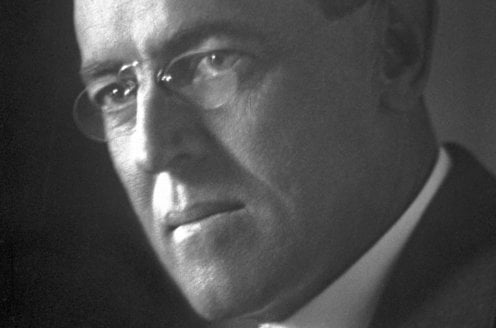
Thomas Woodrow Wilson was awarded the Nobel Peace Prize for his role as founder of the League of Nations.
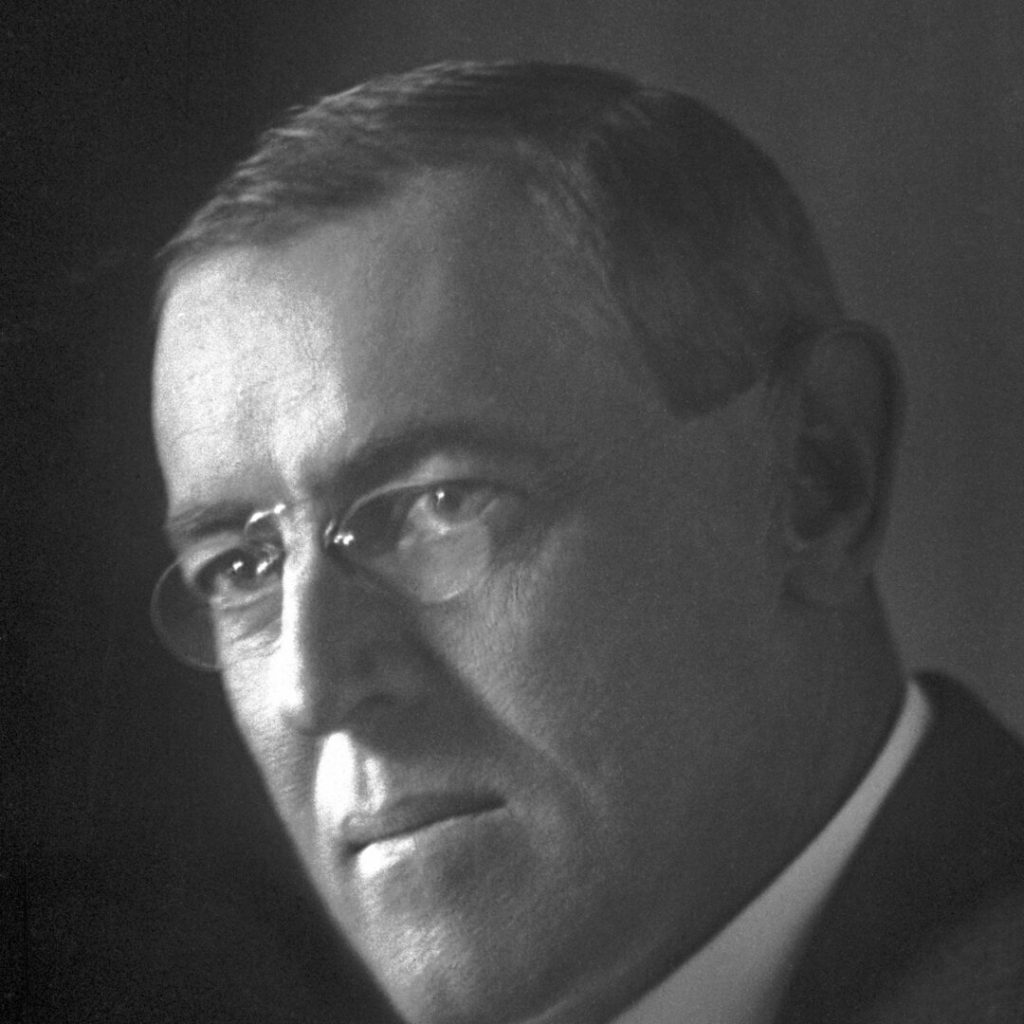
Full name: Thomas Woodrow Wilson
Born: 28 December 1856, Staunton, VA, USA
Died: 3 February 1924, Washington, D.C., USA
Date awarded: 10 December 1920
In 1917 President Wilson led the USA into WWI to prevent a German victory over Great Britain and France. An idealist, Wilson sought to create lasting world peace. He worked to spread democracy and to prevent new bloodbaths from taking the lives of millions. In 1918 Wilson presented his proposals for a post-war peace settlement, known as the Fourteen Points. He supported reconciliation with the defeated nations and self-rule for oppressed peoples. He also called for countries throughout the world to participate in an association of nations that would have the power to prevent war. At the Paris Peace Conference of 1919, the League of Nations was established, but a majority in the US Senate voted against US membership. They did not wish to relinquish control to a supranational authority.
“The President of the United States has succeeded in bringing a design for a fundamental law of humanity into present-day international politics.”
Anders Johnsen Buen, Presentation speech, 10 December 1920.
When WWI broke out in 1914, Wilson wanted the USA to remain neutral. Former President and peace laureate Theodore Roosevelt disagreed, arguing that US participation was necessary to stop German domination of Europe. With the support of the American peace movement, Wilson tried for a long time to negotiate a peaceful solution, but in 1917 he gave up. The US entered the war on the side of Great Britain and France. From then on, Wilson suppressed opponents of the war, who risked unemployment and imprisonment. Two future peace laureates, Jane Addams and Emily Greene Balch, were all but labelled national traitors.
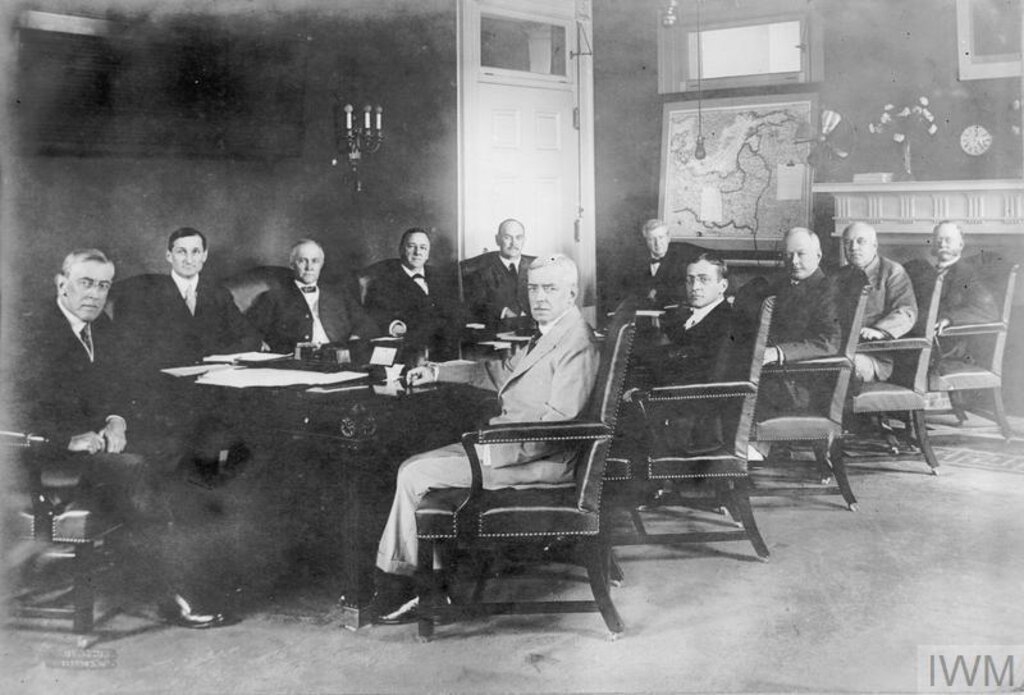
“The League of Nations is the hope of the world.”
Thomas Woodrow Wilson, Presidential message, 1919.
During the 1919 post-WWI peace negotiations, President Wilson gained support to form a League of Nations that would safeguard peace. The problem was that many Americans did not want to relinquish power to a supranational authority. Wilson began the debate on the peace accord in the US Senate with these words: “Dare we reject it and break the heart of the world?” His opponents in the Senate were willing to compromise, but Wilson refused to back down an inch. A majority voted against US participation in the League of Nations, thus weakening the fledgling organisation.
Wilson’s nomination for the Nobel Peace Prize in 1920 triggered strong disagreement among the Nobel Committee members. One member threatened to resign if Wilson were awarded the prize, pointing to Wilson’s failure to achieve US membership of the League of Nations. The international press criticised Wilson for abandoning his ideals in the Treaty of Versailles, which was seen by some as inflicting unjustly harsh treatment on a defeated Germany. In the end, the Nobel Committee awarded Wilson the deferred 1919 peace prize, but he was too sick and exhausted to travel to Oslo to accept it.
During the post-war peace negotiations, Wilson could not prevent France and Great Britain from seeking retribution from Germany. When the US Senate also voted against membership of the League of Nations, many viewed Wilson’s presidency as a failure. Historians have since pointed out that under Wilson’s leadership, the USA led the Allied forces to victory in WWI and the USA emerged from the war as the world’s greatest economic power. Before the war, the US owed millions of dollars to Europe, whereas after the war, the situation was reversed.
“I know of no person alive today who is more deserving of the Nobel Peace Prize than the President of the United States.”
Gunnar Knudsen, Norwegian Prime Minister, Nomination proposal, 1919.
Thomas Woodrow Wilson (December 28, 1856-February 3, 1924) was born in Staunton, Virginia, to parents of a predominantly Scottish heritage …
Disclaimer: Every effort has been made by the publisher to credit organisations and individuals with regard to the supply of photographs. Please notify the publishers regarding corrections.
Woodrow Wilson did not deliver a Nobel Lecture.
On Woodrow Wilson from the Woodrow Wilson Presidential Library & Museum
Acceptance by Albert G. Schmedeman, American Minister.
The Peace Prize for 1919, reserved in that year, was awarded in 1920 to Woodrow Wilson in recognition of his Fourteen Points peace program and his work in achieving inclusion of the Covenant of the League of Nations in the 1919 Treaty of Versailles. Since President Wilson was not present at the award ceremony on December 10, 1920, Albert G. Schmedeman, United States minister in Oslo, accepted the prize in his behalf. Mr. Schmedeman’s speech1, which included the reading of a message from President Wilson, follows:
Mr. President, I have the honor to inform you that I am the bearer of a telegram from Woodrow Wilson, President of the United States, in which he requests me to express his thanks and appreciation for the honor which has been conferred upon him by the Nobel Peace Committee of the Storting in awarding him the prize for the year 1919. Therefore, I have the honor, Mr. President, to request that permission will be granted me to read the message and make a few remarks to the honorable body.
I have been instructed by President Wilson to convey the following message2 of appreciation to President [Chairman] Løvland and the members of the Nobel Peace Committee of the Storting:
“In accepting the honor of your award I am moved not only by a profound gratitude for the recognition of my [sincere and] earnest efforts in the cause of peace, but also by a very poignant humility before the vastness of the work still called for by this cause.
May I not take this occasion to express my respect for the far-sighted wisdom of the founder in arranging for a continuing system of awards? If there were but one such prize, or if this were to be the last, I could not of course accept it. For mankind has not yet been rid of the unspeakable horror of war. I am convinced that our generation has, despite its wounds, made notable progress. But it is the better part of wisdom to consider our work as one1 begun. It will be a continuing labor. In the indefinite course of [the] years before us there will be abundant opportunity for others to distinguish themselves in the crusade against hate and fear and war.
There is indeed a peculiar fitness in the grouping of these Nobel rewards. The cause of peace and the cause of truth are of one family. Even as those who love science and devote their lives to physics or chemistry, even as those who would create new and higher ideals for mankind in literature, even so with those who love peace, there is no limit set. Whatever has been accomplished in the past is petty compared to the glory and promise of the future.
Woodrow Wilson”
I regret that I am unable to address this honorable body in the Norwegian language; even if I were, there are no words which can fully express my appreciation for the high honor conferred upon my country by the award of the Nobel Peace Prize for the year 1919 by the Nobel Committee of the Storting to one of America’s greatest statesmen, Woodrow Wilson, President of the United States of America. This honor which has been bestowed on President Wilson is one of significance and of utmost satisfaction to me – an occasion which will always remain in my memory. To have the privilege of accepting, on behalf of the President of the United States, this evidence of appreciation of his efforts to replace discord with harmony by appealing to the highest moral forces of each nation, is an event to be cherished.
It is unnecessary for me to dwell upon any of those achievements of President Wilson which justify the bestowal of this honor upon him; his comprehensive understanding of international affairs and his discerning and convincing methods of procedure in matters affecting the welfare and success of entire peoples, which, due to his earnest and forceful endeavors, resulted in the formation of the League of Nations, are well known to us all. He, perhaps as much as any public man, is conscious of the fact that the time is past when each nation can live only unto itself, and his labors have been inspired with the idea and hope of making peace universal a living reality. It is impossible to make a proper estimate of Woodrow Wilson and his great work for international peace until time has revealed much that must, for the present, be a sealed book.
Let me assure you, members of the Norwegian Storting, that words fail to convey the deep emotion which stirs within me at this time, when it falls within my province to receive this testimonial on behalf of the President of the United States of America. No more fitting word of appreciation could be voiced than that contained in the President’s message, in which he acknowledges the great honor that has been conferred upon him by the Nobel Peace Committee of the Storting.
President Wilson, who notified the Nobel Committee that ill health prevented his visiting Oslo, did not deliver a Nobel lecture.
1. Taken from the text in Les Prix Nobel en 1919-1920, with two minor emendations based on the text in Forhandlinger i Stortinget (nr. 502) for December 10, 1920 [Proceedings of the Norwegian Parliament].
2. The text and punctuation of the telegram are taken from Les Prix Nobel en 1919- 1920 and verified in Forhandlinger i Stortinget (nr. 502) ; the words in brackets are from the New York Times (December 11, 1920) version of the text.
3. Les Prix Nobel and Forhandlinger i Stortinget read “one”; N.Y. Times reads “only”; the context suggests “only” as the proper reading.
Remarks at the Award Ceremony by Anders Johnsen Buen*, President of the Norwegian Parliament, on December 10, 1920
The letter from the Nobel Committee of the Norwegian Parliament reads as follows: “The Nobel Committee of the Norwegian Parliament has the honor of announcing herewith its decision to award the Nobel Peace Prize for 1919 to the President of the United States of America Mr. Woodrow Wilson and that for 1920 to Mr. Léon Bourgeois, president of the French Senate and president of the Council of the League of Nations.”
Today, Gentlemen, as the Norwegian Parliament meets to present the Nobel Peace Prize for the first time since the World War I1, it is with the conviction that the great ideal of peace, so deeply rooted in the hopes for survival of the nations, will gain fresh ground in the minds of men as a result of the recent tragic events.
As the name of President Wilson comes to the fore on this occasion as the recipient of the Peace Prize, I know that the award is accompanied by the thanks of the people of Norway, because in his celebrated Fourteen Points2 the President of the United States has succeeded in bringing a design for a fundamental law of humanity into present-day international politics. The basic concept of justice on which it is founded will never die, but will steadily grow in strength, keeping the name of President Wilson fresh in the minds of future generations.
[In a final brief paragraph, President Buen refers to Léon Bourgeois, the laureate for 1920.]
* Mr. Buen addressed these remarks to the Parliament at an official session on December 10, 1920, doing so after the Nobel Committee had announced its decision and after the diplomatic representatives of the two absent laureates had been officially admitted to the meeting. He then gave the Nobel diplomas and medals to the two ministers. No presentation speech, in the usual sense of the term, was made. The translation is based on the Norwegian text in Forhandlinger i Stortinget (nr. 502) for December 10, 1920 [Proceedings of the Norwegian Parliament].
2. Wilson’s framework for peace discussions – eight points involve more or less specific territorial and political problems, and six deal with general principles of international relations: “open covenants”, “freedom of navigation”, removal of economic barriers, reduction of armaments, adjustment of colonial claims, and – most famous – “a general association of nations”.
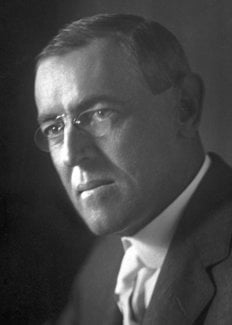
Thomas Woodrow Wilson (December 28, 1856-February 3, 1924) was born in Staunton, Virginia, to parents of a predominantly Scottish heritage. Since his father was a Presbyterian minister and his mother the daughter of a Presbyterian minister, Woodrow was raised in a pious and academic household. He spent a year at Davidson College in North Carolina and three at Princeton University where he received a baccalaureate degree in 1879.
After graduating from the Law School of the University of Virginia*, he practiced law for a year in Atlanta, Georgia, but it was a feeble practice. He entered graduate studies at Johns Hopkins University in 1883 and three years later received the doctorate. In 1885 he published Congressional Government, a splendid piece of scholarship which analyzes the difficulties arising from the separation of the legislative and executive powers in the American Constitution.
Before joining the faculty of Princeton University as a professor of jurisprudence and political economy, Wilson taught for three years at Bryn Mawr College and for two years at Wesleyan College. He was enormously successful as a lecturer and productive as a scholar.
As president of Princeton University from 1902 to 1910, Wilson became widely known for his ideas on reforming education. In pursuit of his idealized intellectual life for democratically chosen students, he wanted to change the admission system, the pedagogical system, the social system, even the architectural layout of the campus. But Wilson was a thinker who needed to act. So he entered politics and as governor of the State of New Jersey from 1911 to 1913 distinguished himself once again as a reformer.
Wilson won the presidential election of 1912 when William Howard Taft and Theodore Roosevelt split the Republican vote. Upon taking office he set about instituting the reforms he had outlined in his book The New Freedom, including the changing of the tariff, the revising of the banking system, the checking of monopolies and fraudulent advertising, the prohibiting of unfair business practices, and the like.
But the attention of this man of peace was forced to turn to war. In the early days of World War I, Wilson was determined to maintain neutrality. He protested British as well as German acts; he offered mediation to both sides but was rebuffed. The American electorate in 1916, reacting to the slogan «He kept us out of war», reelected Wilson to the presidency. However, in 1917 the issue of freedom of the seas compelled a decisive change. On January 31 Germany announced that «unrestricted submarine warfare» was already started; on March 27, after four American ships had been sunk, Wilson decided to ask for a declaration of war; on April 2 he made the formal request to Congress; and on April 6 the Congress granted it.
Wilson never doubted the outcome. He mobilized a nation – its manpower, its industry, its commerce, its agriculture. He was himself the chief mover in the propaganda war. His speech to Congress on January 8, 1918, on the «Fourteen Points» was a decisive stroke in winning that war, for people everywhere saw in his peace aims the vision of a world in which freedom, justice, and peace could flourish.
Although at the apogee of his fame when the 1919 Peace Conference assembled in Versailles, Wilson failed to carry his total conception of an ideal peace, but he did secure the adoption of the Covenant of the League of Nations. His major failure, however, was suffered at home when the Senate declined to approve American acceptance of the League of Nations. This stunning defeat resulted from his losing control of Congress after he had made the congressional election of 1918 virtually a vote of confidence, from his failure to appoint to the American peace delegation those who could speak for the Republican Party or for the Senate, from his unwillingness to compromise when some minor compromises might well have carried the day, from his physical incapacity in the days just prior to the vote.
The cause of this physical incapacity was the strain of the massive effort he made to obtain the support of the American people for the ratification of the Covenant of the League. After a speech in Pueblo, Colorado, on September 25, 1919, he collapsed and a week later suffered a cerebral haemorrhage from the effects of which he never fully recovered. He completed the remaining seventeen months of his term of office and lived in retirement for the last three years of his life.
| Selected Bibliography |
| Axson, Stockton, «Woodrow Wilson as Man of Letters», in The Rice Institute Pamphlet, 22 (October, 1935) 195-270. Three lectures on Wilson: «Heredity and Environment», «The Political Philosopher» and «The Literary Historian». |
| Bailey, Thomas A., Woodrow Wilson and the Peacemakers. New York, Macmillan, 1947. This book combines two books previously published separately: Woodrow Wilson and the Lost Peace (1944) and Woodrow Wilson and the Great Betrayal (1945). |
| Baker, Ray Stannard, Woodrow Wilson: Life and Letters. 8 vols. New York, Doubleday, 1927-1939. |
| Daniels, Josephus, The Wilson Era. 2 vols. Chapel Hill, N.C., University of North Carolina Press, 1946. |
| Link, Arthur S., Wilson. Princeton, Princeton University Press, 1947–. The five volumes published to date are: The Road to the White House (1947); The New Freedom (1956); The Struggle for Neutrality: 1914-1915 (1960); Confusions and Crises: 1915-1916 (1964); Campaigns for Progressivism and Peace: 1916-1917 (1965). |
| Phifer, Gregg, «Woodrow Wilson’s Swing around the Circle in Defense of His League», in Florida State University Studies, No. 23, pp. 65-102. Tallahassee, Fla., Florida State University, 1956. |
| Seymour, Charles, The Intimate Papers of Colonel House. 4 vols. New York, Houghton Mifflin, 1926. |
| Wilson, Woodrow, Congressional Government. New York, Houghton Mifflin, 1885. A modern edition of this book, Wilson’s first and best, may be found in Vol. 4 of The Papers of Woodrow Wilson, ed. by A.S. Link, pp. 6-179. |
| Wilson, Woodrow, A History of the American People. 5 vols. New York, Harper, 1902. |
| Wilson, Woodrow, The New Freedom: A Call for the Emancipation of the Generous Energies of a People. New York, Doubleday, 1913. |
| Wilson, Woodrow, The Papers of Woodrow Wilson, ed. by Arthur S. Link. Princeton, Princeton University Press, 1966. Eight volumes of this definitive work, covering the years 1856 to 1894, have been published to date. |
| Wilson, Woodrow, The Public Papers of Woodrow Wilson, ed. by Ray Stannard Baker and William E. Dodd. 6 vols. New York, Harper, 1925-1926. |
This autobiography/biography was written at the time of the award and first published in the book series Les Prix Nobel. It was later edited and republished in Nobel Lectures. To cite this document, always state the source as shown above.
* Woodrow Wilson also graduated from Princeton University (then the College of New Jersey).
The Nobel Foundation's copyright has expired.