Kenneth G. Wilson – Banquet speech
Kenneth G. Wilson’s speech at the Nobel Banquet, December 10, 1982
Your Majesties, Your Royal Highnesses, Ladies and Gentlemen,
I would like to thank everyone who has made our stay in Sweden so wonderful.
The Nobel Prize is the highest honor recognized by the scientific community. The Nobel award occasions a unique celebration of the vision of science by the public at large. The prestige the prize confers today is largely due to the extraordinary diligence of the Nobel committees. Their heroic efforts over the years have maintained the highest standards expected by scientists the world over. My colleagues who have devoted their lives to the study of critical phenomena feel especially honored by today’s Prize, as I know from their many letters to me. My many friends in elementary particle physics likewise share in present joy.
The scientist’s inquiry into the causes of things is providing an ever more extensive understanding of nature. In consequence, science is more important than ever for industrial technology. Industry now should become a full partner of government in supporting longrange basic research. This is necessary to overcome the slippage of the last decade, especially in instrumentation for both basic research and advanced training in universities. Through this additional support, we must renew our commitment to provide talented young people with the opportunity to build scientific careers based on their curiosity, the same opportunity that was provided to me when I began my work.
The hardest problems of pure and applied science can only be solved by the open collaboration of the world-wide scientific community. Scientists under all forms of government must be able to participate fully in international efforts. There are equally hard problems in determining the impacts, harmful or beneficial, of technology on man and his environment. World-wide collaboration and debate is necessary to obtain correct assessments of these impacts. Scientists, wherever they may be, should be listened to in both government and industry when they report their findings.
The greatest barrier to human progress is the international arms race. Military planning and technology development should be concentrated more on purely defensive systems. There should be less reliance on nuclear arms, because of the terrible consequences of their use. Nuclear weapons development throughout the world should cease.
I accept with pride the 1982 Nobel Prize for Physics. I accept also the responsibility to work myself on some of these issues. I will try to do my best on them. Thank you.
Kenneth G. Wilson – Other resources
Links to other sites
‘Kenneth Wilson and Renormalization’ from DOE R&D Accomplishments
Kenneth G. Wilson – Nobel Lecture
Nobel Lecture, December 8, 1982
The Renormalization Group and Critical Phenomena
Read the Nobel Lecture
Pdf 202 kB
Kenneth G. Wilson – Biographical
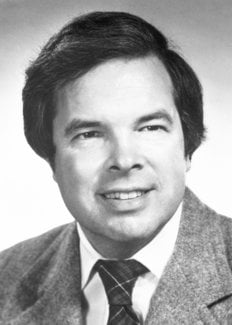
I was born 1936 in Waltham, Massachusetts, the son of E. Bright Wilson Jr. and Emily Buckingham Wilson. My father was on the faculty in the Chemistry Department of Harvard University; my mother had one year of graduate work in physics before her marriage. My grandfather on my mother’s side was a professor of mechanical engineering at the Massachusetts Institute of Technology; my other grandfather was a lawyer, and one time Speaker of the Tennessee House of Representatives.
My schooling took place in Wellesley, Woods Hole, Massachusetts (second, third/fourth grades in two years), Shady Hill School in Cambridge, Mass. (from fifth to eighth grade), ninth grade at the Magdalen College School in Oxford, England, and tenth and twelfth grades (skipping the eleventh) at the George School in eastern Pennsylvania. Before the year in England I had read about mathematics and physics in books supplied by my father and his friends. I learned the basic principle of calculus from Mathematics and Imagination by Kasner and Newman, and went on to work through a calculus text, until I got stuck in a chapter on involutes and evolutes. Around this time I decided to become a physicist. Later (before entering college) I remember working on symbolic logic with my father; he also tried, unsuccessfully, to teach me group theory. I found high school dull. In 1952 I entered Harvard. I majored in mathematics, but studied physics (both by intent), participated in the Putnam Mathematics competition, and ran the mile for the track team (and crosscountry as well). I began research, working summers at the Woods Hole Oceanographic Institution, especially for Arnold Arons (then based at Amherst).
My graduate studies were carried out at the California Institute of Technology. I spent two years in the Kellogg Laboratory of nuclear physics, gaining experimental experience while taking theory courses; I then worked on a thesis for Murray Gell-Mann. While at Cal Tech I talked a lot with Jon Mathews, then a junior faculty member; he taught me how to use the Institute’s computer; we also went on hikes together. I spent a summer at the General Atomic Company in San Diego working with Marshall Rosenbluth in plasma physics. Another summer Donald Groom (then a fellow graduate student) and I hiked the John Muir Trail in the Sierra Nevada from Yosemite Park to Mt. Whitney. After my third year I went off to Harvard to be a Junior Fellow while Gell-Mann went off to Paris. During the first year of the fellowship I went back to Cal Tech for a few months to finish my thesis. There was relatively little theoretical activity at Harvard at the time; I went often to M.I.T. to use their computer and eat lunch with the M.I.T. theory group, led by Francis Low.
In 1962 I went to CERN for a calendar year, first on my Junior Fellowship and then as a Ford Foundation fellow. Mostly, I worked but I found time to join Henry Kendall and James Bjorken on a climb of Mt. Blanc. I spent January through August of 1963 touring Europe.
In September of 1963 I came to Cornell as an Assistant Professor. I received tenure as an Associate Professor in 1965, became Full Professor in 1971 and the James A. Weeks Professor in 1974. I came to Cornell in response to an unsolicited offer I received while at CERN; I accepted the offer because Cornell was a good university, was out in the country and was reputed to have a good folk dancing group, folk-dancing being a hobby I had taken up as a graduate student.
I have remained at Cornell ever since, except for leaves and summer visits: I spent the 1969 – 1970 academic year at the Stanford Linear Accelerator Center, the spring of 1972 at the Institute for Advanced Study in Princeton, the fall of 1976 at the California Institute of Technology as a Fairchild Scholar, and the academic year 1979 – 80 at the IBM Zürich Laboratory.
In 1975 I met Alison Brown and in 1982 we were married. She works for Cornell Computer Services. Together with Douglas Von Houweling, then Director of Academic Computing and Geoffrey Chester of the Physics Department we initiated a computing support project based on a Floating Point Systems Array Processor. I helped write the initial Fortran Compiler for the Array Processor. Since that time I have (aside from using the array processor myself) been studying the role of large scale scientific computing in science and technology and the organizational problems connected with scientific computing. At the present time I am trying to win acceptance for a program of support for scientific computing in universities from industry and government.
I have benefitted enormously from the high quality and selfless cooperation of researchers at Cornell, in the elementary particle group and in materials research; for my research in the 1960’s I was especially indebted to Michael Fisher and Ben Widom.
One other hobby of mine has been playing the oboe but I have not kept this up after 1969.
The home base for my research has been elementary particle theory, and I have made several contributions to this subject: a short distance expansion for operator products presented in an unpublished preprint in 1964 and a published paper in 1969; a discussion of how the renormalization group might apply to strong interactions, in which I discussed all possibilities except the one (asymptotic freedom) now believed to be correct; the formulation of the gauge theory in 1974 (discovered independently by Polyakov), and the discovery that the strong coupling limit of the lattice theory exhibits quark confinement. I am currently interested in trying to solve Quantum Chromodynamics (the theory of quarks) using a combination of renormalization group ideas and computer simulation.
I am also interested in trying to unlock the potential of the renormalization group approach in other areas of classical and modern physics. I have continued to work on statistical mechanics (specifically, the Monte Carlo Renormalization Group, applied to the three dimensional Ising model) as part of this effort.
This autobiography/biography was written at the time of the award and first published in the book series Les Prix Nobel. It was later edited and republished in Nobel Lectures. To cite this document, always state the source as shown above.
Addendum, 1991
Wilson became the Director of the Center for Theory and Simulation in Science and Engineering (Cornell Theory Center) – one of five national supercomputer centers created by the National Science Foundation in 1985. In 1988, he moved to The Ohio State University’s Department of Physics where he became the Hazel C. Youngberg Trustees Distinguished Professor. He is now heavily engaged in educational reform as a Co-Principal Investigator on Ohio’s Project Discovery, one of the National Science Foundation’s Statewide Systemic Initiatives.
He was elected to the National Academy of Sciences in 1975, the American Academy of Arts and Sciences in 1975, and the American Philosophical Society in 1984.
Kenneth G. Wilson died on 15 June 2013.
Copyright © The Nobel Foundation 1991Press release

18 October 1982
NEW THEORY FOR PHASE TRANSITIONS AWARDED
The Royal Swedish Academy of Sciences has decided to award the Nobel Prize in Physics for 1982 to
Professor Kenneth G. Wilson, Cornell University, Ithaca, USA for his theory for critical phenomena in connection with phase transitions.
In daily life and from classical physics we know that matter can exist in different phases and that transitions from one phase to another may occur if we change, for example, the pressure or the temperature. A liquid goes over into a gas phase when sufficiently heated, a metal melts at a certain temperature, a permanent magnet loses its magnetization above a certain critical temperature, just to give a few examples.
Phase transitions have been studied in physics over a long time and for a large number of different systems. The phase transition is often characterized by an abrupt change in the value of some physical properties. In other cases the transition from one phase to another may be rather smooth. Examples of the latter case is the transition between liquid and gas at the critical point, and from ferromagnetism to paramagnetism in metals such as iron, nickel and cobalt. These smooth phase transitions show instead a number of typical anomalies near the critical point. Some quantities grow above all limits when one approaches the critical temperature. These anomalies, usually called critical phenomena, have to do with the very large fluctuations that occur in the system when we come close to the critical point.
A first qualitative description of the critical behaviour of some special al systems was given already around the turn of the century. Examples are the transition between liquid and gas and the transition between ferromagnetism and paramagnetism. The Soviet physicist L. Landau (Nobel Laureate in Physics 1962) published in 1937 a general theory for phase transitions, which contained the results of most earlier theories as special cases.
An essential step towards a further understanding was taken when L. Onsager (Nobel Laureate in Chemistry 1968) found the exact solution for the thermodynamic properties of a twodimensional model, that had been frequently discussed. It was a great surprise to find that the theory of Landau as well as all previous theories failed completely in predicting the behaviour close to the critical point. This puzzling result led to extensive and detailed studies of a large number of systems, and one found that the critical behaviour was quite different from the predictions by the Landau theory. Numerical calculations using different theoretical models also showed strong deviations from the Landau theory. M.E. Fisher, Cornell University played a leading role through his analysis of experimental data, supported by theoretical analysis and numerical calculations and, probably most important; by taking initiative and acting as a catalyst for further progress. One should mention important theoretical contributions by B. Widom, also at Cornell University, by the Soviet physicists A.Z. Patashinskii and V.L. Pokrovski and, most important by L.P. Kadanoff, University of Chicago. Kadanoff put forward a very important new and original idea which seemed to have strong influence on the later development. His theory, however, did not make it possible to calculate the critical behaviour.
The problem was solved in a definite and profound way by Kenneth Wilson in two fundamental papers from 1971 and followed by a series of papers in the following years. Wilson realized that the critical phenomena are different from most other phenomena in physics in that one has to deal with fluctuations in the system. over widely different scales of length. We have normally to do with only one given scale of length for any given phenomenon. Examples of the normal situation is the physics of radio waves, hydrodynamic waves, visible light , atoms, nuclei, elementary particles where each system is characterized by a certain scale of length and we do not have to be concerned with widely different scales of length. For a condensed system or gas near the critical point, however, we cannot limit ourselves to one single scale of length. Besides the large-scale fluctuations of the same order of size as the entire system. We have fluctuations of shorter range all the way down to atomic dimension. In typical cases we may have fluctuations with a range of the order of centimetre and all the way down to less than one millionth of a centimetre. All these fluctuations are of importance near the critical point and a theoretical description must take into account the entire spectrum of fluctuations. A frontal attack with direct methods is out of the question even with the assistance of the fastest computers.
Wilson succeeded in an ingenious way to develop a method to solve the problem. instead of a frontal attack, he developed a method to divide the problem into a sequence of simpler problems, in which each part can be solved. Wilson built his theory on an essential modification of a method in theoretical physics called renormalization group theory, which was developed already during the fifties and was applied with varying success to different problems.
Wilson’s theory for critical phenomena gave a complete theoretical description of the behaviour close to the critical point and gave also methods to calculate numerically the crucial quantities. His analysis showed that sufficiently close to the critical point most of the variables of the system become redundant. The critical phenomena are essentially determined by two numbers: the dimensionality of the system (1, 2 or 3) and the dimensionality of a key quantity called the order parameter, a quantity introduced already in Landau’s theory. This is a physical result of great generality. It implies that many systems, different and completely unrelated, can show identical behaviour near the critical point. As examples we can mention that liquids, mixtures of liquids, ferromagnets, and binary alloys show the same critical behaviour. Experimental and theoretical work from the sixties suggested this form of universality, but Wilson’s theory gave a convincing proof from fundamental principles. Calculations of the crucial parameters show consistently good agreement with experimental data.
Wilson is the first physicist to develop a general and tractable method where widely different scales of lengths appear simultaneously. The method is therefore, with proper modifications, applicable also to some other important and yet unsolved problems. Turbulence in fluids and gases is a classical example, where many different scales of length occur. In the atmosphere we find turbulent flow of all sized from the tiniest whirl of dust to hurricanes. Wilson’s new ideas have also found application within particle physics. He has developed a modified form of the theory and successfully applied it to current problems in particle physics, particularly quark confinement. Wilson’s theoretical methods represent a new form of theory which has given a complete solution to the classical problem of critical phenomena at phase transitions but which also seems to have a great potential to attack other important and up to now unsolved problems.
Award ceremony speech
Presentation Speech by Professor Stig Lundqvist of the Royal Academy of Sciences
Translation from the Swedish text
Your Majesties, Your Royal Highnesses, Ladies and Gentlemen,
The development in physics is on the whole characterized by a close interaction between experiment and theory. New experimental discoveries lead often rapidly to the development of theoretical ideas and methods that predict new phenomena and thereby stimulate further important experimental progress. This close interaction between theory and experiment keeps the frontiers of physics moving forward very rapidly.
However, there have been a few important exceptions, where the experimental facts have been well known for a long time but where the fundamental theoretical understanding has been lacking and where the early theoretical models have been incomplete or even seriously in error. I mention here three classical examples from the physics of the twentieth century, namely superconductivity, critical phenomena and turbulence. Superconductivity was discovered in the beginning of this century, but in spite of great theoretical efforts by many famous physicists, it took about fifty years until a satisfactory theory was developed. The theory of superconductivity was awarded the Nobel Prize in physics exactly ten years ago. The critical phenomena occur at phase transitions, for example between liquid and gas. These phenomena were known even before the turn of the century, and some simple but incomplete theoretical models were developed at an early stage. In spite of considerable theoretical efforts over many decades, one had to wait until the early seventies for the solution. The problem was solved in an elegant and profound way by Kenneth Wilson, who developed the theory which has been awarded this year’s Nobel Prize in physics. The third classical problem I mentioned, namely turbulence, has not yet been solved, and remains a challenge for the theoretical physicists.
From daily life we know that matter can exist in different phases and that transitions from one phase to another may occur if we change, for example, the temperature. A liquid goes over into gas phase when sufficiently heated, a metal melts at a certain temperature, a permanent magnet loses its magnetization above a certain critical temperature, just to give a few examples. Let us consider the transition between liquid and gas. When we come close to the critical point, there will appear fluctuations in the density of the liquid at all possible scales. These fluctuations take the forms of drops of liquids mixed with bubbles of gas. There will be drops and bubbles of all sizes from the size of a single molecule to the volume of the system. Exactly at the critical point the scale of the largest fluctuations becomes infinite, but the role of the smaller fluctuations can by no means be ignored. A proper theory for the critical phenomena must take into account the entire spectrum of length scales. In most problems in physics one has to deal with only one length scale. This problem required the development of a new type of theory capable of describing phenomena at all possible length scales, for example, from the order of a centimeter down to less than one millionth of a centimeter.
Wilson succeeded in an ingenious way to develop a method to solve the problem, published in two papers from 1971. A frontal attack on this problem is impossible, but he found a method to divide the problem into a sequence of simpler problems, in which each part can be solved. Wilson built his theory on an essential modification of a method in theoretical physics called renormalization group theory.
Wilson’s theory gave a complete theoretical description of the behaviour close to the critical point and gave also methods to calculate numerically the crucial quantities. During the decade since he published his first papers we have seen a complete breakthrough of his ideas and methods. The Wilson theory is now also successfully applied to a variety of problems in other areas of physics.
Professor Wilson,
You are the first theoretical physicist to develop a general and tractable method, where widely different scales of length appear simultaneously. Your theory has given a complete solution to the classical problem of critical phenomena at phase transitions. Your new ideas and methods seem also to have a great potential to attack other important and up to now unsolved problems in physics.
I am very happy to have the privilege of expressing the warmest congratulations of the Royal Swedish Academy of Sciences. I now ask you to receive your Nobel Prize from the hands of His Majesty the King.