Georges Charpak – Photo gallery

1 (of 6) Laureates on stage at the Nobel Prize award ceremony at the Stockholm Concert Hall on 10 December 1992. From left: physics laureate Georges Charpak, chemistry laureate Rudolph A. Marcus, medicine laureates Edmond H. Fischer and Edwin G. Krebs.
Nobel Foundation. Photo: Lars Åström

2 (of 6) 1992 Nobel Prize laureates on stage at the Nobel Prize award ceremony at the Stockholm Concert Hall on 10 December 1992. From left: physics laureate Georges Charpak, chemistry laureate Rudolph A. Marcus, medicine laureates Edmond H. Fischer and Edwin G. Krebs, literature laureate Derek Walcott and laureate in economic sciences Gary S. Becker
Nobel Foundation. Photo: Lars Åström

3 (of 6) Georges Charpak with his young relatives after the Nobel Prize award ceremony in the Stockholm Concert Hall on 10 December 1992.
Nobel Foundation. Photo: Lars Åström

4 (of 6) Georges Charpak and Sweden’s Queen Silvia at the Nobel Prize banquet in the Stockholm City Hall, Sweden, on 10 December 1992.
Nobel Foundation. Photo: Lars Åström

5 (of 6) Georges Charpak delivering his speech of thanks at the Nobel Prize banquet in the Stockholm City Hall, Sweden, on 10 December 1992.
Nobel Foundation. Photo: Lars Åström

6 (of 6) Physics laureate Georges Charpak, chemistry laureate Rudolph A. Marcus and laureate in economic sciences Gary S. Becker photographed during Nobel Week in Stockholm, Sweden, December 1992.
Nobel Foundation. Photo: Lars Åström
The Nobel Prize in Physics 1992
Georges Charpak – Other resources
Links to other sites
‘Georges Charpak, Particle Detectors, and Multiwire Chambers’ from DOE R&D Accomplishments
Archives of Georges Charpak at CERN
Georges Charpak – Nobel Lecture
Nobel Lecture, December 8, 1992
Electronic Imaging of Ionizing Radiation with Limited Avalanches in Gases
Read the Nobel Lecture
Pdf 315 kB
Georges Charpak – Banquet speech
Georges Charpak’s speech at the Nobel Banquet, December 10, 1992
Your Majesties, Your Royal Highnesses, Ladies and Gentlemen,
The honour bestowed upon me by the Nobel Foundation appeared to me not to belong to the real world.
I should have found, at my side, everyone from CERN, the European Organization for Nuclear Research. But an incident, a few days ago, enlightened me concerning the surprising decision of the Jury: the official photographer informed me that I was the 137th Nobel Laureate of whom he has had to make a portrait. Certainly all of you know that 137 is a magic, quasi-mystical number in physics. It is equal to the velocity of light times the reduced Planck constant divided by the square of the electron charge! This number governs the size of all objects in the Universe. Some people claim that if this value were to be slightly different life would not be possible.
This information led me, through channels which I cannot reveal publicly, to the origin of the decision of the Jury: they have been inspired by the goddess Freja, the wife of Odin, a spiritual cousin of the goddess Venus, who has decided to choose me to deliver a message.
My very modest contribution to physics has been in the art of weaving in space thin wires detecting the whisper of nearby flying charged particles produced in high-energy nuclear collisions. It is easy for computers to transform these whispers into a symphony understandable to physicists.
But the whispers can also be produced by radiations widely used in biology or in medicine, such as electrons from radioactive elements or X-rays. In this last case it is possible to reduce, by a large factor, the doses of radiations inflicted on the patients. Despite its use still on a very small scale, the first results with wire chambers point clearly to the direction to be taken. The techniques being developed for matching the needs in radiation detectors of the future high-energy colliders foreseen at CERN or in the USA will clearly bring the ideal solution for the imaging of radiations: each quantum will be detected, one by one, with an accuracy of a few microns.
The message from the world of the goddesses Freja and Venus is clear: invest without hesitation in the future high-energy accelerators. You will have as a reward the best solution for the radiography of such fragile objects as women’s breasts.
As a fallout, you will learn everything you want to know about the Higgs field, the hidden matter of the Universe, and marvellous new particles which are haunting the dreams of physicists and will become familiar notions to you. But please, do not consider that I am behaving like some lobbyist in Washington. The message comes from the world of Freja and Venus and I have been chosen as the passive medium.
Georges Charpak – Interview
Interview transcript
Transcript from an interview with Professor Georges Charpak, 1992 Nobel Laureate in Physics, on 6 December 2001. Interviewer is Joanna Rose, science writer.
Professor Georges Charpak, welcome to Stockholm and to this Nobel interview. You are one of the very few French scientists who have been awarded a Nobel Prize. Why is that so?
Georges Charpak: I know a lot of very good scientists in France and I don’t know the rules of the games, since it was a good surprise to have the Nobel Prize. And it so happened because what I did was important for the activity of other physicists who had had the Nobel Prize using the instruments they had made, but I don’t feel it is the most important thing I have done.
What is the most important thing you have done?
Georges Charpak: I’ve worked on many detectors, some were very elegant and useless, and didn’t have a Nobel Prize, so this one was not the most elegant, but it was useful.
You have also written a biography, My Name is Grisha. Where does this name come from?
Georges Charpak: I am born in Ukraine, it is now Ukraine, it was on the border. So I had a very agitated life at the beginning of my life, because I was born in a place where there had been ten years of ethnic fights and revolutionary fights.
Between Ukrainians and Poles and …?
Georges Charpak: Between the Bolsheviks, the anarchists, the Poles, and peace came in 1922 when the Bolsheviks were beaten by the Poles and the border was just on the other side.
So everybody was marching through …
 … I had the same education as somebody who was rich …
Georges Charpak: And so I was on the western side, and it is fortunate, because it was a very undeveloped country and I would not have survived, maybe, with the ethnic conflicts, because I was of Jewish origin, and I came to France at the age of seven and I found a country which for me was a paradise. Because I could then go to school, we were poor, but I had the same education as somebody who was rich. I never found any obstacle entering into a school when I was in Paris.
So how come you got interested in science?
Georges Charpak: I was not interested in science. I was interested in everything. I was reading Jules Verne, Alexander Dumas, even Lenin, I wanted to change the world. I was interested in the world. And France was a place where you have a kind of intellectual evolution between the two halves. You had the fascism coming up, the anti-fascists fighting …
When was it, do you mean? In the fifties?
Georges Charpak: I came in 1931, so between 31 and 40. When the Germans arrived, my adolescence was embedded into an atmosphere of very hard discussion, so …
So you could become a politician.
Georges Charpak: No, I could become a dictator.
A dictator …
Georges Charpak: At that time …
So it’s better with another prize winner.
Georges Charpak: At that time, at this age, you don’t do politics, you do revolutions. And I participated through the war, I was lucky enough to survive, and I started to do science after the war.
Where were you during the war?
Georges Charpak: I spent one year in jail, in the south of France, and one year in Dachau, which is a concentration camp …
A camp.
Georges Charpak: And that didn’t help my education in physics. Because I was working on a field, a landing field, and I was working hard moving earth. But I survived. I was lean, and I’m trying this year to try to reach the same line, but it’s hopeless. But then I started to do science really at the age of 24. By that time, I had an engineering degree, and I entered the laboratory of Joliot-Curie and it was a blessing because there were good scientific traditions there.
And a good tradition of Nobel Prizes.
That is very important – history of science …Georges Charpak: Well, in the sense that the people who had the Nobel Prize were leaving the laboratory, although they were very busy, they were speaking of all their inventions they had made and not made. That is very important – history of science. That played a very important role for me.
Before I knew well how to do an experiment, I knew why Joliot was missing the neutron. Why, yes, miss, why his wife missed the fission, but why they succeeded in having artificial radioactivity. And even why they almost missed other things by doing very nice experiments but didn’t come to a conclusion. That is science. Science is doubt, is research. It is not something which is … that is the danger of teaching which is too academic, and which people explain to you, it is like the logic thing coming out from a computer, which is not true.
It’s not the success story, you mean.
Georges Charpak: Yes. You have intuition, you have passion, so I consider that was a very important period of my life. And I was 24 and I learned then to make instruments. Why? Because I had … in the laboratory we didn’t have instruments, we had to build them by ourselves. And I learned physics that way. Though why I have a special connection to physics through the channel of detectors, because I had to detect particles, I was in a nuclear physics laboratory. What do you do in a nuclear physics laboratory? You detect particles. So I imagined detectors, and my imagination had been what made me in my childhood when I was travelling, because after all, when I was two, I went to Palestine and Haifa, and I came back two years later. When I say I came back, my parents came back …
… brought you.
I came to France, and when I came to France it was a paradise …Georges Charpak: … brought me there, because they were breaking stone on roads, and in 1931 we came to France because the French were making an exhibition on colonial, on the colonies. So my parents obtained a visa as tourists. They were so poor, but they had a visa to come to Paris, and they had a relative who was living in Paris, and we all arrived there and we stayed there. So we were not kind of immigrants, we say, we go to France, we go to the consulate in Warszaw and we get a decent visa. That is not the case. I came to France, and when I came to France it was a paradise. I discovered in France one thing which was essential – tolerance. And that was the richess of France.
You could find people who were intolerant, who were fascists, but they were not the majority. And there were enough of the people who were tolerant and had curiosity towards people who were foreigners. And I found, in no time I had French friends. So it was that in one year I was speaking French, and it was French in my house. And that is something that should be underlined, there are not so many countries where a foreigner can come and in no time to even to live with other foreigners unless he needs some help. I mean, especially for the children. I think the children have a greater sense of hospitality than their parents. They are more ready to play with you if you are the same age than the parents, who I think made me fall in love, do you want to marry my daughter, I mean, we’d better separate.
So you have to start early.
Georges Charpak: You have to start early. This is why I am very glad that the efforts in education in which I am involved started at the age of five, and I can see, we start in suburbs and places where you have ten nationalities, and the children have no problem interfering with each other. And play with each other and being in class with each other doing science. We call that hands-on, it is the /- – -/ part, it is a brand of science where experimentation in groups plays a very important role. And I can see that benefit effect of this approach through teaching, and through social integration.
Yeah. So I understand that it’s very important to get started early, and there is much work to be done. So, good luck, Professor Charpak, and thank you.
Georges Charpak: Thank you.
Did you find any typos in this text? We would appreciate your assistance in identifying any errors and to let us know. Thank you for taking the time to report the errors by sending us an e-mail.
Georges Charpak – Facts
Press release

14 October 1992
The Royal Swedish Academy of Sciences has decided to award the Nobel Prize in Physics for 1992 to Professor Georges Charpak, France, École Supérieure de Physique et Chimie, Paris and CERN, Geneva, Switzerland, for his invention and development of particle detectors, in particular the multiwire proportional chamber.
A breakthrough in the technique for exploring the innermost parts of matter.
This year’s Nobel Prize in physics is awarded to Georges Charpak, France, for his invention and development of detectors in high energy physics. Since 1959 Charpak is working at CERN, the European laboratory for particle physics situated in the canton of Geneva in Switzerland. Charpak invented the multiwire proportional chamber at CERN. The pioneering work was published in 1968. Largely due to his work particle physicists have been able to focus their interest on very rare particle interactions, which often reveal the secrets of the inner parts of matter. Sometimes only one particle interaction in a billion is the one searched for. The experimental difficulty lies in choosing the very few but exceptionally interesting particle interactions out of the many observed. Photographic methods, once so very successful in exploring particle processes, are not good enough for this. In the new wire chamber Charpak used modern electronics and realised the importance of connecting the detector directly to a computer. The invention made it possible to increase the data collection speed with a factor of a thousand compared to previous methods for registering charged particle trajectories. At the same time the high spatial resolution was very often considerably improved. His fundamental idea has since been developed and for more than two decades Charpak has been at the forefront of this development.
The development of detectors very often goes hand in hand with progress in fundamental research. Various types of particle detectors based on Charpak’s original invention have been of decisive importance for many discoveries particle physics during the last two decades. Several of these have been awarded the Nobel Prize in physics. Charpak has actively contributed to the use of is new type of detector in various applications in for example medicine and biology.
Background information
The study of reactions between elementary particles provides knowledge of their properties and of the forces that act between them. The reactions are often very complex, sometimes several hundred particles can be created in a single reaction and to interpret them the scientists very often need to register every single particle trajectory. Up to about 1970 this registration was often done with photographic methods. The pictures were analysed with the help of special measuring devices, a slow and laborious process.
Charpak’s invention consists of using an earlier development, the proportional counter, in a particularly unconventional way. The classical proportional counter, like the Geiger Müller tube, consists of a thin wire in the middle of a tube with a diameter of about a centimetre. Between the wire and the wall of the tube a high voltage of a few kilovolts is applied. A charged particle passing through the gas-filled tube will ionise the gas. In this process electrons, which have negative electric charge, are liberated from the neutral atoms of the gas, which then become positively charged. In the electric field the electrons move towards the central wire, the anode. Near the wire the electric field is very strong and results in a rapid acceleration of the electrons. They then have enough energy to ionise the gas and more electrons are liberated, which in their turn are accelerated and so on. This results in an avalanche of electrons and positive ions and it is the movement of the electrons and the ions that gives rise to an electric signal on the wire. The position of the charged particle that started the ionisation in the gas can however only be determined with a precision of about a centimetre, the size of the tube.
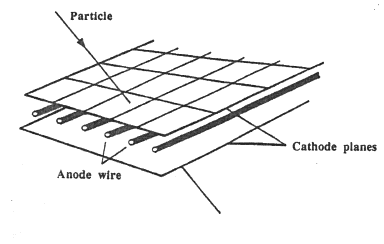
The principle of the multiwire proportional chamber. The distance between the anode wires is about 2 mm and the distance between the cathode planes is about 2 cm. A charged particle ionises the gas between the cathode planes and the charges – the electrons and ions – move towards the anode and the cathodes respectively. Several chambers are placed at different distances from each other to make it possible to determine the particle trajectory precisely.
To cover large surfaces with layers of these classical proportional tubes is impractical and the desired spatial precision cannot be reached. The break-through occurred with Charpak’s invention of the multiwire proportional chamber. It consists of a large number of thin, parallel wires arranged in a plane between two cathode planes a few centimetres away. The thin anode wires have a diameter of about a tenth of a millimetre and are placed about one or a few millimetres apart. In 1968 Charpak, contrary to the general belief, realised that each wire would behave as a proportional counter and result in a spatial precision of about a millimetre or less. Each wire could stand a very high rate of particles, several hundred thousand per second, at that time an exceptionally high rate.
Each wire has an amplifier. The use of such a large number of amplifiers is feasible thanks to the developments in electronics which make it possible to construct compact amplifiers with very small power requirements. An additional very important advantage is the ability to register the signals with computers and handle large amounts of data.
In this pioneering work from 1968 Charpak also points to possible developments of the multiwire proportional chamber. One such application makes use of the time it takes for the primary ionisation to drift to the anode wire. A measurement of the drift time results in an improved spatial precision. This application is called a drift chamber and a spatial resolution better than a tenth of a millimetre has been obtained.
History
Very often discoveries in physics are related to detector development. For the development of the cloud chamber, which registers tracks of charged particles in a gas, the 1927 Nobel Prize was awarded to C.T.R. Wilson. The cloud chamber was used in the discovery of the first antiparticle, the positron, for which C.D. Anderson (of Swedish descent) was awarded the 1936 Nobel Prize. The 1948 Nobel Prize in physics went to P.M.S. Blackett for his development of the cloud chamber technique and its use in the study of the atom nucleus and the cosmic radiation. In studies of the cosmic radiation during the 1940’s and 1950’s special photographic emulsions were used to register the tracks of charged particles. C.F. Powell was awarded the 1950 Nobel Prize in physics for the development of the emulsion technique and the discovery of the pi meson.
The invention of the bubble chamber, for which D.A. Glaser received the 1960 Nobel Prize in physics, was of great importance for the evolution of particle physics in the 1960’s. In the bubble chamber, which is filled with an overheated liquid, charged particles give rise to small bubbles where the liquid is boiling along the track. These strings of bubbles are photographed. However, pictures can only be taken about once per second. During the 1960’s a large number of new elementary particles were discovered thanks to the bubble chamber technique and L.W. Alvarez was awarded the 1968 Nobel Prize in physics for the development of this technique.
Charpak’s discovery in 1968 started a massive development of different types of wire chambers. Today practically every experiment in particle physics uses some type of track detector that has been developed from Charpak’s original invention. Charpak himself has been in the centre of this development from which thousands of scientists, both at CERN and elsewhere, have profited. When the charm quark was discovered in 1974, resulting in the award of the 1976 Nobel Prize in physics to B. Richter and S.C.C. Ting, several multiwire proportional chambers were used. The wire chamber was also used in the discovery of the intermediate bosons at CERN in 1983. For this discovery the 1984 Nobel Prize in physics was awarded to C. Rubbia and S. Van der Meer. Detectors developed by Charpak are being used more and more outside physics, e.g. in medicine for the detection of X-rays.
Award ceremony speech
Presentation Speech by Professor Carl Nordling of the Royal Swedish Academy of Sciences
Translation from the Swedish text
Your Majesties, Your Royal Highnesses, Ladies and Gentlemen,
This year the Nobel Prize in Physics has been awarded to Georges Charpak, France, for his invention and development of particle detectors, in particular the multiwire proportional chamber. It is the tenth time in the history of the Nobel Prize that the word “invention” has been used in the citation for the award in physics.
None of us owns the kind of detector for which the prize is being awarded today, but we are all equipped with other forms of detectors. Our eyes are detectors of light, our ears detect sound, our noses detect odors and so on. The signals from these sense organs are sent to a computer – the brain. There they are processed, communicated to our consciousness and used as the basis of our actions and our conception of the world in which we live.
But we are not always content with this. Our curiosity about the world extends beyond our immediate sensory impressions. For this reason inventive people have constructed devices of various kinds which intensify our senses or replace them completely – if this is at all possible in principle. Galileo Galilei constructed telescopes, Zacharias Janssen invented the microscope etc.
Today’s elementary particle physicists look deep inside matter using accelerators as microscopes. In these accelerators particles chosen as suitable projectiles, electrons for instance, are raised to high energies and then made to collide with each other. This produces new particles like the sparks from fireworks. In this invisible deluge of sparks, which can be discharged a hundred million times each second, there is information about the innermost constituents of matter and the forces with which they interact.
In order to acquire this information, enormous installations are built, which contain various kinds of detectors. Professor Charpak has invented the detector which has meant most for the progress in the area of elementary particle physics during the last few decades.
The list of qualities demanded of a detector of elementary particles is a long one. It must react quickly, must be able to cover large surfaces hundreds of square meters – and must send its signals direct to a computer. It must be sensitive to position, i.e. it must not only be able to say if something has happened but also, where, and it must also be capable of following the total length of the trajectory of a particle, often several meters. And it must be able to do all this even when it is placed in a strong magnetic field.
All of these requirements are fulfilled by the multiwire proportional chamber, the detector which Georges Charpak invented in 1968. This detector is used, in some form or other, in more or less every experiment within elementary particle physics today, and Georges Charpak has been at the centre of the development which has taken place since the original invention was made. Many important discoveries have been made using his detectors.
Charpak’s research is an example of an advanced technological development within basic science. Its original purpose was to contribute to the development of nuclear physics and elementary particle physics in order to provide further facets of our conception of the world. This aim has been achieved, but Charpak’s detector has also found applications well outside the field of elementary particle physics, for instance in medicine. In this development too, Charpak plays a central role.
Monsieur Charpak,
Le Prix Nobel de Physique de l’année 1992 vous a été decerné pour votre invention et développement de détecteurs de particules, notarnment de la chambre proportionelle multifits. J’ai l’honneur de vous adresser les félicitations les plus chaleureuses de I’Académie Royale des Sciences de Suede, et je vous invite à recevoir votre Prix des mains de Sa Majesté le Roi.
Georges Charpak – Biographical
 (Translation)
| Born | |
| August 1 1924 in Dabrovica, Poland Naturalized French citizen in 1946 |
|
| Studies | |
| Lycée Saint Louis in Paris | |
| Lycée de Montpellier | |
| 1945-1947 | Ecole des Mines (Mining school) in Paris |
| Degrees | |
| 1948 | Bachelor of Science. Mining engineer. |
| 1954 | Ph. D. Physics. Experimental research in Nuclear Physics at College de France |
| Positions | |
| 1948-1959 | Centre National de la Recherche Scientifique (CNRS) |
| 1959-1991 | Centre Européen pour la Recherche Nucléaire (CERN) |
| Research | |
| 1960 | Participated in the first exact measurement of the magnetic momentum of the muon |
| 1961-1967 | Development of various types of nonphotographic scintillation chambers |
| 1962-1967 | Nuclear structure studied by reactions (p+2p) |
| 1968 | Introduction of proportional multiwire chambers |
| 1974 | Introduction of spherical drift chambers for studies of proteins by X-ray diffraction (Orsay) |
| 1979-1989 | Introduction of multistage avalanche chambers and application of photon counters for the imaging ionizing radiations |
| 1985-1991 | Participated in experiments at Fermilab (USA). Introduction of chambers based on luminescent avalanches. Development of instrumentation for biological research using b-ray imaging (Centre Médical Universitaire de Genève. |
This CV was written at the time of the award and later published in the book series Les Prix Nobel/Nobel Lectures. The information is sometimes updated with an addendum submitted by the Laureate. To cite this document, always state the source as shown above.
Georges Charpak died on 29 September 2010.