Transcript from an interview with Gerhard Ertl
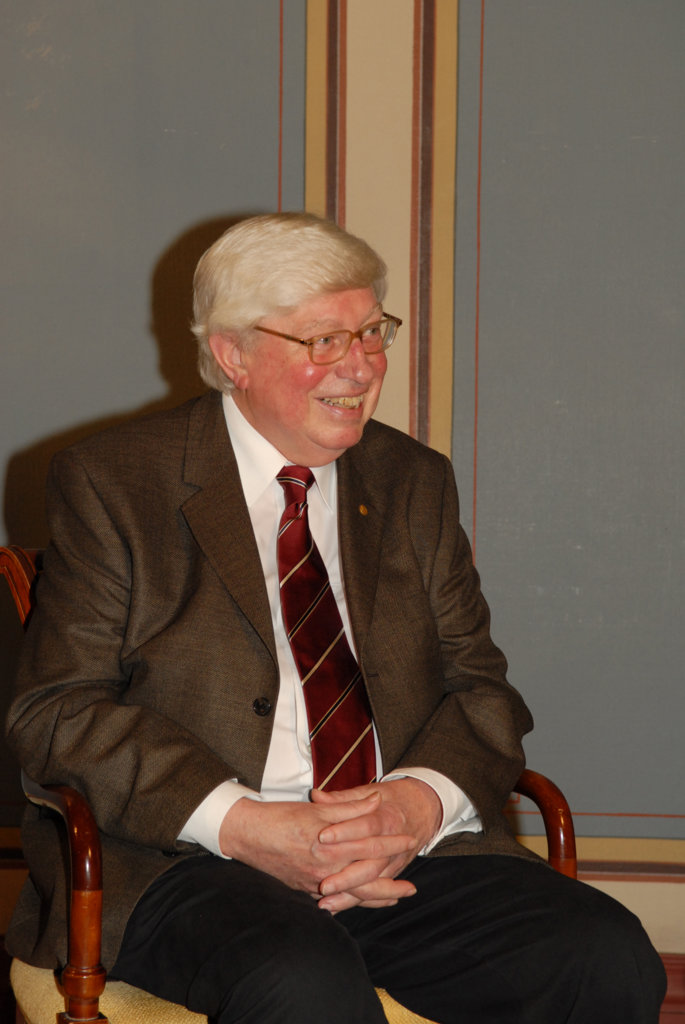
Photo: Hans Mehlin
Interview with the 2007 Nobel Laureate in Chemistry Gerhard Ertl on 6 December 2007. The interviewer is Adam Smith, Editor-in-Chief of Nobelprize.org.
Gerhard Ertl, welcome to this interview with Nobelprize.org. You are the 2007 Nobel Laureate in chemistry for your contributions to the science of surface chemistry and it may surprise people to know how much chemistry actually goes on at surfaces. When people think of chemical reactions, they tend to think of bubbling vessels and fluids and it all happening in liquids, but actually surface chemistry is everywhere.
Gerhard Ertl: Surface chemistry is taking place in almost all industrial plants. All chemicals are made through the operation of catalysts but also in biological systems. Many reactions take place at the surfaces of cells and so on, but the kind of surface chemistry I was studying was essentially with solid surfaces, and this is the basis of catalysis, which in turn is the basis of chemical industry but also of a lot of environmental chemistry.
Given how ubiquitous surface chemistry is, it might be thought to be a little surprising that this is the first Nobel Prize for surface chemistry since Irving Langmuir got it in 1932. Is part of the problem that it’s very difficult to study surface chemistry?
Gerhard Ertl: It’s certainly very difficult to study and as you mentioned Irving Langmuir, he was really groundbreaking, as his ideas, but many of these ideas couldn’t be studied at that time because we needed new techniques and /- – -/ This started only in the 1960s and ‘70s, that’s why surface chemistry is a relatively new field of chemistry in this sense.
What are the challenges, the difficulties in the instrumentation that one faces?
Gerhard Ertl: If you are interested to learn what is really taking place on an atomic scale on the surface, you have to keep in mind that the structure of a solid surface is usually very complex. It consists of different crystal planes, different defects, different compounds at the surfaces and if you expose it to an atmosphere, then impurities from the gas face will accumulate there, so it’s very badly defined. If you want to study really the elementary processes, you first have to start with preparation of clean and well defined surfaces. It needs very high vacuum and the use of single crystal surfaces. This was the event of surface science in the 1960s, when this whole field started.
Right. Taking it on from there, you have your single crystals, you have your vacuum …
Gerhard Ertl: Yes, and then you need the physical techniques to probe the properties of the surfaces because these are properties for one atomic layer, it’s not about properties. We need new techniques which are very surface sensitive and the first techniques which were developed in the ‘60s were based on the interaction of matter with low energy electrons. The mean free path in solid is very short, so we get really information from the topmost atomic layers. In the meantime, there are many other techniques which can probe also these properties in with direct atomic resolution with this scanning tunnelling microscope.
Right. I suppose that goes to explain why it was that one of the things that you did, which was to work out the precise mechanism of the Haber Bosch process in which nitrogen and hydrogen combine on an iron catalyst to form ammonia.
Gerhard Ertl: That’s right.
It was so difficult to do because that was a process that was around from the First World War onwards and has been used on a vast scale industrially around the world and yet nobody until you came along understood exactly how it worked.
Gerhard Ertl: It got realised in a laboratory in 1909 and transformed into an industrial plant in 1913 and I was attending a conference in Switzerland in 1974 where one of the great old men of catalysis research gave a lecture on the mechanism of ammonias and since is concluded. We still don’t know the mechanism. Especially we don’t know whether the nitrogen molecule first has to break up and then it’s reacting with the hydrogen or whether the nitrogen molecule reacts with the hydrogen. I came back from this conference and said to my students, This is a problem we should be able to solve. That’s how we became interested in that.
That’s a lovely challenge. Has it made any practical difference to the process, that you now understand?
Gerhard Ertl: With the knowledge about the process and about the rates of the individual steps, it was also possible to develop a kinetic model and this was done by people in Denmark working with Haldor Topsoe, the company who is one of the big manufacturer of plants for the ammonia synthesis. They tell me, now in the meantime, they developed their plants on the basis of data they have about the kinetics, so it makes it much, much easier for them also.
You defined the rate limiting steps for the reaction?
Gerhard Ertl: Yes, that’s right and we identified also other steps and with all this knowledge putting together, these people, Nørskov and his co-workers, they were able to develop this kinetic model.
One of the things that you’re known for is that you re-visit problems, when a new technology becomes available, you go back to an old problem that you studied previously and you’ll study it again using the new technology. Is the Haber Bosch process one of those that you have looked at more than once?
Gerhard Ertl: We continue to work on this because there was still the question is the iron catalyst the best catalyst? It was invented almost 100 years ago and, in the meantime, there are other catalysts being proposed, mainly by Japanese workers based on ruthenium and indeed it seems to be a better catalyst than iron but it’s very hard to transform this on an industrial scale and …
Iron is cheaper, I imagine.
Gerhard Ertl: Iron is cheaper and also the plants are available but that’s why we also continue to work now on the mechanism of the ruthenium catalyst, the mechanism which is very similar. In this way we continued our work on the ammonia catalyst, ammonia synthesis, to some extent.
Do you think it’s unusual that you re-visit problems?
Gerhard Ertl: I don’t think so. Whenever you solve a problem or answer a question, you are faced with two or three new ones so you are still left with open questions. I think it’s not very unusual that you go back to another question which you had left a couple of years ago.
It indicates a nice open mindedness about things, though, that you don’t want to just close things off and finish.
Gerhard Ertl: Definitely, and of course you always need some fantasy to imagine what could be the answer to this question because this defines the line along which you are doing your new research.
What led you to surface chemistry in the first place? What was your path that ended up there?
Gerhard Ertl: I am not a chemist, I am a physicist, but I was always interested in both chemistry and physics and that’s why I did my first degree where the diploma work was a physical chemist and he was a famous electro-chemist. Electrochemistry is the science of solid/liquid interface, with charge transfer. I did my first work on the reactions in liquid fase but then I wanted to continue for my PhD and I asked my thesis advisor, Is there anything else I could do – everybody here in the laboratory is working on electro-chemical systems? He told me, We know quite a bit about solid/liquid interfaces, but very little about solid/gas interfaces. There is no electrochemistry. If you think you could start with that, you can do it as you like. He gave me completely free way and this was the advantage. He was not an expert in this field but he just trusted me and that’s how I came interested in that.
You must have had considerable self-confidence.
Gerhard Ertl: Yes, definitely, obviously. Yes. No, I owe him very much.
Where did the original interest in science come from? Before you started studying physics at university, what were you …
Gerhard Ertl: I started doing experiments in chemistry when I was a boy at age of about 12 or 13. In these days, no computers were available. I was always very bad in sports, so I was playing the piano. I was interested in music but apart from that, I was interested in science. That’s why I started these chemical experiments. I had a wonderful book called Chemical Experiments That Work and it listed all the chemicals you needed and all the instruments and you could buy them in a drug store and there were no regulations concerning safety, was there, in those days? I started to do these experiments in my bedroom and …
Did they work?
Gerhard Ertl: They worked, yes. Yes, of course, including little fireworks and all these things, but one day my mother said, You should stop that. It smells always so terrible and I am afraid one day in the morning you will not wake up any more. That’s why I stopped the chemical experiments and moved into physics. The alternative to chemistry was electronics radio, all boys at my age were working with radio. That’s how I became interested in physics and since I was very good in mathematics at school, I started physics and not chemistry. We had also a very good teacher in physics and a not so good teacher in chemistry, so that’s why I became a physicist.
But it sounds like it was your mother’s influence, really.
Gerhard Ertl: At the beginning there, certainly. One of my friends in school, a classmate, he started chemistry and he was always interested in the beginning in this large organic molecules which I was not very fond of. They looked too complicated to me and that was the reason why I decided to go away into physics and more fundamental science.
Well, there still seems to be enough to learn about nitrogen and hydrogen.
Gerhard Ertl: Definitely. These are small molecules. I never worked with these large organic.
When you yourself recruit students to your lab, and you’ve recruited many, what do you look for in them? What are you trying to identify in a new student?
Gerhard Ertl: First of all, I had about the same number of students from physics and chemistry and this is very advantageous because both parts have their pros and contrasts and their collaboration was always very fruitful. Then I always check if they are really motivated and interested. It’s not so much the marks they got in their examinations but are they curious enough and also brave enough to take a new problem? You can recognise that very early and I think that was, shall we say, a recipe which worked.
You can recognise their passion for the science?
Gerhard Ertl: Definitely, yes. If somebody really gets interested in a problem, you’ll explain to him.
You say you have an equal mix of chemists and physicists. Is it easy to get the physicists to come across to what is essentially a chemistry environment?
Gerhard Ertl: Yes, because the methods we are applying are physical methods, so many, many physics students are really interested to see what they can do with the physical techniques. These are problems they are usually not faced with, so I never have problems to get good students from physics.
Ok, that’s what you look for in them. What do you think that they look for in you? What are they hoping to get from you as a mentor?
Gerhard Ertl: I think there is a lot of networking between the students. They know in advance what kind of professor is that. They told me that many years later, very often, I went to you because my friend said you should go there and so, yes, and obviously …
It works.
Gerhard Ertl: It works.
But what sort of professor are you? How do you treat your students? How much latitude do you give them? Are you like your doctoral supervisor and just say …
Gerhard Ertl: I think you are very much influenced by the mentor which brings you on on your pass and my mentor Heinz Gerischer was such a perfect person, I must say. Let you complete freedom and give you all the support you need, and I think this was also the way I wanted to treat my students.
And in the main they respond well to that?
Gerhard Ertl: Oh yes. This is just the kind of responsibilities they get in this way. Of course I was told later that very often I had convinced them to do something else than they had in mind but they always agreed that later this was the right decisions I made.
Your students must have gone off and inhabited many, many other departments?
Gerhard Ertl: I’ve many students now who are professors at universities or in leading positions. I’m very proud about that, I must say.
The citation from the committee suggests that really you’ve changed the shape of surface chemistry by seeding all these different environments.
Gerhard Ertl: This is a quotation from the Nobel Committee. I do not want to comment on that. But I agree, there are many, many of my students now working at universities and are professors there.
A question that I often ask, but what is it that you enjoy the most about the practice of science? About the science that you do?
Gerhard Ertl: I think it’s always an adventure to ask a question and to enter a new field where you don’t know the answer in advance. If you then get an answer and if this answer is really surprising, this creates a great joy, always. And this continues, yes.
I’ve had other answers that have suggested that the pleasure is in realising that something is possible and then practically carrying it out, so that’s almost the opposite, that it’s not getting the surprise, it’s getting the confirmation.
Gerhard Ertl: Of course. Very often you have an idea what could be the answer to this question and this is of course also a source of joy, if you get confirmation of what you had expected, but it’s even more rewarding if you get a new answer which was unexpected.
And do you enjoy the lab work very much?
Gerhard Ertl: That’s right, yes. I have spent quite some time with the laboratory. I’m no longer working with my hands but just discussing with the people there and so on. It’s very rewarding also to see how the results come out.
Why do you no longer work with your hands?
Gerhard Ertl: I’m retired. I retired three years ago, so I no longer have a laboratory any more. The more advanced you get, the more other responsibilities you have. You are no longer able to really spend hours in the laboratory, that’s correct. You have to rely on your co-workers and I had always the luck to have excellent co-workers.
Talking of the other responsibilities, how have you enjoyed the building of departments as well and the interplay with …
Gerhard Ertl: Yes. Whenever you come into positions that you are at a somewhat advanced level, of course, others ask you for your advice and since you are part of the system, this is also responsible. I served with the German Science Foundation as vice president for a couple of years and I served as a dean of the department in Munich, so there were many different positions I took over and I think this is also part of our duties we have to fulfil.
What are your feelings about the future of German, European science? Are you optimistic about the way things are going?
Gerhard Ertl: I think the research going on in Europe is not of the same quality as the research going on in the United States. Also funding, of course, that would need better funding for research but this is not the main issue. The main problem of our universities is the structure, the undergraduate training and the structure of the universities. There are many, many students who leave the university after two or three years or so and there is no real challenge for them. They’re just there and of course many professors are a little bit frustrated because they don’t get the support for their teaching which would be necessary. This is something which has to be reformed, quite obviously.
Are you saying that the students are using the universities as a sort of finishing school but not getting anything?
Gerhard Ertl: Yes, yes.
What’s wrong with the structure? Why is that happening, do you think?
Gerhard Ertl: We don’t have any tuition fees in our German system so there are many students, after finishing high school, that really don’t know what to do, so they enter university and they start with some subject and then they do something else. Then eventually they find a job and then they leave again, so yes, there is no real challenge for them to really study a certain subject and bring it to an end.
Right, and tuition fees would add that driving force?
Gerhard Ertl: Yes, of course. As soon as you have to pay something … If you don’t pay for something it’s not worthwhile. We have a long standing debate on this issue in our country at the moment and some parts of Germany now have introduced small tuition fees and I think that will help.
I suppose it must be very important for Germany that they had two new Nobel Laureates this year. Indeed, when I phoned you immediately after the announcement for the telephone interview, I was getting in the way, you were waiting for a call from Angela Merkel.
Gerhard Ertl: That’s right.. She called me the same evening.
Oh, she did? She did.
Gerhard Ertl: I know her personally so I was very happy that she called me in the evening.
That’s nice. But presumably there is perhaps now a pressure to take part in further planning for the future of German science, as a Nobel Laureate?
Gerhard Ertl: So far, I was not approached directly in this respect but, as I told you, I was for many years vice president of the German Science Foundation. I was always involved in the planning of the research funding in Germany so I am familiar with the attempts to improve the situation for German research and I’m sure that I will also be approached in the future again.
On the subject of being a Laureate, how are you finding it? How have you found the last couple of months since the announcement?
Gerhard Ertl: Hectic and chaotic, so it still needs some time for me to really recover from the announcement, I must say, because now many, many people approach you and want answers to questions you never had thought before and on quite different things.
I can imagine, yes.
Gerhard Ertl: And you must be very careful with your answers because they can be used and brought to /- – -/ and then they are completely turned around. An experience which I never had before.
The economics Laureate, von Hayek, in his banquet speech said that, in economics, not in the physical sciences but in economics, he thought that Laureates should take a vow not to speak about anything beyond their competence.
Gerhard Ertl: Of course, but that’s not so easy.
Exactly, if people ask you the questions, yes.
Gerhard Ertl: I got a call from China from a journalist – what shall we do to get Nobel Prizes in China? What do you answer?
What did you answer?
Gerhard Ertl: Don’t copy, that was my answer.
Hopefully they were satisfied.
Gerhard Ertl: I’m not so sure.
Do you have any intentions of how to use the status of being Nobel Laureate in the future or is it too early to say?
Gerhard Ertl: I still have to recover from all these hectic weeks now, so after Christmas, I will retreat into my resort and stay there for a week or so and just think over the whole situation.
Thank you very much indeed and I wish you an extremely enjoyable Nobel week.
Gerhard Ertl: Thank you very much.
Did you find any typos in this text? We would appreciate your assistance in identifying any errors and to let us know. Thank you for taking the time to report the errors by sending us an e-mail.
Gerhard Ertl – Prize presentation
Gerhard Ertl – Photo gallery
1 (of 11)
Gerhard Ertl receiving his Nobel Prize from His Majesty King Carl XVI Gustaf of Sweden at the Stockholm Concert Hall, 10 December 2007.
Copyright © The Nobel Foundation 2007
2 (of 11)
Gerhard Ertl after receiving his Nobel Prize at the Stockholm Concert Hall, 10 December 2007.
Copyright © The Nobel Foundation 2007
3 (of 11)
Gerhard Ertl (left) and his wife Barbara (right) standing with 2001 Nobel Laureate in Chemistry K. Barry Sharpless (centre) after the Nobel Prize Award Ceremony at the Stockholm Concert Hall, 10 December 2007.
Copyright © The Nobel Foundation 2007
4 (of 11)
Gerhard Ertl delivering his banquet speech. © Nobel Media AB 2007.
Photo: Hans Mehlin.
5 (of 11)
Gerhard Ertl signing autographs for enthusiastic pupils during a visit to the Norra Real School in Stockholm, 12 December 2007.
Copyright © Nobel Media AB 2007
6 (of 11)
All the 2007 Nobel Laureates assembled for a group photo during the Nobel Foundation reception at the Nordic Museum in Stockholm, 9 December 2007. Back row, left to right: Nobel Laureates in Physiology or Medicine Oliver Smithies, Mario R. Capecchi and Sir Martin J. Evans; Economics Laureates Roger B. Myerson and Eric S. Maskin. Front row, left to right: Nobel Laureate in Physics Peter Grünberg, Nobel Laureate in Chemistry Gerhard Ertl and Nobel Laureate in Physics Albert Fert.
Copyright © The Nobel Foundation 2007
7 (of 11)
Gerhard Ertl talking to students during the Nobel Foundation reception at the Nordic Museum in Stockholm, 9 December 2007.
Copyright © Nobel Media AB 2007
8 (of 11)
Gerhard Ertl signing autographs after delivering his Nobel Lecture at the Aula Magna, Stockholm University, 8 December 2007.
Copyright © Nobel Media AB 2007
9 (of 11)
Gerhard Ertl delivering his Nobel Lecture at the Aula Magna, Stockholm University, 8 December 2007.
Copyright © Nobel Media AB 2007
10 (of 11)
Gerhard Ertl at his interview with Nobelprize.org in Stockholm, 6 December 2007.
[snippet id="1987"]
11 (of 11)
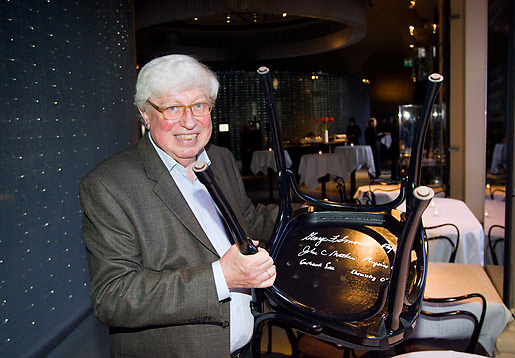
Gerhard Ertl, like many Nobel Laureates before him, autographs a chair at Kafé Satir at the Nobel Museum in Stockholm, 6 December 2007.
Copyright © The Nobel Museum 2007
Photo: Henrik Montgomery
Photo: Hans Mehlin

Photo: Hans Mehlin

Photo: Hans Mehlin
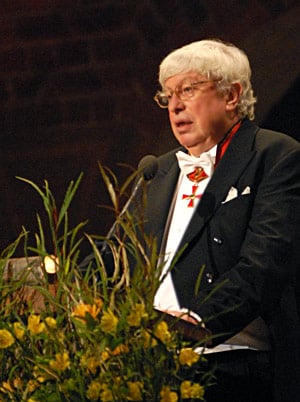

Photo: Niclas Enberg

Photo: Stig-Göran Nilsson

Photo: Annalisa B. Andersson
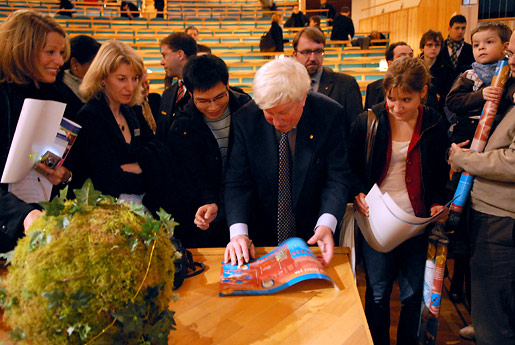
Photo: Hans Mehlin

Photo: Hans Mehlin

Gerhard Ertl – Nobel diploma
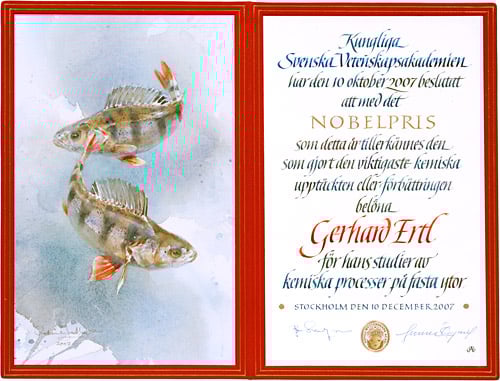
Copyright © The Nobel Foundation 2007
Artist: Roland Jonsson
Calligrapher: Annika Rücker
Photo reproduction: Fredrika Berghult
Gerhard Ertl – Nobel Lecture
Gerhard Ertl delivered his Nobel Lecture on 8 December 2007, at Aula Magna, Stockholm University, where he was introduced by Professor Gunnar von Heijne, Chairman of the Nobel Committee for Chemistry.
Gerhard Ertl delivered his Nobel Lecture on 8 December 2007, at Aula Magna, Stockholm University, where he was introduced by Professor Gunnar von Heijne, Chairman of the Nobel Committee for Chemistry.
Lecture Slides
Pdf 4.79 MB
Read the Nobel Lecture
Pdf 667 kB
Gerhard Ertl – Banquet speech
Gerhard Ertl’s speech at the Nobel Banquet in the Stockholm City Hall, 10 December 2007.
The famous physicist Werner Heisenberg begins his autobiography with the sentence: “Science is made by men.” Since in my own case you honour not a singular discovery, but the lifelong attempt to understand how chemical reactions at solid surfaces take place, this work involved in fact many people. When I was young, I was sometimes dreaming of becoming a musician. That is why I considered my co-workers often as an orchestra with me being the conductor. We know that even the best conductor cannot perform first class music with a mediocre orchestra. But I had the great luck of always being surrounded by an excellent group of co-workers whom I may compare – not with the Royal Stockholm Philharmonic Orchestra – but perhaps with the Berlin Philharmonic Orchestra. But in contrast to the situation with a real orchestra where the artists play notes prescribed by the composer, in our case the players themselves are the composers. By continuously crossing the border between the known and the unknown, they build on the never ending multidimensional symphony of science. The resulting feelings had once expressed by the greatest poet of my country, J. W. Goethe, when he was already over 80 years old: “Es geht nichts über die Freude, die uns des Studium der Natur gewährt” – “There is no greater joy than studying nature.”
Goethe died one year before Alfred Nobel was born, and hence he could not know that there might be an even greater joy, namely when ones own joy from studying nature is honoured in such a magnificent manner by the Nobel Prize.
Thank you very much!
Gerhard Ertl – Biographical
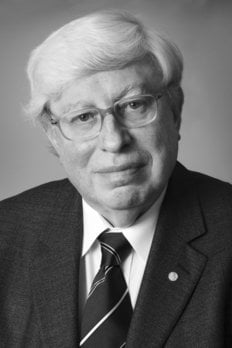
I was born on 10 October 1936 in Bad Cannstatt which is part of the city of Stuttgart in the southwest of Germany. When I was 3 years old, the family moved to the nearby village of Schmiden where I entered elementary school in 1942. In summer 1946, I was admitted to Johannes Kepler Gymnasium (high school) in Bad Cannstatt where I passed the final examination (Abitur) in spring 1955. I had been a fairly good student with some (but not particularly strong) interests in science and history. Computers were not yet available in those days, and it was hence quite common for boys to do at home some chemical experiments. I had a good book on this topic and enjoyed very much to follow its prescriptions in my bedroom. There was, however, sometimes some strong smelling or strange noise so that my mother became afraid of my health and asked me to stop these activities. As a consequence, I turned my interest to radio sets and therefore from chemistry to physics. Since I was very good in mathematics I also decided to study physics instead of chemistry and entered the Technical University of Stuttgart in 1955 where I also obtained my diploma in 1961, after spending some time in between at the universities of Paris and Munich. My studies at these latter places were of more general nature but I attended also lectures from a few of the heroes of my subject – de Broglie, Joliot, Heisenberg.
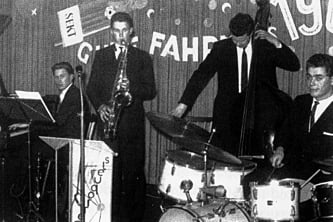
Since my childhood I was also interested in music and played the piano. While being a student I became among others member of a band and earned in this way quite some money. As can be seen from fig. 1, in those days there existed no electronics but simply only acoustics.
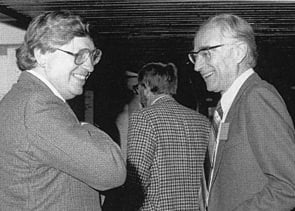
For my diploma thesis work I decided to return to chemistry, and hence physical chemistry became my subject of choice. I had the great luck to find a mentor who was not only an outstanding scientist but also an inspiring person with great humanity: Heinz Gerischer (fig. 2) was one of the leading electrochemists of the 20th century, but also interested in other problems of physical chemistry. Just before I joined his group Manfred Eigen in Göttingen had developed novel techniques for studying the kinetics of very fast reactions in solution for which work he received the Nobel Prize in Chemistry in 1967. Gerischer had the idea that such a method could also be based on rapid heating of an aqueous phase by a short pulse of microwave radiation. This was my first contact with real research, and I became fascinated by the challenge to develop such an apparatus and measure the rate constant of one of the most fundamental reactions in chemistry, the recombination between H+ and OH– to H2O. I could solve this task successfully, but it became soon clear that the applicability of this technique would be limited, and hence I asked Gerischer for another project for my Ph.D. work. After briefly considering some more conventional problems of electrochemistry, he told me: “If you really want to enter a field on which we know only little, instead of studying the solid/liquid interface think what you could find out about the solid/gas interface. I have no idea about this field, but you will have all freedom and my full support as far as available to me.”
At this time Gerischer accepted an offer from the technical University of Munich, and I joined him as an assistant and made my first steps in the just emerging area of surface science. In order to keep a surface clean for long enough time, ultrahigh vacuum (UHV) was required which in those days could only be achieved by sealed glass systems evacuated by mercury diffusion pumps and baked to 450° C – a real adventure. I managed to build such an apparatus and was studying the reaction 2H2+O2 -> 2H2O at surfaces of Germanium single crystal surfaces – not the best choice, but at least sufficient to provide me my Ph.D. degree in early 1965. Much more successful and rewarding was meeting Gerischer’s secretary Barbara Maschek. In the meantime we have been married for 43 years and have two (also married) children and four grandchildren.
During my thesis work the first stainless-steel UHV systems and low energy electron diffraction (LEED) as experimental tool providing information about atomic structures of surfaces became commercially available, and the German Science Foundation (DFG) was soon willing to fund such an apparatus for us.
Now the real surface science era began. I first studied the interaction of oxygen with various Cu single crystal surfaces and made also the first attempt to study the progress of a surface reaction along this approach. This was continued together with my first Ph.D. student, P. Rau, where we combined structural information from LEED with thermodynamics and kinetics in the interaction of O2 and CO with a Pd(110) surface. In 1967, I received my next academic degree (Habilitation), and soon afterwards I was appointed professor of physical chemistry at the Technical University of Hannover. There the studies on adsorption and reactions of small molecules at metal single crystal surfaces were continued, new experimental techniques were incorporated, and the group was continuously growing until 1973 (fig. 3) when I accepted an offer from the University of Munich to succeed one of the ‘grand old men’ in catalysis, G. M. Schwab.
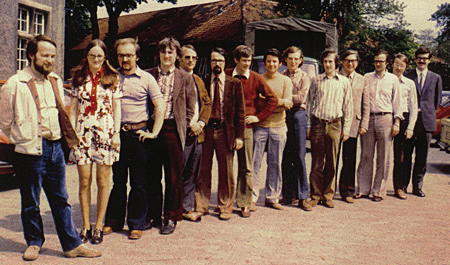
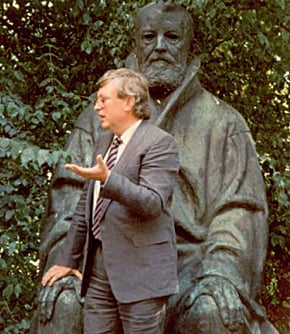
Practically all coworkers joined me. New equipment was acquired, and new problems were studied. In this period, for example, the mechanism of catalytic ammonia synthesis was elucidated after I learned at a conference, that despite of fifty years of research this was still an open problem. But also more physical problems were investigated, such as the study of the electronic properties of the outermost atomic layer by deexcitation of metastable noble gas atoms, and the construction of a molecular beam apparatus initiated our studies in the field of gas/surface dynamics. Fig. 4 shows me in the yard of the institute in front of A. von Baeyer, the 1905 winner of the Nobel Prize in Chemistry. In between I spent two half-year sabbaticals in California (Caltech and Berkeley).
But also this fruitful era came to an end when I received an offer from the Max-Planck Society to become the successor of my teacher Heinz Gerischer as director at the Fritz-Haber-Institut in Berlin. Gerischer served in this position since 1969 and was a student of Karl-Friedrich Bonhoeffer who in turn was Fritz Haber’s assistant until his emigration in 1933. This continuing genealogy was certainly also a factor influencing my decision to move to Berlin. There I took over the fairly large department of Physical Chemistry which grew even further by all the coworkers arriving from Munich. Our main activities concentrated there on the investigation of nonlinear dynamics and spatio-temporal pattern formation (including theory), following surface processes on atomic scale by scanning tunnelling microscopy, the dynamics of fast surface processes studied by femtosecond laser techniques, but also exoelectron emission in surface reactions and atomic-scale electrochemistry etc.
After official retirement in October 2004, I am still active in writing and giving lectures.
This autobiography/biography was written at the time of the award and first published in the book series Les Prix Nobel. It was later edited and republished in Nobel Lectures. To cite this document, always state the source as shown above.
Gerhard Ertl – Other resources
Links to other sites
Gerhard Ertl, Fritz-Haber-Institut der Max-Planck-Gesellschaft
Animation: Oxidation of carbon monoxide on platinum, Fritz-Haber-Institut, Max-Planck-Gesellschaft
Pressmeddelande: Nobelpriset i kemi 2007
English
Swedish
German
10 oktober 2007
Kungl. Vetenskapsakademien har beslutat utdela Nobelpriset i kemi år 2007 till
Gerhard Ertl
Fritz-Haber-Institut der Max-Planck-Gesellschaft, Berlin, Tyskland
“för hans studier av kemiska processer på fasta ytor”.
Modern ytkemi – bränsleceller, konstgödsel och avgasrening
Årets kemipris belönar grundläggande arbeten inom ytkemin. Denna vetenskap är viktig för den kemiska industrin och kan hjälpa oss förstå så skilda förlopp som varför järn rostar, hur bränsleceller fungerar och hur bilens katalysator arbetar. Ytkemiska katalysatorer är avgörande i många industriella processer, bland annat framställning av konstgödsel. Ytkemi kan till och med förklara ozonlagrets nedbrytning, eftersom avgörande steg i reaktionen sker just på ytan av små iskristaller i stratosfären. Halvledarindustrin är ytterligare ett område som är beroende av ytkemisk kunskap.
Den moderna ytkemin började växa fram som vetenskap under 1960-talet just tack vare de tekniker som utvecklades inom halvledarindustrin. Gerhard Ertl var en av de första att se potentialen i de nya teknikerna. Han har steg för steg byggt upp en metodologi för ytkemi genom att visa hur olika experimentella tekniker kan användas för att ge en komplett bild av en ytreaktion. Denna vetenskap kräver avancerad teknisk utrustning för högvakuum, eftersom man vill kunna iaktta hur enskilda lager av atomer och molekyler beter sig på en extremt ren yta av exempelvis metall. Då måste man kunna kontrollera exakt vilka ämnen som släpps in i systemet. En förorening riskerar förstöra hela mätningen. För att få en komplett bild av en reaktion krävs därför både noggrannhet och en kombination av många olika experimentella tekniker.
Gerhard Ertl har bildat skola genom att visa hur man får tillförlitliga resultat inom detta svåra forskningsfält. Hans insikter har lagt en vetenskaplig grund för den moderna ytkemin; hans metodologi används både inom den akademiska forskningen och för processutveckling inom den kemiska industrin. Det angreppssätt Ertl utvecklat grundar sig inte minst på hans studier av Haber-Bosch-processen där luftens kväve fångas upp för att ingå i konstgödsel. Denna reaktion, som sker med en järnyta som katalysator, har en enorm ekonomisk betydelse eftersom just kvävetillgången ofta är begränsande för växtligheten. Ertl har också studerat hur kolmonoxid oxideras på platina, en reaktion som sker i bilars katalysatorer för att rena avgaserna.
| Läs mer om årets kemipris |
| Populärvetenskaplig information |
| Scientific Background |
| Länkar och lästips |
Gerhard Ertl, tysk medborgare. Född 1936 (70 år) i Bad Cannstadt, Tyskland. F.D. i fysikalisk kemi 1965, vid Technische Universität München, Tyskland. Professor emeritus vid Fritz-Haber-Institut der Max-Planck-Gesellschaft, Berlin, Tyskland.
http://www.fhi-berlin.mpg.de/pc/PCarchive2.html
Prissumma: 10 miljoner svenska kronor.
Kontaktpersoner: Fredrik All, informatör, tel. 08-673 95 63, 070-673 95 63, [email protected]
Ulrika Björkstén, vetenskaplig redaktör, tel. 070-206 67 50, [email protected]
Kungl. Vetenskapsakademien, stiftad år 1739, är en oberoende organisation som har till uppgift att främja vetenskaperna och stärka deras inflytande i samhället. Av hävd tar akademien särskilt ansvar för naturvetenskap och matematik.
Pressemitteilung: Der Nobelpreis für Chemie 2007
English
Swedish
German
10. Oktober 2007
Die Königlich Schwedische Akademie der Wissenschaften hat beschlossen, den Nobelpreis des Jahres 2007 für Chemie zu verleihen an
Gerhard Ertl
Fritz-Haber-Institut der Max-Planck-Gesellschaft, Berlin, Deutschland
„für seine Studien von chemischen Verfahren auf festen Oberflächen“.
Moderne Oberflächenchemie – Brennstoffzellen, Kunstdünger und Abgasreinigung
Der diesjährige Chemiepreis zeichnet grundlegende Arbeiten innerhalb der Oberflächenchemie aus. Diese Wissenschaft ist wichtig für die chemische Industrie und hilft uns beim Verständnis so unterschiedlicher Vorgänge wie das Rosten von Eisen, das Funktionieren von Brennstoffzellen und die Wirkung eines Katalysators im Auto. Oberflächenchemische Katalysatoren sind in vielen industriellen Verfahren ausschlaggebend, unter anderem bei der Herstellung von Kunstdünger. Mit der Oberflächenchemie lässt sich sogar der Abbau der Ozonschicht erklären, da entscheidende Schritte in der Reaktion ausgerechnet auf der Oberfläche kleiner Eiskristalle in der Stratosphäre erfolgen. Die Halbleiterindustrie stellt einen weiteren Bereich dar, der von der Wissenschaft der Oberflächenchemie abhängig ist.
Die moderne Oberflächenchemie begann sich in den 1960er Jahren insbesondere dank der in der Halbleiterindustrie entwickelten Techniken als Wissenschaft heranzubilden. Gerhard Ertl war einer der ersten, der das Potential dieser neuen Techniken erkannte. Er hat schrittweise eine Methodik für die Oberflächenchemie entwickelt indem er aufzeigte, wie verschiedene experimentelle Techniken verwendet werden können, um ein vollständiges Bild einer Oberflächenreaktion zu erhalten. Diese Wissenschaft erfordert eine ausgereifte technische Ausstattung für Hochvakuum, da man beobachten möchte, wie sich einzelne Schichten von Atomen und Molekülen auf einer extrem reinen Oberfläche aus beispielsweise Metall verhalten. Dazu muss man exakt kontrollieren können, welche Stoffe in das System hineingelassen werden. Eine Verunreinigung riskiert die gesamte Messung zu zerstören. Um ein vollständiges Bild einer Reaktion zu erhalten, ist deshalb Genauigkeit wie auch eine Kombination von vielen verschiedenen experimentellen Techniken gefordert.
Gerhard Ertls Arbeit hat Schule gemacht, da er aufzeigte, wie man zuverlässige Ergebnisse auf diesem schwierigen Forschungsgebiet erzielen kann. Seine Einsichten haben den wissenschaftlichen Grund für die moderne Oberflächenchemie gelegt; seine Methodik findet Anwendung sowohl in der akademischen Forschung wie auch in der Entwicklung von Verfahren in der chemischen Industrie. Der von Ertl entwickelte Ansatz basiert nicht zuletzt auf seinen Studien des Haber-Bosch-Verfahrens, bei dem Luftstickstoff für die Herstellung von Kunstdünger gefangen wird. Diese Reaktion, die mit einer Eisenoberfläche als Katalysator erfolgt, hat erhebliche finanzielle Auswirkungen, da gerade der Stickstoffzugang häufig begrenzend für das Wachstum ist. Ertl hat auch untersucht, wie Kohlenmonoxid auf Platin oxidiert – eine Reaktion, die zur Abgasreinigung in Autokatalysatoren erfolgt.
| Read more about this year’s prize |
| Populärwissenschaftliche information |
| Scientific Background |
| Links and Further Reading |
Gerhard Ertl, Deutscher Staatsbürger. Geboren 1936 in Bad Cannstadt, Deutschland. Dr.rer.nat in physikalischer Chemie 1965, an der Technische Universität München, Deutschland. Professor Emeritus am Fritz-Haber-Institut der Max-Planck-Gesellschaft, Berlin, Deutschland.
http://www.fhi-berlin.mpg.de/pc/PCarchive2.html
Preissumme: SEK 10 Millionen Schwedische Kronen
Kontaktpersonen: Fredrik All, Verantwortlich für Information, Tel.: +46 8 673 95 63, +46 70 673 95 63, [email protected]
Ulrika Björkstén, Wissenschaftsredakteur, Tel.: +46 70 206 67 50, [email protected]
Die Königlich Schwedische Akademie der Wissenschaften, gegründet 1739, ist eine freistehende Institution, die ihre Aufgabe darin sieht, die Wissenschaften zu fördern und ihre Stellung in der Gesellschaft zu stärken. Nach ihrer Tradition fühlt sich die Akademie besonders verantwortlich für die Naturwissenschaften und die Mathematik.