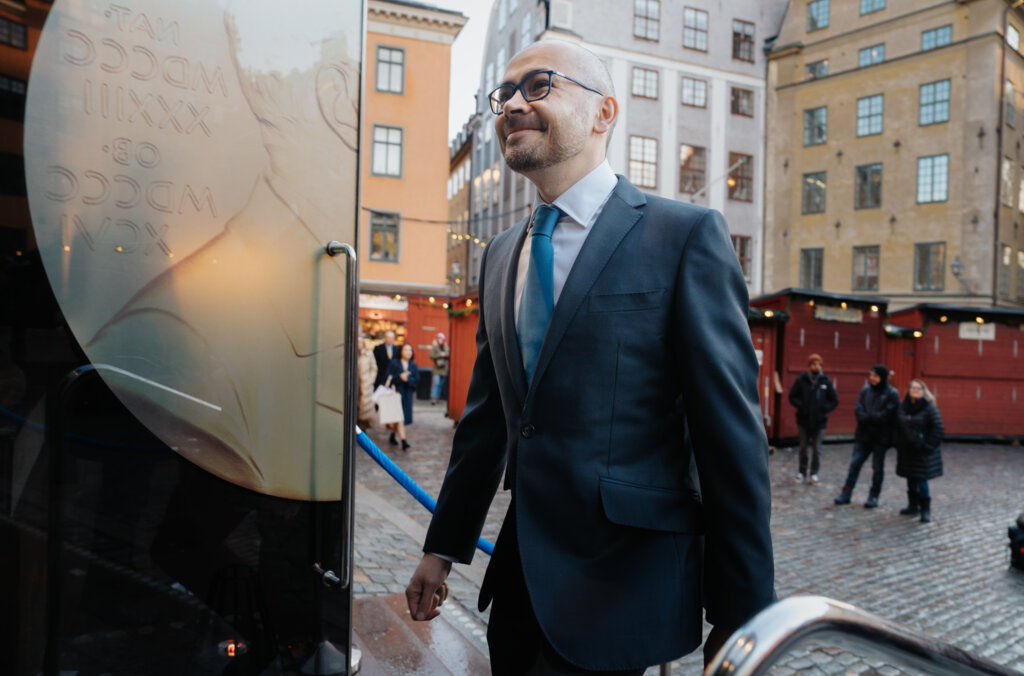
Transcript from an interview with Elinor Ostrom and Oliver E. Williamson
Interview with the 2009 Laureates in Economic Sciences Elinor Ostrom and Oliver E. Williamson on 6 December 2009. The interviewer is Adam Smith, Editor-in-Chief of Nobelprize.org.
Oliver Williamson, Elinor Ostrom welcome to Stockholm and to this interview with, unfortunately, Adam Smith.
Oliver Williamson: It’s our pleasure.
Elinor Ostrom: Our great pleasure.
I think when I phoned you both in October you were both somewhat surprised by the name, it’s a bit of a liability on that day of the announcement. How have the couple of months since the announcements been for you?
Oliver Williamson: In a word – hectic.
Elinor Ostrom: And two words – very hectic.
You must be catapulted into a spotlight and a world of activity.
Oliver Williamson: It is, one of the things that is really gratifying however is how much goodwill you soak out from hearing from friends, former students, colleagues and family. It’s unreal but it’s there and so genuine that I couldn’t have imagine it.
That is nice.
Elinor Ostrom: I double that, some parts of the e-mail load are not friends and family and trying to cope with that has been a bit of a challenge. For our former students and colleagues all over the world, they have been sending joyous messages and that is very gratifying.
And since you are the first woman to have been awarded the Prize in Economic Sciences in its 40-year history I imagine that is slightly added to the load you have been under.
Elinor Ostrom: Yes, I think that there have been many people who have been particularly asking about gender problems in American universities. Universities more general, it’s not just US.
I am sorry, you must be terrible bored of discussing this, but the fact that there has been one in 40 years, do you think that is in any way representative of the female contribution to economics over the last 40 years?
Elinor Ostrom: Not the contribution, but the capability to be in academia.
Do you see things improving?
Elinor Ostrom: Yes, I think that many departments now have new graduate students coming in at a rate, new women graduate students that they did not have previously, and our departments are moving toward hiring more. I don’t think I will be the last.
Do you see a change in the Nobel women coming to the subject?
Oliver Williamson: Oh yes, yes, and as Lin suggests, many are really excellent, and they get good placements and they are doing good work and we are going to hear from them.
Elinor Ostrom: Yes!
So the prize this year is divided into two parts, but you are united in your work by the phrase the committee used such as ‘economic governance’ and broadly you both study ways of regulating transactions in the broader sense. If I could start with you, you study complex economic organizations and complex transactions and one part of your work that has been particularly sort of commented on by the committee is the fact that that allows you to say something about what sort of transactions should be conducted within firms and what sort of transactions should be conducted within a market.
Oliver Williamson: Yes!
Can you give examples of the sort of transaction that we are talking about when we say that?
Oliver Williamson: Yes, but I wonder if I could back off for a minute and talk about governance, because there is a compact two-sentence statement that was made by John R. Commons who was an older stylist, institutional economist, and I think undervalued by a lot of people then and since but never the less profound in many of his insights. And the two-sentence statement runs roughly as follows: “The principal unit of analysis should contain in itself, the three principles of conflict, mutuality and order. This unit is a transaction”. The part of it that I initially related to, because I was working at this more microanalytic level of transactions rather than completed goods and services, was that the transactions /- – -/ analysis. But as I got deeper into the study of organization, I started to ask what is the value added for some of these more complex forms of organization.
This triple of conflict, mutuality and order goes right to the essence and specifically I would describe governance as the means by which to infuse order thereby a medicate conflict and realize mutual games and that was contemplated, I would say, by Commons, even though he didn’t have much success in implementing it. That’s a profound sense of what I think was a missing arena for economics for a long time. A specific example would be the first project that I undertook along these lines and that’s the make-or-buy decision that firms was confronted with, it needs a specialized component let us say. It can either outsource to a independent contractor and mediate that transaction with a written contract that stipulates what’s to be delivered when, why and how they are going to handle difficulties in the like or you can take that transaction out of the market and organize it internally which is the make decision and vertical integrations issues had been around for a long time, addressed mainly as a technological issue addressing it in contractual terms with reference to two alternatives that one might have an advantage over the other or not. But the challenge was to first look at it contractually actually compartive contractually because you always want to think of two or more alternative ways of getting it done and then thirdly one other fact is that to drive it around in one way or another. And working that through was the transaction cost’s economics challenge.
I can see that you can analyze a situation in which a firm is saying should we have this component made outside, buy it in or should we make it ourselves? But you have been able to turn that into theories which suggest in which circumstances the make decision is correct, which circumstances the buy decision is correct and then those theories have been put out to empirical testing and they presumably refine the theory. Is it now, are you able to suggest principles by which firms can govern their decision to the make-or-buy decision?
Oliver Williamson: What you need to do is you need to identify the critical attributes that define transactions so that operationalizing that the concept of transaction by naming what you take to be the critical factors across which transactions cost will vary. Then secondly you need to do the same thing with reference to governance structures, you need to identity the critical dimensions with respect to which governance structures differ. Then you ask the question given this cluster of attributes of transactions. Do they pose easy or complicated kinds of contractual issues? If they are easy, there are lots of easy transactions, I mean this is what spot markets and so are all about, neither party has any kind of dependency relation on the other. It’s sort of the classical problem of exchanging nuts for berries at the edge of the forest, you know. We both benefit from the exchange, but we don’t have any continuing relationship. Where you have to have a continuing relationship, where one party needs to make specialized investments in support of the other and where this contract may break down if it’s done in an intra-firm fashion, that’s where the concept of taking transactions out of the market and organizing them internally is important.
And actually, there is two other sort of major figures that I would say that enter into this and one is, both of them talk about adaptation as being the central problem of economic organization. One of these people is an organization theorist also from the 1930s, namely Chester Barnard, and he was interested in what it was distinctive that was going on within firms and his fear was that coordinated adaptation was the central kind of a contribution that internal organization had to bring and during that in a conscious deliberate purposeful way. This was, I would say, the marvel of internal organization, all was bureaucracy then and since it has been widely scorned. Sometimes for good reasons, but nevertheless there are things that internal organizations are especially good at. The other person was Friedrich Hayek, former Nobel Prize winner, that emphasized autonomous adaptations accomplished to the market in response to changes of relative prizes. This was the marvel of the market as economists had long regarded it but as Hayek specifically nailed it. Well, we have two marvels actually, the marvel of the market and the marvel of hierarchy and we had to appreciate both of them, and we had to know the strength and weaknesses of both of them and that’s part of the exercise.
Is this very much an area of on-going study? Do we know the strength and weaknesses of the firm versus the market or is this just something that is going to continue to evolve as firms evolve and the world becomes more global and all of this?
Oliver Williamson: Well,I don’t think this exercise is over, but I do think that we have made headway and an appreciation for firms and it goes beyond firms and markets, I mean there is also a place for bureaus, theres’s a place for cooperatives. There are lots of challenges that haven’t yet been uncovered and some that have that need to be more fully refined. But one other thing that I would also say, and that is that beyond intermediate product market transactions or close approximations theretoo, any issue that you can, that either arises as or can be reformulated in contracting terms is an issue that you can get some deeper insights by addressing it in transaction cost economizing terms. That isn’t to say that’s the only ones to bring to bear, but it is an instructive ones and that caught me by surprise because I really work with solving this early problem and go out and do other things.
There is more to be uncovered.
Oliver Williamson: Yes!
The mention of cooperatives in particular, leads into your work. You have studied the use of common-pool resources and the different ways that shared resources can be controlled. And your work comes against a back-drop I understand of a body of thought which was suggesting that outside control was the right way to manage, outside control was the right way to manage shared resources that outside control tended to stop people just overexploiting the resources they had access to. But you suggested that actually it was a little different and that common control of one’s own resources was often a more productive way, a more successful way of controlling their exploitation.
Elinor Ostrom: A lot of people presumed that it was impossible for those who used a fishery or groundwater basin or a lake or river to self-organize. So self-organization was considered to be impossible and that was why they recommended either the market or the state not well defined not well worked out, but at least an idealized form. A great deal of research had been undertaken by people describing these efforts, but it was people in multiple disciplines about multiple sectors in multiple parts of the world, no cumulation. The presumption was the news headlines would always headline would give sardines were the story in California was a very great tragedy, but that did not mean that resources everywhere were being destroyed, but that’s what people payed attention to. What we have been trying to do is a systematic understanding of when will people engage in the transaction of self-organizing and then sustaining that organization over time. And they use a variety of forms, so sometimes they create a small government, but that’s not ‘the state’. The group of ground water harvesters I looked at in southern California created, there were 11 cities, all sorts of diversity, but they created something called a special district private water association, a variety of other things and did an incredible job without a single external authority doing it for them. It was tough, but they did self-organize and among the things they did was to develop their property right system.
That’s what I did for my dissertation and I did not know I was studying the commons. I was studying, I thought, Schumpeter’s problem of how do entrepreneurs develop and what did they do etc. I titled my dissertation “Public entrepreneurship” because that was the sort of thing that there were several leaders that were incredible in their effort that they put to getting people to meetings, getting them to discuss, getting them to sit down and this problem of conflict was just immense. If you can’t find a forum in which people can get the facts so that they aren’t arguing about facts at the same time they are arguing about what we should do and that makes a huge difference. In any case we now studied this in the experimental lab where we take the simple mathematical theory and have eight people in a lab making decisions that are the ones that come from the theory and indeed, if in a lab no communication is allowed so we have them sitting independently at a computer terminal around and can’t see each other, can’t communicate, they do overharvest. In fact, they overharvest worse than predicted.
What do you give them to harvest in the lab?
Elinor Ostrom: We give them a certain set of tokens that they can invest in two options, one of which is the same, mathematically, as the common pool resource. The other would be that they go out and work on job market 8 hours for a set wage and there is an equilibrium concept called ‘the Nash equilibrium’ that you can take with a mathematical formulation and they should, according to the Nash equilibrium, pull out more resources from, because they are not cooperating. If we are all going in there and being aggressive you then harm each other and you, in the long run, are actually harmed because you are doing more than you should. Doing worse than Nash means they were even much more aggressive. We allowed one change in the lab, that people could engage in face to face communication, which in game theory was called ‘cheap talk’ because that process, if one person says ‘Why don’t we do x?’ and the others agreed, there was no external enforcer and without a third person enforcer the court or the state it was considered mere cheap talk. Well, mere cheap talk allowed them to greatly increase, they are a joint pay-off, and to preserve the mathematical resource and we tried a number of other things that we are seeing in the field.
We then studied irrigation systems around the world and compared farmer managed systems where the farmers have got to organize everything and figure out who is going to build and how they are going to build and who is going to do the labor and how they are going to allocate water, but they don’t have much, they do not have very many resources so they build very primitive systems. We have compared those with government systems with fancy concrete and beautiful gates and just fantastic amount of money put in them and they can get more water to the tail-end, they can produce more food and their efficiency is higher than the amount of the cost of the resources going in as opposed to the value of the what they obtained. So, to be more efficient, more equitable and do so with extremely primitive tools, a log that is what diverts the water, mud channels etc., is right amazing and now we are studying forests around the world.
As the study of these variety of systems has led you, in 1990, to produce a set of guiding principles so to say which suggest how common pool resources should be used?
Elinor Ostrom: That wasn’t quite my view, I was not doing the ‘should’. I was trying to understand a series of systems that had existed for two hundred or so years and we had good data about them and good information and where there any … I thought we quoted the specific rules they had used in many of these and I could not find a specific rule or set of rules that were always used, so I tried to move up a level and ask what were the generalities across the long-lasting robust systems, I called them design principles, not from the perspective that they were what you should do but if you wanted to be robust you should probably take this seriously but how you would actually apply that would differ from system to system. So, I didn’t mean that the farmers or fishermen or anyone had actually had the principles in mind but they were, maybe we could call it best practices, they worked, they worked over time and then we looked at the failures and they not have the same characteristics.
But given that one must be able to look around the world and just see innumerable examples of places where it is not working as well as it should be. There must be quite a temptation to start saying ‘should’ because if you have got a set of desired principles which you see working broadly around the place. It must be quite tempting to think.
Elinor Ostrom: Some people have applied it and I have a little bit of a tension with some of the ways it’s been applied because USAID and all sorts of – SIDA, others – have gone in and said: Now do this. When one of the principles is that they have developed a way to have conflict resolution locally, well sometimes that’s they have a court, in Spain, in eastern Spain there is a court that has been maintained once a week for back to 1500, Valencia. It’s got a very stylized way of handling things that works for them because they have multiple systems, the water master on each of the systems comes in its under court and if there is a conflict on their system they leave the court and testify in front of it, but that’s a particular design that works very well, that when you get experts who know the problem and face with it every day and then you bring a conflict between two neighbors before and you got a decision now. That is conflict resolution within a week of the conflict emerging. Now that won’t work everywhere as a conflict mechanism, so why I am nervous about people who want to just impose it, and that has been happening from time to time, is: What is it you are imposing? Are you running training sessions with people to give them an idea of the array of conflict mechanisms that people have used and then ask them what are some of their traditions, their ways of doing things, then they may be able to develop a conflict mechanism that works for them, but sometimes that’s a traditional chief. Well, that won’t work in LA.
Or it might!
Elinor Ostrom: Well, not usually, might work in Chicago, not my /—/.
Oliver Williamson: If I could make a couple of remarks and relate to, I think both of our work, and one of them is that I think that we have in different ways explained that organization matters and is susceptible to analysis. A lot of people are persuaded that organization matters, but for a economists it’s important to show that its susceptible to analysis and by doing this kind of microanalytic research and establishing the pre-conditions for some of the stuff to go through was really vital. But also, they were both affiliated with new institutional economics and in a way institutional economics operates at a couple of levels, one of which is kind of this organizational governance level, but there is a higher level. It relates to this inability to have a ‘cookie cutter’ that you can just go in and stamp, that is different nation states, they are differently organized and different traditions and customs as Lin says and those are important to how you organize and that should be factored in rather than simple ignored or glossed over. The last thing I would suggest in this, suggest the ambition of this line of research is that right now we all of I think major states, have something that’s akin to a council of economic advisors and I think that they’re well advised is to have such. I think that organizations are sufficiently important and as we make progressive headway with our understanding of it I think that all nation states ought to begin thinking about having a counsel of organizational advisors so there is lots of stuff that’s going on in Washington DC and around the world right now that has huge organizational applications and isn’t being factored in the same systematic way that basic economics is and sometimes that comes back to serious regret.
I was going to ask about the frustration there must be in, when you study these things and, see people not thinking about it enough and whether that leads you ever to think or maybe having spent all this time studying it, I ought to be in more of a policy position myself and trying to make people listen from a different perspective. Is that a conflict you feel? Do you wish people would listen to you in a different way?
Oliver Williamson: I think we make headway, and it takes time but actually one of the access points for me was I served as special economic assistant to the head of the antitrust division in 1966–67. These were marvelously capable people who had been running the antitrust division but they were doing in a one sided way, there are essentially using text book economics, micro economics supplemented by a little bit of industrial organization but there was almost no attention given to the possibility that organization was important and that instead if you saw a non-standard practice or organizational form, the immediate suspicion was this has anti-social, anti-competitive intent and it’s easy to run with that ball and get the courts to buy into it. And they did. But the other possibility was that some of these have benefits when they are associated with it and one of the things, they are trying to do is infuse confidence into contractual relations that otherwise would break down and that this is an efficient thing to do. And that point of view has made progressive headway. I don’t say it’s the mainstream now but there is much more interest in being symmetrical rather than one sided in our way of doing anti-trust enforcement, and doing regulation and it should be the case that as we design bureaus that this is actively taken into account and take the problem of homeland security that was put together in wrapped fashion in a way which I think many of us that are closer to the organizational side of things are say this really should have been vetted by people with organizational backgrounds and interest and capabilities.
Elinor Ostrom: I did series of studies that looked at a slightly different question now and public goods and how do you organize local metropolitan areas, because we started with water, but then I turned to policing. The presumption was that in a lot of the literature that fragmentation was evil and that what you needed was a single center. Hierarchy was the model that lot of reform efforts had in their mind, that hierarchy would solve all of the problems of metropolitan areas, and I was deeply suspicious of this having done work on a polycentric industry where there were public and private firms working together at multiple levels. It did not appear to me chaotic but many of my colleagues would put a map in a textbook and it would show some individual cities and then show some other units and the heading would be “The chaotic structure of x metropolitan area” because there were multiple units on the map that was chaos.
We studied policing in a number of smaller studies comparing very similar neighborhoods served by independent small departments versus large. We never found a large department that could out preform a small, partly because of knowledge and understanding the … I rode in a lot of patrol cars and if you were in a small or medium size patrol car the officer would tell you a lot about the neighborhood he was patrolling and really knew it. In large departments to cope with the problem of corruption, which happened in large departments, they rotated the officers and so they might have 90 districts and you rotated every 28 days. Well, you didn’t know much about that district so the knowledge level of the officer and the knowledge that the citizens had of the officers serving them was very low. We also then did a study of 80 metropolitan areas looking at the areas in terms of direct services like patrol being provided by small or medium size versus the problems of crime lab for which there were economies of scale, and the argument had been: the economy had scale for crime labs so consolidate everything. We found that in field in 80 metropolitan areas we found only 84 crime labs, so in the field officers and departments and majors had figured it out and they did all try to have their own crime lab, they frequently contracted with the local hospital that had all the equipment and just had to have some personnel that understood the problems of criminal investigation. In 80 metropolitan areas we found the most efficient and effective had some units at the very top and then had a large number of small to medium size direct producers.
This is an entirely different vision but its consistent with the idea that there isn’t just one way of organizing a corporation and this was there is one way of organizing a metropolitan area and I think our work, it complements each other’s because you can’t make those kinds of presumptions although the transaction costs involved in an interaction between a officer and a citizen who don’t know one and other and the interaction between an officer and a citizen who have seen each other in different times, their faces are familiar, you know a little bit about the background, is entirely different.
One of the things, the principles that seem to run through your work, is that people behave more rationally, more sensibly than is assumed in many cases.
Elinor Ostrom: It depends on what you mean by rational.
Yes, I am getting into hot water by using such terms. People are better able to, if you like, to look after themselves, they either use water in a common way more sensibly than the government might think they might or if they’re local police forces they organize themselves more sensibly again than the government might think they might.
Elinor Ostrom: But there are settings in which they would just grab like that so you can’t just assume that people under any circumstance will always take into account others and always be good. Humans are neither all angels or all devils and so it is the context in the institutional context in which they find themselves that enable them to have more willingness to use reciprocity to trust one and other and to be in a situation that ‘I can trust you because I think you trust me, and I won’t be sucker’. And one of the problems with the commons is that if I trust everyone else is going to be a good guy and I am cooperative and there are not, I am a sucker and people are worried about being a sucker.
Are you surprised to find yourself studying what you study? Because you mention that you started out studying entrepreneurship as a graduate student and now you study the commons, when you look back, is it odd that you ended up here?
Elinor Ostrom: It’s a great honor to be in here, but I didn’t, I was studying the commons from the beginning, but I didn’t know it. I was studying a tough problem that people were trying to solve and entrepreneurship in the public or private sphere has to do with people who are able to understand some of the complexity of a setting and how to organize, so the capacity to organize is crucial and yes, the presumption has been the only way that people organize is inside the market or through a state and that’s what I think has to be, we have to move on to understanding that organization can occur at multiple scales and multiple ways and not always the best, so the mafia is organized. That is not always good.
But I asked the question as a prelude to asking who you think ought to come into the area now, what are you looking for in terms of new blood to come in and advance the theory further. Is it possible to say? Is there something lacking?
Oliver Williamson: It is a little bit idiosyncratic but I do think that there is a movement in economics to be more interdisciplinary and in pulling related disciplines together, whereas previously there is and I think there always will be a sense that economics is the prince of the social sciences but that there is a greater appreciation, I think, that there are complex phenomena that if you look at them exclusively through the lens of economics not assisted by any of any of contiguous sciences that you are going to be missing things. One of the things, one of the reasons why I think that I was able to look at some of the issues in anti-trust enforcement differently then was the sort of standard view was that I was part of a really unusual interdisciplinary program in social sciences at Carnegie Tech, then Carnegie Tech, now Carnegie Mellon, in which organization theory was thought to have co-equal status with economics and should both inform and be informed by economics.
There was sort of traffic across this boundary and I do think that having more of our students exposed to the contiguous social sciences and you know, your principal discipline could be political science and you will reach out to economics and that’s been going alright and could be economics and you reach out to political sciences or sociology and that’s been going on. So I think there is, I don’t think everybody by any means should be sort of multi-disciplinary in their work, but I would hope that there will be growing agreements that these sciences have a lot of common ground and that they should work on it in a collaborative way and then often it’s going to be a better more productive. It’s going to be more interesting as a matter research and it’s going to be more productive for the common well.
Elinor Ostrom: I also think interdisciplinarity is a very important. Vincent Ostrom and I established a center called a workshop in political theory and policy analysis back in 1973–74 and we have always had multiple disciplines around the table and that’s just been my life. We now are reaching out more to ecologists because of, if you’re studying forest, you have to learn a little bit more about the ecology of forest because again rules that work well in a deciduous forest don’t work well in a tropical wet forest and trying to understand the ecological foundations is very very tricky and I am having learned a lot of new concepts and new terms.
Are you specializing in forest studies?
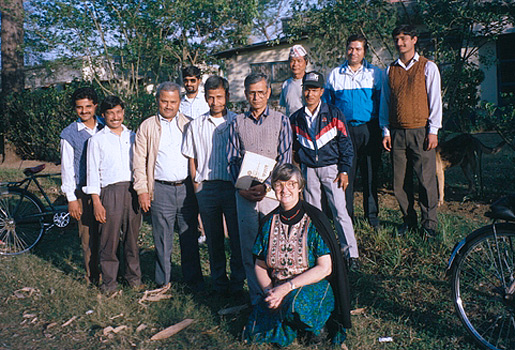
Elinor Ostrom: No, it happens to be the applied area I am working in now heavily. I have a couple of articles I am working on, irrigation, so we have a large database and we have a book coming out in another 6 months or so assuming all of this. But I have just finished a book that I am very very pleased about with the title “Working together – collective choice, the commons and multiple methods in practice” and the thesis of it is besides interdisciplinary is multiple methods. Sometimes we have people only do a mathematical model or only do only case studies or only do large N and they criticize everything else and the problem is that we need to be able, either if we can’t ourselves do the model, that’s foolish but we need to be aware of the advantages and know enough about some of the methods that we can work with an expert in a method and then bring some of our knowledge from a different set of methods together. I love experimental work, but it doesn’t have the richness that I have when I study forests in the field. I love both of them as ways of different ways of getting insights and sometimes being in the field leads back to the lab. In particular I kept seeing people monitoring and sanctioning each other in the field, amazing times and so I came back from a particular vivid occasion in Nepal and said to my colleague Roy Gardner who is a game theorist and Jimmy Walker who is an experimentalist: Let’s please, let’s do a formal game involving people paying their own cost to sanction others, because in the field if they go this was an instance where someone had dug into an irrigation and so several of them went running down the hill and yelling and screaming and others starting patching it immediately and I mean the energy they put in, they didn’t not think about it. There was no rational calculation about this, they just did it.
Well again and the game theory prediction is they wouldn’t, then we could put it in the lab with a simple game we used earlier, but now changing one attribute and giving them a chance to pay a fee to find someone and they did it even though it’s predicted they won’t and if we gave them eventually the choice of what kind of sanctioning mechanism they had and then allowed them to use it, they got to about 94% of optimal. And here is having the game theory model great because we knew what optimal was and we could put it in the lab and figure out what happened, but that was field lab and now on our forest studies because of our earlier findings we asked quite about monitoring and sanctioning. We are finding that whether people who use a forest actually monitor each other to be more important then who owns. Government ownership, private ownership, community organization – all of those are important but if they, the formal rules are there, and the users don’t see a future and don’t see that they are involved and don’t take an interest and don’t monitor – forest goes down.
Forgive this last question, but since you both work on organization theory and the right use of common resources, I wonder whether you are organized people yourselves or whether you are good at organizing things like a complex family which are five children I believe.
Oliver Williamson: That’s true! Well, I think of myself as being disciplined and I guess because I enjoy my work so much I spend a lot of time struggling with new and different issues trying to understand them and trying to see if I can find ways to fold them in and whether or not they have public policy ramifications and the like. It’s been a joyness of work and see things make headways and have good students come through. And its obvious from what Lin says that she’s just really wrapped up in this stuff, its easy to. I wouldn’t call myself an excellent organizer but then the less that it does require keeping a lot of disparate ideas in mind and finding ways to pull them together. There is a certain amount of background organization that goes on. Sometimes actually to my surprise, this has been true more recently than it was when I was a younger fellow, but I will start dreaming about some of this stuff and thinking about what I should be doing and if the ideas are good enough. It doesn’t always turn out that they are, but I get up and jot little notes down and then get back to sleep rather than struggle in the middle of the night and so I have got some subconscious work in front of me, too.
That quite an advantage.
Elinor Ostrom: We have an unusual center that Vincent and I organized long ago, and we had an opportunity both to be in Germany at Bielefeld at the interdisciplinary center and saw the advantage of working with young postdocs as opposed to just graduate students and so we innovated and developed a postdoctoral program, modest in size. That has been a very successful way of both organizing the research side and the teaching side because you have graduate students who are, some of them state of the art on their new tools, but then they are able to talk to young to middle faculty who are not their supervisors but are in the same building and going to the same seminars and discussing when they get and sometimes you know its two-way learning. Then to have interdisciplinary teams and what we have learned is we have had to learn new rules and ways of organizing as we have run into things over time and so adjustability and new circumstances lead you to have to do things slightly differently. We have had the good fortune of a wonderful set of colleagues from all over the world and I think one of the things that will be happening, as far as new entrance, is that we will have more scholars from the developing world and from Asia and that will be contributing to our joint knowledge because they have different experiences and are bringing in new ideas and new ways of thinking about it so I see that as part of the future.
That seems like a marvelous way.
Oliver Williamson: Do you mind if I come back to the organizational issue. One of the things that I was wise about doing is I never took seriously and followed up on any opportunities on to be a Dean.
Elinor Ostrom: Yes, same.
Oliver Williamson: And my experience as department chair is that this was mainly discouraging. There are several things that I did do that did have organizational ramifications and one was when I was at Penn then at Yale and then at University of California Berkeley. I helped to organize workshop and obviously the workshop has been really important to Lin’s work and it’s been important to mine and having colleagues around it interacting and in a constructive way. There is another thing I did, got into it a sort of a backdoor of being a member of the editorial board of the then Bell Journal of Economics, now the RAND Journal of Economics and so I was going to become editor of it and as editor you have a lot of opportunity to move the field around and I have a bunch of really exceptional associate editors who shared a lot of my views in this, probably because I recruited them, but I think that was very satisfying experience. Then when I went to Yale, Yale Law School was interested in having a journal that was edited by the faculty rather than by students, as most law journals are, and we organized a journal of law, economics and organization and I am proud of the accomplishments of that journal. If I put my heart into it I guess I can organize, but taking on jobs like Deans which are important requires you to be a lot more tolerant than I am.
Selective organizational ability. Okay, well splendid. Thank you very much both for this conversation and I wish you a really tremendous week and a lovely Nobel Week.
Elinor Ostrom: Thank you!
Oliver Williamson: Yes, I am amazed that all the good stuff that you drew out of us because at least that is the way I want to interpret it.
Splendid! I enjoyed it very much.
Elinor Ostrom: Its very nice to talk with Adam Smith and a real Adam Smith.
I am afraid my parents saddle me with something that I can’t live up to.
Elinor Ostrom: Well, that isn’t the purpose, you are Adam, you are a real person, we see that, so thank you very much.
Oliver Williamson: Yes, thank you!
Did you find any typos in this text? We would appreciate your assistance in identifying any errors and to let us know. Thank you for taking the time to report the errors by sending us an e-mail.
Elinor Ostrom – Other resources
Links to other sites
Ostrom Workshop at Indiana University
Elinor Ostrom – Prize Lecture
Elinor Ostrom delivered her Prize Lecture on 8 December 2009 at Aula Magna, Stockholm University. She was introduced by Professor Bertil Holmlund, Chairman of the Economic Sciences Prize Committee.
Lecture Slides
Pdf 875 KB
Read the Lecture
Pdf 2.49 MB
Elinor Ostrom – Interview
Interview with the 2009 Laureates in Economic Sciences Elinor Ostrom and Oliver E. Williamson, 6 December 2009. The interviewer is Adam Smith, Editor-in-Chief of Nobelprize.org.
The 2009 Nobel Laureates met at the Bernadotte Library in Stockholm on 9 December 2009 for the traditional round-table discussion and TV program ‘Nobel Minds’. The Laureates discussed the controversy surrounding President Barack Obama’s Nobel Peace Prize, climate change data and science’s integrity in the face of political policy.
Participants of the 2009 edition of Nobel Minds were the Nobel Laureates in Physics Willard S. Boyle and George E. Smith; the Nobel Laureates in Chemistry Venkatraman Ramakrishnan, Thomas A. Stetz and Ada E. Yonath; the Nobel Laureates in Physiology or Medicine Elizabeth H. Blackburn, Carol W. Greider and Jack W. Szostak; the Laureates in Economic Sciences Elinor Ostrom and Oliver E. Williamson. Program host: Zeinab Badawi.
Telephone interview with Elinor Ostrom recorded immediately following the announcement of The 2009 Sveriges Riksbank Prize in Economic Sciences in Memory of Alfred Nobel, 12 October 2009. The interviewer is Adam Smith, Editor-in-Chief of Nobelprize.org.
Interview transcript
[Elinor Ostrom] Hello
[Adam Smith] Oh, good morning. May I speak to Elinor Ostrom please?
[EO] Yes.
[AS] Hello, my name is Adam Smith. I’m calling from the Nobel Foundation’s official website, in Stockholm.
[EO] Yes. Adam Smith, what a name! I’m sorry, you’re kidded a lot, I’m sure.
[AS] Exactly, and I think sometimes the new Economics Laureates think I’m a hoax caller when I do this. We have a tradition of recording very short telephone interviews for the Nobel Foundation website, with the new Laureates, so would you mind speaking for a few minutes?
[EO] Ah, yes, fine.
[AS] Thank you very much indeed. Of course, congratulations on the award.
[EO] Well, it’s an unbelievable honor, yes.
[AS] You, as I know has just been pointed out on the press conference, are the first woman in the forty year history of the Sveriges Riksbank Prize in Economic Sciences to be awarded. Does that make it a greater honor?
[EO] Yes. Having lived through an era, where I was thinking of going to graduate school and was strongly discouraged because I would never be able to do anything but teach in a city college … Ah ha ha, life has changed!
[AS] Do you think that the ratio of Laureates in Economic Sciences – the gender ratio – is it in any way representative of the ratio of people working in the subject now or has it really changed?
[EO] It’s slowly changed. I’ve attended economic sessions where I’ve been the only woman in the room, but that is slowly changing and I think there’s a greater respect now that women can make a major contribution. And I would hope that the recognition here is helping that along.
[AS] I imagine it sends a strong signal, yes. Now, you work on the management of common property by common ownership contrasting it with the effects …
[EO] Among other things, yes.
[AS] Would it be true to say that, broadly, you’ve found that common ownership can be more effective than people thought it might be?
[EO] Yes! It’s not a panacea but much more effective than our common understanding.
[AS] And, is there one example you’d like to give of where this is so?
[EO] Well, let me use the example of lobster fisherman in the state of Maine. In the 1920s, they almost destroyed the lobster fishery. They regrouped and thought hard about what to do and over time developed a series of ingenious rules and ways of monitoring that have meant that the lobster fishery in Maine is among the most successful in the world. The big threat that comes now is that the other fisheries around it have so over-fished fish, that the lobster is a little bit of an extreme example of … If there were an illness or something that came, a bug, that infected them, they would be very exposed. But they have been incredibly effective through the years. There are many other small to medium sized groups that have taken on the responsibility for organizing resource governance. We’ve studied several hundred irrigation systems in Nepal. And, farmer-managed irrigation systems are more effective in terms of getting water to the tail end, higher productivity, lower cost, than the fancy irrigation systems built with the help of Asian Development Bank, World Bank, USAID, etc. So, what we have is many local groups are very effective, but that it’s not universal. So we can’t just now be naïve and think, ‘Oh, well, just leave it to the people, they will always organize.’ There are many settings that discourage self-organization
[AS] Right.
[EO] And, thus, we must understand both the conditions – that they can, but the conditions under which they will.
[AS] Well, I was going to ask you whether your research has also shed light on the conditions that lead to good self-organization. Are there particular features that have to be in place, for instance enough time for participants to work out what their set of regulations should be?
[EO] Yeah, and I have an article in Science in July of this past year which lays out a broad diagnostic framework and identifies a number of variables that are associated with self-organization.
[AS] Would you say broadly though that self-organization should be used and trusted more than it is now? That society should move towards trying to implement self-organizing structures?
[EO] Yes, but not with a formula. So there are many, many efforts now to decentralize and they create a rigid formula and give people rules from on top and say, ‘Now it’s yours.’ And that isn’t worked very well either.
[AS] So, again, there’s a great deal of subtlety to it …
[EO] It’s this … yes. And, you think about the variety. If you look at a countryside, think of the variety out there in terms of the ecological variety. Well, if people are going to manage ecological variety, no single set of rules will work in a semi-arid versus a tropical-wet region. They have to be different.
[AS] Indeed. Another thing you’ve done is to conduct lab experiments …
[EO] Oh, yeah!
[AS] Which I believe have shown that people appear to be more willing to enforce mutually agreed rules than had been expected, again.
[EO] Yes, we’re showing that. But we’re also showing a very important role for face-to-face or even written communication. So, the prediction was that nobody would self-monitor because that’s a second level social dilemma, if you go to Game Theory. But, what we’ve found is that people will, but it can be … people can escalate into, ‘I’ll punish you, you punish him, mamamamamma,’ and it gets worse and worse. So, with communication, where there’s an agreement on what is going to be the … what we are going to do. The ‘we’ then being well-defined, then people can follow rules, be cooperative and, occasionally, sanction one another to help that continue.
[AS] You mentioned Game Theory, there. How much of this is actually an extension of Game Theory and what we’re looking are repeated games in developing these structures?
[EO] The … Game Theory has been very, very important in our work in that we’ve been able to take game-theoretic models and put them in the lab and test them. And thus my early exposure in the 1980s to the work of Reinhardt Selten, who is himself a Nobel Laureate, was a very, very important step in my training. We still … Classical Game Theory is very predictive in some environments but not fully predictive, by any manner/means, in an environment which is a social dilemma. But very helpful for us in analyzing and as we develop a behavioral theory of humans and of other formal mechanisms we can explain why people do cooperate in some settings and not others.
[AS] Right, yes. I’d like to finish just by asking whether you consider that your work is economics or political science or social science, or maybe it doesn’t matter what it is, what it’s branded?
[EO] I consider it to be political economy or the study of social dilemmas. I was trained heavily in economics as an undergraduate. I studied with Armen Alchian and others, and then worked with Reinhardt Selten in the 80s. I work with two colleagues, economists, here in Bloomington that have been very, very important in my work. My husband worked with Charlie Tiebout and they developed a theory of metropolitan organization that was an economic/political science overview, so the … I’ve crossed disciplines, there’s just no question about it!
[AS] I suppose this award has the potential to catch the public imagination, because the citation brands it as economic governance and you’re talking about people getting involved in their own governance.
[EO] Yes!
[AS] It’s likely to be … it’s likely to spark people’s imaginations and they’re going to …
[EO] I hope! Ha ha! That’s what I’ve been working on for all my life! Humans have great capabilities and somehow we’ve had some sense that the officials had genetic capabilities that the rest of us didn’t have.
[AS] Uh hum.
[EO] I hope we can change that.
[AS] Excellent. Well that’s a lovely note to stop on, thank you. When you come to Stockholm in December to receive your Prize we have a chance to speak at greater length, so …
[EO] Wonderful, I’ll look forward to that.
[AS] I look forward to it too. I hope you have a splendid rest of day and once again congratulations.
[EO] Thank you very, very much.
[AS] Thank you, bye, bye.
Did you find any typos in this text? We would appreciate your assistance in identifying any errors and to let us know. Thank you for taking the time to report the errors by sending us an e-mail.
Elinor Ostrom – Photo gallery
Elinor Ostrom receiving her Prize from His Majesty King Carl XVI Gustaf of Sweden at the Stockholm Concert Hall, 10 December 2009.
Copyright © The Nobel Foundation 2009
Elinor Ostrom after receiving her Prize at the Stockholm Concert Hall, 10 December 2009.
Copyright © The Nobel Foundation 2009
Elinor Ostrom and Oliver E. Williamson at the Prize Award Ceremony at the Stockholm Concert Hall, 10 December 2009.
Copyright © The Nobel Foundation 2009
Close-up from the Nobel Prize Award Ceremony (from left to right): Jack W. Szostak, Herta Müller and Elinor Ostrom.
Copyright © The Nobel Foundation 2009
The 2009 Nobel Laureates stand for the Swedish national anthem (from left to right): Charles K. Kao, Willard S. Boyle, George E. Smith, Venkatraman Ramakrishnan, Thomas A. Steitz, Ada E. Yonath, Elizabeth H. Blackburn, Carol W. Greider, Jack W. Szostak, Herta Müller, Elinor Ostrom and Oliver E. Williamson.
Copyright © The Nobel Foundation 2009
Jack W. Szostak arrives to the Nobel Banquet accompanied by Laureate in Economic Sciences Elinor Ostrom.
Copyright © The Nobel Foundation 2009
Elinor Ostrom in conversation with Nobel Laureate in Physiology or Medicine Jack W. Szostak at the Nobel Banquet.
Copyright © The Nobel Foundation 2009
From left to right: Crown Princess Victoria, Mrs Dolores Williamson, Laureate Oliver E. Williamson, Her Majesty Queen Silvia, His Majesty King Carl XVI Gustaf of Sweden, Laureate Elinor Ostrom, Prince Carl Philip, and Princess Madeleine at the Nobel Banquet.
Copyright © The Nobel Foundation 2009
The 2009 Nobel Laureates assembled for a group photo during their visit to the Nobel Foundation, 12 December 2009. Back row, left to right: Nobel Laureates in Chemistry Ada E. Yonath and Venkatraman Ramakrishnan, Nobel Laureates in Physiology or Medicine Jack W. Szostak and Carol W. Greider, Nobel Laureate in Chemistry Thomas A. Steitz, Nobel Laureate in Physiology or Medicine Elizabeth H. Blackburn, and Nobel Laureate in Physics George E. Smith. Front row, left to right: Nobel Laureate in Physics Willard S. Boyle, Laureate in Economic Sciences Elinor Ostrom, Nobel Laureate in Literature Herta Müller and Laureate in Economic Sciences, Oliver E. Williamson.
Copyright © The Nobel Foundation 2009
Elinor Ostrom and Oliver Williamson after delivering their Prize Lectures at the Aula Magna, Stockholm University, 8 December 2009.
Copyright © The Nobel Foundation 2009
Elinor Ostrom delivering her lecture at the Aula Magna, Stockholm University, 8 December 2009.
© The Nobel Foundation 2009. Photo: Orasisfoto
Elinor Ostrom during the reception at the Royal Swedish Academy of Sciences in Stockholm, 7 December 2009.
© The Nobel Foundation 2009. Photo: Orasisfoto
Oliver E. Williamson and Elinor Ostrom at their interview with Nobelprize.org in Stockholm, 6 December 2009.
Copyright © Nobel Media AB 2009
Elinor Ostrom, like many Laureates before her, autographs a chair at Kafé Satir at the Nobel Museum in Stockholm, 6 December 2009.
Copyright © The Nobel Museum 2009
Photo: Jonas Ekström
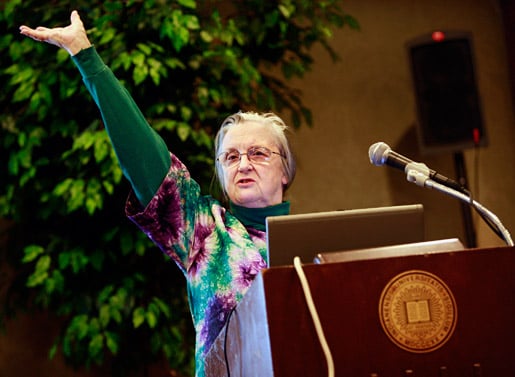
Elinor Ostrom delivering a lecture at Indiana University, Bloomington, July 2008.
Photo: Courtesy of Indiana University
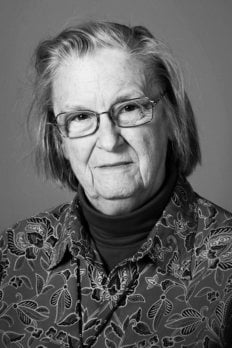
Portrait of Elinor Ostrom.
Photo: Courtesy of Indiana University
Elinor Ostrom (front) with members of the Irrigation Management Systems Study Group during field work in Nepal. Photo taken in March, 1993.
Copyright © Arizona State University
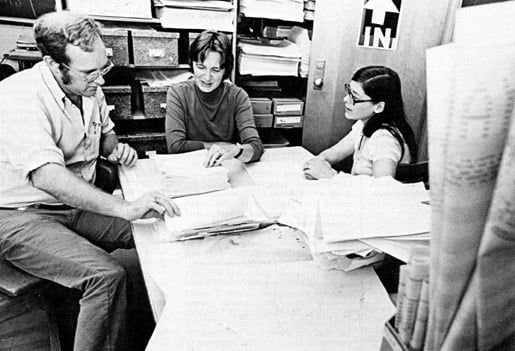
At the workshop in Political Theory and Policy Analysis, political scientists Elinor Ostrom (center), Roger Parks (left) and Diane Eubanks (right) analyze data on American law enforcement agencies. The photo was taken in November, 1977.
Photo: Courtesy of Indiana University
Photo: Frida Westholm

Photo: Frida Westholm

Photo: Frida Westholm
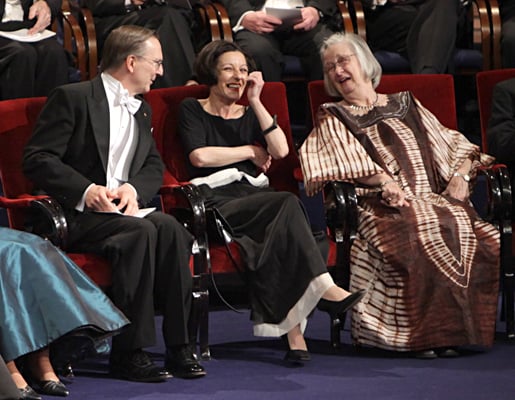
Photo: Frida Westholm

Photo: Frida Westholm

Photo: Orasisfoto
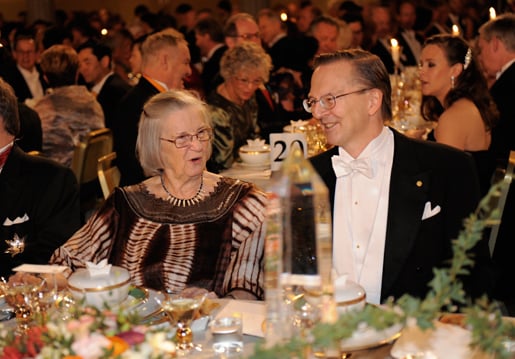
Photo: Orasisfoto
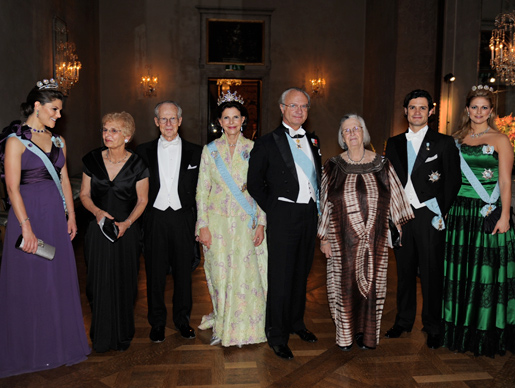
Photo: Orasisfoto
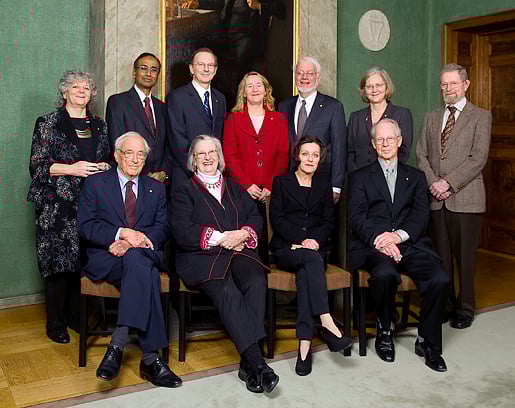
Photo: Orasisfoto

Photo: Orasisfoto

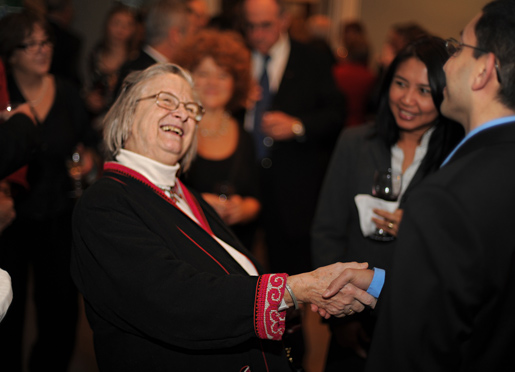
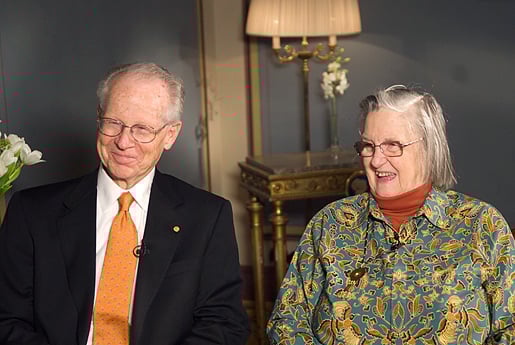
Photo: Niclas Enberg


Elinor Ostrom – Diploma

Copyright © The Nobel Foundation 2009
Artist: Roland Jonsson
Calligrapher: Annika Rücker
Book binder: Ingemar Dackéus
Photo reproduction: Lovisa Engblom
Elinor Ostrom – Prize presentation
Watch a video clip of the 2009 Laureate in Economic Sciences, Elinor Ostrom, receiving her Prize medal and diploma during the Nobel Prize Award Ceremony at the Concert Hall in Stockholm, Sweden, on 10 December 2009.
Elinor Ostrom – Facts
Elinor Ostrom – Biographical
 I was born in Los Angeles, California, on August 7, 1933, and grew up during the Great Depression. Fortunately, our house had a large backyard that we filled with a vegetable garden and fruit trees. I learned how to grow vegetables and how to can apricots and peaches during the heat of summer. During World War II, I learned how to knit scarves for the “boys overseas.” My childhood was spent learning and doing the traditional activities of a girl during the last century. My major recreational activity was swimming, and I eventually joined a swimming team and swam competitively until I started teaching swimming to earn funds that I could save to help put me through college.
Since our home in Los Angeles was located at the lower edge of Beverly Hills, my mother arranged for me to attend Beverly Hills High School. Fortunately, I was encouraged to join the debate team in my junior year of high school and participated actively in speech competitions around the state. Learning debate was an important early impact on my ways of thinking. You are taught that there are always at least two sides to public policy questions, and you have to learn a good argument for both sides as well as knowing how to critique both sides. Participating in team efforts including my debating experience and being on a swimming team was also important.
While it was a challenge being a poor kid in a rich kid’s school, it did give me a different perspective on the future. Since 90 percent of the students in Beverly Hills High School went to college, it appeared going to college was the “normal” thing to do after high school. Even though no one in my immediate family had any college experience, I decided that I should go on to college. My mother saw no reason to support me during my college years since she had been supported only through high school. Fortunately, the semester fees at UCLA at that time were extremely low. I worked in the library, at a dime store, and at the bookstore. I was able to complete my undergraduate degree without going into debt. I took courses across the social sciences and graduated after three years by attending multiple summer sessions and by taking extra courses throughout. In my last year as an undergraduate, I graded Freshmen Economics.
When I started to look for a position after graduation, it was somewhat of a shock to me to have future employers immediately ask whether I had typing and shorthand skills. The presumption in those days was that the appropriate job for a woman was as a secretary or as a teacher in a grade school or high school. I began a correspondence course on shorthand, which I have never used to take dictation, but have found to be very useful when taking notes in face-to-face interviews on research projects. Fortunately, after a year of working as an Export Clerk in a large clerical pool, I did obtain a position as Assistant Personnel Manager for a business firm that had never hired a woman in anything but a secretarial position. I think my experience of obtaining a very good job in my early twenties helped me later when I decided to think about attending graduate-level courses and eventually applying for a research assistantship and admission to a Ph.D. program. I learned not to take initial rejections as being permanent obstacles to moving ahead.
My initial discussions with the Economics Department at UCLA about obtaining a Ph.D. in Economics were, however, pretty discouraging. I had not taken mathematics as an undergraduate primarily because I had been advised as a girl against taking any courses beyond algebra and geometry in high school. While the Economics Department encouraged me to take an outside minor in economics for my Ph.D., they discouraged any further thinking about doing a Ph.D. in economics. Political Science at that time was also skeptical about admitting any women to their Ph.D. program as they feared that only a city college would employ a woman with a Ph.D. That was not a good placement for building the reputation of the UCLA department. I was, however, admitted in a class of 40 students with three other women. We were told after we began our program that the faculty had a very heated meeting in which they criticized the Departmental Committee for admitting any women and offering them assistantships. Fortunately, our fellow male graduate students were friendly and encouraged us all to continue in our program.
In my graduate work, I participated in a research team studying the water industry in Southern California based on some of the initial framing by Vincent Ostrom, Charles Tiebout, and Robert Warren (1961). Several of the graduate students working on this project undertook efforts to analyze the political economy of a group of groundwater basins in Southern California. I was assigned to study the West Basin, which underlay multiple cities along the coast of the Pacific Ocean. The city of Los Angeles partially overlapped the basin as well as a good portion of Los Angeles County. Without knowing I was studying a common-pool resource problem, I became very familiar with the kinds of problems that users of a common-pool resource face in trying to manage such a resource.
It was only after I defended my dissertation in 1965 that Garrett Hardin’s article on “The Tragedy of the Commons” was published in Science, and Mancur Olson’s book on The Logic of Collective Action was published. And, in 1965, Vincent was offered an attractive position as full professor at Indiana University, Bloomington. I tagged along as it was very hard for any department to hire a woman in those days. Fortunately, the Department of Political Science later needed someone to teach Introduction to American Government on Tuesdays, Thursdays, and Saturday mornings at 7:30 a.m. They appointed me as a Visiting Assistant Professor to do that. After a year of teaching freshmen, they asked me if I would be Graduate Advisor and moved me to a regular appointment at that point.
The first 15 years of my research career at Indiana University were focused on studying police industries across the United States. Unfortunately, many scholars had confused multiplicity of units serving the same metropolitan area with a chaotic distribution of services. Not that all multiunit servicedelivery arrangements are effective, but the arrangements we studied in metropolitan areas across the United States were far more effective than the scholarly criticism. We never found a large police department with over 100 officers able to outperform a small- to medium-size department (25–50 officers) in producing direct services including patrol, traffic control, response services, and criminal investigation.
After fifteen years of extensive research on police industry structure and performance, I returned to studying the commons, but this time with the recognition of what I was studying. The National Research Council created a special committee in the mid-1980s to review the empirical research written about common-pool resources. Scholars began to recognize that much research on this topic had been conducted but was divided by discipline, sector, and region. Consequently, scholars who studied inshore fisheries in Africa did not know about other studies of resources in Africa. If they were sociologists, they did not know any of the work done by economists and vice versa. Participating in the NRC committee, and seeing the immense amount of research that had been done but not synthesized, taught me a major lesson. The way we organize the modern American university fragments our knowledge badly. Not only are we divided by discipline, but we are divided by the methods that scholars use. Economists using nationwide statistical data are critical of economists using the experimental lab to test theory. Scholars who do field research are critical of the use of any other method.
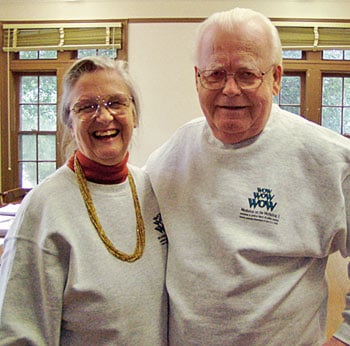
Figure 1. Elinor and Vincent Ostrom during WOW3 (Workshop on the Workshop), 2004.
I have been very fortunate that Vincent Ostrom and I were able to establish an effective research center with a different philosophical foundation during the early 1970s. Vincent named it the Workshop in Political Theory and Policy Analysis. He thought the term “workshop” conveyed a sense closer to his philosophical view of science as a form of artisanship (V. Ostrom 1980). The logic of our Workshop has always been that there would be a variety of scholars across economics, political science, and other disciplines who worked together trying to understand how institutional arrangements in a diverse set of ecological and social economic political settings affected behavior and outcomes. We have delved deeply into how institutional arrangements affected performance of urban police agencies, irrigation systems, and forest resources.
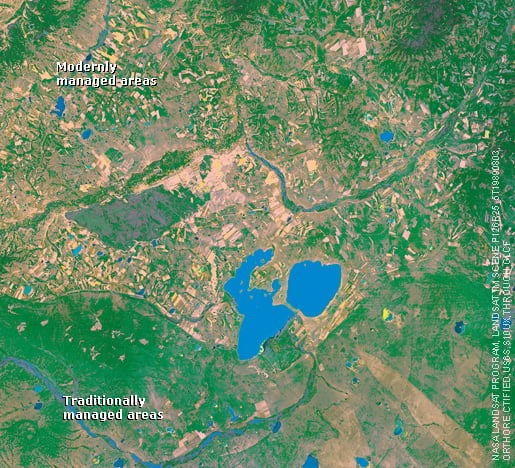
Figure 2. The Workshop in Political Theory and Policy Analysis at Indiana University, Bloomington.
The Workshop philosophy has permeated a very large international program started in the early 1990s. The FAO wanted information collected in a systematic way on the conditions in forests and their governance arrangements and how this affected livelihoods as well as forest conditions. We did not think that this was something that was an appropriate thing for scholars in the United States to do by flying out and collecting data in multiple countries. We developed a collaborative network where scholars who lived in a particular country and had very strong interest in forest conditions and forest policy conducted the studies. We very carefully trained a core staff in each center to use the data collection techniques that took many years to work out. We have encouraged regional meetings of scholars in a particular region to discuss method findings and strategies. We meet as a big network every two years and find that we all continue to learn from one another.
If the research that one wants to pursue can all be done sitting in a library carrel somewhere in one’s home institution, then one does not need to develop the equivalent of a Workshop. However, if one is trying to understand and test theory in the field and in the experimental lab and to really pursue in-depth studies of diverse institutional arrangements around the world, then working with colleagues located in diverse settings at various stages of their careers is crucial for making scientific progress. The general strategy that we have used is now described in considerable depth in Poteete, Janssen, and Ostrom (2010).
| References |
| 1. Ostrom, Vincent (1980), “Artisanship and artifact,” Public Administration Review 40(4): 309–17. |
| 2. Ostrom, Vincent, Charles M. Tiebout, and Robert L. Warren (1961), “The organization of government in metropolitan areas: A theoretical inquiry,” American Political Science Review 55(4): 831–42. |
| 3. Poteete, Amy, Marco Janssen, and Elinor Ostrom (2010), Working Together: Collective Action, the Commons, and Multiple Methods in Practice. Princeton, NJ: Princeton University Press. |
This autobiography/biography was written at the time of the award and later published in the book series Les Prix Nobel/ Nobel Lectures/The Nobel Prizes. The information is sometimes updated with an addendum submitted by the Laureate.
Elinor Ostrom died on 12 June 2012.
11 prizes that help us understand and value our Earth
From understanding climate change to using AI to better protect our planet. Over the years, the Nobel Prizes have recognised those who have sounded the alarm about the risks humanity is taking – and those who are charting a path towards wiser stewardship of our planet. Here are eleven of these achievements.
Connecting the industrial revolution to climate change
Svante Arrhenius, chemistry 1903
Prize motivation: “in recognition of the extraordinary services he has rendered to the advancement of chemistry by his electrolytic theory of dissociation”
Svante Arrhenius is a giant in climate science. He was the first to calculate what would happen to Earth’s climate if carbon dioxide levels rose significantly. This led him to realise that burning fossil fuels would cause the climate to change.
At the time, the industrial revolution was really just warming up. Arrhenius thought that any effect on the climate would be in the very distant future. He could not have possibly known the scale of change in the 20th century.
Arrhenius was a polymath with deep expertise in many areas of physics and chemistry. He was awarded the Nobel Prize for a completely unrelated achievement: how liquids conduct electricity.

Understanding how climate has changed in the past
William Libby, chemistry 1960
Prize motivation: “for his method to use carbon-14 for age determination in archaeology, geology, geophysics, and other branches of science”
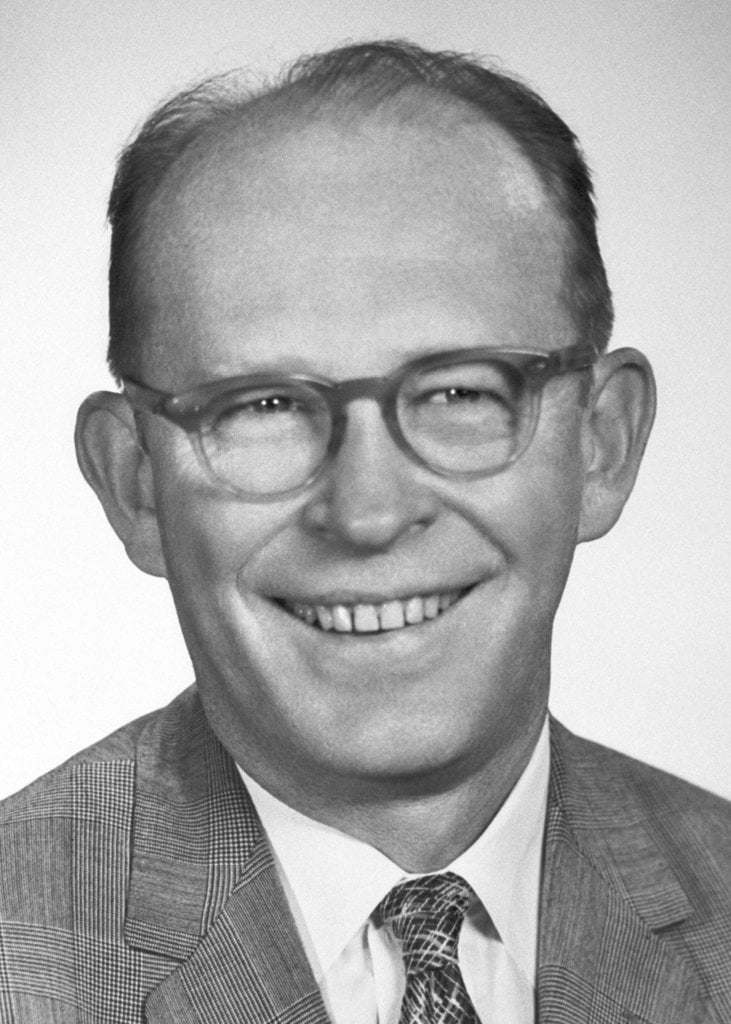
We know climate has changed in the past. But how do we know this? One part of the puzzle is solved if we can accurately date when living organisms such as trees or coral reefs died, perhaps as glaciers advanced or droughts swept a region or volcanoes erupted. William Libby made a fundamental discovery – carbon-14 dating – that allows scientists to do just that. When an organism dies, the naturally occurring carbon-14 in its body – wood, shell or bone – begins decaying in a precise way that tells us its age. This is still an invaluable tool for climate scientists today.
Powering the green revolution
Norman Borlaug, peace 1970
Prize motivation: “for having given a well-founded hope – the green revolution”
For all of human history, famine was a spectre haunting us. Now, very large famines are thankfully less common and linked directly to political instability. How have we made progress? Plant geneticist Norman Borlaug made a significant contribution to developing crops with higher yields than before. His ideas helped improve crop yields in India, Mexico and Pakistan. This work was central to what later became known as the ‘green revolution’, empowering nations across the world to feed themselves.
The ozone hole is beginning to recover
Paul Crutzen, Mario Molina, Sherwood Rowland, chemistry 1995
Prize motivation: “for their work in atmospheric chemistry, particularly concerning the formation and decomposition of ozone”
Paul Crutzen began his Nobel Prize lecture in 1995 mentioning his grandson: “To the generation of Jamie Paul and our future grandchildren, who will know so much more and who will celebrate the disappearance of the ozone hole. I hope you will not be disappointed with us.”
Decades on data shows that the ozone hole is showing strong signs of recovery. Crutzen, Molina and Rowland’s work paved the way for the Montreal Protocol on Ozone-depleting subtances which remains one of the most successful international environment agreements in history.
Crutzen’s interests were broader than just the chemistry of the upper atmosphere. His analyses highlighted the risks of a “nuclear winter” and in 2002, he proposed that Earth has entered a new geological epoch, the Anthropocene. This is a profound idea that has provoked scientific debate and inspired artists, writers and musicians. It challenges us to think differently about our responsibility for the planet and for future generations.
“Children will never know what they have lost”
Wangari Maathai, peace 2004
Prize motivation: “for her contribution to sustainable development, democracy and peace”
Kenyan academic and activist Wangari Maathai’s Green Belt Movement planted millions of trees. But this incredible project did more – it connected environmental protection to economic and political progress and female empowerment. It gave jobs to women and promoted democracy. In her Nobel Prize lecture, Maathai, the first African woman awarded the Nobel Peace Prize, recognised that degraded environments lead “to a scramble for scarce resources and may culminate in poverty and even conflict.”
She went on to say, “In the course of history, there comes a time when humanity is called to shift to a new level of consciousness, to reach a higher moral ground. A time when we have to shed our fear and give hope to each other. That time is now.”

Assessing the scientific knowledge about climate change
IPCC and Al Gore, peace 2007
Prize motivation: “for their efforts to build up and disseminate greater knowledge about man-made climate change, and to lay the foundations for the measures that are needed to counteract such change”
Climate change is such a serious and complex threat to humanity that a unique process was developed to find scientific consensus on climate science that could inform international policy – the Intergovernmental Panel on Climate Change. Thousands of scientists collaborate to establish what we know about climate and human causes with reasonable certainty. Their work also provides valuable knowledge about how society can mitigate the threat and adapt to a changing world. In 2007, the IPCC was awarded the Nobel Peace Prize along with US politician Al Gore.
Managing the global commons requires trust, cooperation and shared knowledge
Elinor Ostrom, economic sciences 2009
Prize motivation: “for her analysis of economic governance, especially the commons”
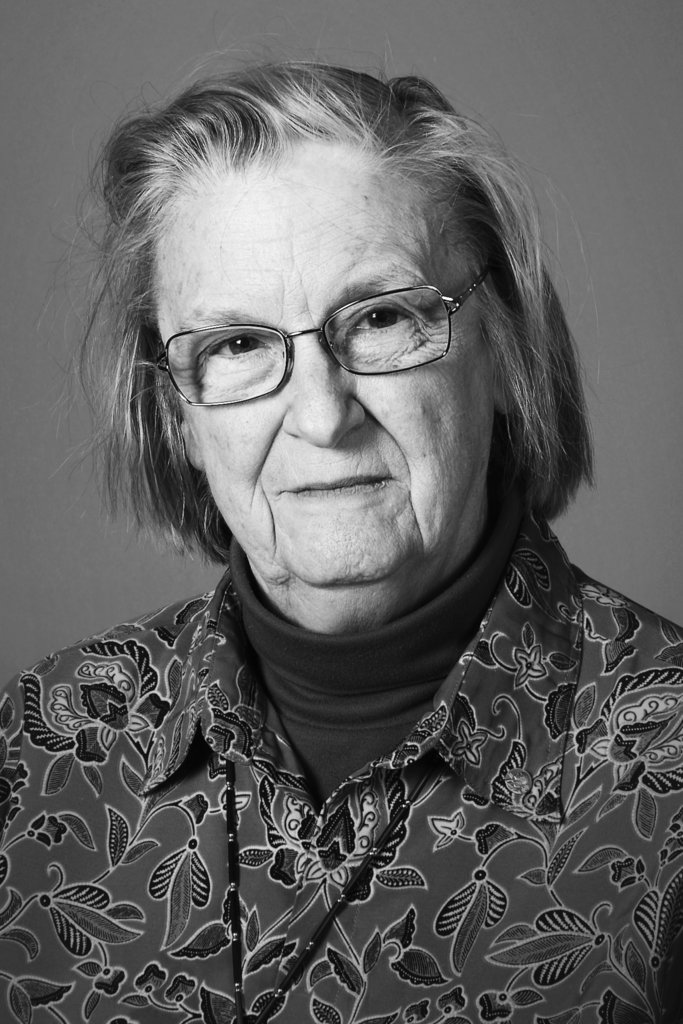
Elinor Ostrom shattered conventional wisdom by showing that communities can sustainably manage shared natural resources – like forests, fisheries, and water systems – without strong government regulations or privatisation. Her work is a cornerstone for modern thinking on sustainability, emphasising trust, cooperation, and shared knowledge as essential tools to support shared stewardship. In an era of global environmental challenges, Ostrom’s ideas remain a powerful guide for collective action and planetary stewardship.
Rewilding our minds
Olga Tokarczuk, literature 2018
Prize motivation: “for a narrative imagination that with encyclopedic passion represents the crossing of boundaries as a form of life”
Facts don’t always move people to act, but stories do. We are a species finely tuned to respond to stories. Olga Tokarczuk’s novels weave together myth, history, psychology, and ecology. In Drive Your Plow Over the Bones of the Dead, she explores the complex relationship between humans and nature through a murder mystery steeped in animal rights and ecological ethics. Her work directs readers to see the world as an interconnected whole – resonating deeply in the age of the Anthropocene.
The lithium-ion battery revolution
John B. Goodenough, M. Stanley Whittingham and Akira Yoshino, chemistry 2019
Prize motivation: “for the development of lithium-ion batteries”
Lithium-ion batteries have revolutionised our lives since they first entered the market in 1991. They are now everywhere powering phones, computers and electric vehicles. Developed step-by-step by John B. Goodenough, M. Stanley Whittingham and Akira Yoshino, lithium-ion batteries are accelerating humanity’s transformation away from fossil fuels – a truly astounding long-term benefit to humankind.
Climate models
Syukuro Manabe and Klaus Hasselmann, physics 2021
Prize motivation: “for the physical modelling of Earth’s climate, quantifying variability and reliably predicting global warming”
Climate models are one of the most important tools scientists have to explore how the climate has changed in the past and how it might change in the future. Today’s state-of-the-art climate models are extremely sophisticated. But they did not arrive fully formed. Their development has taken many decades from humble beginnings.
In the 1960s, Syukuro Manabe pioneered the development of early climate models. Building on his work, Klaus Hasselmann connected weather and climate together in models. Together, their work laid the scientific foundation for understanding and predicting climate change and how fossil fuel emissions from industry can change the Earth system.
Aligning AI with a stable planet
Demis Hassabis, chemistry 2024
Prize motivation: “for protein structure prediction”
Artificial intelligence is revolutionising science. This was acknowledged by the 2024 Nobel Prizes in physics and chemistry. All the AI-related laureates highlighted the potential for AI to support our goal of becoming better planetary stewards. Demis Hassabis, as CEO of Google DeepMind, is directing AI research towards protecting the planet. AI is already improving climate models, and it also has the potential to help design new sustainable materials and find ways of reducing pollution. The challenge now is to ensure this intelligence is governed wisely. Along with AI alignment with human values, there is also room for discussions on Earth alignment.