|
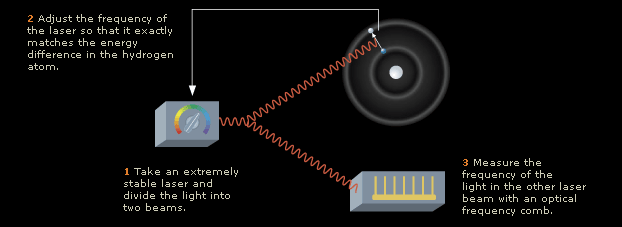
The light frequency, f, that we want to determine is too high to be measured directly. Instead we have to use an indirect technique by which we compare the unknown frequency to a measuring stick – the frequency comb. The comparison between two light frequencies is made with a beat technique that shows the difference in frequency low enough to be measured.
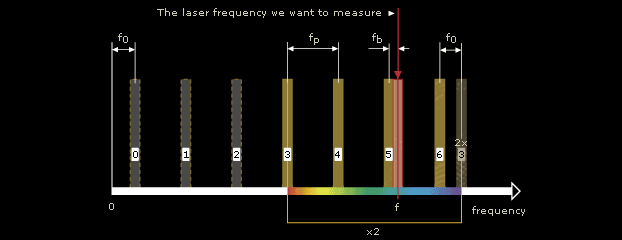
We create this frequency comb by means of a mode-locked laser that emits a train of very short pulses of light. The laser light consists of a long series of different frequencies, like the teeth of a comb. The distance between two teeth, fp, is determined by the time between the pulses.
What we measure are the beats, fb, between the unknown light and the closest tooth on the comb. By approximately determining the optical frequency we can also find out which tooth lies closest (n=5).
For the measurement to be good, the measuring stick, that is, the frequency comb, has to be carefully calibrated. Unfortunately, the first tooth on the comb is not at the frequency of 0 Hz but at the distance f0. The first three teeth in the schematically drawn frequency comb (numbered 0, 1 and 2; in practice there can be a million teeth) contain no light, so a trick is needed to measure f0. Take the first tooth with light (No. 3) and double the frequency. It then stands at the distance f0 from the tooth with twice the number (No. 6), and it is that distance that can be measured.
We then get the unknown frequency: f = n · fp + fb + f0
|