How microwaves let us tune into one another – and the universe
Learn more about how microwaves revolutionised our ways of communicating and helped us understand the origins of the universe.
The Pope is watching. This had better work. Such thoughts perhaps ran through the mind of Guglielmo Marconi in 1932 as he set up a special antenna in the Vatican gardens while His Holiness Pope Pius XI looked on.
This antenna was part of a new radio link connecting the Vatican to the Pope’s summer residence, Castel Gandolfo. And not just any radio link.
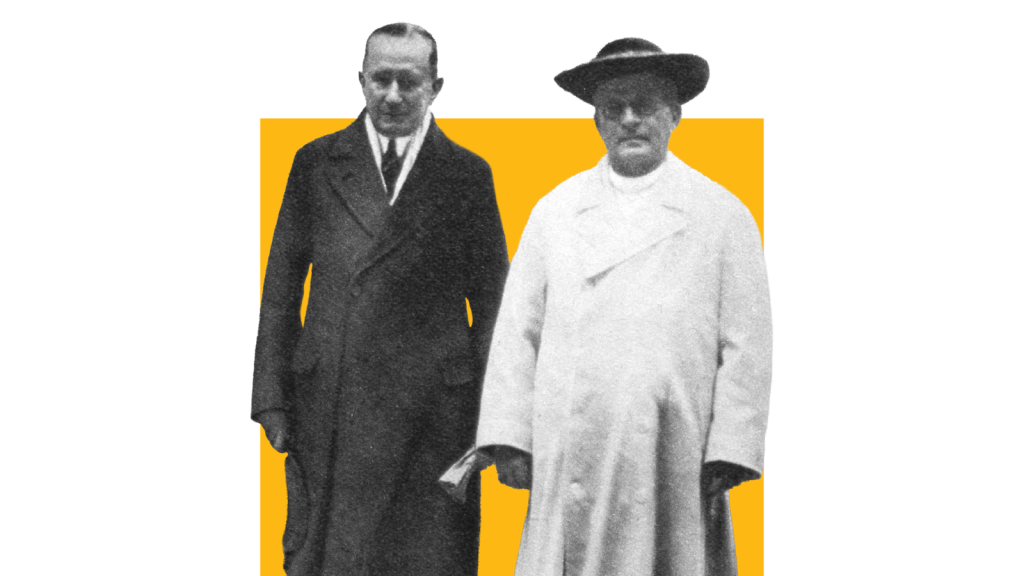
This one used microwaves – radio waves with extra-high frequencies. Marconi also set up a portable microwave communications system attached to a car, connecting the travelling Pope to the Vatican. Some have claimed this was the first mobile phone, albeit a very large one.
Thirteen years earlier, Marconi had shared the Nobel Prize in Physics with Ferdinand Braun for his contributions to wireless telegraphy. The radio age was in full flow. But when Marconi turned to microwaves, he was embracing a part of the radio spectrum with very special properties.
Microwaves can carry vast quantities of information. They can also cook food, or scramble an enemy’s electronics. Microwaves have even helped reveal the very origins of the universe.
Pip-pip-pip
Long before Marconi built a microwave telephone for the Pope, someone else had already experimented with similar frequencies.
In the late 19th Century, a brilliant Indian scientist called Jagadish Chandra Bose – now, sadly, largely forgotten – developed some of the earliest microwave technology.
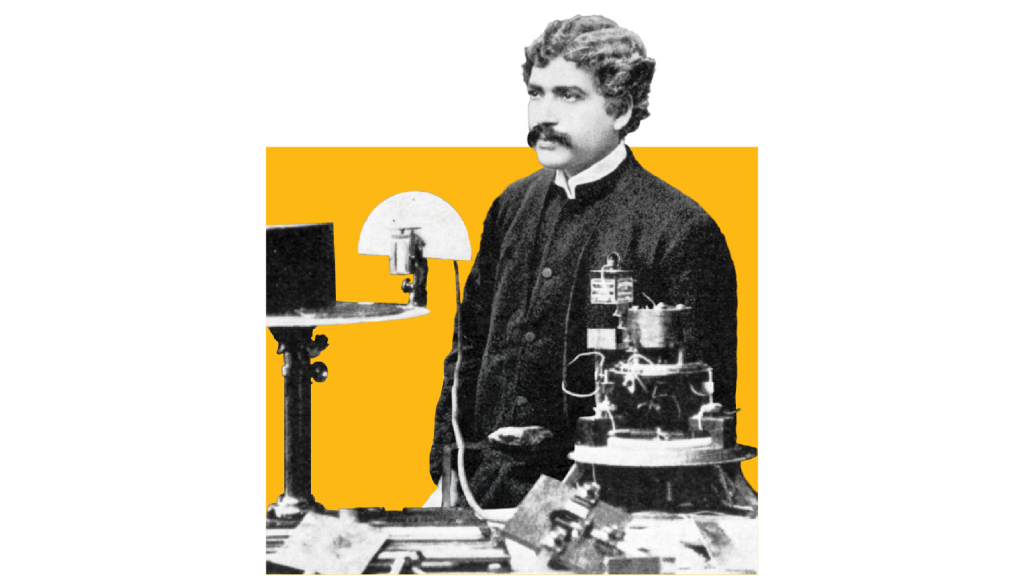
This included the very first equipment for generating millimetre waves – the waves used by 5G devices today. In 1895, Bose demonstrated that millimetre waves could ring a bell, and even fire a gun remotely.
Marconi arguably gained some of his stardom thanks to Bose.
On 12 December 1901, using a non-microwave frequency, the Italian inventor carried out the first transatlantic radio transmission. Sitting in a hut atop a Newfoundland cliff, he listened to a swirling deluge of noise in his earphone for many hours – until he heard what he had been waiting for.
Pip-pip-pip.
The Morse code for the letter S. Frantically, he passed the earphone to his colleague and asked, “Can you hear anything?” He could.
It was an incredible feat. Those radio waves had travelled more than 2,000 miles from the south of England, across open water. At the time, his record for a long-distance radio transmission was just 80 miles.
In the years since, some have questioned whether the transmission really happened as Marconi described.
However, recent investigations show that it was theoretically possible, even with his early radio equipment.
Among that equipment was a device called a coherer, a simple radio signal detector. And while the records are somewhat murky, it appears this coherer was designed by none other than Bose.
“He came up with fascinating instruments,” says Bose’s biographer, Sudipto Das.
But Bose was, perhaps, too far ahead of his time. For one thing, there were few useful applications for microwaves during the early 1900s that weren’t already feasible with lower frequency radio waves. Bose shifted his focus away from physics to his greater interest, plant physiology, and “almost sank into oblivion,” says Das.
Magnetron popcorn
However, World War Two made microwaves important again. Radar allowed militaries to detect enemy aircraft by bouncing radio signals off them. And a microwave device called the cavity magnetron developed in Britain in 1940, turned out to be one of the most powerful and effective radar technologies around.
Small enough to install on aircraft, its fantastic range and precision gave Allied countries an important advantage that helped them win the war.
It was also a microwave-emitting magnetron that inspired Raytheon engineer Percy Spencer to invent microwave ovens in 1945. A peanut bar in his pocket began to melt when he walked past magnetrons in a laboratory. And when he later held up a packet of popcorn, the popcorn popped and “exploded all over the lab,” a Reader’s Digest article later recalled.
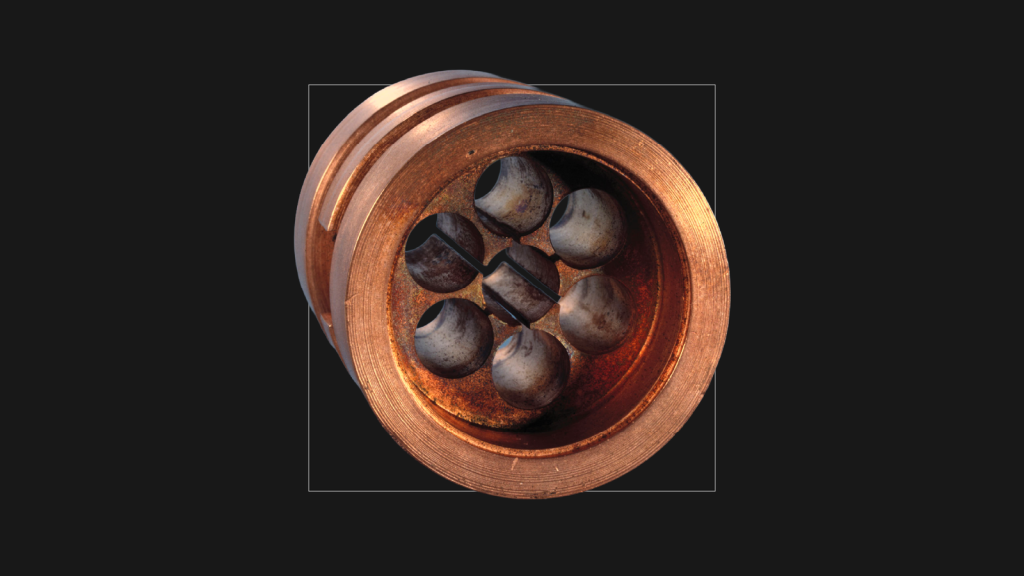
This happened because, at certain frequencies, microwaves excite molecules inside food, making them vibrate at the same frequency. The ensuing friction heats things up.
For microwave ovens, the frequency of choice is 2.4 gigahertz (GHz) – the same frequency used by many wi-fi routers. However, routers emit microwaves at much lower power levels than microwave ovens – that’s why you can’t make popcorn just by surfing the web.
Choosing the right frequency for cooking is really important, says Caroline Ross at the Massachusetts Institute of Technology. Microwaves at 2.4 GHz penetrate well inside food, and this frequency also allows for even absorption of the radiation by food molecules.
“When you go higher, like tens of gigahertz, the penetration depth is pretty small, so it gets blocked by almost anything – even water in the air,” she explains.
Microwaves are special partly because of that ability, at certain frequencies, to interact with matter. OK, reheating your dinner leftovers might not seem very dramatic – but what about using microwaves to induce noises in people’s heads?
Havana syndrome
Military personnel who worked near to large microwave radar installations built during World War II later recalled that they could sense the radar operating. “It was possible to hear the repetition rate of the radar when we were standing close to the antenna horn,” one witness wrote in the 1950s.
James Lin, professor emeritus at the University of Illinois Chicago, heard such stories and attempted to reproduce the effect in his lab during the 1970s.
“I used myself as a guinea pig, basically,” he recalls, as he describes how he set up a microwave antenna and pointed it directly at his head.
Lin has suggested that the microwaves induced pressure waves inside his head, which he sensed as sound. To avoid cooking his brain, he kept the power levels low. “I could hear the pulse,” he says. “The fact I’m still alive… I guess it wasn’t too bad.”
This became known as the microwave auditory effect and it could help to explain a spate of mysterious illnesses reported by American diplomats around the globe, most famously in Havana, Cuba.
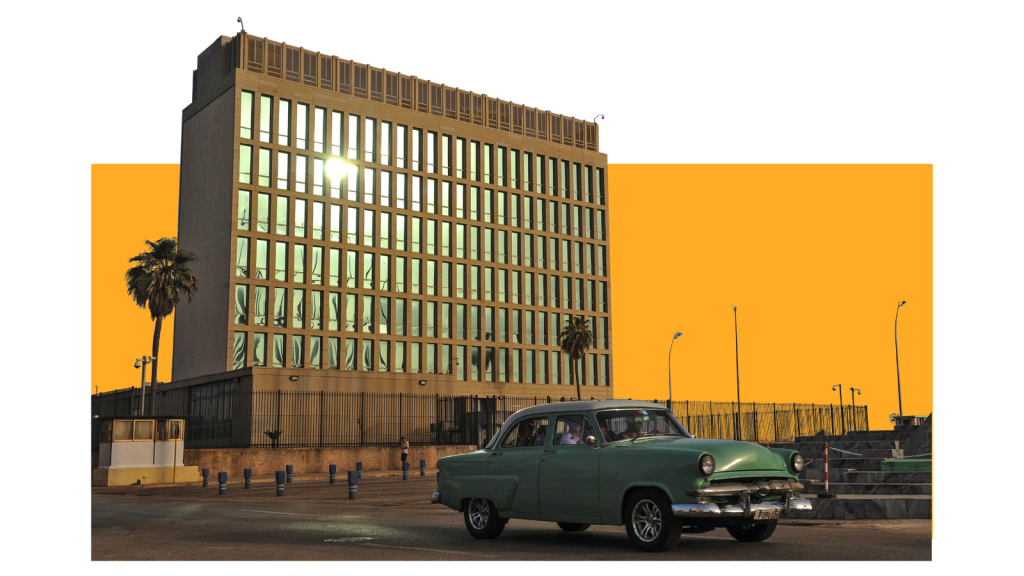
Victims of so-called Havana Syndrome report experiencing strange grating noises, a feeling of pressure building up in their ears, dizziness, nausea and memory loss. Was an enemy directing a microwave beam at these people? While some have dismissed this hypothesis, Lin says it remains the most plausible explanation for the auditory symptoms.
Microwave weapons do exist, though those discussed in public tend to target machines rather than people. The US military has missiles that can zap enemy electronics with microwaves, for instance. Microwaves can even bring down drones.
In contrast, Lin has developed ways of using microwaves to heal – for example, to treat muscle diseases and irregular heartbeats.
For the latter, he says it is possible to insert a tiny microwave-emitting device into the heart, via a catheter, in order to destroy abnormal heart tissue. This technique, now widely used, is less invasive than open heart surgery, he points out: “Just deliver a pulse at high power, a microwave, to burn the tissue.”
The universe talking
But microwaves don’t just save lives. They have also helped to reveal the origins of the universe. In the early 1960s, radio astronomers Arno Penzias and Robert Woodrow Wilson attempted to use a large, horn-shaped antenna in the US state of New Jersey as a radio telescope. But they kept picking up an irritating hiss or static.
At one point, they thought this was caused by pigeon droppings in the antenna, so they shooed the birds away and cleaned up the mess. However, the birds were not to blame. What Penzias and Wilson were hearing was the sound of the universe itself.
“It’s a snapshot of early time,” says Sean McGee, at the University of Birmingham. Penzias and Wilson had discovered what we now call cosmic microwave background radiation – a signature left over from the Big Bang, when the universe exploded into being roughly 13.8 billion years ago. Penzias and Wilson was awarded half of the 1978 Nobel Prize in Physics for their work.
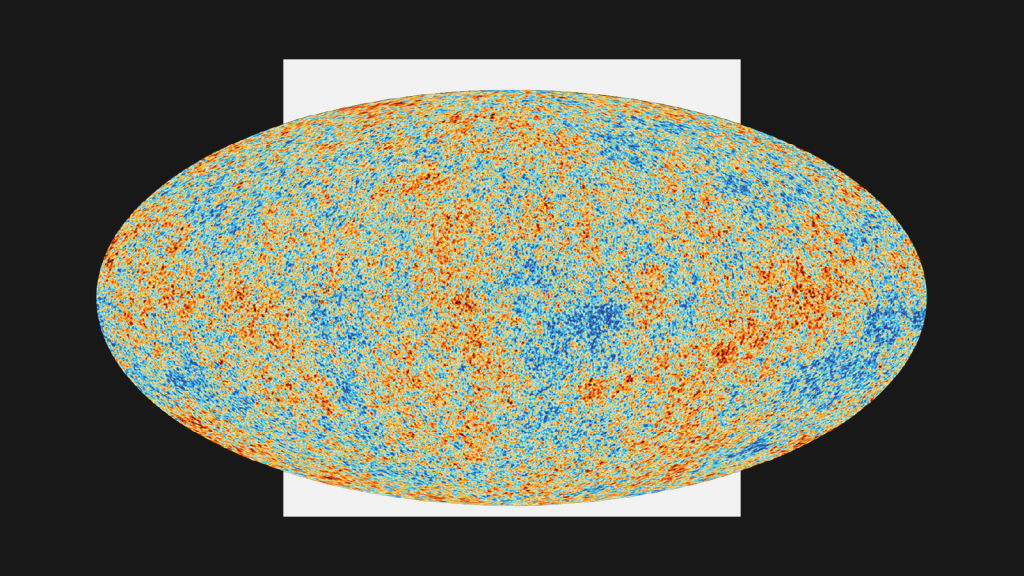
The residual radiation they detected is present throughout the cosmos. A small proportion of the snowy static on analogue television screens is attributable to it. In other words, until LED screens took over, people would pick up remnants of the Big Bang in their living rooms.
Satellites eventually helped astronomers to map the cosmic microwave background, recording its fluctuations as slight differences in temperature. Those fluctuations appear to have influenced where galaxies formed as the universe expanded.
“We’re all the result of quantum fluctuations in the very early universe that then seeded galaxies,” says McGee.
Today, people use microwaves for any international call that is connected by satellite. A great leap from the car-mounted equipment Marconi installed for the Pope in the 1930s.
It’s rather fitting that many people use microwaves to talk to one another day in, day out – since that is also how the universe has talked to us, helping to confirm our understanding of the greatest story of all time. The story of how everything began.
By Chris Baraniuk, BBC World Service. This content was created as a co-production between Nobel Prize Outreach and the BBC.
Published March 2026
Nobel Prize laureates highlighted in this article

Guglielmo Marconi
in recognition of their contributions to the development of wireless telegraphy.

Arno Allan Penzias
for their discovery of cosmic microwave background radiation.

Robert Woodrow Wilson
for their discovery of cosmic microwave background radiation.
Nobel Prizes and laureates
Six prizes were awarded for achievements that have conferred the greatest benefit to humankind. The 14 laureates' work and discoveries range from quantum tunnelling to promoting democratic rights.
See them all presented here.