Ernst Ruska
Facts
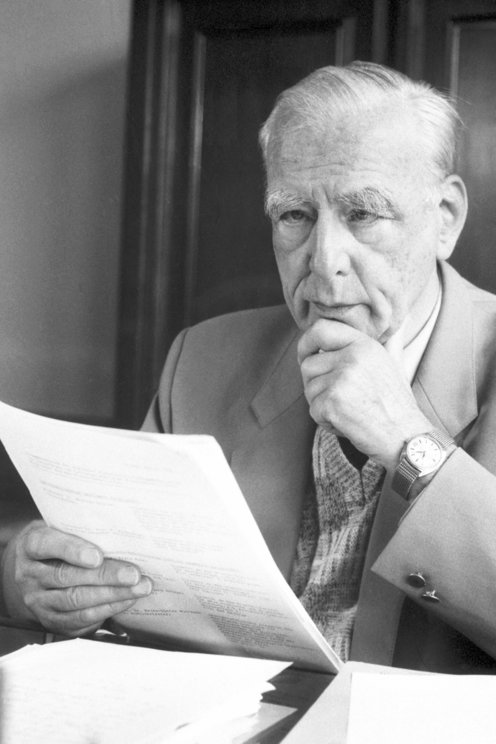
Photo: Marianne Kischke, Fritz Haber Institut der Max Planck Gesellschaft. Nobel Foundation archive.
Ernst Ruska
Nobel Prize in Physics 1986
Born: 25 December 1906, Heidelberg, Germany
Died: 27 May 1988, West Berlin, Germany
Affiliation at the time of the award: Fritz-Haber-Institut der Max-Planck-Gesellschaft, Berlin, Germany
Prize motivation: “for his fundamental work in electron optics, and for the design of the first electron microscope”
Prize share: 1/2
Work
Very small objects can be studied in a microscope, but when objects become as small as the wavelength of light, an image no longer is produced. The discovery that beams of electrons behave as waves with wavelengths shorter than visible light opened up new opportunities. Ernst Ruska discovered that a magnetic coil could be used as a lens for electron beams and developed the first electron microscope in 1933. It captures images of extremely small objects by means of electron beams that are directed towards an object and captured on a screen.
Nobel Prizes and laureates
Six prizes were awarded for achievements that have conferred the greatest benefit to humankind. The 14 laureates' work and discoveries range from quantum tunnelling to promoting democratic rights.
See them all presented here.