Transcript from an interview with Paul Greengard
Interview with the 2000 Nobel Laureate in Physiology or Medicine, Paul Greengard, 13 June 2008. The interviewer is Adam Smith, Editor-in-Chief of Nobelprize.org.
Paul Greengard, welcome to Stockholm and to this interview with Nobelprize.org.
Paul Greengard: Thank you.
It’s been almost eight years since you came to receive your Nobel Prize in the year 2000 and your work on unravelling the pathways of signalling in the nervous system continues, but your first introduction to experimental work was not in biology but in electronics because you were drafted by the army to work on radar.
Paul Greengard: I volunteered in the Navy.
That was during the second World War and that was straight from school. How did you find your first exposure to research work?
Paul Greengard: I really didn’t do much research in the field of electronics. I was not quite sure, I spend a period of time during the war up at the Massachusetts Institute of Technology in what is called the Radiation Laboratory working on the development of a microwave radar. At that time, one of the big problems for the United States was these kamikaze, these low flying Japanese aircraft that would just fly 20 feet above the water and due to the curvature of the Earth, these aircraft could not be detected until they were about 20 miles out. They had these antennae on the tops of the ships but that’s still not very high and so the curvature of the Earth is such that you can only see about 20 miles. This was in the days of very primitive television so the concept was you’d put a radar screen in a plane and then had the image projected down to the aircraft carrier. I’d been sent to an electronic school in the Navy and then they took two of us from that class to go up and work with these physicists who were, I thought at the time, old men, they were probably in their late twenties but I was like 17, 18. It was an amazing place, there were several of them went onto win Nobel Prizes in Physics and so on so I learned a lot. I wouldn’t say I did research, I was like a technician doing things for them.
But a wonderful environment.
Paul Greengard: It was an amazing place. It amazes me, the highest security level in the United States is top secret and the next one is secret and not many people get to see that but our project, we were all given clearance to look at all sorts of secret information and it’s just amazing. We shouldn’t have been, I mean we had no need to know that but for example, we knew that the English … At that time the Germans were trying to bomb London and they had these two beams that intersected over London and what the British did was they had two beams that deflected them so they were crossed in some place, I don’t know, 30 miles north east of London in empty fields. I knew about that, and there were dozens of people who know it with no need at all to know about it and these days you’d say that was a really bad security lapse but people weren’t so ultra-concerned about security then.
Yes, but how extraordinarily exciting.
Paul Greengard: It was amazing for a kid to be exposed to all that was going on.
Would you say that switched you on to doing science or was it just a nice episode?
Paul Greengard: I think it never occurred to me that I wouldn’t do science or mathematics or engineering, that was that spectrum that I was interested in.
But maths and physics was what you went on to study at university and then you made the decision to move towards the study of biological systems. What switched you from a physical sciences track?
Paul Greengard: When I went to college, I wanted to study physics and maths because that’s what I was good at and that’s what I’d majored in, mathematics and physics, when I went to college. When I was going to go to graduate school, then it had been not that long after the dropping of the atom bombs and the only support you could get to go to graduate school was from the Atomic Energy Commission and it just seemed to me, I wanted to do things with my life at whatever chance I might have other than finding better ways to kill people. I had learned from my roommate in college about this emerging field of biophysics or medical physics which is applying physics and mathematics to a biological and medical question, so I applied to study biophysics. At that time there were only two departments in the country that were doing that, and one was at the University of Pennsylvania where they were using electrical approaches to studying signalling in the brain and I applied there and that’s where I went.
Did the interest that you subsequently developed in biochemistry come at that point?
Paul Greengard: No, I learned a lot about the electrical properties and neuro cells and various interesting properties of neuro cells. At that time, just about the time I was going to start my thesis, at that time you had to do basically all the qualifying courses in physics and in biology to get your degree and then you went onto your thesis. During that period while I was still taking courses, Alan Hodgkin came to a lecture in our department and he and Huxley talked about the work for which they won the Nobel Prize on the ionic basis of the nerve impulse. I felt that, it’s going to be a long time before any more advances are going to be made in understanding the property of nerve cells by purely electrical means and I felt that one’s got to get at the biochemistry underneath the electricity. Then I started taking courses in biochemistry and so on and this didn’t exactly go with the main flow of the department, they were purely biophysicists measuring electro properties of nerve cells and membranes and so on.
Yes, because these were very different time. This was the 1950s and chemical neuro transmission in the brain, for instance, still wasn’t accepted …
Paul Greengard: Correct.
… which I think is interesting in itself because peripheral chemical transmission had been known for decades and indeed Dale and Loewi got the Nobel Prize in 1936 for that and yet somehow it was impossible to accept for decades in the brain. Do you have a feeling why that was, why it took so long?
Paul Greengard: It was the background of the scientists working in the field. There were two types of people studying the brain, one was electrophysiologists who measured ion currents and action potentials and were not interested in the biochemistry underlying it. I guess you could formulate their thinking as, well, we need energy to keep these cells alive, we don’t even know why we need energy but we do, so they really were not interested at all in the underlying biochemical basis. The other group were biochemists who would take a brain and homogenize it to measure an enzyme because the brain’s a remarkably active place metabolically and for a huge percentage of enzymes. There’s much more activity in the brain than in the liver, the pancreas or the muscle, so you just take your brain out and homogenize it and use it to study an enzyme reaction.
Yes, mush it up.
Paul Greengard: Yes, and the two groups didn’t really talk to each other. At that time there wasn’t even a field of neuroscience, it was electrophysiology which was studying the electrical properties of nerve cells and then there was biochemistry where you’d use whatever organ provided the best source of an enzyme.
Nowadays there’s a great fondness for saying that people that are going into disciplinary research are trying to unite disciplines. Did you feel you were doing that back then, were you crusading to bring them together?
Paul Greengard: I was not crusading to persuade other people to do it, I did it and it was considered a very eccentric approach, I guess, but in fairness to the faculty of my department, they did not oppose my doing it. I actually did a thesis under the joint supervision of an electro physiologist in our department and a biochemist who was in a place called the Moccollum Pratt Institute which was a biochemistry department basically, as a subsidiary of the biology department but that’s where they did lots of enzymology and so. It was one of the more prominent places in the country at that time, doing enzymological kinds of work, so I did my thesis in the interface between electrophysiology and biochemistry and was interested in selling the biochemical basis for the nerve impulse.
As I continued, then I went on to do post-graduate work. I spent five years in England and continued to work in this boundary between the two disciplines and virtually nobody was doing that at that time, trying to understand the biochemical basis for neurobiological phenomenon. Then I was offered a position as head of biochemistry department at what at the time was Geigy Pharmaceuticals, today it’s part of Novartis. I was interested in the difference in salary between what I would have got in the university and truly it was like 10% or something, but I was quite idealistic and I wanted to use scientific approaches to new drug development, so I went into this company and I was there for eight years. It was a rather exciting period for me but I left because everything was done by committees and to a large extent it still is. Some of the things that I felt were avant garde, the other people would not agree to them and unless the committee would agree, it wasn’t done. I got frustrated and I thought I could do more in terms of understanding the basic biology and how you could use that information to study the action of drugs and develop new drugs. I felt I could do that better going back to university so that’s what I did.
You went back. That interlude must have given you an interesting perspective on what followed and it must have been quite productive if you stayed eight years, you must have really loved it.
Paul Greengard: It was very educational because as the head of the biochemistry division I was obliged to learn lots of stuff that I didn’t know anything about. In those days people were doing biomedical research, didn’t go into medicine, there was so little known about the basis of diseases and so on that it was more like laying on of hands and comforting patients, there was very, very little available, very little scientific knowledge. The situation is quite different now and I would advise young people wanting to do biomedical research to go through medical school now, at least through the first part of the curriculum, so you get a much broader education. I was educated in graduate school in a very narrow area and one of the functions that this being a pharmaceutical company did for me was to give me a much broader education in many different areas of medicine and diseases and I think that’s helped me in the ensuing decades.
When you left Geigy, you did return basically to the same research questions that you’d had before?
Paul Greengard: Pretty much, nobody picked it up in the meanwhile and when I started working again, the projects were somewhat different but the basic philosophy was the same. Earl Sutherland had shown that cyclic AMP mediated the actions of hormones and I’ve been following that work ever since I was in graduate school, it always interested me. Then Ed Krebs together with Fischer showed that the cyclic AMP activated a protein kinase and broke down glycogen.
Showing protein phosphorylation in the liver, yes.
Paul Greengard: Yes, that was phosphorylation in the liver and muscle and since hormones are released by one cell and work on another, it possibly occurred to me that maybe neurotransmitters worked that way, they release from one neuro cell and act on another. I thought, maybe this system is present in the brain and we found that it was. We found that neuro transmitters could raise the levels of cyclic AMP, we found these cyclic AMP activated protein kinase activity and not only was it in the brain in enormously higher concentration than elsewhere, but it was in the synapse, the junction between two nerve cells. It was so high there that I knew this had to be right, that this basic principle that Sutherland and Krebs had elucidated in terms of a hormone making a second messenger go up and then that second messenger regulating protein phosphorylation was going to be important in the brain and I haven’t left since, that was 40 years ago.
If it was unusual to go down a middle path between biophysics and biochemistry earlier, it was positively heretical to work on second messenger systems newly discovered by Earl Sutherland in the brain, in the 1960s. How did it feel to move into an area where you were really …
Paul Greengard: It was interesting. It means I present our data and once a very well-known person got up and said, This is heretical, this is ridiculous, why are you talking such nonsense? It hurt my feelings but it’s interesting, I never doubted that I was right. I don’t know why but with lots of negative reactions, I never doubted I was right and it turned out that this was right and it had advantages and disadvantages. The disadvantage was it’s nice to have people appreciate your work which was not done very much then. The one exception was Earl Sutherland who said, Even if you’re only 90% right, it still meant that it’s been extremely important what you’ve done. He had that vision, he appreciated what I was doing, but most people did not. That was the disadvantage that people didn’t show any appreciation or very, very few did for the work. The advantage was that I had the field pretty much to myself, the signal transduction for almost 15 years and that was nice and by the time that people began to realise it was right, I’d laid out a large part of the foundation for signal transduction in the brain.
Right. How did funding work in that time, because nowadays, to do something that people disagreed with for 15 years would be presumably impossible.
Paul Greengard: That’s an excellent question. The fact is that today you could not get funding for this. At that time, funding was fairly liberal and people said, Well, he’s a smart chap, he’s on the wrong track but let’s fund him until he comes to his senses, it was that sort of thing. I did get good funding even though there was not much belief in that I was on the right track.
Nowadays people describe how they do their real passion on the side and they have pot boiler experiments that keep the reviewers and the grant awarding bodies happy and they do the two in parallel. But you weren’t doing that, you were just going wholeheartedly.
Paul Greengard: At that time, yes. But then, as the competition for money got tougher, I mean virtually everyone now is forced to put in experiments where you’ve already done some of the work because you know how this comes out and you give a more logical presentation. There’s a big difference in the philosophy in terms of support of research in Europe vs the United States. In Europe, if you have a good track record, they pretty much automatically give you money for the next five or ten years and when they evaluate people, they look back, what did they do in that previous period? In the United States it’s a very different philosophy. They say: Well, he did that but what has he done since he discovered fire, what’s he going to do now? They look at your grant application and it’s got to be good. I’ve seen, because I’ve served on committees as well as applying to committees, I’ve seen both kinds by some people saying this guy’s really good or this woman’s really good and let’s fund them another five years although the grant application is written so well, but in other cases, I’ve even seen almost inverse discrimination. They say: This person thinks they’re so hot, and it’s my impression from committees I’ve sat on that they have a higher bar for the more accomplished people, they can do better and that kind of thing.
I’ve seen the bias both ways but in my own case, the first grant I applied for after the Nobel Prize, I got turned down on. That was really amazing, we had a grant deadline in for November 1, and with the Nobel Prize given like October 10 or something like that. I wrote and I actually called somebody at the institute I was applying to, to ask if they could make an exception, so instead of being November 1, could I have an extra two weeks because life is really hectic right after the Nobel Prize and this woman actually said, We can’t do that, what if everybody who won a Nobel Prize wanted to have that exception? It’s really kind of amazing, watching the bureaucracy.
So there just wasn’t time to do it and it got turned down?
Paul Greengard: I don’t remember, did we actually get it? Yes, we got it in on time and then it got turned down. I’ve had other Nobel Laureates tell me that they’ve had grants turned down right after they … I don’t know, they just raised the bar for what they expect or something, but it’s a psychological thing.
Yes, they’ve had their reward, they better do …
Paul Greengard: Yes. But anyhow, to go back to your earlier question, I’ve been very fortunate at getting funding both in the earlier days and now that it’s somewhat more difficult or it’s a lot more difficult now.
Just to return to the sort of inner confidence that people for 15 years in the main were just not believing you and occasionally you were getting criticised by the great and good, so going down the wrong track. You say you never doubted, I think that’d probably strike people as quite an extraordinary degree of self-belief.
Paul Greengard: That’s true and there are people who are ultra, ultra confident, they must have had very happy childhoods. I’m one who often has doubts about different things but I was so convinced that this was the way cells had to work, it all made so much sense. There was loose ends and apparent contradiction, I just tried to figure out why that experiment came out the way it did. Sometimes you’d find interesting unanticipated answers but the basic picture held up, but I’ve talked to other Nobel Laureates who have said that, I think it’s much more the rule and the exception that most Nobel Laureates, I guess you could say we’re all paranoid, feel that their work wasn’t appreciated and everybody was criticising them and finally they prevail. I think, as I said, it’s much more the rule than the exception that people go against the main thought and if you think about it, it makes perfect sense. If you’re just adding a marginal advance onto what’s already known, you shouldn’t get a Nobel Prize, there were prizes given for major discoveries and major discoveries almost by definition go against the prevailing thought that preceded them.
It’s interesting that going against the preceding thought also means encountering opposition in those who believe in the way that things are perceived to be. People don’t necessarily welcome new ideas, they actually positively push them away. I think it’s probably an impossible question to answer but, as you say, many Nobel Laureates have stories about being isolated in their research.
Paul Greengard: You’ve had that experience in interviewing people.
Absolutely.
Paul Greengard: Nobody believed me.
Exactly. Everybody else was burdened by dogma and they somehow saw a way through that and it was self-belief, not trying to prove other people wrong or anything but simply believe what the experiments were telling them.
Paul Greengard: This is the way the system has to work. It’s almost like beyond yourself, I just know this is right. I’m positive I left my keys in that room and if you’re positive, usually they’re there, not always.
Yes, and the experiments are telling you …
Paul Greengard: My ego wasn’t even involved in it, I just felt, this is the way it has to be. It made so much sense, so much could be explained by this way of thinking.
The question I was going to ask is, whether it’s possible to get any sense of the number of people who are doing this sort of thing who aren’t right?
Paul Greengard: Who are not right?
Who are not right, because Nobel Laureates are by definition in the end right, at least on that, but there must be lots of people who are dedicated to what their experiments are telling them, that are going down tracks that never actually get accepted and I wonder how many, what the balance is.
Paul Greengard: It’s easy because it’s because they’re wrong, because if they’re right it is accepted. The only way you could say they were right but their fellow scientists didn’t believe them and so they stopped funding them and then it takes years until somebody else goes back and picks that idea up. I mean that happens in science. Gregor Mendel was not believed in his time, it was only like decades later that support came for his ideas about genetics.
One can’t approach the question of how many good ideas are just being lost by lack of funding or lack of ability to continue.
Paul Greengard: I think the nature side is such that, I think very few ideas are lost because science tends to be such that there’s a next obvious problem to solve and you solve that, then there’s a next obvious problem. I think it’s quite common that different groups make the same discovery at the same time because that’s the body of knowledge that provides the foundation for those discoveries. I don’t think there are too many great ideas that don’t eventually get proven to be correct for lack of funding because I don’t get the funding for it but if that’s idea’s right, you’re going to come along ten years later with the same idea and prove it’s right.
The truth will out, sort of thing.
Paul Greengard: Yes, I believe so.
Your research has explained the intracellular signalling mechanisms behind slow synaptic transmission, which is basically the way that neurotransmitters modulate the responsiveness of the neurons that they’re talking to. Do you feel that you have a complete picture of how intracellular signalling is working or a very incomplete picture? Where are we now?
Paul Greengard: A very incomplete picture. The picture today is the following: these fast-acting neurotransmitters where the signalling goes on in less than a millisecond, that analogies the hardware of the brain and then the slow signalling pathways that we have worked on, you can consider that the software of the brain, what they do is modulate the fast signalling. This modulation is incomparably more complex than the signalling itself and I think we just know a very small percentage of what is to be known. There are so many of these intracellular signalling pathways and I believe we’ve just discovered a very small number of them. Take this region, I mean the Nobel Prize, last year on the ds RNA. This is a major, major regulatory system and nobody knew about it, it’s amazing in retrospect. I’ve heard other scientists say the same thing, how can such a prominent phenomenon not have been found earlier, but it wasn’t and you wonder how many more things are. I’m certain that in terms of these signalling pathways, there are going to be dozens more known. I think we probably know a very small percentage of them.
Bearing that in mind, I’d be interested to talk about the disease implications of your work because, your work’s primarily on the dopamine system which is implicated in lots of diseases of the brain. You’ve identified a couple of key molecules as DARPP-32 which is like a master switch for a synapse and also more recently this P11 which just seems to be a depression associated protein. Those represent good drug targets, that’s the received wisdom, and I know that you and others are trying to target them. Given that they are only a small part of the puzzle and there are lots of pieces that we’re missing, do you think it’s nevertheless a sound idea to pursue those as drug targets, given a very partial understanding of their role?
Paul Greengard: We don’t have an option. We can’t wait until we know the whole story, because we’ll never know the whole story, so there’d never be another drug developed for a disease if you take that attitude. Let’s not start working on this yet because maybe part of the puzzle is missing. In fact this sort of knowledge is already paying off big time. We know enough that some of these signalling pathways that our group and others have studied have become major targets in the pharmaceutical industry. By far the major drug target right now are these receptors for neurotransmitters and a couple for these G-protein-coupled receptors or GPCRs. GPCRs are by far the major target now. These GPCRs are all part of this software or this slow synaptic signalling that I was talking about and I’d say today, the information about slow synaptic transmission has transformed the pharmaceutical industry so that the major targets come from these slow synaptic signalling pathways.
In general, would you say that the drug industry is taking the right approach to pursuing those targets?
Paul Greengard: Yes, I do. The drug industry is sufficiently more sophisticated than it was when I worked in it and I do some consulting for them and I can see it. When I was in the pharmaceutical industry, it was dominated by organic chemists, synthetic chemists and by and large what they would do is say would just modify molecules. Company A would see Company B has such and such a drug and they say, let me see how we can modify that drug to get around Company B’s pattern. There was very little thinking about the biological systems. Just as all the drug companies or almost all the drug companies were dominated by synthetic chemists thinking about how to get around their competitor’s patterns, nowadays the drug companies, their heads of research are almost all biologists who think in these sorts of terms about what are the best targets for developing a new drug, should it be this enzyme or this receptor and so on.
There’s been a dramatic change in the approach and by and large, they’re pretty open, people in the pharmaceutical industry are in general more conversant with the literature than my colleagues in academia and myself because they’re continuously combing the literature to find out what look like interesting new ways to develop drugs. The problem is the momentum or inertia, depending on your point of view of programmes. If some academic person publishes an interesting new story with an interesting target for drug development, the drug companies could say, oh sure we’d like to do that, but they’ve got seven people working on the finishing of this drug and four people on this one and you can’t just keep pulling them off every time something gets published. There’s an understandable resistance to picking these things up too quickly, but the attitude is that the appreciation is there, I guess for the better companies you’d say their attitude would be. I really would like to do this new programme based on that study that /- – -/ just completed but we don’t have the manpower for it right now, we have to wait until this programme is completed and then we go onto it.
Obviously there’s a tremendous amount of effort in this but I guess that the answer is partly finding translational programmes that will take research out of academic environments into drug company environments in a sort of staged way, so that some of that initial testing can still be done within academic environments.
Paul Greengard: One big shift has been that the big pharmaceutical companies are relying more and more on biotech companies. Somebody who is an expert in this area was telling me that, something like 80 or 90% of the research money for new drugs is spent by a big pharma and 80 or 90% of the new drugs came out of biotech. These big pharmaceuticals has almost a necessity of changing their strategy and they’re becoming clinical trial companies, the exciting new leads tend to come out biotech companies. Biotech companies can attract scientists who are very creative and like do something really exciting and don’t have the inertial associated with gigantic pharmaceutical companies where there’s several layers of approval that have to be gotten. They are coming up with these targets and then they’re being either partnering with or being bought by the big pharmaceutical companies who then take these compounds and do toxicity studies on them and then put them into clinical trials. The course goes from the basic research kind of thing which is in the order of millions or tens of millions /- – -/ to these clinical trials when you get into phase three, you’re talking 100s of millions of dollars. With very few exceptions such as Genentech and Amgen, these biotech companies are dependent entirely on partnering with the pharmaceutical companies.
Still on the theme of drugs a bit, I want to talk about pharmacology as a discipline. You moved in 1983 to Rockefeller, to a neuroscience department, and I wondered whether you felt it mattered what the departments you worked in were called and what they were, especially with reference really to the perceived decline in pharmacology these days.
Paul Greengard: At Rockefeller there are no departments, their laboratories are headed by individuals and if there’s anything exciting, then the university will recruit somebody in that area but it will be the ‘Adam Smith Laboratory of Immunology’ or say the Morphology or whatever. Historically I was happy to be in the pharmacology department. The reason we were talking about earlier, that the electrophysiology departments only had electrical equipment and the biochemistry departments only had homogenizers to homogenize stuff. Pharmacology departments had both because they tended to be more biochemically or in pharmacology, more electro-physiologically units. When I was young, that was an attractive thing to do, to work in a pharmacology type of department. When I was in England, I spent several years in the laboratory of man named Wilhelm Feldberg who was one of the people who was involved in this demonstration of chemical transmission in the brain and they had both types of equipment there and so that’s why I chose to go there rather than to a biochemistry department or a physiology department. Today I don’t think I know enough about the structure of various pharmacology departments but I would say most of the cutting edge research now is done in departments other than pharmacology, with a few exceptions.
Yes, I suppose the question is whether that is a problem, whether the lack of pharmacology departments as a draw to students who want to go to places where cutting edge things are happening, might be inhibiting the next generation of pharmacologists from ever appearing, if you see what I mean. It’s just not a very popular discipline these days and is that a problem?
Paul Greengard: It is a problem that pharmacology is no longer considered an attractive science but there are people doing very interesting research which is basically at the molecular pharmacology level, but they do it in all sorts of departments now. These departments make more sense now in terms of teaching responsibilities. Pharmacology departments teach pharmacology and biochemistry departments teach biochemistry and molecular biology and the research that used to be done in pharmacology departments now can be done in any department where there’s somebody interested in the molecular basis for a disease or the molecular basis by which a particular therapeutic drug works.
Turning to teaching, it’s interesting that in your Nobel Lecture you illustrated with pictures of many of your co-workers. Obviously, you have very close and productive relationships with lots of people who come into the lab. What do you look for in a co-worker, how do you choose your co-workers and the post-docs and students who come into the lab?
Paul Greengard: There are several things that one looks for and mostly you just go by your gut reaction. I was reading an interview with Jobs, head of Apple.
Steve Jobs.
Paul Greengard: Steve Jobs, I think it was him, but it might have been one of the other big shots in the field, who said that before he talks to somebody, as they walk in the door to come up to his desk, he knows, he has this gut reaction, yes or no. I think most of us do that. I think if you think about it, you see someone, you sort of like them or don’t like them before there’s a word exchanged, there’s something. I have no idea what it is but there’s body language or whatever, I’m arrogant, you’re modest. That’s a major part just instinct, but before I ever interview the person, in my case I’m fortunate because I’ve had a large number of applicants each year and so I can pick who I think are the best people. Even so one makes mistakes, not infrequently, but you see what kind of laboratory they trained in, what kind of letters of recommendation they have, which journals they’ve published in. Sometimes one will take a student who didn’t publish anything yet, if the letters explained why they didn’t and why this young person’s very promising and so on.
The filtering goes on, first reading the letter, getting letters of recommendation, looking at grade point averages or publications, depending what level, whether it’s a graduate student or post-doc and then the chemistry when they come to the laboratory, if you invite them to the laboratory, what’s the chemistry between them? I also am very fortunate having some extremely talented young people with me and I let them pass the callipers over these potential applicants to. We usually agree pretty much on who we should offer a position, who we should not.
What do you think the people who come to the lab look for most from you? What’s the most important element in your mentorship of them?
Paul Greengard: I think over the years people have come to my laboratory who thought what we were doing is exciting. One of the best yardsticks of how well you’re doing is the kinds of students that apply to you. It goes back to this idea we were talking about before how, you’re a scientist and you have these ideas and you publish papers on these ideas and you want to go on longer with that and your colleagues say that’s not very interesting. The students who don’t have this bias that we all develop think what this person’s doing is really interesting, I want to go and study there. I’ve had that happen to me. This one very distinguished person who told me in high school he wanted to come and stay with me, he’d been reading my paper. He’s a very gifted guy and then he went to college and then when he wanted to go to graduate school, he applied to the department I was in, the pharmacology department, and they turned him down. I didn’t even know about him and then he did a graduate study in another very distinguished laboratory and applied to me at the end of that and he was so good that I took him and then he told me this whole story, I hadn’t met him before that. A lot of times, the more creative and talented young people know what they want to do way before other people do. It’s a funny thing now, there’s an increasing tendency in education to oblige students to rotate in several laboratories. Don’t make up your mind yet. In fact, there’s a strong correlation of my opinion between people deciding exactly what they want to do and then being successful later on.
That’s interesting.
Paul Greengard: What they do now, the best students, they have to go through the system notes and this happens in many schools now. They’ll say, Okay, I want to work with Adam Smith and then they’re told by the dean of students, Well, you’ve got to do three rotations, so he sits down with Adam Smith and finds out what rotations that I’d do would be most helpful to my work with you Sir? Okay.
They keep their focus, yes.
Paul Greengard: Yes, they do and as I said there’s a correlation between. Some of the most gifted people I know and have trained knew at a very early stage they want to go here or here or here. It’s a very interesting yardstick and one of the nice things about having students is we all tend to get into these ruts, like we were talking earlier about how most Nobel Prize winners in their paranoid fashion, feel that they were not appreciated, their work wasn’t appreciated earlier on and finally, having become so overwhelming say, Oh, he was right. The nice thing about having students around is I found myself continuously falling into that thing. There have been several examples in my own case where I thought this young person just published this but this can’t be right, it just doesn’t fit in with what I believe and it turns out they were right, so I really try to keep my mind open.
It’s one of the most important things as you get more structured in your thinking about how the brain works and students are wonderful for that because they’re always questioning whether you’re talking about publications from some other laboratory or your own work, they’re always looking at it with fresh approaches, so that I think is extremely helpful to have graduated students, post-docs but especially graduate students because they are really still, you know, wide eyed and bushy tailed and they haven’t set up a structure of how the system works and I really try to listen to them if they think something’s wrong and often they’re not right but often they are.
You need brave graduate students who are willing to put forward their ideas.
Paul Greengard: That is a problem and it became an increasingly big problem the more recognised I got because the students tend to be very respectful. I’ve talked about this with a number of colleagues and it’s to try to get the students to say what they really think. Criticise me if you don’t like my idea, don’t just sit there and think, Gee, the professor’s wrong. I really want to know about it and I try to draw them out but it’s a problem, for example at our lab seminars, one of the post-doctorate fellows might be giving a presentation and I will critique it and make comments and I’d like other people to, but often they will not do that. They’ll go and talk to the presenter afterwards because they didn’t want to embarrass themselves if they were wrong or embarrass the speaker if they were right. It’s a major task to get the students not to be inhibited.
Yes. In fact, we’re seeing exactly the same thing going on right now in Stockholm, with this Nobel Symposium that you’re at, that Torsten Wiesel, who’s going to sum it up has invited some of the students who are listening to give their comments at the end and of course it’s too frightening to deliver their comments.
Paul Greengard: They don’t want to do that.
It’s too inhibiting.
Paul Greengard: Yes.
They’ll write them down but they won’t…
Paul Greengard: Are they saying they’re going to hand them and he’ll read them?
I think that’s the compromise we’ve reached.
Paul Greengard: That’s a pretty clever way to do it.
I wanted to finish by asking you about the Pearl Meister Greengard Award which you started by donating your share of the Nobel Prize money to endow. It’s an award for women working in science. I think it’s been going for four years now?
Paul Greengard: Yes. It was going to start right afterwards, but the then the president of the university and I had a difference of opinion about how this should be done. Then he left and nothing happened for several years until … I mean I just kept to my position and then when Paul Nurse came in, he was very enthusiastic about it. The idea of the prize was to recognise the most outstanding woman in biomedical research from anywhere in the world each year and a lot of people were very excited about it. I announced that on the day of the Nobel Prize with all the cameras and all that. I had hundreds of emails from women. There was not a single exception to them saying how much this meant to them. Some of these letters, they felt so much discriminated, they said they cried when they heard this, it was just unbelievable, the response. Anyhow, when Paul Nurse came in as president, he was very enthusiastic, we set up an award committee, I think it’s got something like seven Nobel Laureates on it, it’s a pretty prestigious committee. I had assumed the president would bestow the award each year and he had a very clever idea saying let’s have a very outstanding woman not in science present the award …
That’s a good idea.
Paul Greengard: … and so now we really have two prizes and the first one was Sandra Day O’Connor who was the first woman ever on the supreme court who’d been a victim of tremendous prejudice. She graduated third in her law school of Stanford and could not get a job in a law firm in the United States. Each year these people tell about these discriminations and these are very successful people. The scientists were much less well known than the presenters, it’s really funny. A woman named Helen Thomas who was the dean of the Washington Press Corp.
These people are also awarded or they’re just the presenter.
Paul Greengard: No, they present it, but by the very fact they were picked to present the award. They’re picked by another committee which is all women, who pick somebody from various fields each year and then they present it, so it’s not an award but it is an award …
I see.
Paul Greengard: … and they’ve been very prominent women so far so there’s now really like two prizes, which is very nice.
Is it a closed nomination process? Do you invite nominations or can anybody nominate?
Paul Greengard: No, so far the committees have done it themselves because if you start doing that, the costs escalate unbelievably.
Of course.
Paul Greengard: With both of these prizes enough fairly informed people, there’s no shortage of people. Sometimes somebody will say, Gee, you should think about so and so but there’s no letters of not saying, Now can you suggest women, because then the costs go up 100. I mean there’s basically no cost to this. I guess most of the people on the committee are from nearby but some are from distant lands, but the university pays the expenses for their travel, so basically it’s minimal costs for their part.
How nice that it’s up and running, it’s an amazing thing.
Paul Greengard: It’s been great for the university too, it’s like one of the highlights. People have said, this is the highlight of my year and some of the people on the awards committee are very busy people and they say they really love this and thank us profusely for having asked them to be on the committee. I didn’t want to have anything to do with it because I don’t think the people who give the money should, but they asked me if I would be, so we had a compromise right, I sit in on the deliberations but I don’t vote on the winner.
Yes, that’s a nice compromise, very interesting.
Paul Greengard: It seems to work well, yes.
Of course we haven’t mentioned that the award is named after your mother.
Paul Greengard: My mother died giving birth to me, so it’s not like I was a beloved mama’s boy. I didn’t know her, but I’ve seen so much discrimination against women in my own career that I felt it would be nice to do something of this sort and my wife was very supportive about that. She was quite enthusiastic about it, she’s a sculptor and there’s been discrimination against women in all fields. She’s been very successful but she has witnessed lots of discrimination.
With that I’d just like to thank you very much indeed for taking all this time to speak to us, it’s been fascinating.
Paul Greengard: Thank you.
Did you find any typos in this text? We would appreciate your assistance in identifying any errors and to let us know. Thank you for taking the time to report the errors by sending us an e-mail.
Transcript from an interview with Arvid Carlsson
Interview with Arvid Carlsson at the Nobel Foundation, Stockholm, 9 April 2008. The interviewer is Adam Smith, Editor-in-Chief of Nobelprize.org.
Arvid Carlsson, welcome to Stockholm and to this interview with Nobelprize.org. You were awarded the Nobel Prize in Physiology or Medicine in 2000, together with Eric Kandel and Paul Greengard for a quite generally described work concerning signal transduction in the nervous system. But in particular the Nobel committee described your contribution as being the establishment of dopamine as a central neurotransmitter and pointed to the work in which you had used dopamine replacement therapy in animal models of Parkinson’s disease to restore normal function. Which of course paved the way to the use of dopamine replacement therapy as a standard treatment for Parkinson’s disease now. And I’d like to start by looking at that work in relation to the environment at the time, because now we all accept that the brain functions through lots of chemical transmitters, but things were very different in the late 1950s when you were working on these problems. Could you talk a bit about the atmosphere surrounding chemical transmission in the brain in the 1950s?
Arvid Carlsson: What I especially remember was a meeting a few years after we had made our original observations, it was in 1960 in London. And that was a meeting where all of the big people were in the area of chemical transmission actually, the meeting was called ‘Symposium on Adrenergic Mechanisms’, and I was there, I reported on our findings and there was very little acceptance.
It is in some way strange that chemical transmission in the brain was not so much accepted, given that Dale and Loewi had been awarded the 1936 Nobel Prize for establishing chemical neurotransmission in the periphery, so it was established there but not accepted in the brain.
Arvid Carlsson: Yes. There was a fight ongoing during the 30s, 40s and 50s between what was called the ‘sparks’ and the ‘soups’. Sparks were those people who believed in electrical transmission of course, and the soup people were those believing in chemical transmission. But at that time, I think the soup people had gained ground slowly over the decades and they had more or less conquered the whole of the peripheral nervous system. But they had to stop at the level of the blood/brain barrier to get into the brain. I think most people working in this area believed that the brain was different from the peripheral nervous system. In the brain electrical transmission was at least the predominating mechanism of signalling between nerve cells.
In some ways, it’s still a little hard to understand, given that at the level of the anatomy, there were I suppose some basic similarities between what was seen in the periphery and what was seen in the brain. And as it was established in the periphery, one would’ve thought that people would be making the leap.
Arvid Carlsson: Yes, that you may think now, but in those days when the electro-microscopic pictures came, one was so impressed by the compactness in the brain. Everything was so very close, whereas in the peripheral system, the nerves were not in that very tight contact with the whatever, muscles or heart, whatever you have. I think that was one factor really that to help the spark people to keep the brain. I think that was not the only reason why there was so poor acceptance in 1960 of our findings. Another one was that we claimed that dopamine was a neurotransmitter, and all pharmacologists in those days knew dopamine is an inactive compound. Because if you test it in the peripheral system, on the heart and gut and whatever, it doesn’t do anything. In contrast, of course, to noradrenalin and adrenalin. So, dopamine was considered to be just an intermediate in the synthesis of these other compounds and having no physiological importance in itself. So that was another factor. There were several factors like that. There was also some evidence at this meeting that actually never got published. And there probably was no evidence actually, that these compounds had noradrenalin and so forth, they are not located in nerves, they are in glial cells, in the supporting tissue. There were so many arguments that were piled up one on top of the other, so everybody was impressed by all these arguments that were against the idea of dopamine being a neurotransmitter.
Because on the face of it the evidence you presented at that meeting was fairly unequivocal, you gave this precursor to dopamine and to noradrenalin to these rabbits, noradrenalin wasn’t produced but dopamine was. You found dopamine in the motor centres, the rabbits recovered. It’s a sort of open and shut case when you describe it now, but then it just wasn’t seen like that.
Arvid Carlsson: It’s very strange. It’s funny that in retrospect things look so simple. And at the time it was very complicated. It was supposed to be complicated at least.
How did you react to this big rejection?
Arvid Carlsson: I think rather in a kind of aggressive manner. We should really tell them; we should show them how wrong they were. And at that meeting there was a very important person I was collaborating with at that time. His name was Nils-Åke Hillarp. Hillarp, he was a histologist, histo-chemist. We agreed on our way back from that meeting that he should develop a method by means of which one could show that these amines, that were not only dopamine but also noradrenalin and serotonin, were indeed located in nerves and looking in the same way as, for example, noradrenalin does in the sympathetic nervous system. That was what we agreed upon he should do. We got funded by the Swedish Medical Research Council. He could get on leave from his teachership in Lund, at the University of Lund, and could join me. I had just moved to Gothenburg to take over the chair of pharmacology there. He could come down, we had a beautiful new lab building. We had good resources actually, and he got the grant so he could spend all his time on this. On another related topic that also helped very much. Within less than two years, we all had it. He developed that.
He had a very clever technician, George Thieme, who did the work, first on models, just putting a protein solution, albumin actually, on object glass and then putting in whatever amine they were looking at. And then exposing the thing to formaldehyde gas and then these compounds were converted into strongly fluorescent compounds, just to put into the fluorescent microscope, and you had it. Then one could just move from there, from this model to the iris, which is of course a very thin layer containing a lot of noradrenergic nerves and the omentum, then the same thing showed up. One could see the nerves, and from then one could go to the brain. Then of course you had to do more conventional histology, you know. But still, the same principle, and there it was. So that helped very much then to convince people that we were right.
I was going to say you were a young man to be so bullish after the Ciba meeting, but at the same time you were professor of pharmacology at Gothenburg, so that’s quite an established position to be in. You took that chair quite early and you had a good track record behind you, so I suppose there wasn’t much shaking you from that point of view.
Arvid Carlsson: Yes, that’s the one thing that one can say. Yes.
Then opposition melted away.
Arvid Carlsson: Yes.
One thing you stressed in your Nobel Lecture, and have stressed elsewhere, was the importance of all the people who worked around you. I think in your Nobel Lecture you name 40 different individuals at least. I wanted to ask you a little bit about mentorship, what you had gained from people that made you the confident scientist you were at that time.
Arvid Carlsson: Of course, mentorship is enormously important. It’s interesting because I don’t know how to define a good mentor because there are so many aspects. I think one very important thing is the chemistry between the two persons simply, because my first mentor, he was not considered to be a great man at all in science. He was very promising as a young scientist and then he got very early he got a professorship in pharmacology in the University of Lund. After that he didn’t publish anything. But he was a great mentor, for me and for several others. And actually there was another person who also was among his students. He became one of the pioneers in artificial kidney. And that led to the foundation of Gambro, which is a big enterprise, still ongoing. He was an interesting man from that point, he could really convey something to his students, that evidently was very important.
I suppose there are these unrecognised teachers are seeding dynasties of researchers, but because they don’t do anything particularly noteworthy themselves, nobody really talks about them.
Arvid Carlsson: That’s correct. What he could do, he could encourage people. He kept telling me: You will become a great man. And he also guided me in a nice way, such as to broaden my experience. Then of course I had other people supporting me, and very important for me was an American pharmacologist, Bernard B Brodie, when I came over to him in 1955. My thesis was in -51 and that dealt with calcium metabolism actually. When I came to Brodie’s lab in the National Institute of Health, then I got into an entirely new field in a very exciting atmosphere. That was more or less the Mecca of modern pharmacology. Brodie, he was an organic chemist, a very brave man. He stepped right into the heart of pharmacology and started to apply his organic chemistry on pharmacology and all of the pharmacologists around there, they felt he was a crazy man. But he became a great pioneer. He could modernise pharmacology. He was enormously important for me also. These were the two main mentors that I have had.
Interesting that coming from a chemical background, presumably an organic chemical background, he then had a visionary approach to pharmacology.
Arvid Carlsson: Yes. And I think he was not very respectful, and that, I think, is so important. That he just applied his rather conventional chemistry onto the body, looked at the body more or less as a container, where you have a water phase and a lipid phase, and here you put in a molecule and it distributes between the two phases, just like in the test tube. That was his basic concept. And then of course he had to elaborate quite a lot on that. But that became very fruitful.
It’s kind of tearing down all the belief structures that we had around the body. Amazing. You were with him for a very short time though.
Arvid Carlsson: Five months.
It’s extraordinary that he had such a strong influence. You must have been very receptive also. I imagine it was that chemistry.
Arvid Carlsson: I was really impressed by this; it was a new world for me. This was such a dynamic lab. Every day, people came from all over the world, wanted to learn the newest, the most recent discovery, that was the kind of thing. And he developed the technology that was very powerful, especially an instrument that turned out to be very important, so called, spectro-photo-fluorometer, that for a number of decades was very important for the development, also in the field of neurotransmitters.
Because you built one back in your lab immediately.
Arvid Carlsson: Oh yes, immediately. As soon as I got back to Sweden, I ordered the instrument. It was a rather expensive instrument. I didn’t have the money for it, but I just had to have it. I thought maybe if nothing else, I will pay for it myself. I’d go to the bank to borrow the money and pay for it. But fortunately, the Swedish Medical Research Council gave me the money.
The different approaches you’ve seen to mentorship that you’ve received presumably inform the way you like to mentor people. What sort of a mentor do you think you are?
Arvid Carlsson: I have heard different descriptions. I think some people have been very positive and some people have said: Look here comes the guy, he goes into Carlsson’s office and he doesn’t look very happy. Coming out of Carlsson’s office, he looks very happy. So that does one description. Others have said: Well this guy, he just gave me the problem and told him that’s for you to solve it. There were two really very different versions. But regardless of which was correct, I think so many people coming out of my lab became successful.
Most definitely did. I suppose that was partly that you chose the right people to come in. What do you look for when you select somebody to be in the lab?
Arvid Carlsson: That was rather simple in the sense that we had courses in pharmacology medical students and those who did best in the exams, they were asked to come and stay with us. But perhaps also we felt it was very important that the person should at the very outset also have to demonstrate clear motivation. If you don’t have motivation, you do need really in science, because it’s not going to be easy, that one can be sure of.
Can you have motivation without top grades, do you think, and still be successful?
Arvid Carlsson: I would guess so, yes. The correlation between how you are doing in the exams and what you are finally doing then is not terribly good. I think there is one definitely. But there is a lot else that comes in that will have to come in, in order for you to really push your way through all the difficulties.
And do you think, on the question of motivation, is it, do you think, something that you are given as a scientist and then you apply it to whatever problem comes your way or you discover? Is it innate, the motivation, or is it more that it’s driven by the question – that you can be a scientist searching for your motivation and then find it?
Arvid Carlsson: Probably the answer to that is complicated. When I’m thinking about myself, I did several things, a couple of things very different from neurotransmitter work, before and I was happy with all of them. I must say, myself, I like to have a nice problem, to solve a problem. It is not terribly important whether we are dealing with, for example, as I was working with isotopes, the metabolism of calcium labelled the rate of calcium in the body to measure and to see how the skeleton grows and how calcium is coming into the bone and getting out the region, and the whole metabolism, that was fascinating. The reason I switched to neurotransmitters was actually that the people who were at that time dominating in pharmacology in Sweden, when they looked at me and my merits for professorship, for example, they said: Well, he’s ok, but calcium metabolism is really not what a pharmacologist should be doing. I thought these are the guys that are going to be the dominating people for a while in Sweden, I think I’d better do what they say. So that’s the reason why I came over to Brodie’s lab actually.
So you have to be a motivated pragmatist as well.
Arvid Carlsson: Yes.
If we turn back to the dopamine story, it was a good 10 years between your establishing that L-dopa could reverse the effects in the animal models and the practical use of L-dopa in human populations. And we hear a lot these days about the length of time it takes to develop a drug. But those were less regulated days and why did it take so long do you think?
Arvid Carlsson: I think it was a rather trivial thing actually. When dopamine stimulates it’s through various receptors in the central nervous system. One population of receptors that are especially sensitive are those that are in the emetic zone. That means that the first thing that happens if you give the precursor to L-dopa, it’s getting into the brain, converted to dopamine, is to induce vomiting. Nausea and vomiting. And when people started to use L-dopa they started to do intravenous injection and then it’s not easy to overcome this vomiting, this emetic action. But this particular action shows a considerable development of so-called tolerance. If you go slowly, step wise, you’ll go up in dosage, you can overcome the emetic action, not altogether, but it can be handled so to speak, the emetic action. And that is what Cotzias did in 1967.
That’s George Cotzias, yes. And it was his work that formed the basis for the Awakenings book by Oliver Sacks.
Arvid Carlsson: Absolutely, yes.
You’ve actually worked on a good number of different drugs. You developed the first selective serotonin reuptake inhibitor, the SSRIs, which the most commonly known as Prozac. But you developed number one and you also developed a beta-blocker, you brought out beta-blocker number two.
Arvid Carlsson: It is correct.
Having worked in drug research as you have, do you have a feeling for how drug research has proceeded over the decades? Do you feel that we’re in a better state now than we were when you were first doing it?
Arvid Carlsson: I’m sorry to say that the field has become rather gloomy. If you look at the output of new drugs over the last 10-15 years, it has gone down dramatically. It is a very sad thing, and something one should look into very seriously I think because it’s bad for so many reasons. Of course patients need better drugs, first of all. But the pharmaceutical industry is so important also for the development of science, of biosciences, in pharmacology, physiology, biochemistry and so on. The new molecules have a tremendous triggering effect on research. So, if there are no new molecules coming, that will have an impact on a great considerable part of neuroscience and other bioscience. It’s a very serious matter and I am disappointed that people are not more concerned about the situation than they are.
When you say that drug research has an influence on the other sciences, is it that the molecules being produced by drug companies are then feeding out into the life sciences and inhabiting experiments, basically allowing you to do new things. What’s the relationship between the drug companies, who are focused very much on producing something that will have an effect in humans and life science research?
Arvid Carlsson: First of all I think the real basic thing is that new molecules with new sites of action, they are tremendous tools in the study of the physiology of the body and biochemistry, whatever. If we look back and see how different discoveries were made, even if you look at the metabolism in the muscle and whatever, there have always been drugs, most of them poisons, for that matter, to discover. If you have a poison that blocks an enzyme, then all of a sudden you discover something very important. But it’s not only a matter of poisons. The drugs are enormously powerful tools for discovering new secrets, all the secrets that still remain in our bodies. So that’s number one. But the other thing is the triggering effect that pharmaceutical companies have by establishing, at least in many cases, a very fruitful collaboration has been established between pharmaceutical industry and academia. And I have been very fortunate in that kind of collaboration. I have had so much of really positive experience by this kind of collaboration. And of course you mentioned the SSRIs, that was a collaboration with the Astra Pharmaceuticals.
Could you speak a little bit about that? How did that work?
Arvid Carlsson: The first thing, you already mentioned the beta-blockers, actually there was a very … Ivan Renström, he was a very important man. He was head of research in a small subsidiary of Astra in the Gothenburg area. They had moved from the deep south of Sweden to Gothenburg to establish a good relation to the newly formed medical school of Gothenburg, in the University of Gothenburg.When I got there in 1960, Dr Renström – he got an honorary degree later on – he got in touch with me and he asked me what I thought of what they were doing and I thought you are a very good chemist, but I think your strategy is not the best. Because what they were doing was the classical kind of approach, you have some very ingenious chemists and they come up with some very ingenious molecules. And then you have a pharmacologist who is doing his, more or less, rather trivial models, pain, threshold, convulsion threshold, motility, that kind of thing. Then from that to they tried to figure out what these molecules could be good for. I told him that’s not the best way.
The best way of approaching this is to start out from what we know about the body. Start out from the biology and go from there to chemistry and not the other way around. And he accepted this idea, so then I gave him as an example, I said, why not look into these very interesting beta-receptors, the adrenergic beta-receptors, they had been known for a while, actually it was a pharmacologist of Swedish ancestry who discovered the alpha and beta receptors. Ahlquist, right. And then I had been to a meeting in 1958 in Bethesda, where there was the first report of a beta-blocker, DCI, dichloroisoprenaline, and I found that extremely interesting. They had tried it, that was at the Lilly company, and they were unfortunate, one of the first patients died. This probably had nothing to do with the drug.
How inconvenient of them.
Arvid Carlsson: That’s why they stopped it. But I thought this is a great thing. I told him, why not start on this because this is something new that should be, it acts on the heart, it will dampen any too strong stimulating influence on the heart that is likely to occur. If we could dampen that it could be useful for something, I told him. I cannot tell you exactly what. But why not go ahead with this. He like the idea and started on it, and it took a couple of years after we started on this and got some molecules that we learned that there was another company ahead of us. That was the ICI.
That was James Black.
Arvid Carlsson: Exactly, yes. And that was good, and it was bad. It was good from the point of view because the people up in the centre of the headquarters here outside Stockholm, at Astra, they started to understand that maybe what we’re doing is not just some academic playground business, but there could be something real in it. But we were, on the other hand, a bit disappointed, but of course at the same time encouraged. It wasn’t so bad after all what we were doing because there was a big English company doing the same thing. We felt encouraged and finally we came up with Xylocain which turned out to be very competitive. And is still actually making money for Astra Zeneca.
Really, even though it’s off patent?
Arvid Carlsson: Oh, sure yes. They were very clever; they managed to get a renewed patent. But even that one has run out. It has been going on for decades and still it’s one of their major drugs.
Do you still benefit from it?
Arvid Carlsson: No. When the first patent expired, I was out. But they’ve made a new one on the same molecule, but you know a little bit of chemistry on … But it was still the same compound but with a new patent. But I was out. Never mind. Another thing that came out of this was the beta-stimulants, that came out of the same concept, the same kind of bio-assays that we were doing, could also discover stimulants on the beta receptors. That project was considered by the management to be too much for the little Gothenburg subsidiary, so they moved that down to the subsidiary in Lund and that was another good thing coming out that was Bricanyl, also a major drug. These two drugs, Xylocain and Bricanyl, became very important for building our financial strength, for Astra. And probably created a good platform for developing Losec, which of course became an even bigger drug.
Is it now unusual to see companies look outside the walls for their inspiration in the way that Astra were doing then?
Arvid Carlsson: The development here has been very interesting. At that time the very goal-directed politics of Hässle, this subsidiary outside Gothenburg, to create a good collaboration with academia. I think that was something that Mr Östholm was really the man behind doing this, and it was not so usual at that time. But then so many things have happened, not only in Sweden, but all over the world, during the subsequent 1960s, 70s and 80s, the pharmaceutical companies became so enormously powerful, they were so successful. And they became much more financially powerful than academia. That was a switch, an imbalance between the two. The pharmaceutical industry becoming so much more powerful.
What has happened after that is a new phase where, as I said, the big pharma has become much less successful in developing new drugs. They are still successful in making money, but that’s because of the drugs that they are still selling, that they developed earlier. Now they are coming down in terms of being innovative. What has happened because of that? Well, in order to show that they have muscles, what do they do? They merge. They merge and then they look very strong and powerful. But at the same time, during the mergers, then some of the most creative people within big pharma, they move out of it, they don’t like it at all, all these mergers, they get confused. There is no peace of mind for them anymore. So that is how, at this time, the small biotech companies have developed. And now they are the ones that perhaps one should hope for.
I was going to ask you, yes, that’s the hope for drug research now. And also the hope for academic collaboration because they spring out of academia.
Arvid Carlsson: Yes, that’s correct. And the academic, I think for real innovation you need the academic atmosphere. These biotech companies, they have come out of academia and they still have quite a bit of academic atmosphere, so there is a good atmosphere for innovation. But of course, what will happen next, we don’t know. I mean what will happen to all these small biotech companies? We don’t know. I would guess that many of them will not be able to survive. And perhaps others will be bought by the big pharma and if that’s good or bad, I cannot tell.
I must at least force you to have a perspective, because you of course started your own small drug company, working on this idea of dopamine stabilisers, which seem on the face of it to make sense, that rather than turning everything off or turning everything on, you might try and go for some kind of middle ground in brain chemistry. If that’s not too simplistic a description.
Arvid Carlsson: No, I think it’s simple and that’s one of its problems. If you come up with something that’s simple, people will not be impressed. It’s so simple but it’s at the same time so obvious. That is where we have to go. The brain doesn’t like to be pushed hard in either direction, neither up or down. But if anything is up, of course, one should bring it down, if it’s too much. If it’s too little, it has to be brought up. But you have to be very careful not to overdo it. You have to move towards something that’s a reasonable base line. Therefore you must have stabilisers. Of course the simplest principle of stabiliser is of course the partial agonist concept. So that was the one we started on.
This is something that occupies a receptor but only produces a partial response.
Arvid Carlsson: That’s correct. And therefore, if it occupies it can, if there is no endogenous agonist, or very little agonist, then it serves as an agonist. But if you have a lot of the endogenous agonist and it occupies, then it will become an antagonist. It’s a mixed agonist/antagonist.
It can play either role depending on the circumstance.
Arvid Carlsson: That’s correct. And it will bring things towards something more or less normal. So that we were working on for several years and we had lots of problems making people understand that this was worthwhile. We took one molecule to testing, and minus triple P we called it, and it turned out to do exactly what we predicted. In psychoses where dopamine is high, you had an antipsychotic action, and in Parkinson’s where dopamine is low, it had an anti-Parkinson effect, that was shown. But it was not a good drug perhaps because in the long run, if we extend it, the treatment of schizophrenia over several weeks, the effect was there after one week, but then it sort of faded away. And we think we understand why. It’s simply that there is too much of agonist in it and that the brain will respond to that by reducing sensitivity. We predicted this can be done, it’s a good principle, but we have to change the so-called intrinsic activity.
Not too many people thought that was a great idea. But there was one Japanese pharmacologist, Dr Kikuchi, he started all that. He built further on our concept, and out came Abilify, which is doing very well as an antipsychotic agent and also in mania. W had proof of concept and I am very pleased for that. But now we have a new generation of stabilisers, they are different because they are not partial agonists. A partial agonist, as you said, it will bind to the same site as the endogenous agonist and do these things that we said. But in this case, the new compounds that we have, they also bind to the receptor, the dopamine D2 receptor, but on a different site, a so-called allosteric site. That makes the whole thing so much more exciting because it opens up from a medicinal chemistry point of view, so much new opportunities. Because now you’re not only working on one site, you work on two sites, so that opens up so much opportunity for medicinal chemistry. I think this stabilising concept will become a very powerful concept in the not too distant future.
It cries out for a much more detailed understanding of the systems one’s affecting. It cries out for more detail in understanding the circuitry of the brain in this case.
Arvid Carlsson: Absolutely. Also in understanding the receptor. Still there is too much of the simplistic idea that if you have identified a receptor in terms of chemistry, you have the sequence of amino acids, then you have it, they say. That’s not true, because the bodies are enormously clever. If you have a receptor sitting on one site, the brain on this side can make it do a little bit different from in another site. So that will lead to different response also to exogenous molecules. So therefore, even if you have one single receptor molecule which looks exactly the same when you have taken it out and done all the cloning and all that, when it sits in the body it’s not one thing, it’s many different things and you cannot extrapolate from the test tube as much as you think.
That’s an important caveat. Just to draw you back to the start of that question on dopamine stabilisers, you started your own company to develop these but then that was bought up. We were discussing the advantages or disadvantages of small biotech’s being eaten up. Do you think that in your company’s case it was a good thing that it’s been taken over by a larger company? Or is it too early to say yet?
Arvid Carlsson: That’s correct. Because sooner or later, a small biotech company, if it is successful, it cannot take the molecule all the way to the market. Sooner or later, a big company will have to come in. In this case with Carlsson Research, actually before it was sold, it was a Japanese company. And again, it was another one, so I’m impressed by Japanese companies because there was a Japanese company, there were a number of European and American companies that looked into the stabiliser concept, and they stayed away from it. But he comes now, what is now called Astellas, there was a merger before that, but let’s forget about the name. They thought this was something worthwhile working on. They got the licence from Carlsson Research, and they are now developing this compound. But there was one indication that was still left, kept by Carlsson Research, that was Huntington’s disease. Because Carlsson Research felt a small company could very well make enough profit from … Even if it’s a very small population, if it’s a great drug in the disorder, and it seems to be. The first drug that is doing anything that’s worthwhile, that this drug is doing in Huntington’s. Therefore when Carlsson Research was sold to NeuroSearch in Denmark, now NeuroSearch is developing Huntington’s for this compound, the same molecule for Huntington’s and it’s now, this year I’m sure it will start phase 3, so maybe in a couple of years it will be on the market.
That’s exciting.
Arvid Carlsson: You can see, I cannot say, was this good or was it bad? But my conclusion out of this, because some money got freed, so to speak, for me to work on during the purchase. Because I had, and some foundation also got money out of this, because there was a foundation that had shares, and therefore got money. There is now money to do research on and development. So therefore, Carlsson Research when it was sold, it changed it’s name to NeuroSearch Sweden AB. But now I have restarted Carlsson Research, and I’m going on. There is still a very interesting molecule that was the first one of its kind, with this new kind of stabilising properties, that I have managed to get released and we have under control now. The new Carlsson Research will work on this molecule.
And is there a specific disease target for new Carlsson Research?
Arvid Carlsson: The same as the ACR16 that Astellas and NeuroSearch has. We also have data on schizophrenia, we have data on Parkinson’s disease with L-dopa induced dyskinesia, we have Huntington’s. But this is just the beginning because you see if you have something that can stabilise neuro circuitry by stabilising dopamine receptors, you will have a list, you know. It will take a long time to really get an overview of the usefulness of such a drug, but I am sure it’s going to be tremendously useful for this principle.
I’d like to turn to the topic of pharmacology in general. It’s quite unusual for a pharmacologist in the latter part of the 20th century and the 21th century to get a Nobel Prize in Physiology or Medicine, pharmacology is a discipline which perhaps has seen a downturn in interest. Yet, I imagine you’d agree that it’s of fundamental importance for it to continue as a strong discipline on its own. How do you think the status of pharmacology is looking at the moment?
Arvid Carlsson: It doesn’t look too good. It’s not just pharmacology, it’s also physiology actually. The integrated aspects of body functions and the outlook of this part of science into the clinical applications. This is not being very much favoured at this time because of the staggering discoveries in genes and molecular biology, everybody’s moving in that direction. And that is away from integrative aspects of physiology and pharmacology. Therefore there is really not enough training of new people in this field, that’s for both integrated physiology and integrated pharmacology. This is something that you will get into if you are trying to really develop anything in physiology and pharmacology, on the basis of animal work, you will have to go into the integrative aspects. It’s not enough to have a molecule or a cell because the most difficult thing is things to go into, the most complex thing that we have in our bodies is how all these different cells and organs, how they are operating together and how it is controlled from the brain and the endocrine system and all that. This aspect is now not being considered enough, and there isn’t enough people being trained for this very important aspect. You have to get through in order really to get the final answer of what is important for the human being. You must go through this part of the integrative aspects of physiology and pharmacology. And that is going to become a great problem, I think.
It’s funny because there’s a huge emphasis these days on interdisciplinary research, there’s lots of encouragement for that. But yes, there isn’t an encouragement to study things as a whole.
Arvid Carlsson: That’s correct. The cell by itself of course is enormously fascinating, so people are just focusing on the cell. They are so fascinated by the cell, but the cell is just one step, then you have to go into how all these cells are operating together. That’s even more intriguing I think and even more important to understand. Everything is important of course. All the steps are important for the full understanding.
Last question on this theme, is there anything you think that could be immediately done to correct the deficit?
Arvid Carlsson: Of course there have been certain efforts in this direction and there have been great decisions made and once you’ve put in the funding for this bio kind of thing. But it’s very hard to do any … Things are evolving on its own, even if you have ideas of what should be changed and so on, it’s very hard to have an impact on how people think and what priorities they have. I think their priorities are not optimal and there will be a change of course, the pendulum will swing back, but it will take some time still and it will be a tough thing to regain what has been lost.
For a last theme, I’d just like to dwell on the Nobel Prize a little bit. In your case the award came approximately 40 years after the discovery, and I was wondering whether you felt that that was a good thing or a less good thing that it took so long to come?
Arvid Carlsson: I think I can have two comments. One is that for Einstein it took 20 years, for me it took 40 years, which means that my problem was twice as complicated as his. That’s number one. Number two, the reason why it took such a long time was that dopamine started out as really something that nobody thought could simply be of any importance. Over the decades people had started to realise, look here comes dopamine, it’s involved in everything. Therefore, the stock of dopamine has grown over the decades. Finally, so many people understood dopamine is terribly important. Of course, in addition to that, it was so … I think in perspective, it became clear that the whole concept of chemical transmission in the brain depended very much on this early work on dopamine. Dopamine was really the molecule that paved the way for the concept of chemical transmission in the brain. That also became clearer as time went by.
On that sort of theme, it strikes one that you could perhaps have been included in the Nobel Prize in 1986, although it went to three people. It went to Black, Elion and Hitchings for their development of drug treatments. But you also had developed novel drug treatments based on very novel mechanisms, so you could’ve perhaps been part of that prize. If you had been, it would’ve made you a Nobel Laureate 14 years earlier than you were. What sort of effect do you think that might’ve had?
Arvid Carlsson: That’s very hard to tell. It’s always hard to tell if that had not happened or if that had happened, what could have been the impact? I’m not sure it would have been terribly important for my research. Because I know there are people who are, so to say, in the Nobel Prize career, and where they think, in their choice or in their research, which one to take, which is best for me as a candidate for the Nobel Prize. I have never had any thinking like that. What I found that is the most exciting from the research point of view, I have chosen that. As we already talked about, I stepped away from dopamine because I got so excited again by serotonin actually, which was what I started with in Brodie’s lab, by the way. Whatever I find the most exciting thing that has been my priority. Therefore, I don’t think it would have made any difference if I had received the prize so much earlier. I doubt it really. Because I had reasonably good funding until my retirement. Then at the time of retirement, that’s a big problem in Sweden, as a retired person, because then you are pushed off. I was fortunate even from that point of view because I got a very good research collaboration agreement with Upjohn, the American Upjohn company. So that could help me to go on with my research.
It seems one would use the word retirement quite lightly in your case.
Arvid Carlsson: Yes, nobody has given me any thanks for my retirement. I sometimes think why didn’t I get any thanks? That’s because I didn’t stop, you know, it’s my fault that I was never thanked.
Yes, so the 1986 or 2000 question really isn’t relevant because it didn’t really make much of a hiccup in your productivity.
Arvid Carlsson: No. I can tell you I was asked to give a statement as an expert about these candidates. I’m not supposed to tell people, but it’s such a long time ago.
They’re interesting people too, so that’s good. On that note, I think we’ve probably explored many of the interesting things we could. We could talk for much longer, but for the moment, thank you very much indeed Arvid Carlsson for speaking to us.
Arvid Carlsson: And thank you for your kind interest.
Did you find any typos in this text? We would appreciate your assistance in identifying any errors and to let us know. Thank you for taking the time to report the errors by sending us an e-mail.
Eric R. Kandel – Other resources
Links to other sites
Eric Kandel’s page at Howard Hughes Medical Institute
A conversation with Nobel Laureate and neuroscientist Eric Kandel from Columbia University
“The Storage and Persistence of Memory” – a lecture by Eric Kandel from Columbia University
Eric R. Kandel – Nobel Symposia
Eric R. Kandel – Banquet speech
Eric R. Kandel’s speech at the Nobel Banquet, December 10, 2000
Your Majesties, Your Royal Highnesses, Members of the Nobel Assembly, Ladies and Gentlemen,
Engraved above the entrance to the Temple of Apollo at Delphi was the maxim “Know thyself.” Since Socrates and Plato first speculated on the nature of the human mind, serious thinkers through the ages – from Aristotle to Descartes, from Aeschylus to Strindberg and Ingmar Bergman – have thought it wise to understand oneself and one’s behavior. But, in their quest for self-understanding, past generations have been confined intellectually, because their questions about mind have been restricted to the traditional frameworks of classical philosophy and psychology. They have asked: Are mental processes different from physical processes? How do new experiences become incorporated into the mind as memory?
Arvid Carlsson, Paul Greengard and I, the three of us whom you honor here tonight, and our generation of scientists, have attempted to translate abstract philosophical questions about mind into the empirical language of biology. The key principle that guides our work is that the mind is a set of operations carried out by the brain, an astonishingly complex computational device that constructs our perception of the external world, fixes our attention, and controls our actions.
We three have taken the first steps in linking mind to molecules by determining how the biochemistry of signaling within and between nerve cells is related to mental processes and to mental disorders. We have found that the neural networks of the brain are not fixed, but that communication between nerve cells can be regulated by neurotransmitter molecules discovered here in Sweden by your great school of molecular pharmacology.
In looking toward the future, our generation of scientists has come to believe that the biology of the mind will be as scientifically important to this century as the biology of the gene has been to the 20th century. In a larger sense, the biological study of mind is more than a scientific inquiry of great promise; it is also an important humanistic endeavor. The biology of mind bridges the sciences – concerned with the natural world – and the humanities – concerned with the meaning of human experience. Insights that come from this new synthesis will not only improve our understanding of psychiatric and neurological disorders, but will also lead to a deeper understanding of ourselves.
Indeed, even in our generation, we already have gained initial biological insights toward a deeper understanding of the self. We know that even though the words of the maxim are no longer encoded in stone at Delphi, they are encoded in our brains. For centuries the maxim has been preserved in human memory by these very molecular processes in the brain that you graciously recognize today, and that we are just beginning to understand.
On a personal note, allow me to thank Your Majesties, on behalf of all of us, for this splendid evening, and to raise a toast to self-understanding. Skoal!
Eric R. Kandel – Prize presentation
Watch a video clip of the 2000 Nobel Laureate in Physiology or Medicine, Eric R. Kandel, receiving his Nobel Prize medal and diploma during the Nobel Prize Award Ceremony at the Concert Hall in Stockholm, Sweden, on 10 December 2000.
Paul Greengard – Nobel diploma
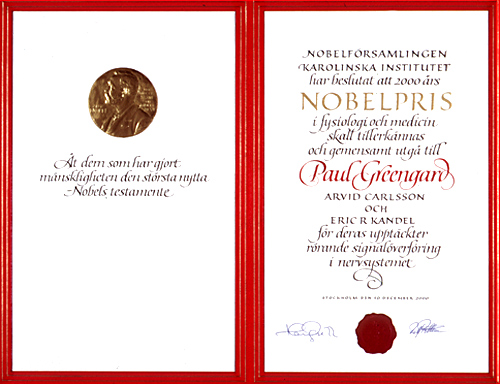
Copyright © The Nobel Foundation 2000
Calligrapher: Susan Duvnäs
Eric R. Kandel – Nobel diploma
Copyright © The Nobel Foundation 2000
Calligrapher: Susan Duvnäs
Paul Greengard – Other resources
Links to other sites
On Paul Greengard from Rockefeller University
An interview with Paul Greengard from PBS.org
Video
‘Paul Greengard, Ph.D. – Oral History Excerpts’ from The Rockefeller University
Paul Greengard – Interview
Interview with the 2000 Nobel Laureate in Physiology or Medicine, Paul Greengard, 13 June 2008. The interviewer is Adam Smith, Editor-in-Chief of Nobelprize.org.
Paul Greengard talks about how the events of World War II influenced his choice to study biophysics, how a lecture by Nobel Laureate Allen Hodgkin inspired his research (5:16), the initial opposition to his ideas about nerve cell function (14:05), how 15 years of hard work and unswerving belief led to his Nobel Prize awarded discoveries (19:54), future challenges for the field (25:00), the wonderful questioning of students (41:27), and why he established the Pearl Meister Greengard Award for women working in science (44:29).
Interview with the 2000 Nobel Laureates in Physiology or Medicine, Eric R. Kandel, Paul Greengard and Arvid Carlsson, by science writer Peter Sylwan, 12 December 2000.
The Laureates discuss whether we ever will be able to understand the mechanisms of mind; talk about their work and discoveries (6.31); making a paradigm shift in the way of looking at the brain (12:25); going against a dominant field (16:15); and their view of the future (19:04).
Interview transcript
Arvid Carlsson, sitting there next to me, welcome. Paul Greengard and Eric Kandel, welcome to us. Three scientists that have really taken us a giant leap on a journey that is, in my opinion, I have to say, the least far more exciting and maybe also far more important than any trip to the stars. The journey to understand our self and to the mechanism of our mind, and maybe at the end of the journey, also the possibility for the conscious experience to experience itself, or to know itself, understand itself. So why don’t we start with the end and ask you this very simple question, and I want a short yes or no on this one. Will conscious knowledge ever be capable of understanding consciousness itself? Arvid Carlsson?
Arvid Carlsson: My answer is no.
Paul Greengard?
Paul Greengard: My answer is yes.
And Eric Kandel?
Eric R Kandel: My answer is probably.
So, there is a little discrepancy between you on this one anyhow. But if I rephrase the question and say, will it ever be possible to understand the mechanisms of mind? What is your answer then?
Arvid Carlsson: To understand there is physiological and physiochemical processes that underlie the mind, that we could perhaps reach. But the actual conversion, how these physical phenomena become consciousness, that is what I think is the real tough thing.
But if you understand the mechanisms or the things that are changing, you can see them, you can measure them, then you can influence the whole system.
Arvid Carlsson: That is very true.
In that way, if my question contains the possibility of interfere with all aspects of mind, your answer is yes.
Arvid Carlsson: Yes.
Paul Greengard?
Paul Greengard: I think that the history of science indicates that one by one various barriers have disappeared in areas that the human race thought were impossible to resolve. And everything seems to be solvable. And I don’t see why an understanding of how we think and what consciousness is wouldn’t be approachable in the same way. I think it’s going to be a very long time till we understand the nature of consciousness, even today with these imaging techniques you can start finding out precisely which type of cells are active when you do this or this type of thinking. It certainly should be possible to do similar imaging and understand when people are awake and asleep and I don’t think it’s a huge step beyond that to understand the nature of consciousness.
So you’re only putting more weight to the answer that all the different mechanisms that at the end lead to the consciousness experience, those mechanisms can be known and cleared. Is science limitless?
Paul Greengard: In certain principles such as the Heisenberg uncertainty principle I think yes it’s limitless. I didn’t always feel that way, it just seems that if you look what happened in the last 30 years it’s unbelievable what the human mind can achieve.
Eric Kandel, on the mechanisms of mind, of course you would have to answer yes on that question as well.
Eric R Kandel: I sort of come down more on Paul’s side. First of all, I think one needs to distinguish between mechanisms of mind, which involves all operations related to mental processes, action, thoughts, memory, perception, and consciousness. There’s lots of perception, mental processes going on of which we’re unconscious for example. You’re shaking your head as we talk, you’re probably not completely aware of the fact that you’re engaged in sort of reflexive autonomic movements as you talk. Those are mental processes but they’re not necessarily conscious ones. And we have made very good progress in understanding aspects of perception and motor action and I’m confident we will continue to do that.
The mechanism of consciousness is a fascinating one, and one that is getting a lot of attention. Not necessarily a lot of scientific progress, but a lot of attention. Francis Crick has developed a paradigm for looking at attention and consciousness, saying that one ought to look at a simple version of it, which is selective attention. You know, when I sit in this room, I attend to you but I’m also in the background perceiving pictures on the wall and things like this. But there’s a special effort involved in selectively attending to you, so the difference between perceiving something and the heightened selection that goes on with attention, is something he’s been studying in experimental animals with the help of other people. And there is now pretty good understanding of how a monkey, for example, attends to a visual image compared to just looking at the image without attention. So simple cases of conscious awareness are beginning to be analysable. To what degree consciousness of oneself, the most interesting parts of consciousness, become understood is unclear as yet. I sort of agree with Paul that a lot of problems that seemed insoluble became soluble with time. When there’s no add of time, we haven’t reached the limit by any means. It is conceivable that this problem is so difficult that the human mind may not have the computational power to analyse it, but we are far from reaching that particular barrier.
But you stick to some of the mechanisms to start with, the one that Arvid Carlsson has discovered is dopamine, and I think there is a fascinating correlation between too little dopamine – then you lose control over your body – and too much dopamine – you lose control over your mind. Is that so Arvid Carlsson?
Arvid Carlsson: As well as the body.
But is there some sort of relation between the mind and the body in this respect that is basically the same mechanism that in a way controls the material world and the mental world?
Arvid Carlsson: That’s a very interesting question. Anatomically the wiring that analyse movements and the wiring that analyse mental processes are very similar. The balance between different neurotransmitters involved in either of these two is very similar. And have probably evolved along with each other which, in a way, makes a lot of sense because if one goes ahead of the other you’ll have no use for it. The mind and movement have to evolve in parallel.
And in this system you have discovered the chemical signal substances between the connection between the nerves, and Paul Greengard your discovery is really what is happening inside the cell. How does your discovery relate to how we react and how we are, how we experience the world? Are there any connections that you have thought of?
Paul Greengard: The work that we did elucidates how these chemicals, the neurotransmitters which are the mechanism by which the nerve cells communicate with each other, how they produce their responses in the target cells on which they act.
And they are related to what sort of mental phenomena?
Paul Greengard: All mental phenomena, memory, consciousness and everything else, is all attributable to the behaviour of nerve cells and what the three of us are doing is trying to understand how one nerve cell communicates with another. It’s through the release of a chemical, a neurotransmitter which activates the second nerve cell and then what happens in the second nerve cell once the neurotransmitter activates it and then how that in turn sends a neurotransmitter to the third nerve cell. What we’re doing at this present level, all three of us, is to understand these biological systems going on, these biochemical molecular systems. Other types of neuroscientists, brain scientists, will take the kind of things that we’re doing and try to relate them to the higher order of behaviour in the nervous system.
But if Arvid Carlsson has done something in between the synapses where the signals are changing the connections between them, you’re only working with molecules inside the cell and how molecules are changing their shape and their effectiveness, what they do, the proteins we are talking about.
Paul Greengard: What we’ve done is to take these neurotransmitters that Arvid Carlsson had been studying and study exactly how they produce chemical and electrical changes in the nerve cells, working out what those biochemical steps are.
And they are related to memory in what way?
Paul Greengard: That remains to be understood to a large extent. Except Eric Kandel’s work addresses that and maybe he’d like to speak to that.
So, memory and changes inside the nerve cells, Eric Kandel. What is the concept or idea?
Eric R Kandel: Let me pick up what Paul Greengard was saying. One way to conceive of the contribution the three of us have made is to think of two sets of processes in the brain – mediating and modulating. That there are vast synoptic connections that are responsible for mediating many of the actions, for example motor actions, sensory perception. But the wonderful thing about the brain is that it can regulate the strength of connections. And my colleagues and I have shown that this occurs during learning, that the strength of connections are not fixed, but that inputs such as serotonergic input or dopaminergic input can modulate the strength of synoptic connections. And it does so by activating processes similar to the kind that Paul Greengard has described. In Aplysia one can show …
Aplysia, that is the sea snake that you have been working with?
Yes, one can show that in fact that a very simple withdrawal reflex, like the withdrawal of a hand from a hot object, can be dramatically amplified by an aversive stimulus. And that amplification involves activation of one of these modular choice systems, the serotonergic system that activates a signalling system within the cell. And activation of that signalling system causes strengthening of the synoptic connection, which is responsible for the enhanced withdrawal.
That means that there is a physical change of the size, so memories are actually made of these changes.
Eric R Kandel: Anatomical changes. That’s right.
This is somewhat exciting that the fast reactions, that is electricity and the somewhat slower …
Eric R Kandel: The fast, and not simply electricity, the faster also chemical transmitters but they act on different receptors.
But long term things are also represented by long term changes.
Eric R Kandel: That’s right.
You have all been part of a dramatic shift in paradigm when it comes to looking at the brain because all electrophysiology before and when you entered this stage you changed the picture totally into biochemistry. Arvid Carlsson, why did you choose to go contrary and against everyone else?
Arvid Carlsson: I think it depended to some extent on ignorance. I was not so well read in the field of brain physiology, so I could look at the facts in a simple, straight forward way, whereas those people who were burdened by a lot of knowledge, they had to think in other terms. They were, so to speak, fixed in the dogma. I was outside, just because of my ignorance, I think.
Eric Kandel and Paul Greengard, what makes someone want to go towards the conventional wisdom of the time?
Paul Greengard: In the case of the study of the brain at the time that Arvid, Eric and I did our work, there were two approaches to understanding brain function. There were physiologists who worked in physiology departments and studied the electrical properties of nerve cells. And there were biochemists working in biochemistry laboratories who took a brain or a liver or a muscle and threw it into a homogeniser and studied the chemicals in the brain. And the two groups did not interact. The people sitting biochemistry were only interested in the biochemistry of the brain. The people doing physiology were only interested in the electrical property of the brain. In one sense we were not going against dogma. There was very little prior art out there. In my own case, my work was guided by the hypothesis that a particular mechanism that had been shown to work in the endocrine system, in which hormone released from one cell activates a target cell, that that system might be analogous to how two nerve cells communicate with each other. And that is through a chemical mechanism, that hypothesis turned out to be correct.
Eric Kandel, you started off as being a psychoanalyst interested in psychoanalysis and everyone thought that was the gateway to the brain at that time. How come that you didn’t believe it?
Eric R Kandel: I did at the beginning and I still find the psychoanalytic view a rich and nuance view of the mind. I just became disappointed as I continued my medical education with how much empirical evidence there was to support it and how devoid it was in thinking about the brain. I became a little bit interested in the brain and as I got more deeply involved I became fascinated with it. And it struck me that memory is the central question in psychoanalysis. And in the 1950s when I began, the dominant view of the brain was that of Karl Lashley at Harvard, who showed that memory was not localisable. That you could remove many regions of the brain and not interfere with memory. What Lashley did not realise is that animals are very smart and if you remove a part of the brain, for example, let’s just say they’re doing a spatial task, if you remove the visual part of the brain, they will use tactile stimuli to find the way, or smell. They have lots of different strategies they can use. I thought one needed to take an extremely simple animal, an extremely simple reflex, where there would be no question about localizability.
Excuse me for interrupting, but I got so curious, but this is true that you have all entered a new way of looking at things that were contrary to the conventional views of the time. And still the question I am really curious about is how is your mental set up to want to go against this?
Eric R Kandel: I think each of the three of us gave a somewhat similar answer, in the sense that we did not think of ourselves as revolutionaries at the barricades. We were working along and we thought that one way of moving in the field was the sound one, it’s almost an intuition that this is the right way to go. It turned out be in opposition to what other people were thinking, but one wants to think in original ways, you try to tackle a problem you think is interesting and approach it in the way that you think is most profound.
Paul Greengard: To amplify what Eric said, it’s not that we were going against conventional wisdom, we were following our own instinct. This must be the way it works. And then more conservative folks would say we were disagreeing with them, but we weren’t, we were just looking at things in a different way.
So in a way it was a very unconscious way of …
Eric R Kandel: That’s right. I think that’s absolutely right.
Paul Greengard: No, I don’t understand what you mean, an unconscious way?
You didn’t really think about going against what was the convention, you just did what you thought was working.
Paul Greengard: It was nothing that they had done was wrong, we were exploring an area that other people hadn’t explored, I would say.
Do you agree Arvid Carlsson?
Arvid Carlsson: No. I was taken by surprise, I must say, when we reported on our data and all the big figures in the field said, no this can’t be true.
Paul Greengard: But that’s true for all three of us.
Arvid Carlsson: I mean, I was right and they were wrong. I mean that is how I experienced it. I wouldn’t like to give them any sort of excuse that we were right, all of us, after all. I don’t agree.
Paul Greengard: Maybe add a certain limited truth, we said, look we think that there are other things going on than what you’ve been studying and there’s all this and this. And then we’d say, yes, there’s all this and this. And then we’d show it and they’d say, no, you’re wrong. We were never saying they were wrong, I don’t think. They were saying we were wrong.
Arvid Carlsson: They were wrong, in my opinion.
Eric R Kandel: I must say that Roy Spencer and I wrote an article in 1968, when we first began to realise that learning could be localised to specific synopses. And we pointed out that Lashley’s view, which was the dominant view, had misled the field.
But if we look then in the future, this is not the last time where things are going to be turned upside down. Have you seen anything in the current science that indicates that there will be maybe a totally new model coming up of how the brain is working? Maybe adding some fundamental new knowledge to the function of the brain?
Paul Greengard: It’s exactly what I’m saying. There will be totally new ways of looking that will not necessarily be contradictory to what we did. What we’re doing is eliminating truths just like the people before us had even more eliminating truths, and the next people add on to that. And they’re not going to prove that the work that we did was incorrect, they’re going to show a new dimension.
Eric R Kandel: It’s almost probabilistic in a sense. The views that we have ended up supporting existed before, just to a minor degree, so people had seen in the endocrine system the kinds of things that Paul discovered in the nervous system. Kajal had spoken about the fact that synopsis could be the site of memory storage. But at the time that we were working those views were rare, very few people held that. Most people held the opposing point of view. For example, many people felt that Bernhard Katz and Eccles had described synoptic transmission in the nervous system, it was fast synoptic transmission. So they thought all synoptic transmission in the brain was fast. When Paul and I began to study slow synoptic transmission, they thought there’s something unusual about this and people were initially sceptical that this could be of importance.
But when the two models that has exchanged for each other, the electrophysiological model, the biochemistry model, what do you think about the future, Arvid Carlsson, are there totally new things coming up?
Arvid Carlsson: I guess there will be paradigm shifts in the future. But I think it’s inherent in the definition of dogma that we cannot identify it. As soon as we identify it as a dogma, it’s no more a dogma.
But before there’s a thunderstorm coming up you can always see a little glimpse of the lightening coming, do you see any glimpse here?
Eric R Kandel: We certainly see that. For example, we thought that the nervous system by the time a child is four or five years old, does not generate any more nerve cells. We thought that the number of nerve cells in the brain are limited – if you lose nerve cells as a result of disease, stroke, Alzheimer’s disease, there’s no way of replenishing those nerve cells from the cells in the brain. There’s now increasing evidence that there is a primitive population of cells that stays around in the brain and they can be the source of additional cells later on. That could be the basis of a new development that would enrich our understanding. So I think that’s a very important development.
And what would be the conceptual change of that idea?
Paul Greengard: Right now it’s thought that the brain has very little ability to repair itself. And with these new ideas that’s not the case. I would like to go back and correct something that I said, refer to something Arvid said on this. The people who are our predecessors, what they did was not wrong, their interpretation was wrong. For example, in his case, they said no, this molecule dopamine cannot be a neurotransmitter, so in that sense they were wrong. The experimental work they had done was correct, their interpretation was not correct. This is, in my case, they said these slow biochemical reactions cannot be involved in mediating communication between nerve cells, they were wrong about that.
But then finally, Arvid Carlsson, do you agree with Eric Kandel that there may be a totally new way of looking on the dynamics of the brain, which is really at the heart of his statements?
Arvid Carlsson: One direction that I think will become very important is the understanding of the interaction between the different neurotransmitters in complex neuro-circuitries. And there are new possibilities to approach these complex problems. And that deals with something that we can call pattern analysis. You can collect enormous number of data and feed into computers and the computers will feed back to you pictures of the data, that actually are patterns of very, very complex processes in the brain, by means of which you can come closer to these very, very complex mechanisms that deal with the mind, feelings and cognition and so forth.
And maybe even get a picture of the conscious experience then on the screen.
Arvid Carlsson: Yes, and also to distinguish between different personalities. By means of imaging you will tell this is a happy fellow and this other fellow here has a short fuse, that kind of thing.
Eric R Kandel: I also think that the human genome is going to enlighten our understanding of mental processes. One of the deep questions that is a confronted analysis of the mind, has been to what degree is the mind built on the base of genetic information? What is nature versus nurture? What do you inherit versus what do you acquire? And most personality traits are quite complex, so they’re not attributable to one or two genes, so they’ve been very hard to decipher. But now that we will have the whole human genome, we’ll be able to look at patterns of genes and we’ll see to what degree any of our behavioural patterns derive from familial traits versus acquired or learned traits. I think that’s going to be a very rich area for investigation.
Paul Greengard: I would like to go back to your original question and ask you and my two colleagues whether there is any reason to think that we won’t be able to understand the nature of consciousness or any other aspect of the brain. What reason is there for pessimism, given the history of the last decade?
Eric R Kandel: I think it’s hard to know what the limitations of knowledge are. I think it is hard to know at this particular point whether the optimism that we all share, that science can solve all problems in the universe, is in fact true. We’ve solved many problems so far, but there is the possibility that there are limitations to human understanding which we and the computers that we develop will not be able to solve.
Paul Greengard: At the moment we have not reached that point.
Eric R Kandel: We have not reached that point.
Thank you gentlemen for sharing of your knowledge with us.
Did you find any typos in this text? We would appreciate your assistance in identifying any errors and to let us know. Thank you for taking the time to report the errors by sending us an e-mail.