Transcript from an interview with J. Michael Kosterlitz
Interview with J. Michael Kosterlitz on 6 December 2016, during the Nobel Week in Stockholm, Sweden.
Michael Kosterlitz, welcome to Nobel Week. And you brought some artefacts for the museum, what did you bring?
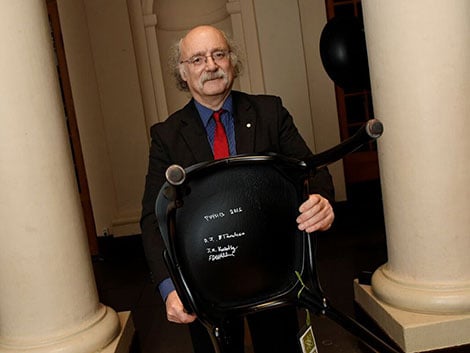
Michael Kosterlitz: I brought some things representing my two passions in life, or my two passions in life at the time. Which are one rock-climbing guide to big cliff in North Wales, and some old calculations on something, that unfortunately is not what I got the prize for, but one of the few hand read notes that we could find, after I had done a major clear-out. That was, what, 40 years ago or something, so of course, it’s had a few clean-outs since. And old scribbled notes which may be of some value, should I become famous. But at the time, the idea of becoming famous was just ridiculous, so it all went.
And the rock-climbing guide, you used to be a very avid rock climber?
Michael Kosterlitz: Yes, I have two greater passions in life; well, probably in order my passions in life were first rock climbing, second physics and third family.
You are awarded the prize this year for absolute first research that you did, coming into the field that you now work in. Can you tell me a bit about how that came about?
Michael Kosterlitz: I was doing high-energy physics and doing lots of elaborate calculations for no return. Then, I was a post-doc in Italy, and of course I needed another job, so the plan was to go to CERN in Geneva, but I failed to get the paperwork in on time, as is my standard procedure, and ended up at Birmingham university, because that was one of the few places from which I got an offer at the very late stage in the game. Birmingham was actually the last place I wanted to go, but it turned out to be the best move I ever made. Because it was there that I met David Thouless and we started working on this problem. Mind you at the time, as far as I was concerned, it was just an entertaining theoretical problem, no more. I had no conception that this could turn in to something big, no idea at all. I doubt that either of us had. It wasn’t until, probably about the 80ies at the earliest, that I realised that we had done something good.
So, in this time after you had done your research, until the time that you really realised what it had led to, did you think about changing fields again, or moving to other parts within physics?
Michael Kosterlitz: Well, I did change fields; I started working on what is called non-equilibrium problems, in other words, on systems which aren’t in thermal equilibrium. And I was hoping to do something as good, when I realised that the work I had done, David and I had done, was actually good work. And I was trying to do something as good in another field but, never managed.
Have you moved back to this field again, is this what you are working on right now?
Michael Kosterlitz: I haven’t moved back, because I haven’t really thought about the field for a long time. And there’s lots of other people work in the field, and are way ahead, you know, have developed it much further. And so, I am, I guess you could call it, one of the ‘grand old men’ of the field, who has trotted out from time to time to say some deep words about it. But beyond that I don’t really do much in the way of research in that field.
You work with topological changes and phase transitions. When the prize was presented, the Royal Academy brought out some different type of baked goods. Can you try to give us a bit of overview why this would be a useful image?
Michael Kosterlitz: Ok, I’ll try. Let me start by saying that topology is a mathematical subject, which is concerned with the shapes of materials. Not the detailed shapes, because after all, as far as topology is concerned, a plane, you know, a flat surface, is equivalent to a sphere, which is equivalent to any shape you like. All that topology is interested in is the number of holes in the system. It’s a classification of shapes which can be continuously deformed into each other.
Right. You can’t have a half of a hole?
Michael Kosterlitz: Right. I mean, the rules are, you can’t get rid of a hole. Once a hole is there, you can’t get rid of it. Or you can’t make a new hole. Now the connection to what we did is a bit of a stretch, but the idea is that if you take your film of superfluid helium on a nice, flat surface – of course there are no holes in this surface. You say to yourself, what on earth has topology got to do with this? Well, in this context it doesn’t, but there are excitations in films of helium, where the fluid circles round and round a point. These are called vortices. And these excitations do exist, and it turns out they are quite important.
This is where topology comes in; because the surface of the manifold of which the topology is defined, is this layer of superfluid, not the actual thing that it is supported on. And so, if you got a vortex, where the fluid is spinning round and round, near the centre of the vortex, the velocity of the fluid has to divert; go to infinity. Which means that the material can’t be superfluid there, so that is going to hole. So, in other words, if you have a vortex produced, for whatever reason, the topology of the system changes.
Right, so you get these topological changes even in this type of material.
Michael Kosterlitz: Yes.
Was that an intuitive leap, I mean, when you first thought of this idea? Because coming from the outside, it seems as two quite disparate things. Was it intuitive to you that this was a mathematical model that could be used?
Michael Kosterlitz: Not directly. Because to me the physics was all in the various excitations that can occur. So, it is obvious that if you like, well we didn’t know it before we worked on this, that a vortex in superfluid helium, the centre of the vortex, was either empty, nothing there, or it was a normal fluid, not superfluid. So that part of it is simple. And so, I myself came from this point of view; I was only interested in the excitations, topology I didn’t know a thing about. Of course, I had the advantage of working with David Thouless, who seemed to know everything about everything. So, he realised that this was, you know, he used the word topology. And once he explained what topology meant, to me it suddenly became obvious. Call it topology or not, it didn’t really matter, but it sounded like a nice way to talk about it, so we called it ‘topological excitation’.
Are you surprised of how much this field has grown since you’ve worked in it?
Michael Kosterlitz: I am amazed. Because there are so many … The original papers are referred to so often it’s almost embarrassing. I knew that we both knew very well, that the same ideas could be applied to talking about two-dimensional crystals, at least the melting of two-dimensional crystals. Because the essential excitations that melted the crystal, you can call them dislocations if you wish, which are analogous to vortices in superfluid helium. That is as far as we went with the two-dimensional melting. You can work anything out, at least I did a calculation which didn’t go anywhere, because we made the assumption that the lattice structure didn’t matter. Then we also knew that in principle it could be applied to a superconducting film. So, given an estimate of what the critical temperature should be and so on.
But we never really took it seriously, because our argument was that you couldn’t have true superconductivity in thin films. Which is a correct argument, but we never thought about the question of how, what length scales superconductivity could exist. In turns out that experimentally, if you have a system of, let’s say, a centimetre, you know linear size a centimetre or so, which is big by experimental standards, then, as far as, this system should obey the standard vortex theory, and the cut off that is inherent in superconductivity is irrelevant, because it’s of the order of a centimetre as well.
So, are there any of these, I mean, there a number of proposed practical applications for this work. And sort of, moving on looking into the future, are there any applications that you are especially looking forward to seeing?
Michael Kosterlitz: Oh yes! Oh yes yes yes. Because the hope is that the applications in quantum mechanical systems will eventually lead to this magic quantum computer. And I’ll be waiting for my desktop quantum computer. I hope to get one before I die, but I think that perhaps I shouldn’t hold my breath and wait and expect to get one. But anyway, with the developments in quantum mechanics, related to our ideas, it’s starting to look like a quantum computer may not be such a pie dream as I originally thought.
Looking at your career as a scientist, is there any person that really has inspired you, in your work or in your life?
Michael Kosterlitz: Lots of people. My co-worker David Thouless. I first met him as a London graduate in Cambridge and Oxford around 1961, something like that. And he was teaching us, and it was ‘mathematics for scientists’ or something like that. And as soon as he started lecturing, I realised I am in presence of a mind that operates in a different level to mine, and probably most other people. So, of course, I was incredibly happy to collaborate with David, because collaborating with somebody with a mind like that, is just an amazing experience.
Then there are other people who have certainly influenced me greatly. There is Michael Fischer at Cornell, who taught me, I was a post-doc there, back in, when was it 1973-74, who taught me about phase transitions and critical phenomena and the importance of experimental work and how theories and experiments should collaborate and criticise each other. Then there was John Reppy, also Cornell, also a superb experimentalist, and who is responsible for the experimental verification of our theory. So, I guess there are all sorts of people who influenced my thinking and my career. But the most important ones happened early in my life. And the most important one is of course David Thouless.
A bit more personal question; I know you have been diagnosed with MS some time ago. How did you, what did you do? And how did you sort of overcome, and handle something like that?
Michael Kosterlitz: I didn’t really manage to handle it very well at all, because at the time, as I said earlier, my major obsession, and a big part of my life, was mountain climbing. And that I had to quit because I couldn’t do it anymore. It is not easy to continue when half your life is just cut, you know you have no choice but to cut it out. I had a great deal of difficulty in coming to terms with my disability. However, fortunately, as my neurologist likes to say, I’m his star patient, so I did… My version of MS is at least one of these, going to the big remission where I come back almost to the level that I was before the attack. So eventually I managed to replace my passion for mountaineering with other things, and now I do work a lot and I travel a lot. And fortunately, I’ve got a very valuable wife who supports me whatever I feel like doing. And keeps on insisting ‘Look Michael, you can do it – its not as bad as you think, you can do it’. That is very important to me.
A final question; you’ve said earlier that coming into the field that you were awarded the prize for, one of the crucial things was your total ignorance of the details of that field. What do you mean by that, what do you mean when you say that?
Michael Kosterlitz: Exactly what I said. Because, I was a high-energy physicist. And so, my graduate work at Oxford was all in high-energy physics, and I simply went to the required lectures and so on, and something called statistical mechanics, which I sort of ‘mm’ it was one of these model, rather difficult subjects, where it wasn’t part of my chosen research. I didn’t pay much attention to it. But statistical mechanics is the central tool of condensed-matter physics, so when I went to this problem with David Thouless, changed from high-energy to condensed-matter, then statistical mechanics became very important.
And was it important for you to sort of look at the problem with sort of unconventional eyes, or…?
Michael Kosterlitz: Well sure, oh yes! Because, if you knew too much about it, if you were a normal person like me, you wouldn’t even go into the field because there are plenty of rigorous theorems, which were interpreted, is meaning that in that in systems like thin films of helium, two-dimensional crystals couldn’t exist. And there’s nothing wrong with the theorem, it’s just the interpretation of the theorem that was wrong. So David, who knew about these things, realised that it was just the interpretation that was wrong. Me, I was so stupid and ignorant that I said, I had no idea that this lack of long-range order was a serious problem. And so, I went ahead and basically looked at the problem in a different way, and it worked out.
Thank you so much for your time.
Michael Kosterlitz: You’re welcome.
Did you find any typos in this text? We would appreciate your assistance in identifying any errors and to let us know. Thank you for taking the time to report the errors by sending us an e-mail.
Transcript from an interview with F. Duncan M. Haldane
Interview with F. Duncan M. Haldane on 6 December 2016, during the Nobel Week in Stockholm, Sweden.
Duncan Haldane, welcome to Nobel Week in Stockholm
Duncan Haldane: Thank you.
I noticed that you brought an artefact for the museum, what is it?
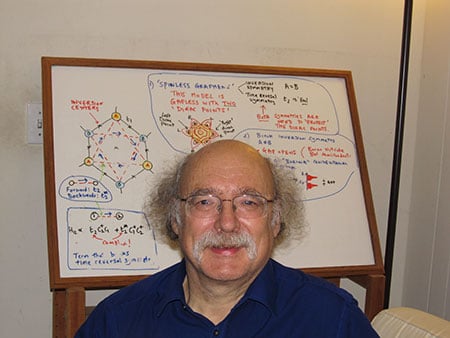
Duncan Haldane: Well, when I initiated the work, which this prize was given for, one of the two works which I received this prize for took a long time for to be published, because it was actually contradicting conventional wisdom at the time. Perhaps I didn’t explain it clearly enough, but in any case, this paper was rejected by a number of journals. And in fact, the original arguments which I discovered that magnetic chains had what we now know is a topological phase, when the quantum spin with an integer-spin, but not a half-integer-spin, which was … no one had thought that was an important feature. Why I discovered this really accidentally, I mean I, as a consequence of another piece of work I had done earlier. And it turned out that people’s understanding of magnetic chains was confused and that there were two sources of it.
One was kind of that semiclassical picture that thought of spins like little compasses, little arrows, that pointed and wanted to be parallel/antiparallel. And that works very well in high dimensions when long-range order occurs at low temperatures. But it was actually when it had been known mathematically that a one-dimensional chain, a very long, thin chain of atoms couldn’t, it ought to be destroyed by quantum mechanical fluctuations at any finite temperature, but also at zero temperature. On the other hand, there was a mathematically exact solution of a toy model, that Hans Bethe had discovered, before he went on to, you know, do huge work in understanding why the sun, how the sun works, and working on nuclear energy. But his early work on magnetic chains had this interesting solution which he guessed, and it turned out to be correct. And he probably didn’t understand why it worked, because he thought he would apply the same methods to higher dimensional magnets, and he promised that in his original paper. But of course, it turns out that what he’d locked on to, involves some very deep mathematics that took about 50 years to understand.
So, most of the scientists who work in magnetism, they knew of the existence of Bethe’s exact solution for a chain of magnetic atoms where the spin took the smallest possible value of 1/2, and locked superficially exactly like the spin wave theories that worked for, that were basically semiclassical, that worked in higher dimensions. And so, they assumed that ok, there was a little kind of, some kind of technical problem with the spin wave theory, but it had to be morally correct; the detail, this little problem didn’t really matter. But they were completely wrong, because the resemblance was purely superficial, and we now know that Bethe’s solution describes very interesting excitations which you call ‘spinons’ now, that it should carry spin-1/2 why the spin wave would carry spin-1, and they got nothing, it’s just an accidental coincidence of the formulas.
I actually, by covering this from a completely different angle, which was that there had been a, again going back to the 30ies, a remarkable relation between fermions and spins, a spin-1/2 object could take two possible states; up and down. And if I have an orbital which you can put a fermion in, it can either be empty or filled, and there is a kind of mapping between the two. But fermions, they have this fundamental property that if you exchange two of them you get a minus one sign, so fermions are said to … the operators that create them are said to anti-commute well. You get a minus sign if you add or remove them in different orders, while the spins don’t have that. But Jordan and Wigner in the 30ies had discovered a nice little way to map the two by putting in, what’s now called a string, in front of the things in the operator. So, they had a remarkable relation between spins and fermions that worked. So, it was pointed out that you could map the spin half chain problem that Bethe solved into a problem involving fermions. And at some limit these were non-interacting fermions, so you could understand the thing.
Based on that language, a completely different language, which I had followed on some work that Alan Luther and Vic Emery and I guess Luther and Ingo Peschel had done in the early 70ies. This allowed one to calculate things – not exactly – but in an approximate method. While the Bethe solution, the one that gave you the energy levels, no one at that point had ever worked out how to calculate anything else out of these very complicated wavefunctions that Bethe gets. It took another, probably 20 years, before, finally the solution of how to calculate with Bethe’s solution was found. So, using these methods, which a normal physicist, who isn’t a very abstract mathematician, could actually do a calculation. So, in this language of the fermions, I made a kind of theory called ‘Luttinger liquids’, which gave a general scheme for what interacting fermions should do in one dimension, and then applied it to this spin-1/2 model. So, Luther and Peschel had made a large progress in the spin-1/2 model; by treating it as a fermion field theory we could actually do a calculation.
But they had missed a detail, which was if the spins like to be in the line plane, like compass needles, you could treat it easily this way, because one of the limits is non-interacting fermions. But the interactions in the fermion picture when the spin is to stand vertically upwards and down, like point towards the North pole or South pole, and they’d missed out why the transition happens at a certain point. From doing numerical calculations, in fact, by applying my general theory to the Bethe “Ansatz” solutions, I saw within them exactly what had been missed. And so, it gave me the understanding of how to properly do a treatment of spins. And then I could actually treat any spin, not just spin-1/2, and immediately I did it. I found that in fact, using arguments based on what Kosterlitz and Thouless had done, that the conventional argument was just wrong. And something quite different happened for the next spin up, spin 1, and all spins which were integer values rather than half-integer values. So, that was it. In fact, this paper states the first lines of stating that, you know, this leads to a very unexpected conclusion; that the spin-1 chains behave completely different from what the Bethe “Ansatz” solution said/did, and it was nothing to do with the spin waves.
So, this was kind of against the orthodoxy … because a lot of people … I mean spin chains were kind of obscure, but in the 70ies a lot of people started working on them because there was some possibility of actually making materials that did this. And, in fact, spin chains had grown a lot of current research on understanding how thermal equilibration happens; people are using spin chains for all kind of things now. But, anyway, this started getting popular, but I was unable to get this published. I sent it to one journal, got turned down with three dismissive reports. So, I just sent it to another one, and I got essentially, I don’t know if it went to the same referees, but essentially, I got the same kind of reports back. So, it took another couple of years, to get the thing published, I mean I, perhaps I didn’t explain it in the language that these people could understand. But in fighting these referees’ reports, I rephrased the arguments in a much more, perhaps, a better way. But the original way I discovered this got completely lost from it. So, this paper was actually, was referred to in the literature because people went on and basically validated the results in here.
There wasn’t an archive at those times, and somehow, I, in moving around, I didn’t have this paper. The people who worked on this problem, and actually validated that I had found what they referred to, that they never had any copies anymore. The institute in Grenoble, the institute in Laue-Langevin, where I did this work, there was an official number of pre-print, but of course they had cleaned out all their cabinets. And I was searching in the boxes in my basement. In fact, the Swedish television people wanted me to meet to show them the boxes, because I have a problem with throwing out papers. So, I have lots of boxes, unopened boxes, which had accompanied me in various moves that was accumulated, and I thought that it might be in there. But in fact, a Hungarian physicist Jenő Sólyom, who worked this problem, eventually came up with the missing pre-print. So, it was actually very interesting cause it actually, it does make a connection that I had forgotten about completely with the work of Kosterlitz and Thouless.
Initially you wouldn’t even think there was a connection because their work was based on, essentially, classical problem of a super fluid film in two dimensions. And Kosterlitz, when he talks about this, he makes it clear that he just deals with classical mechanics, and quantum mechanics introduces too many complications. But, in fact there is a remarkable relation between two special dimensions and one space- and one time-dimension, which is kind of like the relation between relativity in space-time; three space dimensions and one time-, and you get the four-dimensional space-time continuum. Well, a one-dimensional system, where you have a one-dimensional space-time continuum, one plus one dimensional, you have time and space. And there is a remarkable mapping that maps statistic, classical, statistical mechanics of systems at finite temperature described by the Boltzmann factor, with probability weight, and quantum mechanics, which is described by an amplitude for a process to happen. So, the vortices in two dimensions, which if you wonder around the vortex, the spins rotate by two π, turns into, in one space-time dimension, what’s called an “instanton” process, or “tunnelling” process, where, if the spins are all kind of untwisted at one time, and they twist through one turn around a plane and a second plane, and if I do a walk in space time around that, the spin rotates by two π. But the remarkable thing is that quantum mechanics is far richer than the statistical mechanics, cause in the Boltzmann’s formulation of statistical mechanics, the weight factor, the probability factor is always positive. Probabilities, in classical mechanics, are positive, where in quantum mechanics, there are in general complex numbers. But if there is some kind of time-reversal-invariance property, they can be their real numbers, which are plus or minus. But, when things can be both plus or minus, when you combine them, they can cancel, which cannot happen in that.
So, it turned out that the basic process, which should be, the general process was the one I discovered, and the spin-1/2 was a very special case, which was behaving differently, so, the question was not why the spin-1s behave differently from the spin-1/2s, but why the spin-1/2s behaved the way they did. And that’s basically because there was a minus one factor when cancel things. So, this relation to Kosterlitz-Thouless was actually how I realised the thing is a mapping from the classical Kosterlitz-Thouless transition in two dimensions, to the quantum version, in one plus one, which has been incredibly fruitful for all the people working in one-dimensional systems too. So, despite Kosterlitz’s disembowel of quantum mechanics, in his work it has actually been very important also in quantum mechanics. So, this paper has that in it, and as to say, the published version, which is two years later, that connection was completely lost. So, it’s very interesting to remember this and how I discovered things. I was very pleased that someone finally, after I had drawn a blank everywhere, for copies of my own work …
Did you ever doubt yourself; did you think that you must have made a mistake or must be wrong?
Duncan Haldane: No, I was always confident. I mean people were kind of telling me things like this is a … some referee reports were saying this was obviously wrong and in complete contradiction to fundamental principles of physics, such as continuity, or something like that. About that time … and other people called this the ‘Haldane conjecture’, I never, actually I looked in the paper and I used the word ‘conjecture’ about some other tiny detail, which is not the main thing. Somehow this got built as, not a prediction or a theory, but a conjecture – as if it was a guess, a speculation. And of course, it wasn’t. But sometime around that time, the Bethe’s method was applied to a modified spin-1 chain. In fact, two authors in the Soviet Union seemed to have found this spin-1 chain solution about the same time. So, there was two versions of this, and I was the referee of both, actually. And I guess they, of course, found something that looked very much like the exact solution of the spin-1/2 chain. But it wasn’t solving the regular problem, there was a slightly modified problem; an extra piece was added on. And, I suppose I might have had about ten minutes worth of soul-searching when I got the first of these to referee.
But finally, I realised that they were doing a slightly modified problem that was special. And in fact, that turned out to be the case; that if you add this extra piece to the problem, and vary in strength; if you switch it to zero – nothing, it’s the same as what I predicted, but as you switch it up, there’s a critical point at which a phase transition to another kind of state, called the dimary state happens. The solvable, the models aren’t exactly solved by Bethe’s method; they’re usually special, and this one was exactly on a critical point. Now, it turned out that these models were extremely interesting for conformal field theories, which were turned out. So, lot of developments happened in this whole business. And those were very interesting models, but they weren’t generic case, so, I suppose I had ten minutes worth of doubt. But I quickly recovered. It was so clear to me that I couldn’t quite understand why people wouldn’t appreciate my arguments. But maybe we feel that we are clearer than we really are …
Is there any person that you have worked with that has been a huge inspiration for you?
Duncan Haldane: I was very fortunate to work with Philip Anderson, who was a 1977 Laureate in Physics, or one of the three. In fact, he got the Nobel Prize with his graduate advisor, Van Vleck. So, I guess that puts a big pressure on my students to make sure they don’t break the chain, right? So, he had a very unorthodox way of thinking, and maybe that rubbed off on me in some way. I mean, I was extremely inspired by the way he thought about things. I think obviously that was a big influence on the way I developed as a physicist that I had a good chance to interact with Philip Anderson, who has done an amazing amount of different things. With Philip, the Nobel Prize he got wasn’t for the thing he did which was the best; a bit like Einstein, who got the Nobel Prize for the photoelectric effect and not for the gravitational theories.
What do you feel, do you feel that you’ve gotten the prize for the thing you are most proud of?
Duncan Haldane: Well, I’m proud of a number of things. I guess I, this was interesting; it’s probably only in the magnetic chain stuff I always felt was ok, it was interesting, but it didn’t have any obvious applications. It was maybe changing what you thought about things, but more of a kind of theorist thing, right? But it was interesting to a special … some set of people. But a lot of people were very impressed by it. I suppose, partly because … if a lot of people had post it, they had to say, well, it was either, if it was obvious – it meant they were stupid. So, I had to be brilliant instead, to have discovered it, I suppose. But no, I’ve done a number of things, but, the general theme I think, has been this topological matter. And, the other piece of work I did, which was to find, to realise, that you could have a quantum Hall effect without a magnetic field, just due to some kind of magnetic interactions in the system. It is potentially a very practical, useful thing. But it has taken some time to actually be creative in real materials. You know, it doesn’t really matter to me what they gave it for I suppose. It’s kind of a great honour, and it is great for our field, actually.
What I think has happened is that, when I look back and see what, the way I was taught about physics, in the 70ies, and the way that condensed matter was feud by people. I think, my advisor Phil Anderson, were one of the few people who took a very different view point. But the way we think about it has just changed. The things that went in the textbooks, that people thought were important, they’re kind of just rather boring details. And all the new stuff is absolutely absent. So, it’s been a, you know, great honour I think to be involved in laying the groundwork for this complete change of the way we look at things. So, I suppose that’s probably why this prize has happened. And partly because of what happened about ten years ago; some of this work was generalised to so called “time-reversal-invariant topological insulators”. It suddenly turned out that there were real topological materials that had been sitting on people’s shelves for many years without being noticed. And, just the power of theoretical ideas to, reveal something, very worthy, big calculators and experimentalism that’s just not noticed, it’s amazing, right?
So, it’s a question of really, I think we need the imagination to see what quantum mechanics can do, and we need to understand all about quantum mechanics, it’s laws, but we don’t really understand this potential. In the past things were studied by basically hitting them with a hammer, but now we have arrived at where we are actually able to try and tweak or nudging things around, and understand how quantum mechanics influences what happens. And I think my basic line on this, is that quantum mechanics does stuff much cooler than we could’ve even imagined, and part of this emerges, part of this work. And much more, cooler, things have been emerging since then. And people have dreams of quantum computers and all kinds of quantum information technologies and things. And I am not sure what’s going to happen, but something’s going to happen, because so many people now are looking at this, and it has really become … I mean, once you’ve got real things, then people start taking it seriously. And it has become incredibly inspirational and exciting to lots of young people. And everywhere one sees, an experimentalist gives a talk and he views a little video of a coffee cup turning into a doughnut and backwards, a physicist, and you can find this on YouTube and …
The idea that topology has something to do with this material – it just, makes such a big impact on people. It’s just incredible how this thing has taken off. So, these ideas were kind of a sleeper for a long time, and it’s really the final thing where you’ve taken – it’s got three mathematical backgrounds to it, which, you know, I don’t really understand. But, I understand some of it, but just knowing the abstract mathematics doesn’t lead to something either. The mathematics was actually around for a very long time, since the 40ies, and it was only when some mathematician realised, the mathematical physicist realised, that, the formulas for example that David Thouless, and Kohmoto, Nightingale and den Nijs had found, were actually, they found that this topological, this number that didn’t change, and it was recognised, oh this is Chern’s integral of a curvature of a manifold, right?
Once you kind of name the mathematics, then of course there’s lots of tools around. But to actually find it, you’ll have actually be able to do, a concrete little, what they call a toy model calculation. So, the mathematics is often too abstract to actually pin down. But in what I have done, and what Thouless did, is to be able to do very simple calculations, that you can actually do, preverbally on the back on an envelope. Perhaps you’ll need a computer a little bit to do something simple. But to actually see what a model does you need to strip all the irrelevant details out of something and go down to the simplest, possible model, that contains the physics that you’re interested in, right. And I take this line in seminars that it is almost like contract law. Because if you have a contract, very often it’s got a little phrase in it that says that “anything that’s not written in this contract cannot be considered to be part of it” and the contract is the entire document, right? Once you’ve got your model down to be very simple, and it still exhibits the physics you are after, then it’s not omissible to discuss, to attempt to use anything if you have already thrown away as part of the explanation of the thing. So, this is a technique to getting down to the cleanest, simplest example of things. Then, if you can actually do a calculation, then you can be concrete. And then maybe you can see how it works with the deep and beautiful mathematics that gets exhibited in the actual solution.
But the final thing you need, on top of that, is once you have actually shown it can be made in a model, in a toy model, it’s remarkable that the material science has got to the point where, if you think it can be made, someone’s going to make it. Before the toy models were attempts to make, you know, text-book thing for modelling complicated real matter, and the large school of ab initio calculation, to get everything right, all the details right. And of course, the people who worked on that, often had a poor opinion of toy models. But it turns out they missed all these fundamentally, simple and beautiful things. So, toy models are great, but once someone actually makes it, then you got the three ingredients; you got the mathematics, calculation that a kind of ‘simple working physicist’ can understand, and then, an actual material. Once that started to happen about in the last decade, once these three things came together, this field has just taken off, and who knows where it’s going to go.
It’s really obvious, talking to you, that you find this really engaging, and that you still find this immensely interesting. How have you been able to keep your enthusiasm up within this field during your career?
Duncan Haldane: I think we’ve just kept on, things just got cooler. I think in this whole field, I mean, it’s been so fruitful. It’s been actually great for young people at every stage in their career in this field. Other fields, like high-temperature superconductivity has really been the graveyard of many people, because it has been unclear, it’s complicated, and there’s lots of rival theories which fights this and that, and there’s people knifing each other… But in this field, every time a problem came up it got solved and something very interesting and new came up, and people said “fine”. But it’s renewed, it has kept on; new things have kept coming on, and in fact, it’s just been a sequence of progressively more and more cool things coming out. So definitely it keeps one’s interest up. And of course, you try and understand the big picture; the big picture is kind of gradually being assembled. So, it is still an exciting field and it is still going to continue to be an exciting field.
Thank you so much
Did you find any typos in this text? We would appreciate your assistance in identifying any errors and to let us know. Thank you for taking the time to report the errors by sending us an e-mail.
Press release
English
English (pdf)

4 October 2016
The Royal Swedish Academy of Sciences has decided to award the Nobel Prize in Physics 2016 with one half to
David J. Thouless
University of Washington, Seattle, WA, USA
and the other half to
F. Duncan M. Haldane
Princeton University, NJ, USA
and
J. Michael Kosterlitz
Brown University, Providence, RI, USA
”for theoretical discoveries of topological phase transitions and topological phases of matter”
They revealed the secrets of exotic matter
This year’s Laureates opened the door on an unknown world where matter can assume strange states. They have used advanced mathematical methods to study unusual phases, or states, of matter, such as superconductors, superfluids or thin magnetic films. Thanks to their pioneering work, the hunt is now on for new and exotic phases of matter. Many people are hopeful of future applications in both materials science and electronics.
The three Laureates’ use of topological concepts in physics was decisive for their discoveries. Topology is a branch of mathematics that describes properties that only change step-wise. Using topology as a tool, they were able to astound the experts. In the early 1970s, Michael Kosterlitz and David Thouless overturned the then current theory that superconductivity or suprafluidity could not occur in thin layers. They demonstrated that superconductivity could occur at low temperatures and also explained the mechanism, phase transition, that makes superconductivity disappear at higher temperatures.
In the 1980s, Thouless was able to explain a previous experiment with very thin electrically conducting layers in which conductance was precisely measured as integer steps. He showed that these integers were topological in their nature. At around the same time, Duncan Haldane discovered how topological concepts can be used to understand the properties of chains of small magnets found in some materials.
We now know of many topological phases, not only in thin layers and threads, but also in ordinary three-dimensional materials. Over the last decade, this area has boosted frontline research in condensed matter physics, not least because of the hope that topological materials could be used in new generations of electronics and superconductors, or in future quantum computers. Current research is revealing the secrets of matter in the exotic worlds discovered by this year’s Nobel Laureates.
Read more about this year’s prize
Popular Science Background
Pdf 424 kB
Scientific Background
Pdf 800 kB
Image – Phases of matter (pdf 900 kB)
Image – Phase transition (pdf 622 kB)
All illustrations: Copyright © Johan Jarnestad/The Royal Swedish Academy of Sciences
David J. Thouless, born 1934 in Bearsden, UK. Ph.D. 1958 from Cornell University, Ithaca, NY, USA. Emeritus Professor at the University of Washington, Seattle, WA, USA.
https://sharepoint.washington.edu/phys/people/Pages/view-person.aspx?pid=85
F. Duncan M. Haldane, born 1951 in London, UK. Ph.D. 1978 from Cambridge University, UK. Eugene Higgins Professor of Physics at Princeton University, NJ, USA.
https://www.princeton.edu/physics/people/display_person.xml?netid=haldane&display=faculty
J. Michael Kosterlitz, born 1942 in Aberdeen, UK. Ph.D. 1969 from Oxford University, UK. Harrison E. Farnsworth Professor of Physics at Brown University, Providence, RI, USA.
https://vivo.brown.edu/display/jkosterl
Prize amount: 8 million Swedish krona, with one half to David Thouless and the other half to be shared between Duncan Haldane and Michael Kosterlitz.
Further information: http://kva.se and http://nobelprize.org
Press contact: Jessica Balksjö Nannini, Press Officer, phone +46 8 673 95 44, +46 70 673 96 50, [email protected]
Experts: Thors Hans Hansson, phone +46 8 553 787 37, [email protected], and David Haviland, [email protected], members of the Nobel Committee for Physics.
The Royal Swedish Academy of Sciences, founded in 1739, is an independent organisation whose overall objective is to promote the sciences and strengthen their influence in society. The Academy takes special responsibility for the natural sciences and mathematics, but endeavours to promote the exchange of ideas between various disciplines.
Nobel Prize® is a registered trademark of the Nobel Foundation.
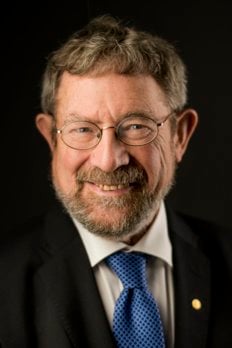
J. Michael Kosterlitz – Biographical
 Childhood
I was born on June 22, 1943 in wartime Aberdeen, Scotland and lived there for the first sixteen years of my life. My parents, Hans Walter and Johanna Maria Kosterlitz (Gresshöner) had fled Hitler’s Germany in 1934 because my father, a non-practicing Jew, came from a Jewish family and was forbidden to marry a non-Jewish woman like my mother or to be paid as a medical doctor in Berlin. Under the circumstances, my father decided that it would be in his best interests to leave Germany and accept the offer of a lectureship at Aberdeen University. My mother, who came from a conventional Christian German family, decided that she would follow my father to Britain so that they could be married, which they were in Glasgow.
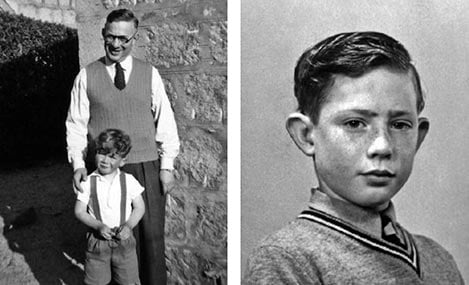
I had a happy childhood in Cults which used to be a small village just outside Aberdeen and separated by farms and fields from the city but now is just another suburb of a much larger city. I was raised as a British child unaware of my German origins, although I was aware that my parents were different from those of my friends because they had a secret language used to communicate when they wanted to exclude me. My parents would have nothing to do with Germany and spoke only English at home except occasionally under special circumstances. As a result, I grew up speaking only English and had to wait several years before learning some basic German at school. In fact, for several years I did not know I was actually of German Jewish origin nor did I know what being Jewish meant. The only thing I knew was that a boy in my class got some extra vacation because of his Jewish religion. When this became known among the class, everyone wanted to change their religion for the extra holidays. My father had no interest in religion and left all instruction in these matters to my mother, who was a devout Christian. I was a nominal church going Christian until I left home for Cambridge University on a scholarship when, to my great relief, I could drop all religion and become my natural atheist self.
Education
My early schooling was in Aberdeen at a semi private school, Robert Gordon’s College, which I attended from kindergarten up to age sixteen. There I had a broad education including the sciences, mathematics, history, geography, Latin and French with a strong Aberdonian accent. Some of the teaching left much to be desired particularly in physics where even I, at the age of fourteen, could tell that the teacher did not understand the subject. My parents decided that I showed some talent for academics and that I was worth grooming for Cambridge or Oxford University. In 1959, I went to Edinburgh Academy where the English A and S level subjects were taught. There I was able to specialize in the sciences and mathematics. With the improved teaching, I found I could do best in physics and mathematics. Eventually, I concluded that the reason for this was that my ability to make logical deductions compensated for my unreliable memory.
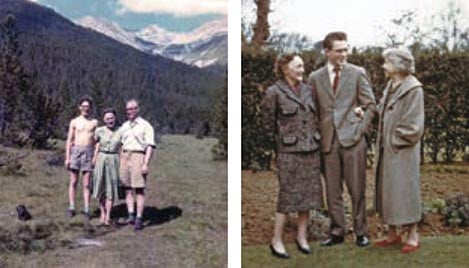
At school, I was fairly average at the humanities but excelled at mathematics and the sciences. Chemistry was the science I enjoyed most because we were allowed a lot of freedom in the laboratory at school, where I would carry out various forbidden syntheses of explosives and other noxious substances. I remember a few occasions where the lab had to be evacuated when one of these experiments went wrong and a noxious gas escaped. Despite the enjoyment these chemistry “experiments” gave me, I was not very good at the subject because of the memory required and I had to make too many guesses, especially when we studied organic chemistry where the chemical formulae were too complicated to memorize. However, despite the rather boring experimental part, physics was where I excelled at school. It satisfied my six fact memory limit because I was able to deduce correct results more often than not. Also, about this time in my life, I discovered that I am red green blind and that this disability does not fit well with chemistry. Some of the experiments required me to distinguish between several test tubes each containing a different reddish fluid. They all looked the same to me, but my classmates assured me that they were all quite different. At this point, I decided that chemistry was not for me despite all the fun I had mixing the various chemicals I could access.
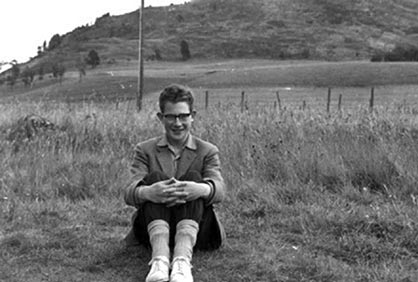
While I was at Edinburgh Academy, along with several fellow students, I sat the Cambridge University scholarship examination and, to my great pleasure, I was awarded a major scholarship in the Natural Sciences to Gonville and Caius College. A condition for attending Edinburgh Academy was that one joined the army cadet corps. Once every week in Edinburgh, I wore my kilt feeling foolish. Despite being born and raised in Aberdeen, Scotland, I did not have a drop of Scottish blood in me and had never worn the kilt before. I came to understand Edinburgh’s reputation as a windy city by parading through the streets in winter in my kilt in the usual cold horizontal rain which is an experience never to be forgotten.
Undergraduate Years
As an undergraduate at Cambridge from 1961 to 1965, I did the natural sciences tripos which covered most of the science subjects of that time. I chose to do physics, mathematics, chemistry and biochemistry because I enjoyed the chemistry at school. My color blindness again made this very frustrating and my poor memory made organic chemistry a bit of a nightmare as there were many situations where guessing did not work. I remember one situation in a biochemical experiment, where I ended up with a test tube containing some nondescript fluid. I was staring at it wondering what I should see in it or if I should do something else to the contents when, suddenly, it started to change color. Instinctively, I averted my gaze just before the test tube exploded. To this day, I have no idea what happened but that episode confirmed that chemistry was not for me and that the less dangerous and less memory intensive subject of physics would be my best bet. For fun, I joined the Cambridge Climbing Club which ran a bus or minibus to Derbyshire or North Wales every weekend. I discovered I was good at rock climbing and enjoyed the thrill of being high on a cliff with almost nothing to stop a fatal fall. From that moment, climbing at weekends became like a drug and I became obsessed by the sport.
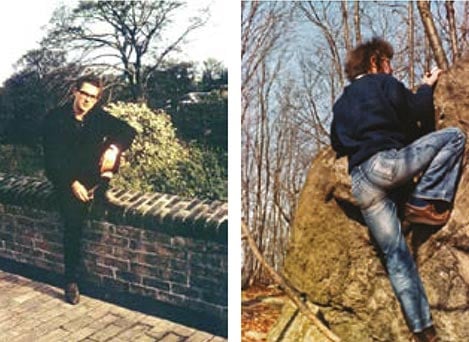
About this time my grandmother died at age ninety-two and left me a small bequest which I promptly spent on a car and the necessary insurance. With the help of my little car a typical weekend would be scheduled as: Friday evening – drive as fast as possible to Llanberis pass in North Wales or to the Lake District or, in the cold winter, to Glencoe or Ben Nevis in Scotland for the ice climbing. Climb on Saturday and Sunday, if not raining, and drive back to Cambridge late Sunday night and early Monday morning. Then I would sleep until I woke too late to go to class, thus not having any lecture notes. The weekly tutorials kept my nose to the grindstone and rescued my academic career.
My life settled into a routine which was close to my father’s dictum of work hard and play hard. By now Berit had become part of my weekly routine. Although she did not climb herself, she enjoyed being with me in the mountains. On Friday evening, Berit and I would jump into the car and drive as fast as possible to North Wales and Berit blames this period in our lives for causing whiplash injuries to her neck. We would return to Cambridge or Oxford late on Sunday after a hair raising race through the dark and I would try to stay awake in class until the following Friday. I would often leave for an afternoon’s climbing on some closer rocks once a week or perhaps do a bit of climbing on some nearby buildings. I had so much fun with these extra curricular activities that I seriously neglected my studies, especially in my final year. Also, in the Part 1 exams at the end of my second year at Cambridge, I did rather well in line with the expectations of me as major scholarship holder and I now expected to obtain a first-class degree in my third year with ease.
However, I did not perform as expected in the all-important final year and ended with an upper second class degree. I am a bit surprised that I did so well because I hardly studied, nor did I attend many classes mostly because I had done so well in the first two years without studying much. I thought to myself “Michael, you are some sort of genius”, but the final year taught me differently. Shortly before the final exam, I realized that I did not know what had been in the syllabus and panicked. I borrowed lecture notes from friends as I did not have any and read and read for most of each day as I watched time passing inexorably towards the final examinations. I struggled with questions I half understood, knowing that my enjoyable undergraduate days of climbing and pubs were now exacting their price. In the summer, I went on a climbing expedition to the Peruvian Andes where I could forget my Cambridge failures.
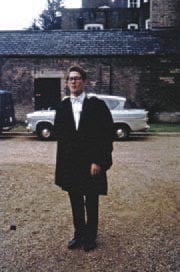
While I was in Peru, my father arranged for me to have an extra year, 1965– 66, at Cambridge to do Part III mathematics to try to improve my disappointing performance. He was an eminent academic who well understood the importance of a Ph.D. degree. This year was a mixed success because I did not appreciate the almost rigorous approach of the applied mathematicians and physicists teaching the courses. Much of what I learned I found useful later. Unfortunately, I had not learned my lesson and my obsession with rock climbing again prevented me from spending the necessary time and effort my studies really needed. Again, I had to be satisfied with an upper second class performance. At the end of the year, I was lucky to have the necessary qualification for graduate school at Cambridge, but not in high energy theory which I was determined to do. I was offered a position with Nevill Mott in experimental solid state physics but I turned this down in favor of an offer from Oxford in high energy theory.
Graduate and postdoctoral years
I spent the next three years, 1966–69, in Oxford sharing a rented house with several medical students and my future wife, who spent the time complaining that she had to work too hard keeping several messy males tidy, clean and fed while I worked on my Oxford D.Phil. We quickly fell into a routine where Berit left for work at 8:00 am and I at 10:30 am to arrive for the 11:00 am coffee at Rudolph Peierls’ department of theoretical physics. My D.Phil. supervisor, John Taylor, left me alone to do my own research and find my own problems which upset me at the time but, in retrospect, this was excellent training for my later career. Whatever his reasons, I am eternally grateful to John for putting up with my foibles at Oxford. I managed to write three papers on Regge poles and the Veneziano model, a precursor to modern string theory, with other graduate students.
These were the subjects I would continue to work on in Torino and later at Birmingham until I changed fields. In 1969, I managed to write my thesis, imaginatively titled “Problems in strong interaction physics”, which, I suspect, has never been read. Of course, the weekends and vacations were still reserved for my climbing obsession, which still occupied all my leisure time. At this time, I spent all summer vacations climbing in the French or Italian Alps and even Yosemite Valley in the USA and managed to get quite a reputation as a mountaineer.
Our next adventure was when I managed to obtain a Royal Society grant for a postdoctoral fellowship which I could use anywhere in Europe. I decided on the Istituto di Fisica Teorica, Torino, Italy because Sergio Fubini, one of the pioneers of modern string theory, was there but, more importantly, it was close to the Alps where the best mountains such as Mont Blanc are situated. Neither Berit nor I spoke any Italian but we were young enough that this was just a minor challenge to be overcome. We had many other interesting challenges to overcome of which renting an apartment and furnishing it, all in Italian, was one. Another was to deal with the local car drivers. I learned to love alpine skiing, made contact with outstanding local climbers and created a climb in the Val d’Orco which bears my name, “Fessura Kosterlitz” which was not repeated for a decade. My achievements in physics are somewhat less well known but I did do some very long calculations on a precursor to modern string theory. This resulted in one paper “The General N-Point Vertex in a Dual Model” with a fellow postdoc, Dennis Wray. I did not realize at the time that I was in the forefront doing research in what was later to become string theory.
While I was in Italy, there occurred a pivotal event which led to my Nobel Prize. I applied to CERN for a postdoctoral position for 1971–1972 but failed to submit the necessary paperwork in a timely fashion and was turned down. Panic set in as the prospect of unemployment hung over me. Berit walked to the main train station to buy a British newspaper which contained advertisements for academic jobs. There was one for a three-year postdoctoral position at Birmingham University in England and I dutifully applied for this although I did not really want to go there for high energy physics. I got offered the job and duly accepted.
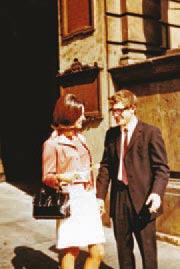
Another, even more pivotal, event occurred in Italy. Berit and I had by now been an inseparable couple for seven years. The question of marriage arose on and off during those years, but we decided that I was too immature and the three-year difference between our ages was too great. By now we felt differently and I suggested that our relationship seemed very stable and we might as well make it legal. We married in Torino in September 1970 after a long battle with the local bureaucracy. Also, this avoided the problem of obtaining work permits for Berit. Since then, we have had more than a few adventures and three children who are now settled in Boston and Providence in New England. We have also been blessed with five grandchildren.
I spent the next three years, 1970–1973, as a Research Fellow at the Department of Mathematical Physics at Birmingham University. I continued my calculations on the dual resonance model of Veneziano and was about to write up my calculations when a preprint by a group at Berkeley doing exactly what I had done appeared on my desk. Needless to say, I was rather annoyed but shrugged my shoulders and started a new long and laborious calculation. I completed this and started to write it up when another Berkeley preprint arrived on my desk. When this happened yet a third time, I did get rather upset and went from office to office asking the occupants if they had a problem I could look at or if I could help in some way. Eventually, I found myself in David Thouless’ office listening as he described concepts and ideas I knew nothing about. He talked about superfluidity in 4He films, crystals in two dimensions, vortices, dislocations, topology and many other related ideas.
Although this was all new to me, as was statistical mechanics which I had ignored as being unnecessary for high energy physics, the ideas made sense to me. After I left David’s office with my head spinning with all these new ideas and concepts, I returned to my own smaller office and began to work on these new wonderful ideas which David had introduced to me. The central idea was that the only way a flow in 4He can dissipate is by the creation of vortices and their subsequent motion. A superfluid can be characterized by the absence of free vortices and a normal, dissipating fluid by the presence of a finite concentration in thermal equilibrium. In two dimensions, the problem becomes equivalent to the equilibrium statistical mechanics of a set of point charges interacting by a Coulomb potential. David and I introduced the concept of a vortex as a topological excitation or defect. The same ideas can be used to discuss the melting of a two-dimensional crystal with point dislocations playing the same role as vortices in a superfluid. David and I wrote two papers on this [1, 2] where we discussed the basic theory of defect mediated transitions. About this time, David casually directed my attention to some papers by Phil Anderson and coworkers on the Kondo problem and its mapping to a one dimensional 1/r2 Ising model [3] which introduced me to renormalization group methods, although this terminology only came into use later. I did nothing for six months but reading and re-reading this seminal paper and reproducing the calculations to try to understand it. During this time, Berit tried in vain to tidy my office but was firmly told to leave all papers alone. A year later, based on this research, I published a paper which discusses a renormalization group treatment of the two-dimensional planar rotor model of superfluid 4He [4] which is the basis for the exact prediction for the superfluid density [5].
My next position arranged by David Thouless was as a Postdoctoral Fellow at LASSP at Cornell in 1973–74. There I met Michael Fisher and his young, very smart graduate student, David Nelson. Even at this early stage in his career, David demonstrated that he was going to become something special. I was excited by the prospect of learning about phase transitions and critical phenomena from the Cornell experts, Michael Fisher and Ken Wilson. Field theoretic methods and the epsilon expansion of Wilson and Fisher [6] had permitted enormous progress in understanding a huge variety of phase transitions and I badly wanted to be one of the pioneers in this. Working with Nelson and Fisher opened my eyes to what physics is all about, how important experimental data are and how to choose the problems to work on. In the 1970s, critical phenomena was a field which was at last opening out by Wilson and Fisher’s epsilon expansion methods. With Nelson and Fisher, I worked on bicritical points using renormalization group methods. To our great pleasure, we were able to understand in great detail the shape of the phase diagram in the vicinity of a bicritical point and why the various phase boundaries had the shape of experiments on anisotropic antiferromagnets. This was at the height of the development of critical phenomena in 4 − Ɛ dimensions and I was excited to be in the middle of it with the leading authorities in the field. I learned the importance of testing one’s theory against the ultimate authority in physics, experiment.
During all my postdoctoral years I kept to my mantra: first climbing, then physics and last family. In fact, when I was in my twenties, I was one of the best climbers in Britain and even considered giving up physics in favor of a professional climbing career. My teaching duties prevented me from going on any of the Himalayan expeditions I could have joined. However, on thinking about the possible consequences of this choice, sanity and my wife finally prevailed. I realized that, although I was technically good enough, a career in academia and physics would allow me enough vacation time to indulge in my climbing obsession. Some of my climbing acquaintances had chosen to become professional mountaineers and a few succeeded but most did not. I decided that I would probably not succeed in this.
Tenured years: Birmingham and Brown
I returned to Birmingham University in 1974 as a tenured lecturer, then was promoted to Senior Lecturer in 1978 and finally to Reader in 1980. I continued working on phase transitions and critical phenomena while teaching two courses at the same time. David Nelson and I managed to produce our important prediction for the superfluid density of a thin film of 4He [5], but my significant output slowed down although I produced several papers on critical phenomena. David Thouless was still at Birmingham, during which time we continued our collaboration on spin glasses until he moved to the USA. I spent a semester in 1978 as a visiting professor at Princeton, Bell Laboratories and Harvard respectively, bringing my family. My stay at Harvard was especially productive as David Nelson and I wrote our paper “Universal Jump in the Superfluid Density of Two-Dimensional Superfluids.”
By 1978 we had two children in Birmingham schools and my wife and I were happy and thought we were settled there forever. I was doing what I loved, climbing, immersed in physics, and spending the remaining time with my growing family. However, this contented period of my life was not to last, because I contracted the nasty autoimmune disease of multiple sclerosis. I awoke one day in September 1978 and was unable to stand up because my balance did not function. I was admitted to hospital where I spent one week while the doctors tried to figure out what was wrong. Eventually, a solemn neurologist said that there were two possibilities, a brain tumor or multiple sclerosis, of which the latter was the better alternative. It turned out I did indeed suffer from MS and life as I knew it was forever changed. Needless to say, I did not react well to this news as I assumed it meant the mountaineering half of my life was over and I would have to live the rest of my life without it. My wife was not as upset as I was because, by this time, a number of my climbing friends had died in climbing accidents and she was relieved that this would not happen to her husband. However, this thought was little consolation to me who could not envisage life without the mountains and I went into a deep depression which lasted for several years. The professor of neurology offered these kind words of encouragement, “There is no cure, some people live longer than others. If you can look back after 25 years you will know how bad a case you are.” Needless to say, this information also affected my physics productivity for a few years.
In 1979 I was offered a position as a tenured full professor at Brown University and Birmingham counter offered a promotion to a research professor as an incentive to stay. This would be at a Center of Excellence centered at Birmingham, which I was inclined to accept. I was about to refuse the offer from Brown when Birmingham abruptly withdrew their offer. Combined with my illness, for which I subconsciously blamed Britain, this was the last straw and I immediately tendered my resignation and left for Brown, where we have been since 1982. My wife and I finally became citizens of the USA in 2004 because, in that year, Sweden permitted dual nationality and my wife did not wish to give up her Swedish nationality. As a British citizen, I had no difficulty because Britain has always permitted dual nationality. After 9/11, I felt that my wife and I and, especially, our children needed the protection of citizenship, so we paid a lot of money to an immigration lawyer and became US citizens in 2004.
At Brown, my interests changed somewhat and, with the help of a grant from NSF, I started to work on various effects in two dimensional arrays of Josephson junctions such as disorder and in a magnetic field. These can be represented by a frustrated planar rotor model, which is quite different from the original 2D planar rotor model [4]. In this, I was greatly helped by a very good graduate student from Brazil, Enzo Granato. This system is an excellent system for the study of many variants of the original system of Kosterlitz and Thouless and is still under quite active theoretical and experimental investigation. We looked at some of the more elementary aspects of the system and slightly increased our understanding of it. These experimentally accessible variants of the model took us out of the realm of analytic work and my student and I turned to numerical simulations, which was the only way we could make any progress. This has turned into a more than twenty-year collaboration with Enzo at INPE in Brazil.
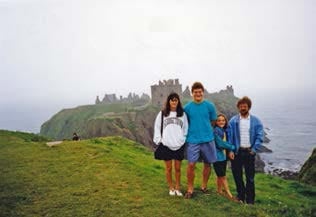
In 1985, I went on a sabbatical to France, bringing my family as I realized this might be the last opportunity for a family adventure. The children went to French schools and I spent six months at Saclay and Orsay with my Brown graduate students continuing the work on planar rotor models.
On return to Brown I became interested in numerical work with a couple of graduate students from Korea. Our projects were to study the kinetics of growth of a surface by random deposition. We studied the scaling of the interface width with time and evaluated the exponent to a high degree of accuracy. However, we could not compete with the massive simulations from a group in Germany. The other project was to investigate if it was possible to identify a weak first order transition by purely numerical methods [7] which method is still being used in 2016. Jooyoung has turned his talents to the protein folding problem and his group is now recognized as a leader in this field as they consistently score very highly in the CASP competitions. A Japanese graduate student, Nobuhiko Akino, has been very successful in his numerical work on randomness in superconductors and in XY spin glasses which have been longstanding intractable problems. We concluded that an XY spin glass exists in three dimensions and above, which result can also be obtained via massive simulations.
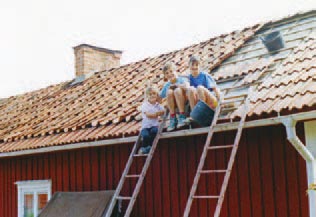
For reasons which are still unclear to me, I lost my NSF funding over this and have never been able to get it back. However, the problem never stopped to intrigue me and over the last ten years I have doggedly pursued the solution although it has proven to be somewhat elusive. I had a brilliant graduate student given to me by Brown who was invaluable help to me doing difficult numerical work, and together we managed to get a paper accepted in 2010.
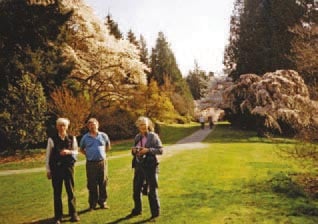
I also have had a longstanding collaboration for the last twenty-five years with my colleague Tapio Ala-Nissila in Finland working on phase field models of growth. This is a surprisingly successful method for the numerical study of growth in fluids and in solids which we recently applied to the hydrodynamics of crystals [8]. This collaboration has also included my colleague, Martin Grant, at McGill in Montreal, Canada and Ken Elder at Oakland University in Michigan, USA as well as my Brown colleague See-Chen Jing. I also started a collaboration at the Korea Institute of Advanced Study in Seoul, Korea where I am now a Distinguished Professor visiting for two months every summer. Even at my advanced age of 73, physics still fascinates me because there are so many problems waiting for a solution that, despite my increasing incompetence, I would like to see understood before I retire. Perhaps in this respect, I am like my father who refused to give up working until he was over 90! On reflection having produced nearly sixty papers in my time at Brown is not bad, but nothing will ever compare to the exhilaration of our 1977 paper [5] when theory agreed quantitatively with experiment [9]. Each summer, Berit and I travel a lot, spending time in Brazil, Finland and Korea but always keep four or more weeks sacrosanct for our Swedish summer house where we can relax completely by watching the grass grow. The only disadvantage is that it always does grow and then needs cutting, which gives me about the only exercise I have during the year.
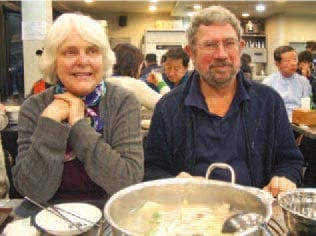
Last but by no means least, I am happy that I have managed to work since that dreadful day in September 1978 when I was diagnosed with MS. The twenty-five years have gone and, as predicted by the neurologist then, I now know the outcome. I was not a bad case. I had attacks every 18 months from age 35 to 55, some quite bad, some small relapses. When I was 55 my neurologist put me into a trial for a new MS drug. This was very successful and opened up a whole new field of pharmacological drugs for the easing of MS. Since then, I have been lucky in that I have never had another attack. I only battle the deadly fatigue that comes with the disease. I want to take this space to tell any budding scientist that, however bleak the future may seem due to illness or other problems, one cannot say you will not be successful.
More people than I can list here have contributed in vital ways to my success. Those that are probably the most important are David Thouless whose friendship, patience and collaboration are central to my career, Berit, my wife, for her patience and forbearance with my peculiarities and absences when I was either climbing mountains or working too hard and my children, Karin, Jonathan and Elisabeth for putting up with and loving their strange father who was absent too often and too long. I also acknowledge the support and friendship of my colleagues at Birmingham and Brown.
References
- J.M. Kosterlitz and D.J. Thouless, J Phys C: Solid State Phys 5 L124–6 (1972).
- J.M. Kosterlitz and D.J. Thouless, J Phys C: Solid State Phys 6 1181–203 (1973).
- P.W. Anderson, G. Yuval and D.R. Hammann, Phys Rev B 1 4464 (1970).
- J.M. Kosterlitz, J Phys C: Solid State Phys 7 1046–60 (1974).
- D.R. Nelson and J.M. Kosterlitz, Phys Rev Lett 39 1201 (1977).
- K.G. Wilson and M.E. Fisher, Phys Rev Lett 28 240–3 (1972).
- Jooyoung Lee and J.M. Kosterlitz, Phys Rev Lett 1990 137 (1990).
- V. Heinonen et al., Phys Rev Lett 116 024303 (2016).
- D.J. Bishop and J.D. Reppy, Phys Rev Lett 40 1727–30 (1978).
This autobiography/biography was written at the time of the award and later published in the book series Les Prix Nobel/ Nobel Lectures/The Nobel Prizes. The information is sometimes updated with an addendum submitted by the Laureate.
F. Duncan M. Haldane – Biographical
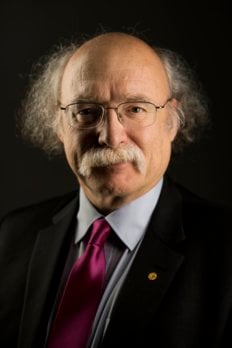
I was born in London in 1951, in a medical family who greatly valued science and education in general, but never tried to push their children to go into medicine, although my younger brother did choose that path. My father was a psychiatrist working in the newly-created National Health Service, and came from Scotland. He had wanted to become a psychoanalyst, but the war had prevented his planned training under Freud’s pupil Melanie Klein, and he was trying to find some way to apply techniques or insights inspired by psychoanalytic theory to the much more limited possibilities for psychotherapy in an NHS practice. My mother was a Carinthian Slovene from a bilingual region in southern Austria, who had met my father when he was an army doctor in the British Occupation Forces there. She was a medical student working in a hospital when she met him, but never managed to complete her studies after coming to Britain, because all the exams she had passed in wartime Vienna would not have been recognized, and she would have had to restart all the medical training from scratch, in what was, to her, a foreign language. Instead, she had a family. My parents’ backgrounds gave me a multicultural heritage, with relatives in both Scotland and in Austria, where we often visited for summer holidays, so I became reasonably fluent in German, but sadly my command of Slovenian remained very basic indeed. My mother was proud of her heritage, as was my father of his, and he would wear a kilt on formal occasions, so although I grew up in London, without a trace of a Scottish accent, I self-identified as half-Scot, half-Slovenian.
I was sent to private schools, first a mixed elementary school a short walk from our house in Bedford Park, in west London, where I appear to have excelled in subjects like arithmetic and spelling, but always lost out on my handwriting skills, which remained messy and irregular, despite my being made to copy out pages of text again and again (or so it seems in my memory). When I was ten, I was sent to the “preparatory school” (Colet Court) for St. Pauls School, and then to St. Pauls itself, which is a well-known “public” (i.e., private) boy’s school noted for a rigorous educational curriculum. The school was very cosmopolitan, and was mainly a day-school with pupils coming from many parts of London, with a small boarding component. I was one of the one hundred and fifty-three scholars at the school (the number has biblical significance as the number of fish miraculously caught by the apostles), and because of this, I wore a little silver badge in the shape of a fish.
I always remember being interested in mathematics and science. In English schools, at least at that time, one had to specialize early. Looking at the list of General Certificate of Education “O levels” that I took, they were English, Latin, French, mathematics, “physics-with-chemistry,” with the only unusual one being “physical geography and elementary geology.” At some point I had to choose between continuing with history or geography, and the rocks and minerals seemed interesting and I was fascinated by the crystal collection the school had (perhaps an early attraction to “condensed matter”?).
For “A” levels, I just have mathematics, physics, chemistry, so somehow, I never studied biology (I think one only studied it if one was planning to go to medical school?). Of course, as these last years of school were during the late sixties, there were lots of distractions for teenagers in London during that period, but I managed to keep my academics on track. In my final year at school, I had a very enthusiastic and inspiring physics teacher who got me interested in the subject, while previously I had found chemistry definitely more interesting.
Somehow, I managed to combine interest in science with interests in rock music and sixties counterculture. I had a gap of nine months after leaving school, and before starting University, and decided to travel. I worked for a while at a book publishers’ organization extracting data on names and fields of study of faculty members from German university catalogs, and with my savings, and a large backpack, then set off on the then-well-traveled overland trail to India and Nepal via Iran and Afghanistan (and back!) – a journey impossible today! (I would later get to see India (and Nepal) from a rather different perspective during visits as a professional Physicist.)
I was admitted to “read” Natural Sciences at Christ’s College, Cambridge where I “matriculated” in October 1970. Three subjects plus mathematics were required, so I finally had the chance to learn some cell biology as well as physics and chemistry, but I found I was not so gifted in the laboratory, and after an experience when I accidentally swallowed some nasty chemical I was supposed to measure out a small dose of using a “mouth pipette” (I do not believe such things still exist with today’s work-safety rules) I decided I should opt for prudence and focus on theory!
In my third and last Cambridge undergraduate year, 1973, I took a class called something like “advanced quantum mechanics” taught by Phil Anderson, where, if I remember correctly, he talked about the problem of localization by disorder, the Kondo effect, and other inspiring things. These were deeply conceptual quantum problems different from the diet of scattering problems which seemed like mathematical exercises in partial wave expansions and spherical harmonics that the more conventional classes had been feeding us. I was hooked and decided that if I was accepted to stay on at Cambridge as a graduate student in the Cavendish Laboratory (which happened), I would like to work with Anderson. I also considered working with Michael Green on an intriguing problem of “massless spinning relativistic strings”: since string theory as a model for the hadrons was abandoned shortly thereafter, and took ten years “in the wilderness” till it was repopularized as a possible theory of quantum gravity, my choice to work with Phil seems a fortunate one, at least for one made in 1973! It is probably the case that any successful research career can be traced to “accidentally” making a series of non-obvious choices at the right time, and various chance events. I think it was the concreteness of condensed matter, in that it was much easier to experimentally realize systems that exhibit all sorts of remarkable effects, that kept me on the condensed matter theory trail. In some sense, particle theorists have only one physical vacuum, with its beautiful but highly constrained Lorentz point-symmetry group, to play with, while condensed matter physics can “build” a huge variety of model vacua with different symmetry groups and “elementary particles” (elementary excitations), and play with them experimentally.
In the TCM (Theory of Condensed Matter) group at the Cavendish, Phil gave me the problem of “valence fluctuations” in the Anderson model of a magnetic impurities to look at and a reprint of his Les Houches lectures about the Kondo impurity spin model, including the “Anderson-Yuval-Hamann” renormalization group treatment of the mapping that turns the path-integral of spin-flips of the impurity into a coulomb gas of charges of alternating sign that interact with a logarithmic potential. This had a “renormalization group” (RG) treatment that provided the precursor for the method developed by Kosterlitz and Thouless for the Nobel Prize-winning solution of their famous problem. I also had to study Phil’s less-complicated “poor-mans method” that rederived the same RG scaling equations for the Kondo model. Phil spent part of the year in Cambridge and the rest at Bell Laboratories, so I had to work through these mysterious texts by myself. The majority of the TCM group were interested in accurate computation of material properties, especially surface properties of metals with different kind of atoms or molecules absorbed on them for catalysis, so in my advisor’s absence, I tried to learn from them and did not understand his “toy model” approach, which was that accurate details really do not matter if one is trying to understand the essence of some phenomenon, provided that the ingredients retained in the model are indeed the ones that matter.
I remember puzzling over the Kondo, Anderson and Wolff models which were all representations of something like a transition-metal d-orbital deep inside the core region of a transition metal atom, in which there are strong electron-electron interactions, mixing with a weakly-interacting metallic conduction band derived from outer s-like orbitals. I even got hold of a self-consistent Hartree-Fock program written in FORTRAN-66 line by line on a huge stack of IBM punched cards that had to be fed into a card-reader hopper to submit the job to a mainframe computer, and tried to puzzle out how the real orbitals of the notional metal atoms would behave as charge leaked off or onto the impurity atom from the metal background. Needless to say, all this was quite pointless, even though it was some kind of learning experience. When Phil returned again, I still had not figured out what the toy models really meant physically. For example the Wolf and Anderson models seemed to be mathematically equivalent, depending on whether the extra “d” orbital was interpreted as being part of the conduction band or orthogonal to it.
But instead of helping me struggle with these niggling details, when Phil returned, he gave a marvelous course of lectures that became his book “Basic Notions of Condensed Matter Physics” where he sketched his ideas of “adiabatic continuity” within phases until critical points were reached, and that all points within the same phase shared the same essential “fixed-point” independent of all the fine details. Through hearing him flesh out his ways of thinking, and going to see him about some details I was missing, and instead having him share with me his interesting thoughts about some apparently quite different but essentially related issue, I began to see his point of view that tries to identify what is needed to see the “big picture,” when trying to understand the physics of strongly-correlated systems. Somehow, that was what having a “mentor” was all about.
In the middle of my second year as a graduate student Phil announced that he would be exchanging his half-a-year at Cambridge, half-a-year at Bell Laboratories position for a similar one that replaced Cambridge University with Princeton University. I and Phil’s other student, Ali Alpar, who was working on pion superfluidity in neutron stars, never learned the reason for the move. This was in any case a very interesting change for us both, as Phil arranged to take us with him to the very different world of Princeton, New Jersey, starting with a few summer months at Murray Hill, New Jersey, the location of Bell Telephone Laboratories, then in its heyday. This was a tremendous privilege for a graduate student.
In September 1975, I moved down from Murray Hill to Princeton, and Ali Alpar and I shared an office on the fourth floor of Jadwin Hall, which was a larger office divided in two by partition, on the other side of which was Natan Andrei, working on particle theory with David Gross, and not yet on the Bethe Ansatz that he would go on to use to unexpectedly find the exact solution to problems I worked on such as the Kondo model, which I would tell him about. Other contemporary students on our floor included Ed Witten and Steve Girvin, who was working with John Hopfield on the “X-ray edge singularity” problem (which like the Kondo problem involved singular behavior at the Fermi level, especially the “orthogonality catastrophe” discovered by Anderson that affects dynamical degrees of freedom that excite particle-hole pairs in a metal that they couple to).
There were many blackboards on the fourth floor. One slightly disconcerting feature of the environment was that John Nash, the future Economics Nobel Laureate, who was in the middle of his illness, would gain access to the building at nights or weekends and systematically cover all the blackboards with mysterious equations connecting politics, pop culture, and numbers. Frank Wilczek had just become an Assistant Professor, and he gave a many-body class about the 3D interacting Bose fluid that I took. Barry Simon and Elliot Lieb were working on the stability of matter, which I also took a class on. Through Princeton and Phil Anderson, I was privileged to meet so many of the leading theorists who were at Princeton, or visiting; for example I was invited to dinner at the Andersons when Phil’s old friend David Thouless visited, meeting him for the first time.
It was an intellectually exciting time to be at Princeton, and in that atmosphere, I finally understood what I was trying to achieve with my extension to Anderson’s treatment of the Kondo problem that allowed valence (charge) fluctuations as well as spin fluctuations of an Anderson model impurity. The renormalization-group treatment showed a novel effect that there was a logarithmic temperature dependence of the energy level of the impurity orbital as a consequence of the interaction.
The renormalization group can be viewed as a way to resum a divergent series derived by perturbation theory, in this case in the mixing between the impurity orbital and the metal in which it is embedded. This means that the results can be validated by a detailed examination of the structure of the perturbation series. The test required that the sum of pieces of each of about forty distinct fourth-order terms in the series should exactly cancel. With the aid of the huge table of integrals by Gradsteyn and Ryzhik, I set out to do the test, but it did not quite work, the cancellation was just not happening. I checked and rechecked each of the forty terms time and time again, to no avail. Finally, after about two months of intense struggle, and being convinced that my results were correct, I realized that one of the complicated integrals I was taking from G&R could not possibly be right, because a simple approximation produced a lower bound that the printed result violated. When I worked out the integral for myself, there was a missing factor of two in the formula given in the tables, and the correction finally made everything work as expected. (When the next edition of G&R was published, there was indeed an erratum that corrected the printed formula!) The experience gave me confidence in standing by results I believed to be true, as well as a lifelong antipathy to doing high-order perturbation theory!
During my last year of graduate studies, the French physicist Philippe Nozières came to give a seminar, and Phil introduced me to him. Later, just when I was wondering where to apply for a postdoctoral position, I got a letter offering me a five-year position in France, at the Institut Laue-Langevin in Grenoble, a city with a large number of research laboratories. The ILL is a neutron-scattering facility, a joint consortium between France, Germany, and Britain, but had a theory group as well as experimental groups who used the neutron source. The idea of experiencing a new country, France, was very appealing, and especially as the dollar was at a low point of the exchange rate, the job looked very attractive, so I accepted. I finished writing up my thesis, and before leaving for France, I had the great opportunity to attend, with Phil’s recommendation, a workshop on strongly-correlated electron systems at the Aspen Center for Physics, in Aspen, Colorado, and then spend a month with Sebastian Doniach at Stanford University.
My brother came to visit, and shared the driving in my old VW beetle from Princeton to Aspen, and it was quite amazing to experience transcontinental driving! That year was a special year at Aspen, as a high-powered delegation from the Landau Institute in the USSR, led by Lev Gorkov, was also attending the workshop. My future colleague Sasha Migdal was among the Soviet party, and it was very interesting to witness the internationalism of science. (There was also a lot of speculation about who was acting as the KGB minder who it was assumed had to be there to keep an eye on the rest of the delegation!) This was followed by a further drive through the spectacular western scenery to Stanford, where I met my future long-term collaborator Ed Rezayi, then a graduate student with Doniach, and then another transcontinental drive back across the US to New Jersey, from where I left for France.
I had perhaps foolishly shipped my American-model Volkswagen to France, but picked it up at the port of Le Havre, and was driving down the autoroute to Grenoble when I heard on the car radio that Phil Anderson was to share that year’s Nobel Prize for Physics with his advisor John Van Vleck and Nevil Mott, who had brought him to Cambridge in the sixties.
I soon found that while my years of French language studies at school had prepared me to decipher street signs and read menus, understanding what people were saying was another matter. On the other hand, the multinational work environment at the ILL was mainly English-speaking, which did not help to improve my French. This was remedied after I met Odile Belmont, a native of the Grenoble region who would later become my wife.
In learning about the Anderson-Yuval-Hamann treatment of the Kondo model I learned about the X-ray-edge singularity problem, which Nozières and de Domincis (ND) had solved in terms of singular integral equations, and the much simpler later variant treatment by Schotte and Schotte using “bosonization,” a remarkable and mysterious representation of electron creation operators apparently just using harmonic oscillator variables, related to those used by Tomonaga in his 1950 treatment of sound waves in a one-dimensional Fermi gas. The two treatments agreed at weak coupling, but differed at strong coupling, where the ND treatment seemed more complete, but in fact the model assumptions used in the two treatments were slightly different, so the models were different at strong couplings. I became aware that Daniel Mattis had claimed to solve the Wolff model exactly using bosonization techniques, but I knew that, at least formally, the Wolff and Anderson magnetic impurity models were equivalent, and from my thesis work, felt something was not right with the proposed bosonization solution. One of my new colleagues at ILL, Hans Fogedby, was also working on the Wolff model with Mattis’ technique, and I determined to try an understand the bosonization technique, and find out why it was giving results I disagreed with, including a phase transition to a magnetic state as the short-range (contact) interaction strength (usually denoted “U,” by analogy to the Hubbard model, a widely-used “toy model” for studying magnetism) was increased.
The Anderson and Wolff models feature a single “impurity orbital” in which there is a Hubbard “U” coupling. Because the Pauli principle prevents two electrons with the same spin from being present in the single impurity orbital, there is no direct interaction between electrons with the same spin, and these were explicitly discarded in the bosonization treatment. However, while the ND treatment of the X-ray edge problem, preserved the contact-type nature of the interaction, the bosonization treatment was secretly treating a long-range interaction which could couple electrons of the same spin, so it was not valid to simply discard same-spin interactions. This subtlety was hidden in the now-explicitlyspecified “ultra-violet cutoff ” structure, invalidating the bosonization treatment of the Wolff model, but I wanted to “clean up” aspects of the bosonization technique, which had been recently also been used to great effect by Luther and Emery for one-dimensional metals, and by Luther and Peschel for the spin-1/2 easy-plane spin chain.
At this time, the correctness of the Kosterlitz-Thouless treatment of the topological phase transition had not yet been universally acknowledged, and there was a counterproposal by Luther and Scalapino based on bosonization of a 1D quantum spin chain. I attended a workshop at NORDITA in Copenhagen, where Luther had moved to, where this was a heated subject of discussion. At that meeting I also first met my future colleague Kazumi Maki, and there was also a Soviet contingent, including Igor Dzyaloshinksky of the famous Landau-Institute AGD (Abrikosov-Gorkov-Dzyaloshinsky) triumvirate, who had produced the foremost text on diagrammatic perturbation methods in condensed matter theory. Igor was an old friend of Philippe Nozières, and I got to know him well when he subsequently came for an extended visit to Grenoble. He had produced an interpretation (with Anatoly Larkin) of bosonization in terms of standard diagrammatic perturbation theory, which was a useful alternative viewpoint.
In my investigation of bosonization, I found that its exact formulation needed two action-angle variables to replace the absent zero-wavelength sound-wave mode, and the lack of this in the earlier formulations such as Luther’s had been “patched up” with a cutoff that was not really consistent. The new variables added topological winding-number excitations with their own distinctive energies to the well-known Tomonaga sound waves, and allowed me to formulate what I called “Luttinger liquid theory,” first as a replacement for Landau Fermi-liquid theory in one dimensional electron systems. However, because “2kF” for a spinless Fermi fluid would also be the Bragg vector if the fluid crystallized, it also applies to 1D Bose fluids and gapless uniaxially-anisotropic spin chains. As I described in my Nobel lecture, this led to a a deeper understand of spin chains, including my very expected discovery in early 1981 that the spin-1 isotropic antiferromagnetic chain had a gapped spin-liquid state that is now recognized as an early example of topological quantum matter.
I was quite surprised when analysis starting with the Luttinger-liquid approach, supplemented with the mapping of the Kosterlitz-Thouless transition to (1+1) dimensional quantum mechanics, led inescapably to my surprising conclusion. I was even more surprised at the resistance this received from the quantum magnetism community when I submitted the paper for publication: it was rejected by multiple journals, and was labeled a “conjecture” even though it was, in my mind, a clear prediction. I recall that one referee pontificated that my claims “were in manifest contradiction to fundamental principles such as renormalization and continuity”! Of course, my predictions were later vindicated both by numerical studies and experiments.
While in France, I received an unexpected invitation to visit the University of Southern California in Los Angeles for a job interview. It turned out that Kazumi Maki had written to Philippe Nozières asking for suggestions for candidates. I visited, and was seduced by the beach and palm trees. I had not yet actively started to look for a faculty position, but at that time, the news I was hearing from British friends was anecdotally rather pessimistic about the UK physics job market, and government research funding. So by default, I inadvertently joined the “brain drain” to the US. A lasting legacy from my time in France was my French life-partner Odile, who agreed to try out the California lifestyle with me.
In my last year at the ILL, I was fortunate, perhaps as a result of my “Luttinger liquid” work, to be invited to one of a small group of “promising young scholars” invited to a Taniguchi Symposium in Japan where the Japanese philanthropist Toyosaburo Taniguchi envisaged they would come together to interact in ideal and luxurious surroundings, in this case a lodge next to Mt. Fuji. Not all the “scholars” were that young, and I had the chance to meet and discuss with John Hubbard, who had introduced a key “toy model,” the Hubbard model for strongly-interacting electrons, who was also there, and seemed to be enjoying the meeting. (Tragically, it was his last meeting, as he died just after returning home.)
By the time I got an extensively rewritten paper on the spin-chain finally published (in Physics Letters A) I had been in California for over a year. During that time I received two papers (from the same journal) to referee (first by Takhtajan, then by Babujian) both describing an exactly solvable gapless S = 1 spin chain with a Bethe Ansatz solution very similar to the gapless S = 1/2 chain. The exact solutions were claimed to represent the generic behavior of arbitrary-spin Heisenberg antiferromagnets, and they apparently completely contradicted my theory! I must admit I had about ten minutes of self-doubt when I received the first of these papers, but soon saw that the solvable model was a modified model with a large non-Heisenberg unphysical “biquadratic exchange” term, and did not represent the standard Heisenberg model I had treated. Furthermore, though they were gapless, I could not fit them into my “Luttinger-liquid” picture. Around this time, (1+1)-d conformal field theory was starting to be developed. Eventually it emerged that “Luttinger liquids” were related to Abelian conformal field theories, that can have continuously tunable critical exponents. The new S> 1/2 Takhtajan-Babujian solvable models were critical, but correspond to nonAbelian conformal theories that require fine-tuning the couplings to exactly cancel “relevant” perturbations, so do not represent generic spin chains. The S = 1 case represents a critical point between the generic “Haldane-gap” nondegenerate symmetry-protected topological (SPT) state, and a non-topological gapped broken-symmetry two-fold-degenerate dimerized state.
An apparently unconnected series of surprises were independently discovered in those years. First, Klaus von Klitzing discovered the integer quantum Hall effect (QHE). As soon as it had been concluded that, in two dimensions, localization by a disordered potential would always lead to integer quantization of the Hall conductivity, Dan Tsui, Horst Störmer and Art Gossard discovered the fractional quantum Hall effect. This was far more of a shock for theorists, as the understanding of the integer QHE showed a fractional effect could only occur as a consequence of interactions. Furthermore, at the time it was generally believed that second quantization and diagrammatic perturbation theory was the principal tool for understanding interaction effects. In fact these techniques are only useful if some adiabatic connection can be found between a non-interacting system and the interacting one, which was not the case for this problem. The Soviet physicists at the Landau Institute outside Moscow were the world’s leading practitioners of diagrammatic techniques in condensed-matter physics, and interestingly, the fractional QHE was the first problem to which they were unable to make many contributions.
Of course, the key breakthrough was Laughlin‘s discovery of his eponymous state, apparently through carrying out a numerical diagonalization of a threeparticle system projected into the lowest Landau level. Perhaps his training in band-structure calculation allowed him to take this direct route to investigate the problem. The key experimental clue was that the QHE states occurred at Landau-level filling v = 1/3 but not at v = 1/2. I had been thinking about some kind of “supersolid” picture, when in early 1983 I received Laughlin’s paper to referee. Within ten minutes I knew he had found the right (Nobel prize-winning) explanation, an incompressible quantum fluid with fractionally-charged excitations, that was later realized to be topologically ordered. In addition, it was fundamentally disconnected from free-particle Slater-determinant states, so there seemed to be no hope of understanding it based on diagrammatic perturbation theory. The most convincing detail was that it provided a natural explanation based on Fermi statistics for why it occurred at v = 1/3 but not v = 1/2. The wavefunction also provides a clear picture of what was later called “flux attachment.” The Laughlin state had a huge effect on the way I thought about condensed matter physics.
Later that year, there was a meeting at Bell Laboratories to celebrate Phil Anderson’s sixtieth birthday, and I stopped over in New Jersey on my way to France, for a summer collaboration with Rémi Jullien, Robert Botet, and Max Kolb, who done the first numerical studies to test my claims about the integerS antiferromagnetic spin chains, and had also attracted skepticism when they reported results supporting my predictions. I had a very interesting discussion about the Laughlin state with Phil, who noted that if three units of flux were injected at a point to create three concentric quasiholes, the resulting state was the same as that resulting from locally removing an electron from the Laughlin state. Thus adding three units of flux plus one electron would just change the N-particle state to the (N + 1)-particle state, in analogy to a Bose condensate where particles were composite objects. Independent of Laughlin’s work, a numerical exact-diagonalization study had also independently been carried out with (quasi)periodic boundary conditions by Yoshioka, Halperin and Lee (YHL) in an anisotropic basis which seemed to suggest a liquid state with a three-fold degenerate ground state, but was not as revealing as Laughlin’s picture.
I had been wondering how to do a numerical calculation that incorporated isotropy, without the problem of boundaries, which YHL avoids. That night, I was staying as a guest in Chandra Varma’s house, and woke from a dream in the middle of the night with the image of a spherical surface around a magnetic monopole, which solved the problem, and turned up to be an incredibly powerful tool for numerical investigation of the fractional QHE. I suppose my brain had been churning over my discussion with Phil Anderson earlier that day, to produce this Kekulé-like experience. Having woken up, I worked out all the details there and then.
I flew on to France, but instead of working on spin-chains with Rémi Jullien and his group, I found that their spin-chain programs were built with arbitraryrange exchange, which allowed me to use them “as-is” (for bosonic Laughlin states) to test ideas suggested by the spherical geometry, such as the powerful pseudo-potential idea, and the idea that the Laughlin state was an exact eigenstate of a “toy model” that retained only short-range components of the interaction potential, analogous to the Hubbard model, except without a background lattice.
In France, I learned the basic techniques of the Lanczos sparse-matrix diagonalization method. When I got back to Los Angeles, I was coincidentally contacted by Ed Rezayi who had just moved there, and we began a fruitful collaboration on numerical studies of the fractional QHE. Because of the inapplicability of diagrammatic methods for this problem, these have been the only quantitative source of information about energies and stability in the problem, to date.
The next year I received an interesting job offer to join Bell Laboratories as a member of technical staff. I took a leave of absence from USC, and we moved to New Jersey, one month after our son was born. It was just the time of telephone deregulation, and of the split between AT&T Bell Laboratories, and BellCore, the part of the research division going to the new local telephone companies, and who were still in the same building as us for several months more. There was fantastic research going on at the Bell Labs, but in the end I decided that I missed the academic environment of a university and accepted a position at the University of California, San Diego, starting at the beginning of 1987, where I stayed until mid-1990. The effect of breaking up the Bell telephone monopoly inevitably led Bell Labs to decline to a shadow of its former self over the succeeding thirty years.
In January 1987, we moved to La Jolla, California, with its beautiful weather and beaches. At that time I was working on both quantum magnetism and the fractional quantum Hall effect. While at Bell Labs, as soon as I heard a rumor that Ian Affleck, with Tom Kennedy, Eliot Lieb and Hal Tasaki (AKLT) had come up with a variant spin-1 magnetic chain model for which the ground state could be exactly found (the AKLT state), I correctly immediately knew, with no further details, that it had to work by the same “pseudopotential” idea that made the Laughlin state an exact eigenstate of a truncated short range interaction. At UCSD, Assa Auerbach and Daniel Arovas, who were postdocs at the University of Chicago had asked to come to visit La Jolla during the Chicago winter, and do some work on quantum magnetism. They found a beach motel to stay for a month, and we were able to get very nice insights into the excitation spectrum of the AKLT model using methods borrowed from the fractional quantum Hall effect, in the process starting a lifelong friendship. Interestingly, this work provided the first clue that there could be some relation between the spin-chain and the quantum Hall effect: this is now clearer, as both are now recognized as forms of topological quantum matter.
In this period at UCSD, I came across various interesting results, such as an exactly-solvable spin chain model with long-range exchange (independently discovered simultaneously by Sriram Shastry, and now called the “Haldane-Shastry” model), in which the “spinons” of the spin-1/2 chain are especially simple.
I also came up with the second discovery that the Nobel committee mentioned: I called it the “zero-field quantum Hall effect,” but it is now usually called the “quantum anomalous Hall effect” or the “Chern Insulator,” and is the first member of the topological insulator family, but one with broken time-reversal symmetry, unlike the later time-reversal-invariant topological insulators. The idea was started when I read a 1986 paper in Physical Review Letters (PRL) by Eduardo Fradkin, Elbio Dagotto, and Daniel Boyanovsky (FDB), called “Physical Realization of the Parity Anomaly in Condensed Matter Physics.” I am not sure if I understood it properly, but it seemed to propose a quantum Hall effect in the absence of a magnetic field and with unbroken time-reversal symmetry, on a domain wall in a semiconductor with strong spin-orbit coupling. This interesting paper also stimulated Frank Wilczek to think about axion electrodynamics in a condensed-matter context. But thinking about it, I realized that there was no problem with a QHE in the absence of magnetic field, provided time-reversal symmetry was broken, which explicitly was not the case in the FDB paper. I tried to make this point by submitting a “comment” to PRL on the FDB paper, but as is often typical in this kind of “Comment/Response” dialog, it really became two monologs, where neither side understands what the other is saying.
In the course of sharpening my arguments, I looked for as simple and transparent a model as possible with which to make my point, and since Gordon Semenoff has used a “graphite monolayer” (i.e., graphene) as the condensedmatter backdrop for Dirac points, I used that too. The 2D Dirac points are stable if both spatial inversion and time-reversal symmetries are unbroken: Semenoff broke inversion symmetry to get an entirely-unremarkable insulator that had a field-theoretic description as two copies of a massive Dirac equation. With a bit of magic involving complex second-neighbor bonds, I broke time-reversal symmetry and ended up with a topologically-non-trivial state exhibiting a “quantum anomalous Hall effect” where “anomalous” in this context means that the Hall effect is not driven by a uniform magnetic flux density, but arises from magnetization. At this point I realized that this effect was extremely interesting in its own right, especially if could be realized experimentally in a real material. I dropped out of the Comment/Response cycle, which in any case was getting nowhere, and published the result in its own right.
The model of graphene with a “mass gap” due to breaking of time-reversal symmetry, conceptually provided by an additional ferromagnetic degree of freedom with a magnetic moment normal to the graphene sheet, was a simple and transparent enough “toy model” to be used for a number of model calculations. As well as the gapped quantum anomalous Hall regime, it had a metallic regime, with the Fermi level inside a band, which could model a 2D version of a metallic (unquantized) anomalous Hall effect, and David Vanderbilt and coworkers later put it to good use to find and test a general Berry-like formula for the magnetization of a material in terms of its bulk bandstructure. I later also used it to guide me to new expressions for the anomalous Hall effect in 2D and 3D metals as a pure Fermi-surface formula, which is relevant to the currentlyhighly-studied “Weyl semi-metals.”
Later in 1988, I had two very interesting foreign trips, one to the People’s Republic of China, where T. D. Lee organized a meeting at Beijing University with a cast of colleagues such as Bob Laughlin, Steve Kivelson, Ganapathy Baskaran, Dung-Hai Lee, and others. This was when it was just becoming possible to travel to the PRC, and the Beijing streets were still rivers of bicycles, unlike today. In the second trip, I was invited by David Pines, to join a party sponsored by the National Academy of Sciences to visit the USSR, in particular the Landau Institute at Chernogolovka, which had long been off-limits to westerners (we were in fact the second group of western visitors to visit). There I met such future condensed colleagues such as Paul Wiegmann, who also independently solved the Kondo problem (and who a year later was able under Perestroika to get a passport to come with his family to a visiting position at UCSD), and my future Princeton colleague Sasha Migdal, as well as meeting senior Soviet physicists such as Gorkov, Abrikosov, and Khalatnikov. Everyone in the visiting party at the Landau Institute also wanted to meet my renowned future Princeton colleague Sasha Polyakov, but then, as now, he was a fanatical jogger, and was out running somewhere in the woods and could not be found! After a day at the Landau Institute, we went on to a meeting in Tbilisi, which was greatly enjoyed by our hosts, as the alcohol ban that Gorbachev had decreed in Moscow did not extend to Georgia. While meetings between physicists from the US with those from Russia and China are commonplace today, at the time these were quite exceptional experiences.
In 1990, Princeton University successfully enticed me away from California, and with a new baby daughter, we moved back to the East Coast. Princeton, long known for elementary particle physics, was building up its condensed matter group. In 1992, I spent a half-year sabbatical at the École Normale in Paris, and after giving a seminar on the mysterious symmetries of the Haldane-Shastry model, which a year earlier had led me to formulate a novel “fractional exclusion statistics” a suggestion from Vincent Pasquier and Denis Bernard led the identification of an unusual form of the “Yangian quantum group.” In 1993, while attending a workshop, I unexpectedly learned from Steve Kivelson that I was that year’s Oliver Buckley Prize winner for the old quantum spin chain work: it turned out that that had been announced a few weeks earlier, but I had mistaken the large white envelope with the APS letter for some routine circular, and left it unopened, and no-one else had told me. This must have been the days before email was widespread! A few years earlier, David Thouless had told me he was nominating me for Fellowship of the Royal Society of London, and (perhaps because of the Buckley Prize) I was finally elected in 1996 and had the honor of signing the parchment Charter Book, with entries going back to Newton.
For a long time, nothing had happened with my 1988 graphene-like toymodel for the zero-field quantum Hall effect. In 1999, work by Ganesh Sundaram and Qian Niu (a former graduate student of David Thouless) revived the longignored work of Karplus and Luttinger on the anomalous Hall effect in ferromagnetic metals, showing that it had a modern interpretation in terms of Berry curvature. This re-energized the study of Berry curvature effects in band structures. My 1988 model satisfied the “TKNN” topological result of David Thouless, with coworkers Mahito Kohmoto, Marcel den Nijs, and Peter Nightingale, that was cited by the Nobel committee as David Thouless’s seminal contribution to topological matter. When the gap was opened by breaking time-reversal invariance the conduction and valence bands had Chern invariants ±1 respectively.
In the early 2000s after attending a seminar by John Joanopoulos on the new subject of “photonic crystals” where the flow of light is modified by passing it through engineered spatially-periodic “metamaterials,” I realized that, at least as far as “one-way” edge states were concerned, some of the physics of the quantum anomalous Hall effect could be transplanted into the field of photonic crystals, which could also have Chern invariants. Still it took some time to come up with an explicit photonic bandstructure that would this. Eventually, in early 2004, while I was on sabbatical at UC Santa Barbara, my student Srinivas Raghu, who came with me, found a candidate structure inspired by the same hexagonal graphene structure that exhibited the electronic effect in my 1988 model. A calculation confirmed that it indeed would show the effect, and the new field of “topological photonics” was born.
At that time, there was also a lot of discussion about a “spin Hall effect” in systems with spin-orbit coupling and unbroken time-reversal symmetry. As a toy model, it was natural to combine conjugate copies of the 1988 model for what could now be called the “quantum anomalous Hall effect” to form a time-reversal invariant structure that would exhibit a “quantum spin-Hall effect.” While at UCSB, I played with this model, but because it had edge modes that traveled in opposite directions, I assumed that it could not represent a true stable topological phase because spin-non-conservation by generic Rashba spin-orbit coupling would surely mix and destroy the edge modes because the total Chern invariant satisfied 1 − 1 = 0. This is a good lesson for not assuming things without actually doing a calculation! Charles Kane and Eugene Mele has the same idea, but actually tested it with a numerical calculation, and realized that the quantum spin-Hall state was indeed topologically stable because of a previously-unrecognized topological invariant. Furthermore, a few years later, in 2007, it was simultaneously realized by a number of groups that this new invariant could be extended to three dimensional materials, now called “topological insulators.” This was shortly followed by the discovery by Liang Fu and Charles Kane of an extremely simple formula for determining whether such insulators with additional inversion symmetry were “topological” or not, leading to many experimental discoveries of topological materials, and an explosion of interest in the field.
In this period of the discovery of time-reversal-invariant topological insulators, my own work focused on rather different problems of the role of geometry rather than topology in the fractional quantum Hall effect, but in 2008, my student Hui Li and I discovered remarkable topological features in what we called the “entanglement spectrum” of quantum states, showing how the detailed structure of the entanglement revealed by its Schmidt decomposition contained far more information than just the single number characterizing entanglement entropy. This has turned into a widely-used diagnostic for studying the topology of entanglement.
In 2012, I was very gratified when the role that the 1988 “zero-field Hall effect” model had played in the topological insulator was recognized when I shared the prestigious International Centre for Theoretical Physics Dirac Medal with Charles Kane as well as Shoucheng Zhang, whose work with Laurens Molenkamp had led to a physical realization of the 2D quantum spin-Hall effect.
Finally in 2013, Shoucheng Zhang’s collaboration with the experimental group at Tsinghua University in Beijing, where magnetic material was deposited on the surface of a layer of 3D topological insulator, finally led to the experimental realization of the quantum anomalous Hall effect envisaged in my 1988 paper. Because of the robustness of the unidirectional edge states, these materials are potentially even more useful than the time-reversal invariant topological insulators.
Finally, this chapter of my story ends in October 2016, when I was awakened by the 5:00 a.m. phone call from Stockholm, followed by the magnificent ceremony and banquet there on the 10th of December. While my mentor Phil Anderson was not able to travel to be in Stockholm in person, he passed on tips and observations he had made when he received his own Nobel Prize in 1977. John Van Vleck, Phil Anderson’s thesis advisor, who shared the 1977 Nobel Prize for Physics with him, had as thesis advisor advisor Edwin Kemble, who, while he himself did not win the Nobel Prize, had an advisor Percy Bridgman who was the sole Physics Laureate in 1946. So I discovered I have an illustrious “academic gene line,” stemming from fortunate choices I made back in 1973!
This autobiography/biography was written at the time of the award and later published in the book series Les Prix Nobel/ Nobel Lectures/The Nobel Prizes. The information is sometimes updated with an addendum submitted by the Laureate.
David J. Thouless – Biographical
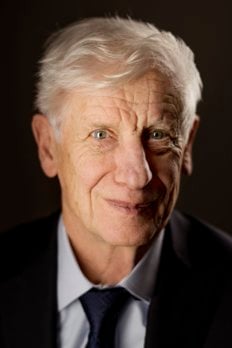
The Name
The name Thouless is very rare. Fewer than 150 people with the name live in Britain, almost all of whom are connected to Norwich. This is because it is a relatively new spelling of an old name spelt variously Thules, Thewless, Thewlis etc. Five generations before David, his ancestor John was born Thules. When John’s son, James, was born, both parents were illiterate and the clergyman filling out the baptism certificate wrote what he thought he heard – ‘Thouless.’ It seems that almost everyone with this particular spelling of the name is descended from James.
Mother’s Family Background
David’s mother was born Ella Grafton Gorton in 1898. She changed her name to Priscilla when she was studying in Italy, where she found that having a name that translated to “She” in Italian was inconvenient. The family name originates in Gorton, a suburb of Manchester. Her father’s family had been Church of England clergymen back into the 1600s and continued this tradition through her generation. Her grandfather, father, three of her brothers and two of her brothers-in-law were all clergymen. The most prominent of these was her brother Neville Gorton, the Bishop of Coventry who was deeply involved in building the new cathedral after the war.
Priscilla was the sixth of seven children. She was taught by a governess who did not like mathematics and influenced her pupil to feel the same way. After her father died, she went to Altrincham High School and then got a scholarship to Manchester University. She gained a BA and MA in literature and taught English at Manchester until David’s older sister Susan was born in 1925.
David’s generation, which included 14 first cousins on his mother’s side, were not involved with the church or science. The most notable of his cousins was Assheton Gorton, who was an artistic director of a number of well known films such as Blow Up and The French Lieutenant’s Woman.
Father’s Family Background and Scientific Interests
David’s father Robert Henry Thouless was born in Norwich in 1894. Robert’s father Henry James Thouless married Maud Harper from Devon who was studying at a Teacher Training College in Norwich. Henry James was a company secretary at Barnards, a Norwich engineering firm. However, his passion in life was natural history, with a particular interest in insects, specifically moths. He served a term as the President of the Norfolk and Norwich Natural History Society and had a bungalow on the edge of a marsh in Wroxham, which was ideal for finding insects. He bequeathed a collection of insects he had collected, which included two named after himself, to the museum in Norwich Castle.
Robert had two sisters, Sybil and Margaret. Sybil became a nun and taught school in the order of Notre Dame. The younger sister, Margaret, also became a teacher. She studied at Oxford University before they allowed women to take degrees. Once women were allowed to take degrees, she returned to study Latin for a year, as this was a requirement for graduation. Margaret had wanted to study science, but she was considered too frail to do the lab work required. Instead, she taught English literature and foreign languages at St. Mary’s Calne, a girls’ private boarding school.
David’s father Robert attended King Edward VI School in Norwich. In 1912 he went as a scholar to Corpus Christi College, Cambridge. In 1914 he was awarded a bachelor’s degree in natural sciences. He joined the Royal Engineers as a signaller. After a couple of years, in 1917 he went to the Salonika Front, from which by his account he was lucky to have come home alive. He became a lifelong pacifist but it did not stop him joining the home guard to defend his own town, Cambridge, during the Second World War.
After the First World War, Robert returned to Cambridge and did a PhD in psychology. He then became a lecturer at Manchester University before moving to Scotland to start the Psychology Department at the University of Glasgow. While at Glasgow, he did his most important work on how an object is perceived, introducing the term “phenomenal regression” in 1931. In the 1930s this was a very unfashionable line of research, and it did not enter mainstream psychology until the 1950s. Robert was offered the resources to study this phenomenon in Australia after he had retired, but he replied that he did not have the strength and brain power he had had when he wanted to study the topic 40 years earlier. David has followed his father’s originality of thought, which sometimes came before the rest of the world is ready to engage in a topic.
Robert Thouless was also known for his radio programmes on how to critically analyse flaws in reasoning and arguments, which he later turned into the book Straight and Crooked Thinking. This is known as How to Think Straight in the US. It has been a required textbook for many generations of students of rhetoric. His grandson Christopher Thouless has revised the last two editions, so it has been in print for over 85 years.
Later in life, Robert concentrated his research efforts on studies of the paranormal. He was elected President of the Society for Psychical Research in 1942. Although a frequent result of his painstaking investigations was the detection of cheating in apparent cases of psychic powers, he continued to believe in the possible existence of such abilities.
David’s Education with Emphasis on Mathematics
Even as a four year old, David was precocious in mathematics. One day, after discussing with his father how far counting goes, David decided to take the experimental approach. His family was bored by the time he reached 500 and even more bored by the time he reached the second thousand.
Just before his fifth birthday David and his sister were evacuated to his grandmother’s house in Devon at the outbreak of the Second World War. While there, David taught himself to read and write, with the help of his grandmother’s housekeeper.
As soon as it appeared that a German invasion would not happen immediately, David and Susan returned to Cambridge and David started school. At this point David stopped asking how to spell words and started thinking about arithmetic. With the aid of a simple abacus he worked out problems for himself. He worked out the 2 times table, working out what 2 times 27 was before he got bored with the project. At age 7 he set himself the task of working out how many seconds there are in a year. From age seven through eight, he spent two years as the only boy in the top class of the school, with the rest of the class being large 9- to 11-year-old girls, which was not a situation he enjoyed at that age. Much to his relief, his next school St. Faith’s was a boys’ prep school.
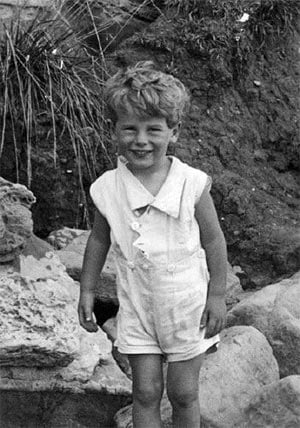
David’s father had a big influence on his intellectual development. “When I was 5 my father taught me to play chess, at which I slowly acquired competence but not brilliance. I think I was a teenager before I had a good chance of beating him at chess, but I was generally much better than my friends.” In fact David continued to play chess until he was in graduate school, when he felt the mental effort was too similar to physics. He and his friend played chess in their heads on long Territorial Army marches.
My formal education in science was close to non-existent until I was nearly fourteen. I can remember one young man trying to teach chemistry. Half the boys knew what he was talking about, but I had no idea why a chemical should go in one particular direction, rather than to any other end-product that had the same number of each atomic species. Fortunately my father was always willing and able to fill such gaps in my understanding.
I cannot enumerate all the things I learned from my father. He certainly told me about Wegener’s theory of continental drift, which was very unfashionable at that time. His enthusiasm for probabilistic reasoning was something he shared with me quite early; he was an early follower of Cyril Burt in stressing the importance of careful statistical analysis of psychological tests. He showed me how base 2 arithmetic could be used to win the game of Nim. I saw, but never really absorbed, the Boolean notation he used to solve problems in logic.
David met interesting visitors his father invited to the house. “A frequent visitor to the house in the early years of the war was the philosopher Ludwig Wittgenstein. My father had been to his lectures before the war, and there was an annotated copy of the Blue Book among his papers when my father died. I also found notes on a series of conversations on philosophical and scientific matters between Wittgenstein, my father and Cyril Waddington. These were published in 2003 by James Klagge and Alfred Nordmann in the book Ludwig Wittgenstein: Public and Private Occasions.”
Winchester
St Faith’s School in Cambridge encouraged David to compete for a scholarship to Winchester College. He was not sure he wanted to go, so his parents made alternative arrangements in case it should prove too stressful for him. He won the top scholarship of the year with an outstanding mathematics result and very good English and Latin. David had not studied Greek, so he did not attempt that paper. He was the first ever student to come top in the scholarship exam having only done three out of the four papers.
It was also decided that I should take the School Certificate at the end of the first year, despite the fact that I would still be thirteen, because in preparation for the introduction of O-levels in 1950, there would be a minimum age for School Certificate in 1949.
As a result of this I took the exams in English Language, English Literature, Mathematics, Further Mathematics, History (Ancient Greece), Latin, Greek and Divinity (including St. Luke in Greek). I was still struggling with Greek, quite enjoying the struggle, and got Credit in Greek, but got Very Good in all the other subjects. I had no official science background, nor any modern foreign language qualification. I did not take any serious external examination in foreign languages until I entered the Cornell Graduate School on my 22nd birthday.
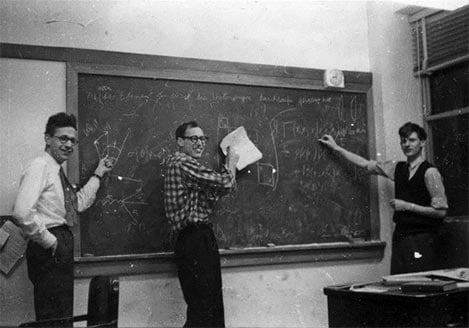
David got an excellent education in science at Winchester. “In all subjects there was a lot of emphasis on private study and assignments, and we spent relatively little time in class, perhaps less than eighteen hours a week, over about 36 weeks a year.” Time was found for a broad rounded education in addition to science. For example, “One of the joys of my second year was that the formmaster was Harold Walker, the head of the history department. His one-term course on American history left enough in my memory that I found no need to revise when I took the test for US citizenship. His scholarly but sceptical teaching of divinity was challenging and refreshing, particularly to someone like me who took religion rather too seriously.”
During David’s time at Winchester his termly reports did comment on his mathematical ability but expended far more space on his untidy work and handwriting. This may have led to his excellent habit of developing his equations on scrap paper and when he was satisfied with them copying them into hard backed numbered page note books. These have now been deposited in the archives of the Royal Society.
Cambridge University
David was fortunate that he did not get the scholarship he wanted to Trinity College, but did get one to Trinity Hall next door. Trinity Hall was a much smaller college, better suited to his introverted personality. He made a number of really good friends while there, some of whom he sees to this day. He became an honorary fellow of Trinity Hall in 2014 and enjoys participating in some of their activities.
Describing his undergraduate experience, he said:
I knew the Senior Tutor Charles Crawley well, as his son John was and is a good friend of mine. My own Tutor was the distinguished historian and theologian Owen Chadwick, and the other Tutor was Shaun Wylie, who supervised me in mathematics, and was probably the single most important influence on my academic development as an undergraduate. None of us were supposed to know the significance of Bletchley during the war and of Cheltenham later, but somehow or other, from various different sources, I had picked up a fair idea of what Shaun and his colleagues had been up to in those places.
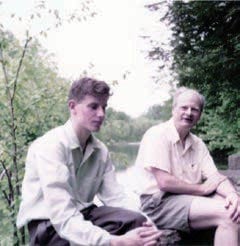
The other piece of good fortune was that Trinity Hall did allow David to defer military service until after he graduated, which Trinity College would not have done. This led into his later studies with Hans Bethe (Nobel Laureate, 1967). In June 1955, the Cavendish Professor Mott (later Sir Nevill) called David into his office and asked him what he was doing next. David said that he was going to do his military service, as he did not wish to defer until after graduate school because he did not want to do military research, which would have been the likely outcome once he had a graduate degree. Mott told him that he could continue to get a deferral as long as he continued his scientific work and that the requirement for compulsory military service was likely to be discontinued. This led to an interesting situation in which no one had time to take David on as a doctoral student but the Cavendish had money for a stipend for him. Professor Mott suggested that he work with Hans Bethe, who was on sabbatical at the Cavendish Laboratory, Cambridge University. After a year, Hans offered David the opportunity to go to Ithaca with him and study for a Cornell PhD, which David accepted.
Cornell University
David obtained a Fulbright Foundation scholarship, which paid for his Atlantic trip on the Queen Elizabeth ocean liner and a train trip on the Lehigh Valley railroad to Ithaca. He travelled with Ronnie Peierls, son of Professor Peierls (later Sir Rudolph) of Birmingham University, who was also going to Cornell to study with Hans Bethe. There were various students sitting at their dining table on the liner who were going to a variety of different universities. One of these kindly sent congratulations to David after the award of the Nobel Prize; even though they had not seen or contacted each other in the 60 years since the journey.
In David’s first week at Cornell he passed his modern language exams in French and German. He also passed the departmental qualifying examination with “flying colours.” He was particularly pleased as there were no required courses for physics graduate students in Cambridge and “Hans Bethe had been complaining about the poor knowledge of general physics shown by PhD students he had met in England.”
Cornell was unusual in having no graduate school course requirements, but the Physics Department required all its students to do two semesters of an experimental physics course. “I do not think any of my experiments came out right, but apparently the explanations I gave of what had gone wrong and what I needed to do about it were sufficiently convincing that I got the highest grade in the course, and was excused taking a second semester of experimental physics.”
While at Cornell, David met Margaret Scrase, a biology student in the College of Agriculture. They married and have now been together for 60 years.
Mathematician Mark Kac was on David’s doctoral committee and David said that “Getting to know Kac and to learn from him was one of the unexpected benefits of going to Cornell. I treasured his explanation of the difference between a physicist and a mathematician: that a physicist was interested in the simple properties of complicated systems, but a mathematician was interested in the complicated properties of simple systems.”
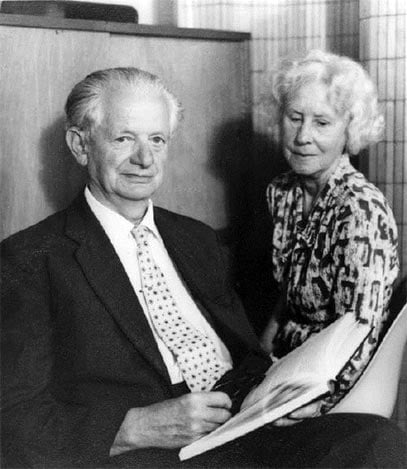
In the 1960s (according to John Rehr) a story went around the Cornell physics department that David asked Hans Bethe for a topic for his PhD and then showed up two years later with a completed thesis. The fact is that Bethe was a scientific advisor to President Eisenhower. He travelled back and forth by train from Ithaca to Washington D.C. every week, so it was hard for them to have regular meetings. David’s remark about this topic was, “if I had a good talk with him once a month, he left me with enough to think about for the next three months.” However there was some truth to the rumour. David did produce a finished thesis and ask for a year’s postdoctoral fellowship so that Margaret could finish her degree at Cornell. If David had shown Hans the thesis earlier the answer would have been yes, but as it was all of Hans’ money was committed so David had to look elsewhere. Instead he obtained a postdoctoral fellowship for a year at the Lawrence Radiation Laboratory in Berkeley, which allowed Margaret to complete her undergraduate degree.
Postdoctoral Fellowships
Cornell University had been such a marvellous experience for David and Margaret that whatever came next was bound to be a disappointment. David did not appear to have a preceptor in the Radiation Lab, but he did publish two papers and taught a course on atomic physics on the Berkeley campus which went quite well. Living in Berkeley was a pleasure and David and Margaret’s explorations of San Francisco, the surrounding hills and beaches and the Sierra Nevada would not have happened if either of them had been taking work more seriously.
David moved to the Department of Mathematical Physics at Birmingham University for two more years of postdoctoral research. He worked under Rudolf Peierls from 1959 to 1961. David was working very hard because there were a great many interesting physicists in Professor Peierls’ department in Birmingham University. David recollects, “I was probably more interactive with my colleagues during these two postdoctoral years in Birmingham than I was at any other period in my professional career.” David and Margaret’s two sons, Michael and Christopher, were born during this time.
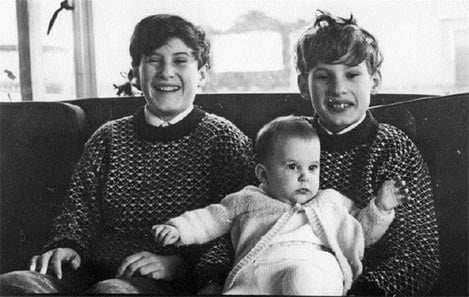
David spent the summers of 1960 and 1961 at the Niels Bohr Institute and Nordita in Copenhagen. These were a pleasure for all concerned and helped with the parlous financial state that resulted from trying to support a family on a British postdoctoral salary.
Cambridge: Churchill College fellow, university lecturer
David went to Churchill College as a Director of Studies and a Fellow in 1961, the first year the college took undergraduates. He also became a lecturer in the Department of Mathematics and Theoretical Physics. He learned a lot, particularly about teaching undergraduates, but he said there was less to show researchwise for the four years in Cambridge than in his previous positions. This had something to do with the intensive Cambridge 8 week term. He would get exhausted and spend much of the vacation recovering from respiratory diseases rather than doing research. His health only improved after the family moved into a centrally heated house in Birmingham in 1966.
In March 1965, David went to an interesting conference in Novosibirsk. Russia had temporarily opened up and there were no Intourist guides in Novosibirsk. This allowed the Russian physicists to talk freely with the Western physicists.
In David’s own words:
In the early spring of 1965 the most memorable scientific meeting I have ever attended took place. This was a conference on many-body problems, which was held in Akademgorodok, about 20 km south of Novosibirsk. The town was the centre of work on nuclear physics, and had been closed to outsiders until that year. Teachers at the local English language school had been invited to translate for us, but Bogliubov told them they were not wanted, because it was better for the Russians to practice their bad English rather than to rely on teachers with good English and no understanding of physics. The teachers sat in on the sessions and in the intervals tried to talk to the few of us who spoke English from the right side of the Atlantic.
We were able to go for walks in small groups, unobserved by security people. We met with people like Abrikosov, Gorkov and Dzyaloshinsky, whose book was making my own book out of date. This meeting was the first occasion on which I met Vitaly Ginzburg, who later spent time in Cambridge, and came, with his wife, to visit us in Birmingham. I also got to know A. B. Migdal and V. M. Galitskii, who were the authors of the Paper on Green’s function that had been so in influential on my work at Cornell in 1958. An outing led, I think, by Migdal, was my first experience of cross-country skiing, in bright sunshine, but with crisp spring snow. The only unfortunate thing about this trip was that I had a bad cough, perhaps the remains of a pneumonia attack I had during the winter. I flew back as far as Sverdlovsk with a couple of young Russian physicists, but when we came back to the plane after a short walk I was accosted by a furious Intourist official, who was supposed to have been escorting me back to Moscow.
I spent two days in Moscow, visiting the Landau Institute and Moscow State University, hosted by Pitaevskii and by Abrikosov. One morning I wandered round the Kremlin by myself, and I was stopped by a guard, probably offended by my scruffy duffel coat. When I said I was “angliskii” he smiled broadly, waved his arms, and told me to look around. Unfortunately my first visit to Russia was probably also my last.
A couple of months later I happened to see Ginzburg and, if my memory is correct, Khalatnikov wandering around the Cambridge market place, during a break from a relativity conference. We invited them both home for dinner and got my colleague Roger Tayler to meet them. The third guest was a lucky choice, as he had translated one of Ginzburg’s books.
University of Birmingham Professor
In 1965 David was appointed professor of physics at the University of Birmingham.
He has left six pages of detailed notes about the development of his research during the first three years at the University of Birmingham and one year of sabbatical leave when he visited Chalk River, Cornell, Stony Brook and several places in Australia.
Before leaving Birmingham on sabbatical in 1968 Margaret loaned their only car, a Bedford camper van, to neighbours. When Margaret and David got back a year later the friends had moved to Bristol, taking the van with them. The husband was in South America and his wife had a new baby just when Margaret and David needed their car back, so David had to go and fetch it. He stopped and had lunch with John Ziman, then a professor at the University of Bristol, which changed the future of his physics research. Two of Ziman’s students said they had disproved Philip Warren Anderson and Nevill Francis Mott’s 1958 theory of electron localisation disorder, so David said he would look at their papers. In the end he convinced himself that Anderson and Mott were right; the Nobel Committee for Physics came to the same conclusion in 1977 when they awarded them the prize. The exercise of reading, analysing and rewriting Anderson and Mott’s work gave David opportunities to think about a topic that he had not thought about before and opened up connections within the physics world. David later thanked Margaret for changing the direction of his research life by lending their car.
Around 1970 Michael Kosterlitz, a research fellow whose funding was not tied to any particular project, began to work with David on the interaction energy of a pair of vortices in a two-dimensional neutral superfluid. David commented on their relationship, “We worked well together, since I had the broad ideas and tried to understand the big picture, whereas Mike would find the holes in my arguments and ways to solve the problems I had ignored.” This collaboration resulted in Kosterlitz-Thouless transition theory, described in their 1972 paper, which is one of two cited for the 2016 Nobel Prize in Physics.
The other events of significance in 1972 for Michael and David were the births of their daughters Karin Kosterlitz and Helen Thouless.
Reasons for Leaving Birmingham University
There has been a lot of discussion of the “brain drain” of the 1970s, which is often attributed to a lack of money for academics. However, David did not leave the UK for money, but because of difficulties with the university administration. When David arrived back in Birmingham from sabbatical leave in 1969 he had a meeting with the new Vice Chancellor, who asked David what he would be doing next. David gave the true but impolitic answer that he did not have any definite plans. This led to an ongoing saga which resulted in the Vice Chancellor eventually telling David that if he had a chance to leave the university he should do it.
Although David did not have any definite plans on returning from sabbatical, his curiosity and openness to new topics led to an extraordinarily fruitful period from 1970 through 1978. He published 16 of his most important papers in five distinct topics, including the work for which he was eventually awarded the Nobel Prize. As noted by Ana Mari Cauce, President of the University of Washington, David was known for his curiosity-driven research which, decades after the initial research, has led to many practical uses.
There were no theoretical physics chairs vacant in the UK at that time so David left the UK, much as he did not want to. David went briefly to Yale but clearly he did not talk adequately to whoever was in charge of making the appointment because Yale wanted David to build a research group, whereas David had always preferred to work with colleagues rather than being a group leader.
University of Washington Seattle USA
David’s life and work up to the year 1972 is known from his own detailed autobiographical notes. His story from that year forward is told without the benefit of such a first-hand account.
The University of Washington did not need David to build a big research group. There were enough other independent theoretical physics professors there to whom David’s students and postdoctoral fellows could talk if he were away. He mostly taught graduate students and upper class undergraduate courses. He had many graduate students from around the world, but never an American-born student.
Shortly after arriving in Washington in 1980, David wrote a grant proposal in which he described the work he intended to do, but also suggested he might investigate some entirely different topic if a more interesting one came along. David’s reputation for producing interesting work meant that he was awarded this grant despite the vagueness of the grant proposal; President Ana Mari Cauce has observed that this would be unlikely to be funded today, when grants driven mainly by curiosity do not get much support.
In 1982, David published a paper called Quantized Hall conductance in a two-dimensional periodic potential with research fellows Kohmoto, Nightingale and den Nijs (TKN2), which is the second paper cited for the Nobel Prize. The word topology is not mentioned in the title of the 1982 paper and does not appear in his titles until 1985. However, when David Thouless wrote the book Topological numbers in nonrealativistic physics in 1998 he said “Topological numbers crept up on the physics community before the community was aware of them. I did not think in these terms until I started working on the topological aspects on long range order in the 1970s, although I had been working on aspects of superfluidity that are not topological for several years before that.”
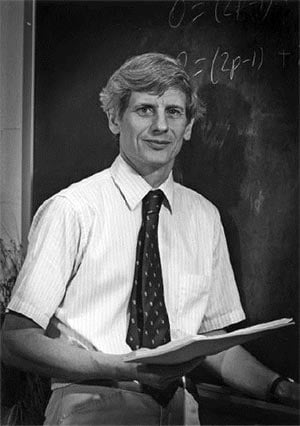
Marcel den Nijs has remained in Seattle and has been a great supporter of David but they have not published any more papers together.
In 1990 David was awarded the Wolf Prize in physics with Pierre-Gilles de Gennes (Nobel Laureate, 1991). Over the years he has received a number of other awards and honours. For example, he was elected a Fellow of the Royal Society (FRS) in 1979, a Fellow of the American Academy of Arts and Sciences (1981), a Fellow of the American Physical Society (1987) and a member of the US National Academy of Sciences (1995).
David enjoyed working and living in Seattle. He has never had many hobbies but he loved to hike in the mountains, camp, cross country ski and occasionally sail. His house had a 180-degree view of Lake Washington and mountains, including Mt. Rainier. Even though some of the surrounding trees have grown, a marvellous view remains. The garden faces southeast and has excellent soil for gardening. David’s biggest hobby over the years was reading. He read widely, but history interested him most. He was very happy in retirement reading in his chair and then resting his eyes on the view.
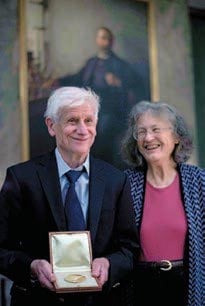
Assessing his own work, David wrote:
My scientific accomplishments as a graduate student and in postdoctoral positions had been very solid, with a successful book published, and several papers which were either novel or at least close to the latest work in the field. There was less to show for my four years in Cambridge. The work on the exchange mechanism for nuclear magnetism in solid 3He, inspired by Phil Anderson, was a substantial contribution, and taught me a lot, but it was more than twelve years after publication that the theoretical work became relevant to experimental measurements. The situation did not change immediately after I went to Birmingham, but my work, for various reasons, blossomed after I had been there for two years, and continued flourishing for the next twenty years or so.
The following are the papers David judged to be his most important work.
A. Papers on nuclear matter
D.J. Thouless. Application of perturbation methods to the theory of nuclear matter. Phys. Rev. 112 (1958) 906–22.
M.A. Thorpe and D.J. Thouless. Oscillations of the nuclear density. Nucl. Phys. A156 (1970) 225–41.
B. Papers on collective motion in nuclei
D.J. Thouless. Stability conditions and nuclear rotations in the Hartree-Fock theory. Nucl. Phys. 21 (1960) 225–32.
D.J. Thouless. Vibrational states of nuclei in the random phase approximation. Nucl. Phys. 22 (1961) 78–85.
D.J. Thouless and J.G. Valatin. Time-dependent Hartree-Fock equations and rotational states of nuclei. Nucl. Phys. 31 (1962) 211–30.
R.E. Peierls and D.J. Thouless. Variational approach to collective motion. Nucl. Phys. 38 (1962) 154–76.
C. Papers on statistical mechanics
D.J. Thouless. Critical region for the Ising model with a long range interaction. Phys. Rev. 181 (1969) 954–68.
D.J. Thouless. Long range order in one-dimensional Ising systems. Phys. Rev. 187 (1969) 732–3.
J.M. Kosterlitz and D.J. Thouless. Long range order and metastability in two dimensional solids and superfluids. J. Phys. C 5 (1972) L124–6.
J.M. Kosterlitz and D.J. Thouless. Ordering, metastability and phase transitions in twodimensional systems. J. Phys. C 6 (1973) 1181–1203.
D. Papers on superconductivity and superfluidity
D.J. Thouless. Strong coupling limit in the theory of superconductivity. Phys. Rev. 117 (1960) 1256–60.
D.J. Thouless. Perturbation theory in statistical mechanics and the theory of superconductivity. Annals of Phys. 10 (1960) 553–88.
D.J. Thouless. Critical fluctuations of a type II superconductor in a magnetic field. Phys. Rev. Lett. 34 (1975) 946–9.
G. Ruggeri and D.J. Thouless. Perturbation series for the critical behavior of type II superconductors near HC2. J. Phys. F 6 (1976) 2063–79.
D.J. Thouless, P. Ao and Q. Niu. Vortex dynamics in superfluids and the Berry phase. Physica A 200 (1993) 42–9.
D.J. Thouless, P. Ao and Q. Niu. Transverse force on a quantized vortex in a superfluid. Phys. Rev. Lett. 76 (1996) 3758–61.
M.R. Geller, C. Wexler and D.J. Thouless. Transverse Force on a Quantized Vortex in a Superconductor. Phys. Rev. B 57 (1998) R8119–22.
D.J. Thouless, M.R. Geller, W.F. Vinen, J.-Y. Fortin and S.W. Rhee. Vortex dynamics in the two-fluid model. Phys. Rev. B 63 (2001) 224504.
E. Papers on magnetism
D.J. Thouless. Exchange in solid 3He and the Heisenberg Hamiltonian. Proc. Phys. Soc. 86 (1965) 893–904.
D.J. Thouless, P.W. Anderson and R.G. Palmer. Solution of ‘Solvable model of a spin glass’. Phil. Mag. 35 (1977) 593–601.
J.R.L. de Almeida and D.J. Thouless. Stability of the Sherrington-Kirkpatrick solution of a spin glass model. J. Phys. A 11 (1978) 983–90.
D.J. Thouless, J.R.L. de Almeida and J.M. Kosterlitz. Stability and susceptibility in Parisi’s solution of a spin glass model. J. Phys. C 13 (1980) 3271–80.
D.J. Thouless. Spin glass on a Bethe lattice. Phys. Rev. Lett. 56 (1986) 1082–5.
F. Papers on electrons in disordered systems
D.J. Thouless. Anderson’s theory of localized states. J. Phys. C 4 (1970) 1559–66.
J.T. Edwards and D.J. Thouless. Regularity of the density of states in Anderson’s localized electron model. J. Phys. C 4 (1971) 453–7.
B.J. Last and D.J. Thouless. Percolation theory and electrical conductivity. Phys. Rev. Lett. 27 (1971) 1719–21.
D.J. Thouless. A relation between the density of states and range of localization for one dimensional random systems. J. Phys. C 5 (1972) 77–81.
J.T. Edwards and D.J. Thouless. Numerical studies of localization in disordered systems. J. Phys. C 5 (1972) 807–20.
D.J. Thouless. Localization distance and mean free path in one-dimensional disordered systems. J. Phys. C 6 (1973) L49–51.
R. Abou-Chacra, P.W. Anderson and D.J. Thouless. A self-consistent theory of localization. J. Phys. C 7 (1974) 1734–52.
R. Abou-Chacra and D.J. Thouless. Self-consistent theory of localization: II. Localization near the band edges. J. Phys. C 7 (1974) 65–75.
D.J. Thouless. Electrons in disordered systems and the theory of localization. Phys. Reports 13 C (1974) 93–142.
D.C. Licciardello and D.J. Thouless. Constancy of minimum metallic conductivity in two dimensions. Phys. Rev. Lett. 35 (1975) 1475–8.
D.C. Licciardello and D.J. Thouless. Conductivity and mobility edges for two-dimensional disordered systems. J. Phys. C 8 (1975) 1803–12.
D.J. Thouless. Maximum metallic resistance in thin wires. Phys. Rev. Lett. 39 (1977) 1167–9.
D.J. Thouless. Percolation and localization. In Ill condensed matter, ed. R. Balian, R. Maynard and G. Toulouse (North-Holland 1979), pp 1–62.
D.J. Thouless. The effect of inelastic electron scattering on the conductivity of very thin wires. Solid State Commun. 34 (1980) 683–5.
G. Quantum Hall effect and related topics
D.J. Thouless, M. Kohmoto, M.P. Nightingale and M. den Nijs. Quantized Hall conductance in a two-dimensional periodic potential. Phys. Rev. Lett. 49 (1982) 405–8.
D.J. Thouless. Quantization of particle transport. Phys Rev. B27 (1983) 6083–7.
D.J. Thouless. Band widths for a quasiperiodic tight-binding model. Phys. Rev. B28 (1983) 4272–6.
D.J. Thouless. Wannier functions for magnetic sub-bands. J. Phys. C 17 (1984) L325–7.
Q. Niu, D.J. Thouless and Y.S. Wu. Quantized Hall conductance as a topological invariant.Phys. Rev. B 31 (1985) 3372–7.
Q. Niu and D.J. Thouless. Quantum Hall effect with realistic boundary conditions. Phys. Rev. B 35 (1987) 2188–97.
D.J. Thouless. Scaling for the discrete Mathieu equation. Commun. Math. Phys. 127 (1990) 187–93.
D.J. Thouless and Y. Gefen. Fractional quantum Hall effect and multiple Aharonov-Bohm periods. Phys. Rev. Lett. 66 (1991) 806–9.
D.J. Thouless. Edge voltages and distributed currents in the quantum Hall effect. Phys. Rev. Lett. 71 (1993) 1879–82.
H. Mesoscopic systems
Y. Gefen and D.J. Thouless. Zener transitions and energy dissipation in driven systems. Phys. Rev. Lett. 59 (1987) 1752–5.
Books
D.J. Thouless. The quantum mechanics of many-particle systems. Academic Press, New York and London, 1961; second edition, 1972.
D.J. Thouless. Topological quantum numbers in nonrelativistic physics. World Scientific Publishing Company, Singapore, 1998.
Note: Much of this biography is based on David’s words written in his own detailed autobiographical notes.
Thank you to Christopher Thouless, Michael Thouless and Peet Sasaki for making substantive comments and editing.
Biography by David, Margaret and Helen Thouless
This autobiography/biography was written at the time of the award and later published in the book series Les Prix Nobel/ Nobel Lectures/The Nobel Prizes. The information is sometimes updated with an addendum submitted by the Laureate.
David J. Thouless passed away on 6 April 2019.
J. Michael Kosterlitz – Nobel Lecture
J. Michael Kosterlitz delivered his Nobel Lecture on 8 December 2016 at the Aula Magna, Stockholm University. He was introduced by Professor Thors Hans Hansson, member of the Nobel Committee for Physics.
Topological Defects and Phase Transitions: Lecture slides
Pdf 1.4 MB
Copyright © J. Michael Kosterlitz
Read the Nobel Lecture
Pdf 2.7 MB
F. Duncan M. Haldane – Nobel Lecture
F. Duncan M. Haldane delivered his Nobel Lecture on 8 December 2016 at the Aula Magna, Stockholm University. He was introduced by Professor Thors Hans Hansson, member of the Nobel Committee for Physics.
F. Duncan M. Haldane delivered his Nobel Lecture on 8 December 2016 at the Aula Magna, Stockholm University. He was introduced by Professor Thors Hans Hansson, member of the Nobel Committee for Physics.
Topological Quantum Matter: Lecture slides
Pdf 15 MB
Copyright © F. Duncan M. Haldane
Read the Nobel Lecture
Pdf 2.7 MB
Advanced information
Scientific background: Topological phase transitions and topological phases of matter
Pdf 1.7 MB
F. Duncan M. Haldane – Photo gallery
1 (of 13)
F. Duncan M. Haldane receiving his Nobel Prize from H.M. King Carl XVI Gustaf of Sweden at the Stockholm Concert Hall, 10 December 2016.
Copyright © Nobel Media AB 2016
2 (of 13)
F. Duncan M. Haldane after receiving his Nobel Prize at the Stockholm Concert Hall, 10 December 2016. © Nobel Media AB 2016. Photo: Pi Frisk
3 (of 13)
All thre Physics Laureates at the stage. From left: David J. Thouless, F. Duncan M. Haldane and J. Michael Kosterlitz. Far right: Chemistry Laureate Jean-Pierre Sauvage.
Copyright © Nobel Media AB 2016
4 (of 13)
Overview from the Nobel Prize Award Ceremony at the Stockholm Concert Hall, 10 December 2016. © Nobel Media AB 2016. Photo: Alexander Mahmoud
5 (of 13)
F. Duncan M. Haldane in conversation with Queen Silvia of Sweden at the table of honour at the Nobel Banquet, 10 December 2016. © Nobel Media AB 2016. Photo: Niklas Elmehed
6 (of 13)
F. Duncan M. Haldane delivering his banquet speech at the Nobel Banquet, 10 December 2016. © Nobel Media AB 2016. Photo: Niklas Elmehed
7 (of 13)
F. Duncan M. Haldane takes a look in the Nobel Foundation's guest book, signed by the Laureates since 1952, during his visit to the Nobel Foundation on 11 December 2016.
Copyright © Nobel Media AB 2016
8 (of 13)
F. Duncan M. Haldane signs the Nobel Foundation's guest book.
Copyright © Nobel Media AB 2016
9 (of 13)
F. Duncan M. Haldane takes a closer look at his Nobel Medal during his visit to the Nobel Foundation on 11 December 2016. On this occasion, the Laureates retrieve the Nobel diploma and Medal, which have been displayed in the Golden Hall of the City Hall following the Nobel Prize Award Ceremony. The Laureates also discuss the details concerning the transfer of their prize money.
Copyright © Nobel Media AB 2016
10 (of 13)
F. Duncan M. Haldane showing his Nobel Medal.
Copyright © Nobel Media AB 2016
11 (of 13)
Nine of the eleven Nobel Laureates of 2016 assembled at the Nobel Foundation in Stockholm on 12 December 2016. From left: Jean-Pierre Sauvage, J. Michael Kosterlitz, David J. Thouless, Oliver Hart, F. Duncan M. Haldane, Bengt Holmström, Bernard L. Feringa, Yoshinori Ohsumi and Sir J. Fraser Stoddart.
Copyright © Nobel Media AB 2016
12 (of 13)
Like many Nobel Laureates before him, F. Duncan M. Haldane autographed a chair at the Nobel Museum in Stockholm, 6 December 2016.
Photo: Jonas Ekströmer/TT.
13 (of 13)
Duncan Haldane in front of a whiteboard explaining his 1988 work on the quantum Hall effect without a magnetic field that led to topological insulators. The photo was taken by his wife, Odile Belmont, on 4 October 2016, the day of the announcement of the 2016 Nobel Prize in Physics.
Photo: Odile Belmont.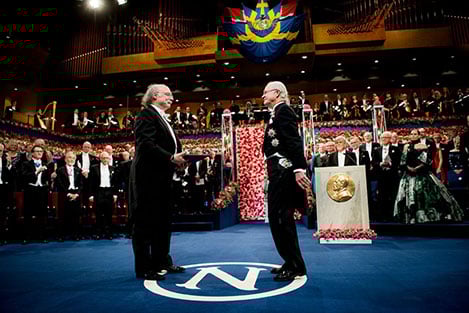
Photo: Alexander Mahmoud 
Photo: Pi Frisk 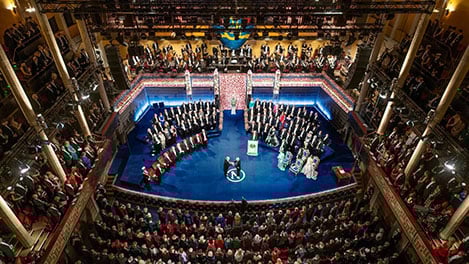
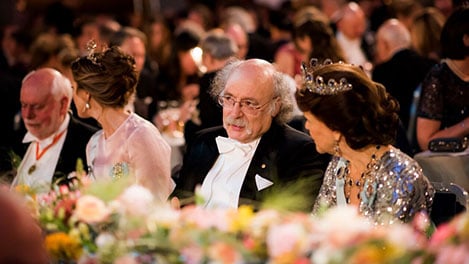

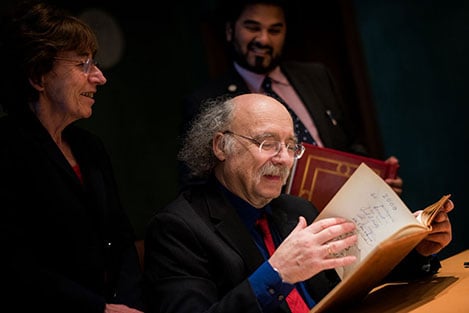
Photo: Alexander Mahmoud 
Photo: Alexander Mahmoud 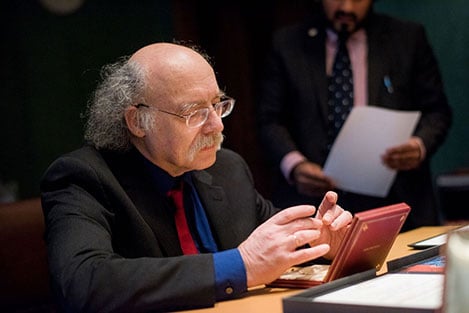
Photo: Alexander Mahmoud 
Photo: Alexander Mahmoud 
Photo: Alexander Mahmoud