The Nobel Prize in Physics 2003


The Nobel Prize in Physics 2003


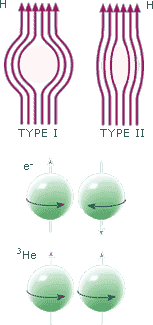
Two types of superconductors
Type-I superconductors are characterised by a total so-called Meissner effect. This means that the superconductor completely expels a magnetic field. If the magnetic field becomes too strong, the superconductive property disappears abruptly. But there are other superconductors, often alloys, in which the Meissner effect is not total. Here a surrounding magnetic field can intrude partly and the materials can retain their superconductive property even in very strong magnetic fields.

It takes two
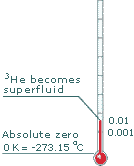
If electrons and 3He atoms are to condense into a superfluid liquid, they must first pair up. This can take place in two ways concerning the particles’ magnetic properties, their so-called spin. This is described with an arrow – a compass needle. The spins are either opposite, in which case they counteract each other (electrons in a superconductor) or in the same direction so that they reinforce each other (3He atoms in a superfluid). In the latter case the superfluid can have magnetic properties.

To cite this section
MLA style: The Nobel Prize in Physics 2003. NobelPrize.org. Nobel Prize Outreach 2025. Fri. 5 Dec 2025. <https://www.nobelprize.org/prizes/physics/2003/9510-the-nobel-prize-in-physics-2003-2003/>

Nobel Prizes and laureates

Six prizes were awarded for achievements that have conferred the greatest benefit to humankind. The 14 laureates' work and discoveries range from quantum tunnelling to promoting democratic rights.

See them all presented here.
Illustration

Explore prizes and laureates

Look for popular awards and laureates in different fields, and discover the history of the Nobel Prize.