The Nobel Prize in Physics 2002


The Nobel Prize in Physics 2002


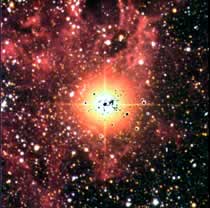
The Supernova 1987A
Photo: The Anglo-Australian Observatory


What is a supernova?
When the fusion reactions in a massive star end, it collapses and throws off its outer layers in a giant explosion. In just a few seconds, huge amounts of energy – about 100 times the energy generated by our sun during its lifetime – are released. Gravitation compresses the stellar core, producing a neutron star or – if the star is sufficiently massive – a black hole. Protons in the stellar core are transformed into neutrons, a process which also generates neutrinos. Some of these were detected by Kamiokande.


To cite this section
MLA style: The Nobel Prize in Physics 2002. NobelPrize.org. Nobel Prize Outreach 2026. Sun. 9 Aug 2026. <https://www.nobelprize.org/prizes/physics/2002/9632-the-nobel-prize-in-physics-2002-2002-5/>

Explore prizes and laureates

Look for popular awards and laureates in different fields, and discover the history of the Nobel Prize.